
Over the past decade, a common narrative has taken hold in Western media and academic circles: the United States is declining while authoritarian powers - particularly Russia and China - are rising. Moscow is strategically patient. Beijing is methodically expanding its influence. Together, they represent a looming alternative to the Western order.
Yet something interesting has happened in recent years. Despite rhetoric, threats and regional pressure campaigns, both Russia and China have been relatively restrained when it comes to direct confrontation with the United States and its allies. They posture. They complain. They run exercises and make speeches. But they stop short of full escalation.
Many commentators interpret this quiet as strategic wisdom or clever long-term planning. But there is another possibility that deserves serious consideration.
The quiet may not reflect strength. It may reflect constraint.
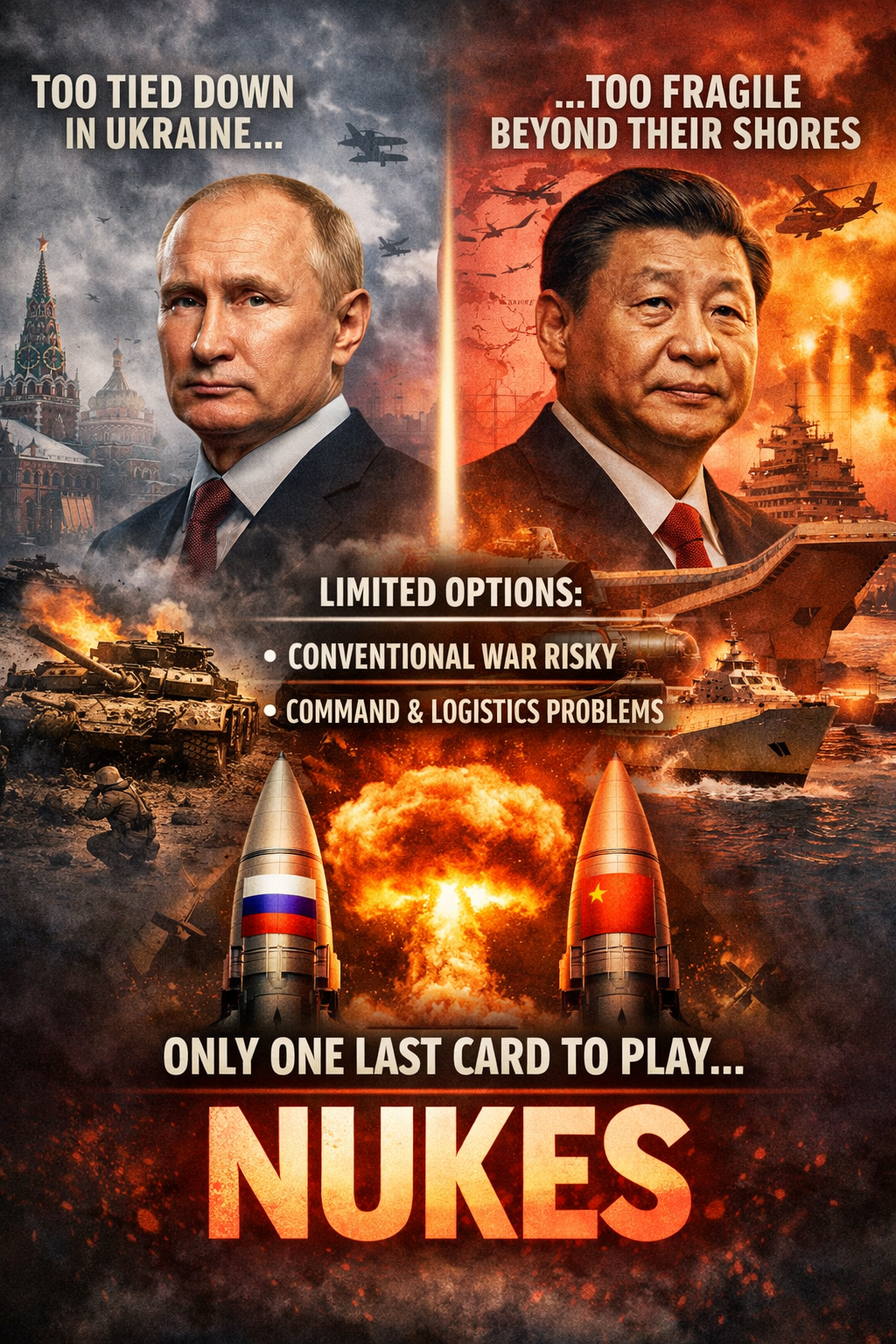
Russia currently has more on its plate than it can realistically handle. China's military expansion is real, but its ability to sustain operations far beyond its borders remains uncertain. And both nations understand that if a major conventional conflict spirals out of control, the only decisive escalation available would involve nuclear weapons - an option no rational government can treat lightly.
Russia: A Superpower Consumed by Ukraine
Russia entered the war in Ukraine with expectations of speed and dominance. The original invasion plan suggested Moscow believed the Ukrainian government would collapse quickly and that Russian forces would secure strategic objectives in a matter of weeks. That did not happen. Instead, the conflict became a grinding war of attrition that has lasted far longer than anyone anticipated.
Wars of attrition consume resources - manpower, equipment, logistics capacity and political capital. Russia has committed enormous portions of its military infrastructure to sustaining operations in Ukraine. The longer a war lasts, the more it drains a country's ability to project power elsewhere. A nation deeply engaged in one large-scale conventional war is rarely in a position to open another.
Russia today faces several structural pressures simultaneously:
- Sustaining a massive front line stretching hundreds of miles requires continuous resupply, troop rotations, intelligence operations and equipment replacement.
- Sanctions and export restrictions have limited Russia's access to advanced technologies and financial channels, affecting long-term military production and modernization.
- The Russian military has absorbed substantial losses in equipment and experienced personnel. Replacing hardware is possible; replacing trained officers and seasoned combat units takes far longer.
- Russia's demographic challenges were already severe before the war. A shrinking and aging population limits the country's ability to sustain prolonged military mobilization.
This does not mean Russia is powerless. It still possesses formidable nuclear forces, a large conventional military, advanced missile capabilities and a long history of strategic resilience. But its capacity to open another major conventional conflict - particularly against NATO - is extremely limited while it remains locked in Ukraine. Russian threats currently take the form of rhetoric, cyber activity and nuclear signaling rather than new large-scale military offensives. The country already has more on its plate than it can comfortably manage.
China: A Rising Power With Unproven Reach
China represents a very different case. Unlike Russia, China is not currently fighting a major war. Its economy remains far larger and more dynamic. Its manufacturing base dwarfs most other nations and its military modernization has proceeded at remarkable speed. However, building a powerful military is not the same as mastering global power projection.
Wars are not won by the first strike. They are won by the ability to keep fighting long after the first strike.
China's military has made impressive progress in recent decades - a rapidly expanding navy, sophisticated missile forces and widely regarded cyber capabilities. Yet important questions remain about how effectively these forces could operate far beyond China's immediate region. Three challenges stand out:
China's three unresolved challenges
- Logistics. Sustained operations require fuel, ammunition, spare parts, medical support and maintenance capacity. The U.S. has spent decades building a global network China does not yet possess - minimal overseas basing, still-developing blue-water logistics, limited experience sustaining long-duration operations outside its near seas.
- Command and control. Complex operations require resilient communication networks under cyber attack, electronic warfare and battlefield chaos. Authoritarian political systems that centralize decision-making can create complications when command structures are disrupted or isolated.
- Operational experience. The PLA has not fought a major war since the late 1970s. Training exercises simulate combat conditions, but simulations are never identical to real warfare. Combat reveals weaknesses that planning consistently overlooks.
These realities do not mean China is weak. It is clearly becoming more capable and more confident. But projecting sustained military power far beyond its borders remains a complicated challenge - particularly for scenarios like Taiwan, where amphibious operations, naval warfare, air dominance and long-term supply chains would all play decisive roles. The question would not simply be whether China could launch an attack. The question would be whether it could sustain a complex war against technologically advanced opponents for weeks or months. That is a much harder test.
The Nuclear Ceiling
Both Russia and China possess nuclear weapons. This fact fundamentally shapes strategic decision-making. Nuclear weapons create a ceiling above which conventional conflicts become existential threats. Once that ceiling is crossed, escalation becomes difficult to control.
Below the ceiling
Gray zone competition
- Economic pressure and sanctions
- Cyber operations and espionage
- Political influence and propaganda
- Regional military activity
- Proxy conflicts and support
Above the ceiling
Catastrophic escalation
- Direct large-scale conventional war
- Attacks on NATO Article 5 territory
- Escalation chains with no off-ramp
- Nuclear confrontation risk
- Consequences neither side can control
Because of this reality, nuclear weapons paradoxically act as a powerful restraint. They do not eliminate conflict, but they impose limits on how far conflict can escalate. Russia and China both understand this dynamic. They can challenge Western influence through regional pressure, diplomatic maneuvering and gray-zone activities. But direct large-scale war against the United States and its allies carries enormous risks - risks that increase rapidly if escalation spirals toward nuclear confrontation.
In other words, both Moscow and Beijing operate under the shadow of the same ceiling that constrains Washington. Deterrence may be uncomfortable, but it remains a powerful stabilizing force.
Why the Current Quiet Makes Sense
When these factors are considered together, the current relative restraint from Russia and China becomes easier to understand. Russia is deeply engaged in Ukraine, where it must dedicate massive resources simply to sustain the war it has already started. China continues to expand its military capabilities but faces logistical and operational challenges when projecting sustained power far beyond its immediate region. Both countries recognize that escalation against the United States and its allies could lead to unpredictable and potentially catastrophic outcomes.
The result is a strategic environment where competition continues but open confrontation remains limited - what analysts call the "gray zone." Quiet does not mean peace. But it can mean caution.
The Bottom Line
Russia and China are serious geopolitical competitors. Ignoring their ambitions would be naive. But exaggerating their strength can be just as misleading as underestimating them.
Russia is constrained by a major war that continues to absorb enormous resources. China's military modernization is impressive, but projecting sustained combat power across oceans under wartime conditions remains a difficult challenge. And above all of this hangs the nuclear ceiling that discourages direct confrontation between major powers.
When commentators ask why Russia and China appear relatively quiet in certain global crises, the answer may be simpler than many assume. They understand the risks. They understand their limitations. And they understand that some escalations cannot be reversed once they begin.
Fear-based narratives can distort public debate and encourage reckless policy decisions. At the same time, complacency can lead to dangerous miscalculations. Russia and China remain influential and ambitious states - but they are not omnipotent challengers capable of reshaping the world overnight. Recognizing these realities does not eliminate geopolitical competition. But it does remind us that power, even in authoritarian systems, has limits. And sometimes silence says more about those limits than any speech ever could.
References
- International Institute for Strategic Studies. (2024). The Military Balance 2024. London: IISS.
- U.S. Department of Defense. (2024). Military and Security Developments Involving the People's Republic of China.
- North Atlantic Treaty Organization. (2024). Defence Expenditure of NATO Countries Report.
- World Bank. (2024). World Development Indicators.
- Stockholm International Peace Research Institute. (2024). SIPRI Yearbook: Armaments, Disarmament and International Security.