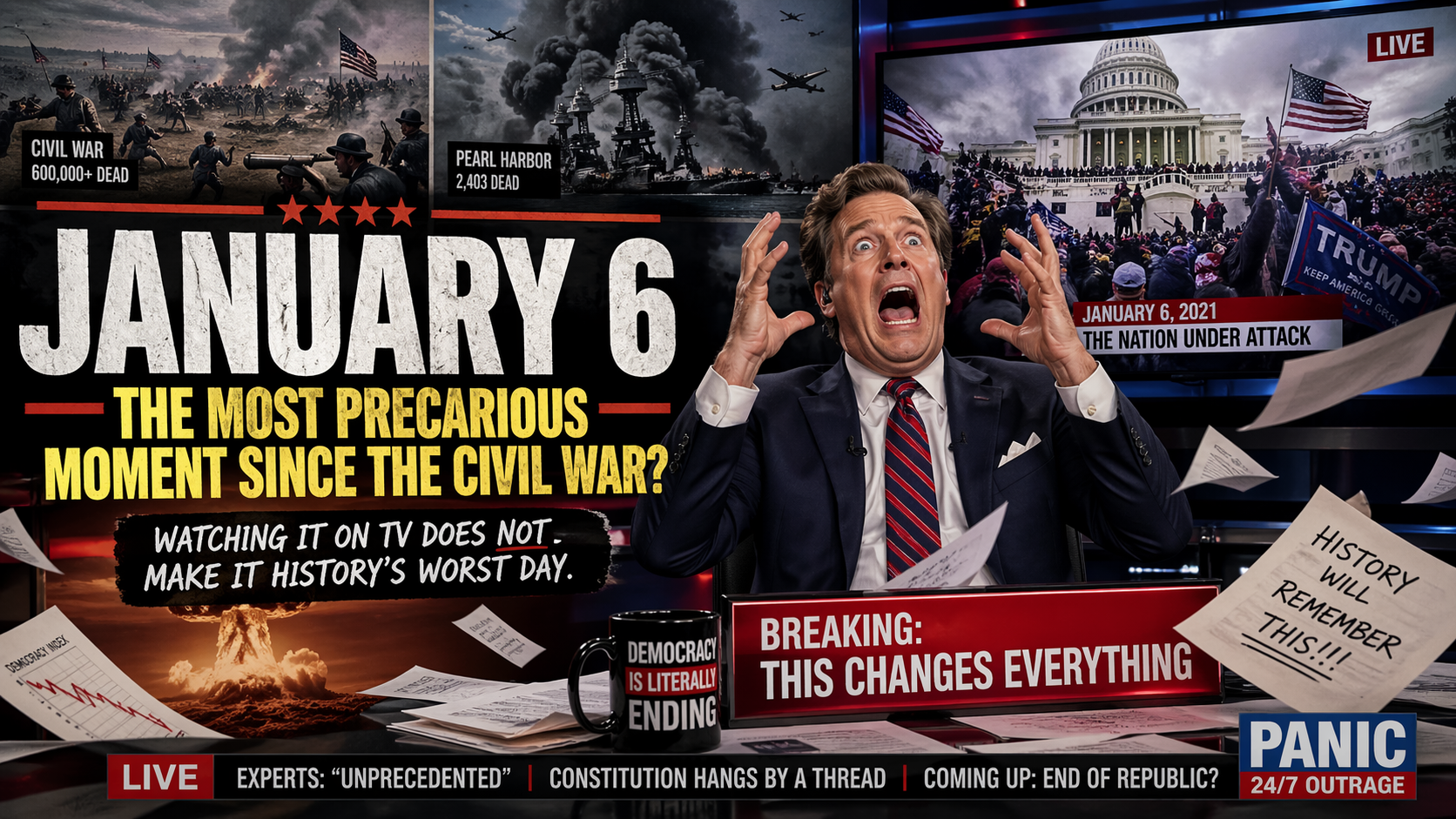
The comment is a perfect specimen of a particular kind of political reasoning that substitutes emotional intensity for historical analysis and then accuses anyone who declines to share the intensity of willful ignorance. I watched it live, the person says. You cannot erase what happened. To say it could not have gone very differently is to be willfully ignorant. Let us take these claims one at a time, because each of them contains an error, and together they produce the kind of historical illiteracy that passes for civic wisdom in the current environment. Nobody is erasing January 6. It was a riot at the Capitol. People were injured. One protester was shot and killed by Capitol Police. Police officers were assaulted. The building was breached and occupied for several hours. Property was damaged. Hundreds of people were subsequently charged and convicted for their conduct. That is the accurate account of what happened. It is also nowhere close to the most precarious moment in American democracy since the Civil War, and the person who watched it live on television and reached that conclusion has confused the emotional experience of watching a disturbing event unfold in real time with the historical judgment required to place that event in the context of everything else that has happened to this country across 250 years of existence.
What "Most Precarious Since the Civil War" Actually Requires
The Civil War killed approximately 620,000 Americans. That figure represents roughly two percent of the entire American population in 1860 - the equivalent, in proportional terms, of roughly seven million Americans dying today. Eleven states left the union. The constitutional order dissolved for four years and was reconstituted only after the most destructive conflict on American soil. The question of whether the United States would continue to exist as a single nation was genuinely open. Fort Sumter was not televised. There was no live cable coverage of Antietam, where more Americans died in a single day than died in any other single day of conflict in American history. The people making the "most precarious since the Civil War" claim have not explained what mechanism on January 6 came within range of anything approaching that magnitude.
The context does not stop at the Civil War. The assassination of Abraham Lincoln in 1865 - the murder of a sitting president at the moment of the nation's most fragile reconstruction - was arguably more precarious than a Capitol breach that ended with the building cleared, the session reconvened and the electoral count completed the same night. The attempted assassination of FDR before his inauguration in 1933, where a gunman killed the mayor of Chicago and missed Roosevelt by inches, could plausibly have altered the entire trajectory of the New Deal at the moment the Great Depression was at its worst. Pearl Harbor killed 2,403 Americans in two hours and drew the country into the most destructive war in human history. The Cuban Missile Crisis brought the United States and the Soviet Union to the literal brink of nuclear exchange - a scenario in which not democracy but civilization itself was the stake. None of these events produced the "most precarious since the Civil War" framing from serious historians, because serious historians understand what precarious actually means when you measure it against what has actually happened to this country.
Watching something disturbing on television in real time is an intense emotional experience. It is not a substitute for historical judgment. The person who watched January 6 live and concluded it was the most precarious moment since the Civil War has confused their nervous system's response with an assessment of comparative historical risk.
The "Could Have Gone Differently" Argument
The second claim - that to say it could not have gone very differently is to be willfully ignorant - is more interesting because it contains a kernel of a legitimate point buried under an illegitimate conclusion. Of course things can always go differently. Elections can go differently. Battles can go differently. Assassinations can miss or they can hit. The Cuban Missile Crisis could have ended in nuclear exchange. The question is not whether January 6 could have gone differently in some abstract sense. The question is what the plausible alternative outcomes were and whether any of them constituted a genuine threat to the constitutional order rather than a significantly worse riot.
Walk through the actual alternatives. Suppose the crowd had gone further into the building and done more damage. The constitutional process was delayed, not canceled. The election results were certified by the states and were not susceptible to being uncertified by a mob. Suppose members of Congress had been physically harmed. That would have been a catastrophe for the individuals involved and a national tragedy - and it still would not have produced a different president, because mob violence cannot change electoral vote certifications that have already been submitted by the states. Suppose Mike Pence had been found by the crowd. Even in the worst scenario involving Pence, the constitutional architecture did not depend on Pence's survival for the outcome to be determined. The electoral votes were already certified. The states had already spoken. The vice president's role was purely ministerial - a point that Luttig himself, correctly, had clarified for Pence. The scenario in which January 6 produces a different president requires a chain of counterfactuals so long and so dependent on the complete abandonment of the entire constitutional order by every institution simultaneously that calling it "could have gone differently" overstates the case by an order of magnitude.
The United States has absorbed the following without the democratic order collapsing: a civil war that killed two percent of the population, the assassination of four sitting presidents, the attempted assassination of several more, two world wars, the Great Depression with 25 percent unemployment, the McCarthy era's assault on civil liberties, the urban riots of 1968 that killed dozens and burned sections of major American cities, the assassination of both a presidential candidate and the nation's foremost civil rights leader in the same year, Watergate and a president resigning under threat of impeachment, the September 11 attacks killing nearly 3,000 Americans in two hours, and the 2008 financial crisis that brought the global banking system to the edge of collapse. Against that backdrop, a three-hour Capitol breach in which the building was cleared, the session reconvened and the count completed the same night is a serious incident and a national embarrassment. It is not a constitutional near-death experience. Calling it one is not civic vigilance. It is historical innumeracy with a cable news aesthetic.
The Willful Ignorance Accusation
The willful ignorance charge is worth addressing directly because it is doing significant rhetorical work in the comment. The accusation is that anyone who declines to share the assessment that January 6 was the most precarious moment since the Civil War is choosing not to see something obvious. But the actual cognitive error here runs in the opposite direction. The person who watched a dramatic event on television and concluded it was the worst thing to happen to American democracy since the Civil War has made an error that has a specific name in psychology: availability bias. Available, recent, emotionally vivid experiences feel more significant and more threatening than distant, abstract or statistical ones. The person who watched January 6 live experienced it as intensely threatening because it was happening in real time, in high definition, with breathless commentary and the emotional investment that comes from political identification with one side of the conflict. That experience is real. The conclusion it produces - that this was more dangerous than the Cuban Missile Crisis, than Pearl Harbor, than the Civil War itself - is not supported by any rational comparative analysis. It is supported by the intensity of the watching experience. Calling the person who applies comparative historical analysis to correct that conclusion willfully ignorant is exactly backwards.
The willful ignorance in this conversation belongs to the position that emotional intensity is a reliable guide to historical significance, that watching something on television constitutes a form of expertise about its comparative danger and that acknowledging the limits of that expertise is somehow an erasure of what occurred. January 6 is in the historical record. It is documented, prosecuted and studied. None of that requires accepting a claim about its comparative magnitude that is contradicted by every serious measure of what constitutional danger actually looks like when you consult the actual history rather than the cable news archive.
The Function of Catastrophism
It is worth asking what work the "most precarious since the Civil War" framing actually does in the political environment, because ideas this disconnected from historical evidence do not persist by accident. The framing does several things simultaneously. It justifies any level of resistance - if democracy itself is on the line, no tactic is disproportionate and no opposition is excessive. It pre-loads future elections with a framework that treats any outcome unfavorable to one side as evidence of the collapse that was always coming. It immunizes the people holding the belief from having to engage with contrary evidence, because any evidence that the institutions are holding can be reframed as evidence of the danger's sophistication rather than its absence. And it creates a social and moral hierarchy in which those who share the catastrophist view are the clear-eyed realists and those who do not are either willfully ignorant or complicit in the coming authoritarianism.
This is a closed epistemic system. It cannot be falsified from the inside because every data point - the system holding, the courts ruling, the elections proceeding, the transitions occurring - is absorbed as evidence of the threat's patience rather than evidence against the threat. The person who watched January 6 live and concluded it was the most dangerous moment since the Civil War is not applying historical judgment. They are participating in a political narrative that requires the permanent emergency as its organizing premise. The permanent emergency justifies the permanent resistance. The permanent resistance justifies the narrative. The circle is complete and self-sustaining. Pointing out that the history does not support the comparative claim is not erasure. It is the beginning of an honest conversation that the catastrophist framing is specifically designed to prevent.
My Bottom Line
January 6 was a riot, a disgrace and a failure of political leadership. The people who stormed the Capitol behaved criminally and were appropriately prosecuted. The event should be studied, understood and used as a reminder that political rhetoric has consequences and that crowds can be incited to destructive behavior by leaders who should know better. All of that is true and none of it requires accepting the claim that January 6 was the most precarious moment in American democracy since the Civil War. That claim is historically illiterate, emotionally driven and politically functional in ways that serve the permanent resistance narrative rather than the honest understanding of what happened. The Civil War killed 620,000 Americans. January 6 killed one. The Civil War split the country in two for four years. January 6 delayed a congressional session by several hours. The democracy that was supposedly in its most perilous moment since 1865 certified the election the same night, inaugurated a new president twenty days later and has continued to function ever since. That is not willful ignorance. That is the record.
Watching something disturbing on live television makes it vivid and immediate and emotionally real. It does not make it the worst thing that has ever happened to the country. The Civil War was not on cable. That does not make it less significant. It makes it more.
Disclaimer: The views expressed in this post are the personal opinions of the author and are offered for educational, commentary and public discourse purposes only. They do not represent the positions of any institution, employer, organization or affiliated entity. Nothing in this post constitutes legal, financial, medical or professional advice of any kind. Commentary on historical events and political analysis reflects the author's independent analysis and is protected expression of opinion. References to historical events are based on publicly available historical records. Readers are encouraged to consult primary sources and form their own conclusions.