
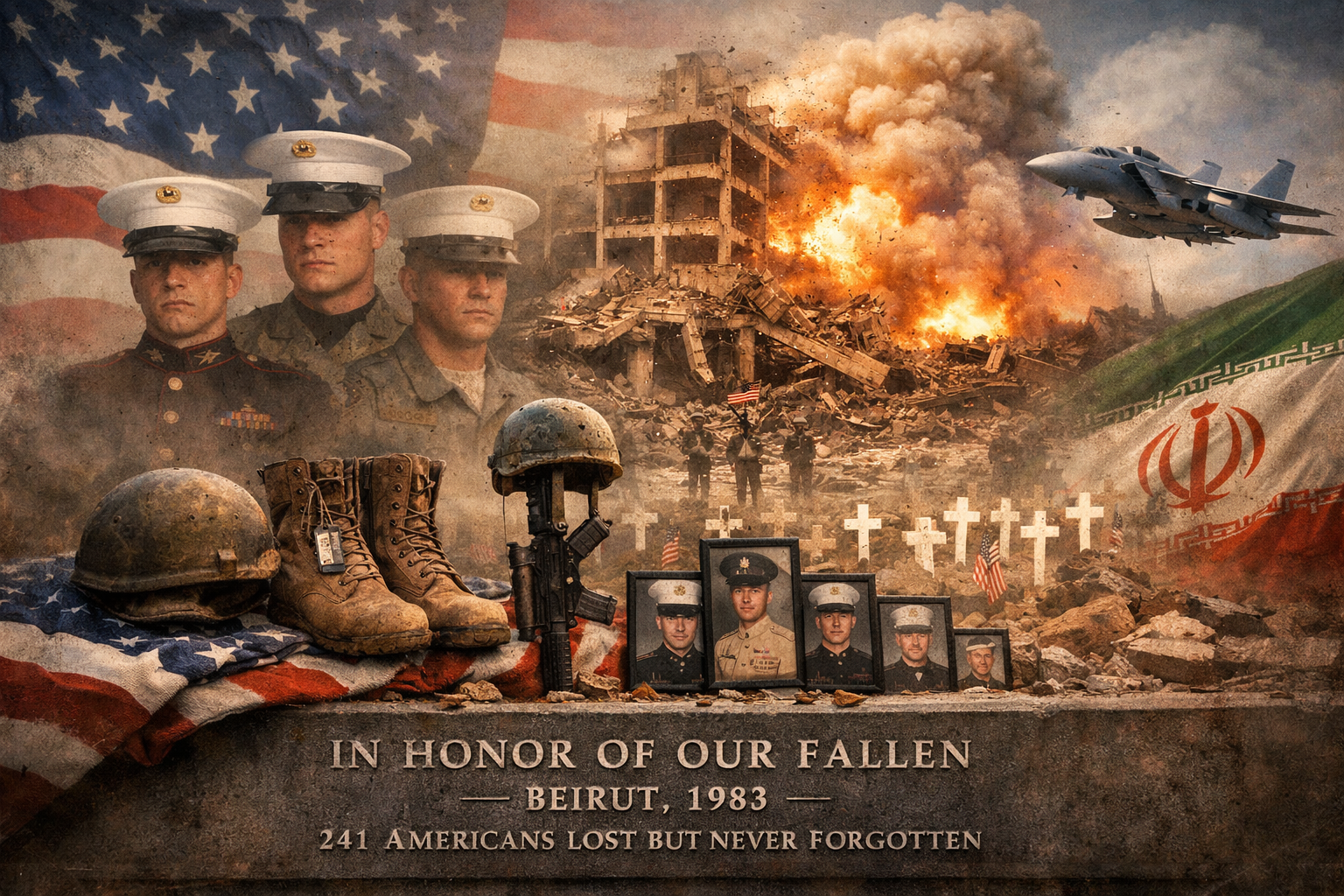
Some events pass through history like headlines. Others never leave.
For many Americans - especially military families - the 1983 bombing of the Marine barracks in Beirut belongs to the second category. On October 23 of that year, a suicide truck bomb destroyed the Marine barracks in Lebanon. It was one of the deadliest terrorist attacks against U.S. forces prior to 9/11.
For the families of those Marines, sailors and soldiers, the loss did not fade with time. Decades passed. Governments changed. Wars came and went. But the memory of that morning remained fixed.
1983 Beirut International Airport
The Day the Barracks Fell
The Marine presence in Beirut was part of a multinational peacekeeping force during Lebanon's brutal civil war. The mission was supposed to stabilize the region after the Israeli invasion and help create conditions for political recovery. Instead, it became one of the earliest battlefields of modern state-sponsored terrorism.
Shortly after sunrise on October 23, 1983, a truck carrying thousands of pounds of explosives drove through the perimeter of the Marine compound at Beirut International Airport. Within seconds the truck detonated, collapsing the four-story building where Marines were sleeping. Two hundred forty-one Americans were killed. Almost simultaneously, a second truck bomb struck a nearby French military compound, killing 58 French paratroopers.
Investigations in the years that followed linked the attack to militant networks tied to Hezbollah, operating with support from Iranian Revolutionary Guard elements that had entered Lebanon earlier in the conflict. For many Americans, the bombing quickly faded into the background of Cold War politics. For the families, it never did.
The Long Wait for Accountability
Terrorist attacks often create a strange form of historical delay. The attack itself happens in seconds. The consequences can take decades.
The networks responsible for the Beirut bombing did not disappear. They evolved. Militias became political movements. Regional alliances shifted. Governments issued denials while proxy organizations continued operating across the Middle East.
Military families remember dates differently than the rest of us. Anniversaries are not historical markers - they are personal reminders of the moment life split into "before" and "after."
During those decades, American families who lost loved ones in Beirut watched the geopolitical chessboard move around the people responsible. For them, the passage of time did not erase the crime. It only extended the wait.
Deterrence Is Not Revenge
One of the most common misunderstandings in discussions about counterterrorism is the confusion between revenge and deterrence. They are not the same thing.
Revenge
Emotional. Immediate. Personal.
A response driven by grief and anger. Focused on the past. Measured by the pain of loss.
Deterrence
Strategic. Calculated. Forward-looking.
A response designed to shape future behavior. Focused on consequences. Sometimes takes years - or decades - to manifest.
The idea behind deterrence is simple: if attacking Americans brings serious consequences, future enemies may reconsider their actions. But deterrence only works if those consequences eventually arrive. When attacks occur without meaningful response, adversaries can interpret restraint as weakness. Over time, that perception emboldens organizations willing to use terrorism as a political tool.
Reestablishing deterrence requires demonstrating that attacks on Americans will not be forgotten - even if accountability comes years later.
Why Memory Matters
For the families of those killed in Beirut, the issue has never been theoretical. They remember names, not statistics. They remember the empty chair at the table, the phone call that changed everything and the decades of watching the world move on while their personal history remained frozen in 1983.
When people express relief or a sense of justice years later, critics sometimes interpret that reaction as celebrating violence. But that interpretation misses the deeper point.
What acknowledgment means to those who lost someone
- That the lives lost mattered - not just as statistics, but as people
- That the attack was not simply another footnote in a long list of global conflicts
- That time does not erase responsibility
- That their grief was not invisible to the country they served
The Meaning of Justice in International Politics
Justice in international affairs rarely arrives quickly. Diplomacy moves slowly. Intelligence operations unfold quietly. Governments balance risks that the public rarely sees. But when action eventually comes, it sends a message beyond the immediate target.
It reminds adversaries that distance, time or political complexity do not guarantee immunity. For countries confronting terrorism, this principle matters enormously. If attackers believe they can act without consequence, deterrence collapses. When consequences eventually arrive - even years later - it reinforces the idea that the killing of civilians and service members will not simply vanish into diplomatic history.
The Bottom Line
The Beirut bombing remains one of the darkest days in Marine Corps history. For those who lost brothers, friends or fellow Marines that morning, the grief never disappeared. It simply became part of life.
When the United States eventually confronts networks responsible for attacks on its citizens, the moment is not about cheering violence. It is about reaffirming a principle.
Americans do not forget their dead. And those who attack them should never assume that time will protect them from accountability.
Terrorism is built on the assumption that violence can be used without lasting consequences. Restoring deterrence requires challenging that belief. When a nation demonstrates that attacks on its citizens will eventually bring consequences, it strengthens the credibility of its security commitments and discourages future aggression.
For the families of the Marines killed in Beirut, the issue has never been abstract policy. It has always been memory. And memory is powerful.
References
- Levitt, M. (2013). Hezbollah: The global footprint of Lebanon's party of God. Georgetown University Press.
- Ranstorp, M. (1997). Hizbollah in Lebanon: The politics of the Western hostage crisis. St. Martin's Press.
- U.S. Department of Defense. (1983). Report on the Beirut barracks bombing.
- Council on Foreign Relations. (2020). Hezbollah's origins and evolution.