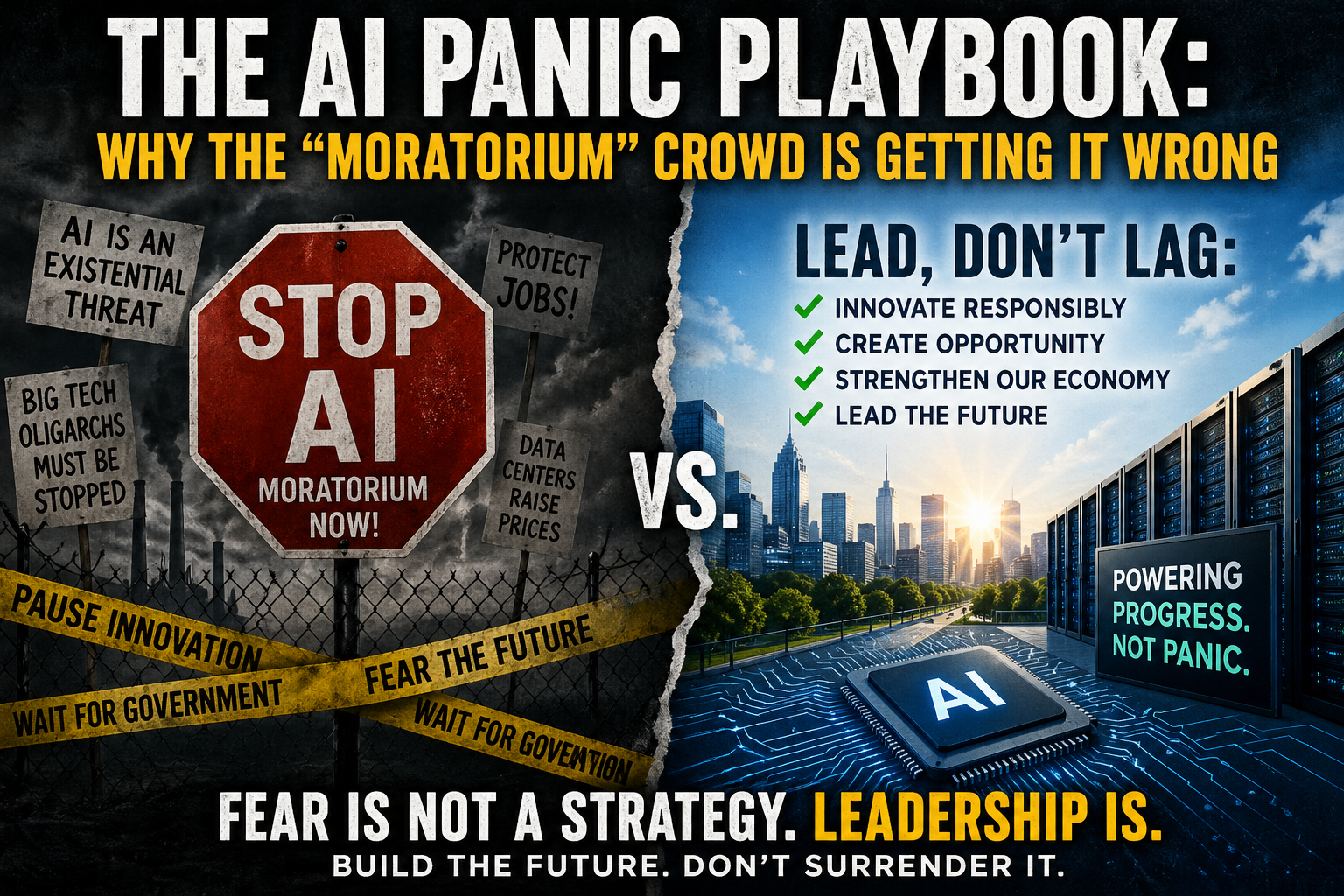
Every generation gets its technological panic and every generation's panic follows the same playbook. Identify a real concern, inflate it to existential scale, propose a sweeping solution that would cripple the technology in question and dress the whole enterprise in the language of protecting ordinary people from powerful interests. Industrialization was going to destroy humanity. Electricity was dangerous. The internet would collapse society. Social media would end democracy. Now it is artificial intelligence, and the latest version of the panic comes packaged as the Sanders-Ocasio-Cortez proposal for a federal moratorium on AI data centers - a measure sold as protection against existential harm to humanity. That framing is not serious policy. It is fear-driven overreach dressed in legislative language, and it reflects a fundamental misunderstanding of how technology, economics and global competition actually work. The concerns it invokes are real. The solution it proposes would make every one of those concerns worse while delivering the future of AI development to the one government on earth least likely to use it in humanity's interest.
The "Pause Until Government Understands It" Fantasy
The core argument is disarmingly simple: AI is advancing rapidly, it could harm jobs, privacy and democratic institutions, therefore development should pause until government catches up. That sounds cautious. It falls apart the moment you apply it to the history of technology and governance. Government has never fully understood emerging technology at the moment it emerged. It did not understand the internet in the 1990s. It did not understand social media in the 2000s. It barely understands cryptocurrency today. None of those failures of comprehension produced a moratorium on the technology in question. Technology evolved. Regulation followed. That is how every major technological advancement in modern history has worked - not because regulators were irresponsible but because innovation moves faster than legislation by design, and the alternative, requiring full governmental comprehension before deployment, would have guaranteed that none of the technologies we now take for granted ever existed.
The proposal flips this dynamic on its head and does so specifically for AI while doing nothing to constrain the development of AI anywhere else on the planet. That is the fatal flaw the moratorium advocates either have not thought through or have chosen not to acknowledge. AI development is not confined to the United States. It is being pursued aggressively by China, by Europe and by private actors and open-source communities worldwide. A U.S.-only moratorium does not stop AI. It stops American AI. China's program continues. Europe's continues. Open-source development continues. The United States gets to watch from the sidelines while the most consequential technology of the coming generation is shaped by governments and institutions with no particular commitment to the values the moratorium's sponsors claim to be protecting.
A U.S. moratorium does not stop AI. It stops American AI. China is not going to pause because Congress is nervous. Calling that protection is like locking your own front door while leaving all the windows open and calling it security.
The Jobs Argument and the History It Ignores
The claim that AI will destroy jobs at unprecedented scale is the oldest fear in the technological panic playbook and it has been wrong in the same way every time it has been deployed. Automation has been displacing specific categories of labor for more than a century. It has also been creating entirely new industries, roles and economic opportunities that were invisible from the vantage point of the displacement. The automobile eliminated horse-related industries and created manufacturing, logistics, infrastructure and supply chain sectors that employed orders of magnitude more people. Computers replaced manual accounting and created software engineering, information technology and digital services. The internet eliminated categories of work in retail, media and communication while building economies that had not previously existed. The pattern is consistent enough that serious economists have a name for it - the Lump of Labor fallacy, the mistaken belief that there is a fixed quantity of work to be done and that technology permanently eliminates rather than transforms it.
Will AI eliminate specific jobs? Yes, and that displacement will be real and painful for the people it affects. The correct response is workforce adaptation, retraining investment and targeted policy support for affected workers - not a moratorium that guarantees the jobs lost to American AI are simply moved to jurisdictions where the technology continues developing without American standards, American labor protections or American values built into the systems. The difference between this technological transition and previous ones is not the scale of disruption. It is that this time, the fear is being framed as catastrophic rather than transitional, and that framing is not supported by the historical evidence. It is supported by the political utility of catastrophism for the people proposing to solve it.
One of the central proposals is a moratorium on AI data centers. That requires being clear about what data centers actually are. They are the backbone of modern digital infrastructure - the physical infrastructure that powers cloud computing, financial systems, healthcare data management, national security operations and the ordinary internet functions that billions of people use every day. Targeting data centers because they support AI development is like targeting power plants because they support manufacturing. The energy consumption concern is real and worth addressing. Data centers do consume significant power and that consumption will grow with AI workloads. The solution is to improve efficiency, expand clean energy production and modernize the grid - all things that require investment and planning rather than a moratorium that addresses none of the underlying infrastructure problems while guaranteeing that the energy-intensive AI development simply relocates to countries with fewer environmental constraints than the United States.
The Concentration Claim and the Decentralization It Ignores
The argument that Big Tech oligarchs will control the AI future if the government does not intervene is classic populist framing - it sounds compelling, it plays well politically and it is incomplete in ways that matter. Large technology companies are leading AI development. That is not unusual or sinister. Large companies have always led capital-intensive innovation, whether it was railroads, automobiles, aerospace or telecommunications. The concentration of early-stage capital in large actors is a feature of how expensive foundational technology gets built, not evidence of a conspiracy against ordinary people. What the argument consistently ignores is the simultaneous and substantial decentralization that is already happening in AI. Some of the most capable and widely deployed AI tools today are open-source, freely available and being developed and improved by researchers, universities and independent developers with no connection to the handful of companies the moratorium advocates invoke as the threat.
A federal moratorium on data center construction would not constrain those large companies in any meaningful way. They have the resources to navigate regulatory environments, relocate infrastructure to other jurisdictions and continue development through international subsidiaries. The entities actually constrained by a moratorium are the startups, the academic research institutions, the small companies and the individual developers who cannot absorb the compliance costs, legal uncertainty and infrastructure restrictions that a blunt federal moratorium would impose. The policy would protect large incumbents from competition while delivering exactly the concentrated control of AI development it claims to be preventing. That outcome is not surprising. It is the standard consequence of sweeping technology regulation proposed in the language of protecting the little guy.
The Experts-Want-a-Pause Claim
Supporters of the moratorium point to statements from prominent technologists - including some who built the systems now being regulated - calling for a slowdown in AI development. This is selective quoting that conflates meaningfully different positions. Many of those statements were calls for caution, coordination, safety research investment or reflection on specific deployment practices, not endorsements of blanket indefinite moratoriums enforced by the federal government. There is a significant difference between "we should think carefully about how we deploy this technology and invest heavily in safety research" and "we should freeze the infrastructure that powers it." The legislation conflates these positions because the second position sounds more urgent and the first does not justify the sweeping intervention being proposed. The researchers who signed cautionary letters were not endorsing federal construction moratoriums. They were expressing concern about the pace of deployment relative to safety understanding - a concern that is legitimate and that can be addressed through targeted safety requirements, mandatory testing frameworks and liability standards that create incentives for responsible deployment without shutting down the American AI ecosystem entirely.
My Bottom Line
The concerns underlying the moratorium proposal are real. AI does raise legitimate questions about privacy, labor displacement, algorithmic bias, security and the concentration of technological power. Those questions deserve serious policy engagement. What they do not deserve is the panicked, blunt instrument of a federal moratorium that would reduce domestic innovation, shift investment to other jurisdictions, weaken American competitiveness in the defining technology of the coming generation and accomplish none of the specific protective goals it claims. The United States does not need to stop AI development. It needs to lead it responsibly - with smart targeted regulation, mandatory safety testing for high-stakes deployments, clear legal frameworks for misuse and liability, workforce investment for affected workers and energy infrastructure investment to support the growth of the sector without sacrificing environmental goals. That is harder and less politically dramatic than a moratorium. It is also the only approach that actually works. Fear-based policymaking has a long track record in American history. It is almost always wrong, and it is always most wrong when it is most confident.
There is no global pause button. The United States can choose not to lead AI development. It cannot choose to stop AI development. Those are different decisions with very different consequences, and confusing them is not caution. It is abdication dressed up as responsibility.
References
- Sanders, B. (2026). Public statements on AI regulation and data center moratorium proposal.
- Ocasio-Cortez, A. (2026). Public statements on AI oversight and infrastructure concerns.
- Brynjolfsson, E., & McAfee, A. (2014). The Second Machine Age. W. W. Norton & Company.
- Autor, D. (2015). Why are there still so many jobs? The history and future of workplace automation. Journal of Economic Perspectives, 29(3), 3-30.
- World Economic Forum. (2023). Future of Jobs Report 2023. weforum.org.
- U.S. Department of Energy. (2024). Data center energy consumption and efficiency trends. energy.gov.
Disclaimer: The views expressed in this post are the personal opinions of the author and are offered for educational, commentary and public discourse purposes only. They do not represent the positions of any institution, employer, organization or affiliated entity. Nothing in this post constitutes legal, financial, technical or professional advice of any kind. References to public figures are based on publicly available statements. Commentary on technology policy and economic history reflects the author's independent analysis and is protected expression of opinion. Readers are encouraged to consult primary sources and form their own conclusions.