- Part 1 — Why Church and State Must Stay Separate
- Part 2 — Suppression of Rivals After 380: When Imperial Backing Ended the Debate
- Part 3 — Holy War and Mob Slaughter: The Crusades in Full
- Part 4 — The Inquisitions: Torture, Fear and the Architecture of Heresy Control
- Part 5 — Forced Conversion and Expulsion: Spain, Goa and the Colonial World
- Part 6 — The Witch Hunts: Christian Europe's Ugliest Moral Panic (this post)
- Part 7 — Colonial Brutality Under a Christian Banner
- Part 8 — Christian-on-Christian Violence: The Confessional Wars
- Part 9 — Moral Cover for Slavery
- Part 10 — Resistance to Modern Liberties: Institutional Christianity vs. the Enlightenment
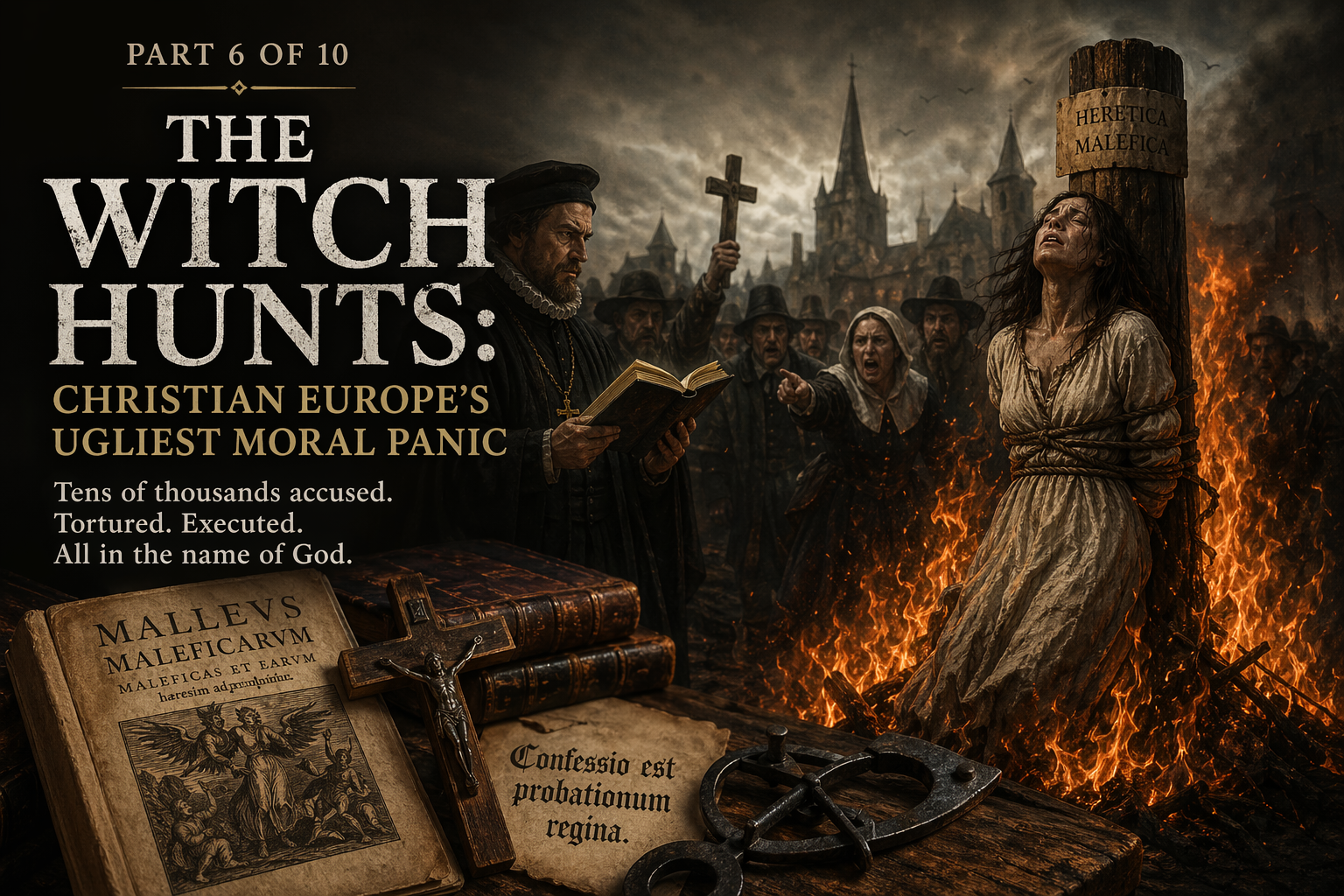
The witch hunts sit in the modern imagination like some foggy campfire myth - broomsticks, black cats, pointy hats and maybe Salem if someone paid attention in high school. That framing is childish. The real history is uglier, more systematic and much more revealing. Between roughly the fifteenth and eighteenth centuries, Europe and its colonies saw a prolonged wave of witch prosecutions that claimed somewhere between 40,000 and 50,000 lives - not in the so-called Dark Ages but in a period of functioning churches, courts and literate states that absolutely knew how to build institutions and use them. That timing matters. This was not primitive ignorance at work. It was organized institutional persecution dressed in theological language, and it peaked when European civilization was busily congratulating itself on printing presses, universities and reformed churches. The machine that killed tens of thousands of people - most of them women - was assembled from sermon, statute and scaffold by people who believed they were protecting the faithful from Satan's agents. That is the most important thing to understand about the witch hunts before any of the details: the people who ran them were not confused about what they were doing. They thought they were right.
The Devil Needed Accomplices
Classical and medieval Christianity had always believed in demons, spiritual warfare and the active presence of evil in the world. What changed in the early modern period was not the belief in evil itself but the increasingly elaborate conviction that witches formed an organized satanic conspiracy operating inside Christian society. The witch was no longer just a suspected spell-caster or local troublemaker. She became a traitor to God - a servant of the Devil who attended sabbats, participated in infanticide, spread disease and entered into sexual corruption with demonic powers. That escalation transformed prosecution from a local matter of village suspicion into an urgent theological obligation. Finding and destroying witches was not cruelty. It was warfare against Satan's foot soldiers inside the church's own borders.
Demonological writing helped turn scattered folk fears into a system. The Malleus Maleficarum, produced in the late fifteenth century, is the most notorious artifact of that intellectual rot. Serious historians have pushed back against exaggerated claims about its direct legal authority - it was not a universally adopted manual and its influence varied significantly by region - but it helped popularize a framework in which suspicion of witchcraft was tied to gender, sexual panic, heresy and the Devil's active work in the world. It gave elite paranoia a vocabulary and handed local authorities moral cover. That matters because bad ideas become dangerous when they move from sermons and texts into institutions. A village rumor is ugly. A magistrate armed with demonology and judicial authority is far worse. A church culture that teaches people to interpret misfortune - failed crops, infant death, illness, storms, impotence, unexplained livestock loss - as evidence of hostile supernatural agency operating through human agents is worse still. Once communities were taught to look for witches, they started finding them.
The standard dismissal of the witch hunts as a product of generic medieval ignorance lets the institutional actors off the hook they deserve to hang on. These hunts were not driven by peasants alone. Clergy, jurists, magistrates and educated writers helped build and legitimate the system. Learned demonology did not restrain folk superstition. In many places it sharpened it - translated it from village rumor into prosecutable charges with theological backing and legal procedure. The hunts were fed simultaneously from above and below: elite theory from educated demonologists, local fear from communities already primed to see invisible enemies in their midst. That is one reason the hunts varied so dramatically by region. Some places saw relatively limited prosecution. Others exploded. The Holy Roman Empire became one of the worst killing grounds, its fragmented jurisdictions and weak procedural restraints giving panic room to metastasize. Where courts were more skeptical or central authorities intervened, the death toll was lower. The hunts were not inevitable. They were enabled. Institutions made the difference between rumor and execution, between accusation and burning.
Women Bore the Brunt
Roughly 75 to 80 percent of those executed for witchcraft in early modern Europe were women. That fact does not blur into a general human tragedy. It specifies one. Men were also accused and killed, and the proportion varied by region and period, but the pattern is too strong and too consistent to dismiss as coincidence. The witch stereotype mapped onto older Christian suspicions about women, sexuality, temptation, disorder and moral weakness with a precision that cannot be accidental. The same civilization that spent centuries preaching about Eve, about the susceptibility of female flesh to corruption and about the particular spiritual vulnerabilities of women was remarkably ready to believe that women were likelier to enter into Satan's service than the men who accused them.
The accused did not fit a single social profile. They could be widows, healers, outsiders, quarrelsome neighbors, poor women, elderly women or simply unlucky women who lived where conflict was already simmering and needed a focal point. But the gender skew tells the truth plainly enough. The witch hunts were not only about theology. They were also about vulnerability. They struck hardest where existing prejudice met legal power - where communities already half-believed certain women were dangerous and found in the demonological framework a procedure for acting on that belief with state authority behind it. The church supplied the theology. The courts supplied the mechanism. The accused supplied the bodies.
Catholic and Protestant Hands Are All Over This
No serious telling of the witch hunts gets to pin the blame on only one side of Christian Europe, and the attempt to do so is one of the more common apologetic moves in this territory. Catholic territories participated. Protestant territories participated - in some periods and regions with greater intensity than their Catholic counterparts. Confessional conflict often intensified the broader atmosphere of fear because rival churches were already training their populations to think in apocalyptic categories: truth against error, God against Satan, purity against corruption, the faithful remnant against the hidden apostates. Once those categories harden and spread, it becomes very easy to cast internal enemies as spiritual contaminants requiring not just theological correction but physical elimination.
This cross-confessional participation is one of the most damaging facts for easy apologetics about the witch hunts. Christians who disagreed violently on the nature of the Eucharist, on justification by faith, on the authority of the pope and on a dozen other points of doctrine still found common ground in demonological fear and coercive prosecution. They were divided on many things. They were frequently united in the belief that invisible evil agents were operating inside Christian society and had to be rooted out with whatever institutional power was available. That unity across confessional lines suggests something structural rather than accidental - something rooted in the shared framework of cosmic warfare that both traditions inherited and intensified rather than in the specific doctrinal errors of one branch of the faith.
Christians who disagreed violently on almost every point of doctrine still found common ground in demonological fear and coercive prosecution. The witch hunts were not a Catholic problem or a Protestant problem. They were a Christian civilization problem, and the shared framework that produced them was the conviction that invisible enemies were real and had to be found.
Confession Was Manufactured
The legal process at the heart of witch prosecution was a mechanism for producing exactly the evidence it required. Torture, coercive questioning and circular logic turned fantasy into courtroom material. Authorities demanded confession, then treated confession as proof of the charge, then used the names produced under extreme physical pain to widen the circle of prosecution. The accused were trapped inside a rigged system from which there was no legitimate exit. Confess and you confirmed the panic. Deny the charges and your denial could be read as devilish cunning - further evidence of the supernatural assistance that made witches so difficult to catch. Either way, the machinery kept moving and the body count kept rising.
This is the dimension of the witch hunts that sanitized accounts most consistently obscure. These were not harmless beliefs floating around a village square. They were judicial outcomes. Real courts, operating under real legal authority, applying real procedural rules - however corrupt those rules were by any honest evidentiary standard - imprisoned, tortured, humiliated and executed human beings because a Christian moral universe had made absurd charges feel not merely plausible but urgent. Religious fear did not remain in the domain of sermons and personal conviction. It became procedural. It became institutional. That is always when it gets dangerous, because institutional momentum does not require individual malice to keep killing. It only requires that no one in the system has sufficient authority or incentive to stop it.
Salem Was Real - But It Was Not the Main Event
Americans tend to use Salem as the shorthand for the entire phenomenon of witch prosecution, and Salem matters as a documented, studied and heavily interpreted episode. But Salem was late and small compared with the broader European witch craze. The real epicenter was Europe, and the larger pattern stretched across nearly three centuries. Salem is memorable partly because later Americans turned it into literature, allegory and civic warning - Arthur Miller's The Crucible being the most famous transformation - and because the episode is neatly bounded, thoroughly documented and geographically specific in ways that make it accessible. Europe, by contrast, supplied the body count across a landscape too large and a timeframe too long to reduce to a single dramatic incident.
That distinction matters because Salem can feel like an anomaly - one unstable community, one terrible year, one local breakdown that the rest of American civilization quickly corrected and repudiated. It was not. It was a colonial aftershock of a much larger Christian tradition of demonological fear that had been operating in Europe for more than a century before the first Salem accusation. If you isolate Salem you miss the structure. If you look at the European record across the fifteenth through eighteenth centuries, the structure becomes impossible to miss: this was not a random outbreak of mass delusion but a recurring pattern produced by specific theological convictions, specific institutional arrangements and specific social conditions that repeated wherever those conditions were met.
Why the Hunts Eventually Broke
The witch hunts did not end because Christianity suddenly discovered tolerance or reached a doctrinal correction about demonology. They declined where skepticism grew, where evidentiary standards tightened and where central authorities became less willing to indulge judicial chaos that was disrupting civil order as much as it was purging spiritual contamination. In some cases, state actors intervened not from principled concern for the accused but because the prosecutions had become so disorderly and self-feeding that they threatened the broader stability of the communities they were supposed to protect. That is revealing in its own right. The mechanism that ended the hunts was not primarily theological self-correction. It was procedural restraint and external skepticism imposing limits that the theological framework had not supplied from within.
This is one of the recurring lessons that runs through this entire series. The institutions that restrained Christian coercion were often external to the theological system itself - state centralization, emerging skepticism, evidentiary demands developed independently of church teaching and eventually the Enlightenment habits of mind that treated extraordinary claims as requiring extraordinary evidence rather than confession extracted under torture. The church did not civilize power by its own internal resources alone. More often, power had to be constrained from outside theological panic before ordinary people became safer. That pattern is not unique to Christianity, but it is specifically Christianity's pattern in this era, and acknowledging it is the beginning of honest historical engagement rather than the end of it.
My Bottom Line
The witch hunts were one of Christian Europe's ugliest moral panics because they reveal with unusual clarity how quickly piety becomes persecution when fear is blessed by doctrine and enforced by law. Tens of thousands of people were killed in a world that had convinced itself Satan had human accomplices in every neighborhood and that Christian authorities had both the right and the duty to find them. Most of the dead were women. The process was irrational, procedurally corrupt and institutionally sustained across generations. The standard apologetic response - that this was not true Christianity, that bad actors distorted genuine faith - has the virtue of emotional comfort and the vice of historical uselessness. Real Christians did this. Not every Christian, not only Christians and not in every place with equal intensity, but enough Christians, over enough time, with enough judicial and clerical backing to make the point impossible to dismiss. The witch hunts were not a foreign growth attached to Christian civilization from outside. They grew from within it, fertilized by its own demonology, watered by its own institutional authority and harvested by courts that answered to its moral framework.
Any movement that claims access to absolute moral truth, imagines hidden corruption everywhere and starts pressuring civil authority to enforce its vision deserves to be watched with deep suspicion. The witch hunts are not ancient trivia. They are what happens when fear gets a halo and courts get religion.
References
- Bailey, M. D. (2021). Witchcraft and demonology. In Magic, Science, and Religion in Early Modern Europe. Cambridge University Press.
- Thurston, R. W. (2020). Violence towards heretics and witches in Europe, 1022-1800. In The Cambridge World History of Violence. Cambridge University Press.
- Levack, B. P. (2006). The Witch-Hunt in Early Modern Europe (3rd ed.). Pearson Longman. (Standard scholarly survey of scope, geography and causes.)
- Briggs, R. (1996). Witches and Neighbors: The Social and Cultural Context of European Witchcraft. Viking. (On social dynamics and the community-level mechanics of accusation.)
- Apps, L., & Gow, A. (2003). Male Witches in Early Modern Europe. Manchester University Press. (On the gender distribution and its exceptions.)
- Goodare, J. (2016). The European Witch-Hunt. Routledge. (Comprehensive regional analysis including confessional comparisons.)
- Roper, L. (2004). Witch Craze: Terror and Fantasy in Baroque Germany. Yale University Press. (On the Holy Roman Empire as primary epicenter.)
- Norton, M. B. (2002). In the Devil's Snare: The Salem Witchcraft Crisis of 1692. Knopf. (On Salem's relationship to the broader European tradition.)
Disclaimer: The views expressed in this post are the personal opinions of the author and are offered for educational, commentary and public discourse purposes only. They do not represent the positions of any institution, employer, organization or affiliated entity. Nothing in this post constitutes legal, financial, medical or professional advice of any kind. This post examines historical episodes of religiously authorized coercion and does not make claims about contemporary Christianity or individual believers. References to historical events, scholarship and primary sources are based on publicly available materials cited above. Commentary on religious and historical subjects reflects the author's independent analysis and is protected expression of opinion. Readers are encouraged to consult primary sources and form their own conclusions.