A recent piece in the Great Commission Gazette asks whether you have a life verse. The author shares his - Joshua 1:9, a verse about courage in the face of fear. He writes about needing it, about being scared and about anchoring himself to something larger than his own nerve. That is an honest account of what faith does for people at their most vulnerable. There is nothing in that story worth mocking and I am not going to mock it. But the newsletter it appeared in closes with a line that is worth examining very carefully: "Together, we'll cover the world in Christ." That sentence is not a personal faith statement. It is a mission declaration. And when a mission declaration aimed at covering the entire world appears in a newsletter that mixes personal testimony with political and cultural commentary, the separation of church and state stops being an abstraction and starts being a live question.
The life verse is private. The Great Commission is not. That distinction is where this conversation has to start.
What the Great Commission Actually Says
The Great Commission comes from Matthew 28:19-20, where the risen Jesus instructs his disciples to go and make disciples of all nations. It is the theological foundation of Christian missionary activity and has been for two thousand years. Inside the church it is understood as a call to evangelism - to share the faith, to convert, to expand the reach of the gospel to every corner of the earth. That is what "covering the world in Christ" means. It is not a metaphor for personal courage. It is a program for global religious transformation.
Christians have every right to pursue that mission. They have every right to evangelize, to build institutions, to publish newsletters and to organize communities around that goal. That right is protected by the same First Amendment that protects everyone else's right to believe differently or to believe nothing at all. The problem is not the mission existing. The problem is the mission being confused with civic obligation - or worse, being pursued through civic structures that belong to everyone.
The Great Commission Gazette wraps a call to global Christian transformation inside personal testimony about courage and fear. That framing is effective precisely because it is disarming. You start reading about a man's vulnerability and his need for a verse to carry him through hard times. By the time you reach "Together, we'll cover the world in Christ" you have been softened by the personal and are less likely to pause on the political. This is not a conspiracy. It is how religious movements have always recruited - through story, through emotion and through the gradual normalization of a shared mission that started as a personal narrative. Recognizing the technique does not require assuming bad faith. It requires staying awake.
It Sounds Familiar Because It Is
Let me make a comparison that will make some readers uncomfortable. Good. It should.
The goal of covering the world in Christ is structurally identical to the Islamic doctrine of Da'wah carried to its political conclusion. Da'wah means the call to Islam - the obligation of every Muslim to invite the world to the faith. In its mildest form it is personal evangelism, no different from any Christian sharing their testimony. But in its politicized form - the form that produced the caliphate model and continues to animate movements from the Muslim Brotherhood to more openly militant organizations - it becomes something else entirely: a divine mandate to bring all of human civilization under Islamic governance. Not to persuade. To transform. To cover the world.
After September 11, conservative Christians spent considerable energy - rightly - arguing that a religion organized around global conquest and the submission of all peoples to its law was incompatible with pluralist democratic society. They were correct. A movement that does not accept the legitimacy of secular civil authority, that treats the expansion of its faith as a divine obligation superseding national law and that organizes politically to advance that expansion poses a genuine threat to the constitutional order. That argument was sound in 2001. It remains sound today. The only thing that has changed is the religion making the claim.
Because "Together, we'll cover the world in Christ" is the same sentence with different proper nouns. The logic is identical. God commands. The faithful obey. The world submits. One faith. One mission. Everyone covered whether they asked to be or not.
The problem was never Islam specifically. The problem was theocratic universalism - the idea that one God has commissioned one tradition to bring the whole world under its authority. That idea does not become safer because the tradition holding it built the country.
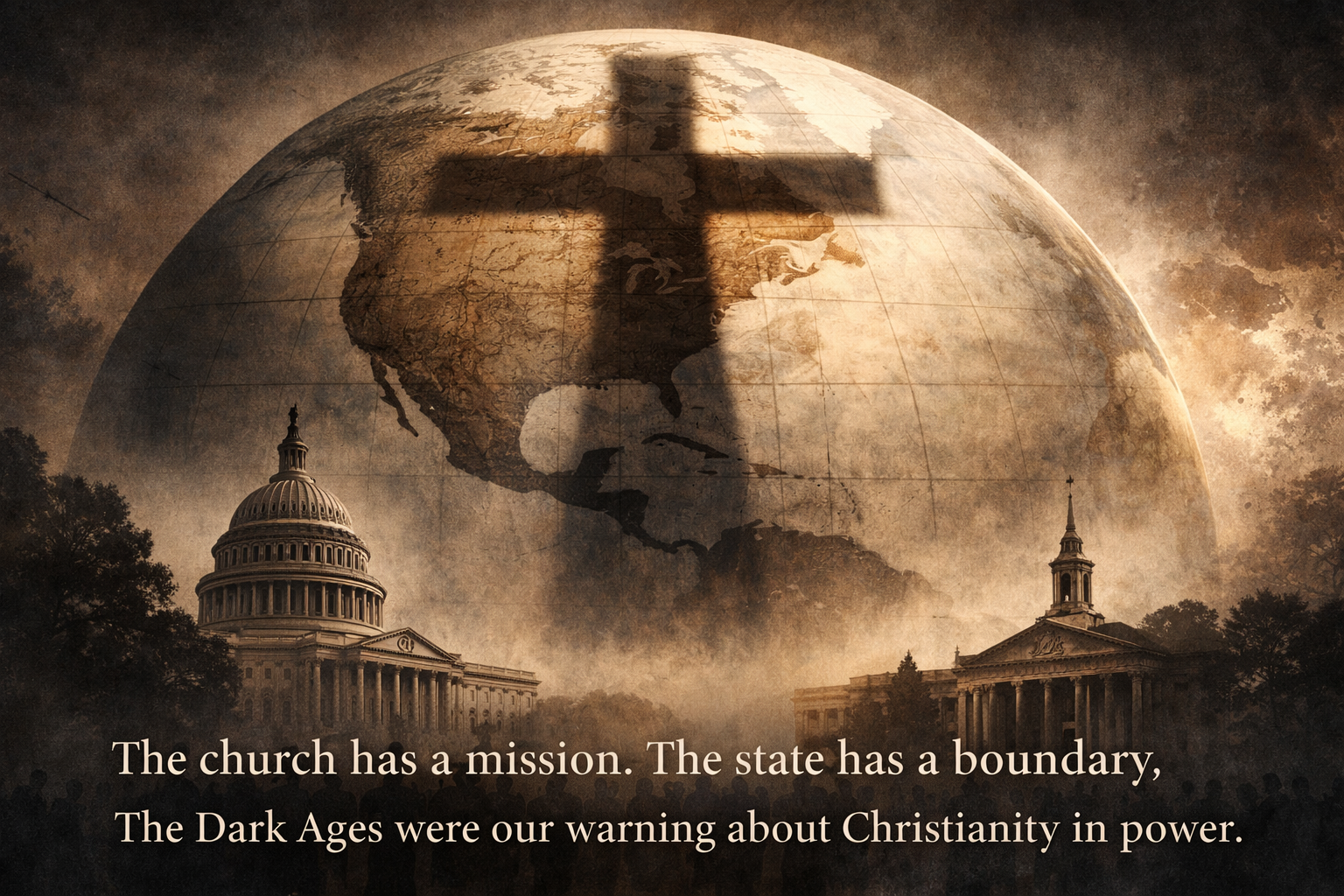
This is not to say that American evangelical Christianity is equivalent to jihadism in its methods or its immediate danger. It is not. But the distinction between them is one of degree and current political power, not of foundational logic. Both rest on the same premise: that a divine mandate to transform the world supersedes the consent of the people being transformed. That premise is exactly what the American founders were warning against when they built the wall between church and state. They were not naive about religion. Several of them were deeply religious men. But they had read their history and they knew exactly what organized religion did when it got its hands on governmental authority - regardless of which religion it was.
James Madison, the architect of the First Amendment, wrote that religion flourishes in greater purity without the aid of government. He was not hostile to faith. He was hostile to the institutional fusion of religious and civil authority, which he had studied across centuries of European history and found uniformly corrupting to both. Thomas Jefferson called the wall between church and state a protection for the state from religion as much as for religion from the state. John Adams was more blunt: in the Treaty of Tripoli he wrote that the government of the United States was not in any sense founded on the Christian religion - a statement addressed to a Muslim nation, intended to make clear that America's civic identity was not a theological one. These were not the words of atheists trying to drive religion out of public life. They were the words of men who had watched religious institutions accumulate civil power and knew where it led. They had seen it in England. They had seen it in France. They had seen it across the continent. The Great Commission does not alarm a serious student of the founders because it is Christian. It alarms him because it is theocratic. And theocracy, whatever name it wears, has a consistent historical record.
Joshua 1:9 and What It Is Being Asked to Carry
Joshua 1:9 is a verse about courage under divine command. In its original context it is God speaking to Joshua before the conquest of Canaan - a military campaign, not a metaphor. "Be strong and courageous" is not advice for navigating personal anxiety. It is a mobilization order. The verse has been separated almost entirely from that context in modern Christian usage and repurposed as general encouragement, which is how most people encounter it. The author of the Gazette piece uses it that way and I take him at his word that for him it is about fear and obedience in the most personal sense.
But context does not disappear because we prefer the softer reading. When a verse about courage under divine command appears in a publication whose stated mission is covering the world in Christ, the original military and expansionist context of that verse is not entirely absent. It is dormant. The question worth asking is what activates it - and whether the people reading that newsletter understand the difference between a personal verse and a recruitment pitch.
Courage in the face of personal fear is admirable. Courage as the engine of a movement to transform the world under one religion's authority is something the rest of us are entitled to notice and name.
The Separation Principle Is Not Anti-Christian
I have made this argument before and I will make it again here because it gets misread every time. The separation of church and state does not tell Christians to stop believing, stop organizing or stop speaking. It does not tell them their faith is unwelcome in the public square. It tells everyone - Christian, Jewish, Muslim, atheist - that no religious tradition gets to use the machinery of civil government to advance its theological program. That boundary protects Christians as much as it protects everyone else. A country where the Great Commission can be enforced through civic structures is a country where the next majority religion can do the same thing to the Christians who built the precedent. That is not a hypothetical. It is the repeating pattern of every civilization that let one tradition capture the institutions of civil power.
The people who push back hardest against the separation principle are usually confident they will always be the majority. That confidence is a historical error. Majorities shift. Institutions persist. The rules you build when you are dominant are the rules that govern you when you are not. Madison understood this. Jefferson understood this. The founders built a secular constitutional framework not because they were irreligious but because they were students of history and they knew what happened next when the church got the keys to the government. Every time. Without exception.
There is a strand of American Christian thought called dominionism that holds, in varying degrees of explicitness, that Christians are called to exercise dominion over all aspects of society - government, education, law, culture and economics - in order to prepare the world for Christ's return or simply to fulfill the mandate of the Great Commission. It is not a fringe position. It runs through significant portions of the evangelical and charismatic movements and has found political expression in movements from the Moral Majority to the New Apostolic Reformation. "Together, we'll cover the world in Christ" sits on that continuum. It may represent a mild expression of the idea. It may represent something more organized. The point is that the language is not innocent shorthand for personal spiritual growth. It is the stated vocabulary of a genuine political theology - one that sounds, to anyone paying attention, almost exactly like the political theology that the same evangelical community has spent twenty years warning the country about. The mirror is uncomfortable. It should be.
What I Actually Respect About the Post
I want to say this clearly because the argument I am making is not personal. The author of the Gazette piece writes with real honesty about fear. He does not dress up his faith as heroism. He says he needed the verse because he was scared. That is more self-aware than most motivational religious content, which tends to airbrush the doubt out of the story and sell the resolution without the crisis. A man who admits he was frightened and needed something to hold onto is not a man I have any interest in dismissing.
Personal faith that functions as a private anchor - that gets someone through fear and into the kind of steadiness that lets them be useful to others - is not something secular society needs to regulate or resent. It is a legitimate use of the religious tradition. The argument I am making is not that faith is dangerous. The argument is that faith organized into a program for transforming the world, and promoted through media that blurs the line between personal testimony and missionary recruitment, deserves scrutiny from the people who will be on the receiving end of that transformation whether they consented to it or not.
My Bottom Line
Your life verse is yours. What you carry into hard moments to keep yourself upright is a private matter and I have no quarrel with it. Joshua 1:9, held by one man in the dark of his own doubt, is not a threat to anyone. It is a human being doing what human beings have always done - reaching for something beyond themselves when their own nerve is not enough.
But "Together, we'll cover the world in Christ" is not a private statement. It is a collective one. It has a direction, a scope and a target. It describes a world in which one tradition's theological claims have been extended over everyone - not as an invitation but as a program. That program is the business of every person who does not share the faith. It is also, if you are paying attention, indistinguishable in its basic logic from the program that the same newsletter's audience has spent decades arguing is incompatible with American democratic life when Muslims are the ones making it.
The founders warned us about this. Not about Islam. Not about Christianity. About all of it. About the thing that happens when any organized religion stops being a private source of meaning and becomes a machine for capturing civil authority. They had seen it happen too many times under too many banners to believe it was a problem specific to any one faith. Power organized around divine mandate is dangerous. That is the warning. It does not expire because the flag over the church is familiar.
Respect the man. Read the mission statement carefully. Those are not the same thing and treating them as identical is how the line gets moved without anyone noticing.
The separation of church and state is not hostility toward faith. It is the arrangement that lets faith stay honest by keeping it free from the corrupting temptation of compulsion. The moment a religion needs the state to cover the world, it has stopped trusting its own gospel - and started doing exactly what our founders spent their lives trying to prevent.
Disclaimer: The views expressed in this post are the personal opinions of the author and are offered for educational, commentary and public discourse purposes only. They do not represent the positions of any institution, employer, organization or affiliated entity. Nothing in this post constitutes legal, financial, medical or professional advice of any kind. References to named publications, authors and organizations are based on publicly available content and are intended to support analysis and argument. Commentary on religious and political subjects reflects the author's independent analysis and is protected expression of opinion. This post critiques an organizational mission statement and a theological framework, not any individual's personal faith or character. Readers are encouraged to consult primary sources and form their own conclusions.