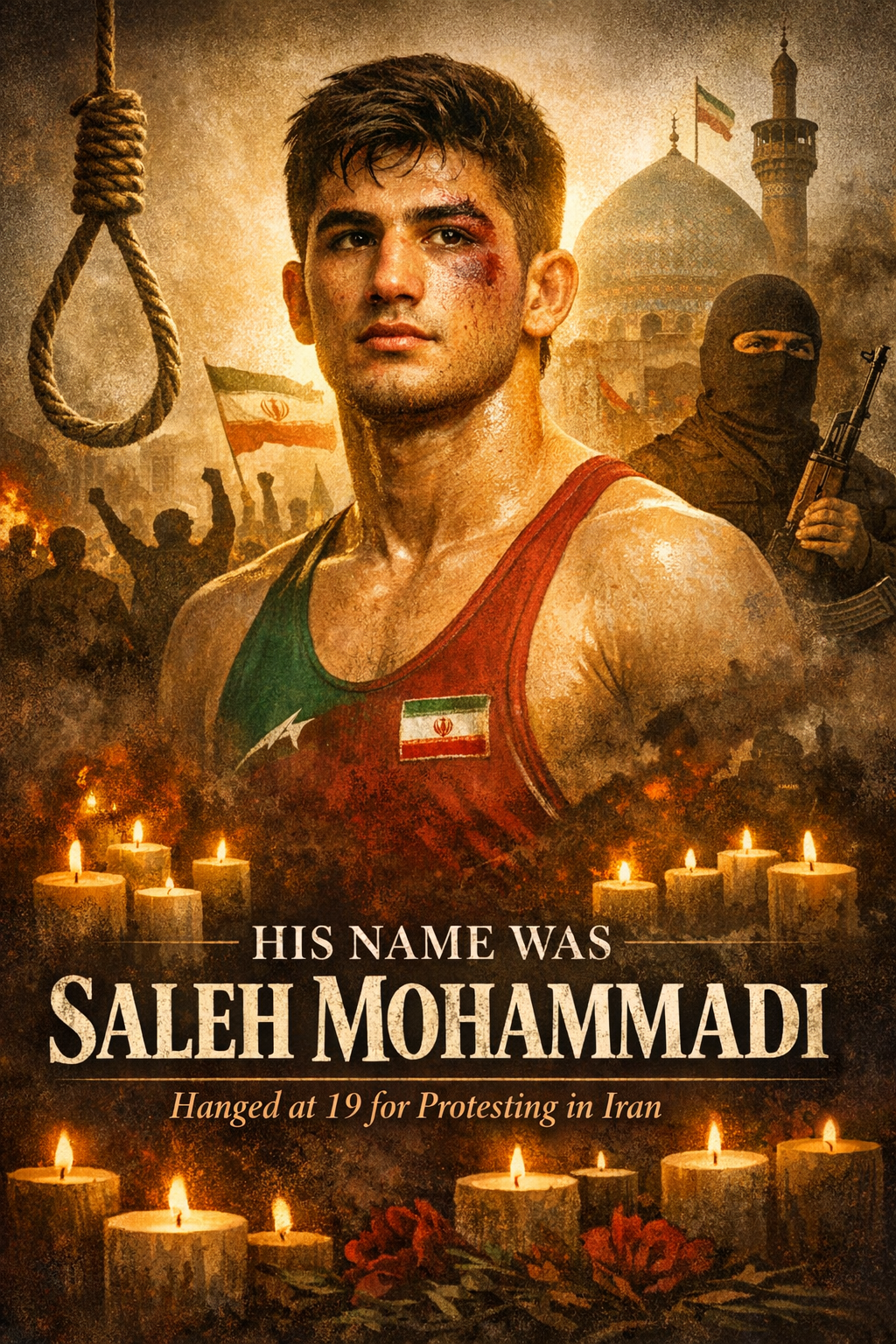
His name was Saleh Mohammadi. He was 19 years old. He was a national wrestling champion who won a bronze medal representing Iran at an international tournament in Russia in 2024. Three months before he was executed this morning, he posted a video of himself returning to training after a long injury. The caption read: "And we held on beyond what we ever imagined for ourselves." The Islamic Republic of Iran hanged him at dawn at Qom Central Prison, alongside two other young men, on charges of waging war against God. He had denied everything. His lawyers said the confession was obtained under torture. CCTV footage presented in court did not identify him. None of it mattered. The regime needed a body, and a 19-year-old wrestler's body was available.
I want to start there before I say anything else about policy or ideology, because the argument I am about to make is sometimes misread as hostility toward Muslim people. It is not. Saleh Mohammadi was Muslim. The millions of Iranians who went into the streets in December 2025 and January 2026, at enormous personal risk, were largely Muslim. The regime that hanged him invokes Islam as its governing authority. Those are three different things, and collapsing them into one is the kind of intellectual sloppiness that produces bad analysis and bad policy in equal measure.
What the Iranian Regime Actually Is
The Islamic Republic of Iran is not a government that happens to be Muslim. It is a theocratic state that uses Islamic law as the instrument of political control. The charge of Moharebeh - waging war against God - is not a theological concept applied to genuine apostasy. It is a legal weapon used to execute people who protest. The regime has now hanged at least 13 people on charges linked to the 2025-2026 wave of unrest. It executed a wrestler in 2020. A karate champion in 2023. Thousands of ordinary citizens across forty-seven years of this system. The supreme leader has been killed in the ongoing conflict with Israel and the United States, but the judicial machinery that processed Saleh Mohammadi's death sentence was still running at dawn today.
This is what political Islam in its fully realized, state-governing form looks like. It is not a thought experiment. It is not a Western projection onto a misunderstood culture. It is a documented, operating system of theocratic law that executes teenagers for demanding political change, hangs dual nationals on espionage charges without evidence and runs sham trials in closed courtrooms with confessions extracted through torture. The people inside Iran who have risked and lost everything to resist this system understand it better than any Western academic who insists the problem is Western bias. They are not confused about what they are living under.
The question America has to answer is not whether Muslim people are dangerous. They are not, as a class, any more than Christians or Jews or anyone else. The question is whether a political system that uses religious law to justify the execution of wrestlers for protesting should be treated as just another governance tradition deserving cultural deference.
The Distinction That Has to Be Made Honestly
There are roughly 3.5 million Muslims in the United States. The overwhelming majority are citizens, taxpayers, veterans and neighbors living entirely ordinary American lives. A significant portion of Iranian-Americans are among the most vocal critics of the Islamic Republic in the world. Masih Alinejad, who spent years fighting the regime's compulsory hijab laws from exile in New York, called out the execution of Saleh Mohammadi within hours. Iranian-American wrestlers publicly pleaded for his life in February. The Iranian diaspora in America is not the enemy of American values. In many cases it is one of the clearest voices for them.
The distinction that needs to be made clearly - and that gets deliberately blurred by people on both sides of this debate - is between Muslim people and political Islam as an ideology of governance. A Muslim American going to mosque on Friday is exercising a constitutional right that should be protected as fully as any other. An organized political movement that seeks to establish religious law as civil authority, that treats apostasy and dissent as capital offenses and that uses theological framing to insulate its power from democratic accountability - that is a different thing entirely, and it deserves no deference from a secular society.
Saleh Mohammadi is not the first Iranian athlete executed for political opposition. Navid Afkari, a Greco-Roman wrestler, was executed in 2020 after being convicted of murder during the 2018 protests. Mohammad Mehdi Karami, a 22-year-old karate champion, was hanged in January 2023 following the Mahsa Amini protests. The regime targets athletes deliberately. They have public profiles. Their executions send a message to anyone with a platform that visibility does not protect you. It makes you a target. The charge is always the same: murder of a security officer, waging war against God, acting on behalf of Israel or America. The evidence is always thin. The confessions are always coerced. And the executions proceed anyway because the point is not justice. The point is fear.
What This Means for American Policy
The argument I made in the original version of this post was about wariness toward Islam in America. I want to sharpen that argument now, because the execution of Saleh Mohammadi this morning makes the stakes concrete in a way that abstract policy discussion does not. The concern is not Muslim Americans. The concern is the importation and normalization of the political ideology that killed him.
Sharia as a framework of personal religious practice is no different from Jewish halakhic observance or Catholic canon law governing internal church matters. It is a religious tradition that belongs entirely to private and communal life. That is not the issue. The issue is Sharia as a governing claim - the assertion that religious law should supersede secular civil authority, that blasphemy and apostasy should carry legal penalties and that political dissent can be framed as a theological offense. That framework, wherever it has been given state power, produces exactly the system that put a rope around Saleh Mohammadi's neck this morning. It does not produce that system because Muslims are uniquely violent or uniquely intolerant. It produces it because unchecked theocratic authority, of any religion, moves toward self-protection through coercion. History is uniform on this point.
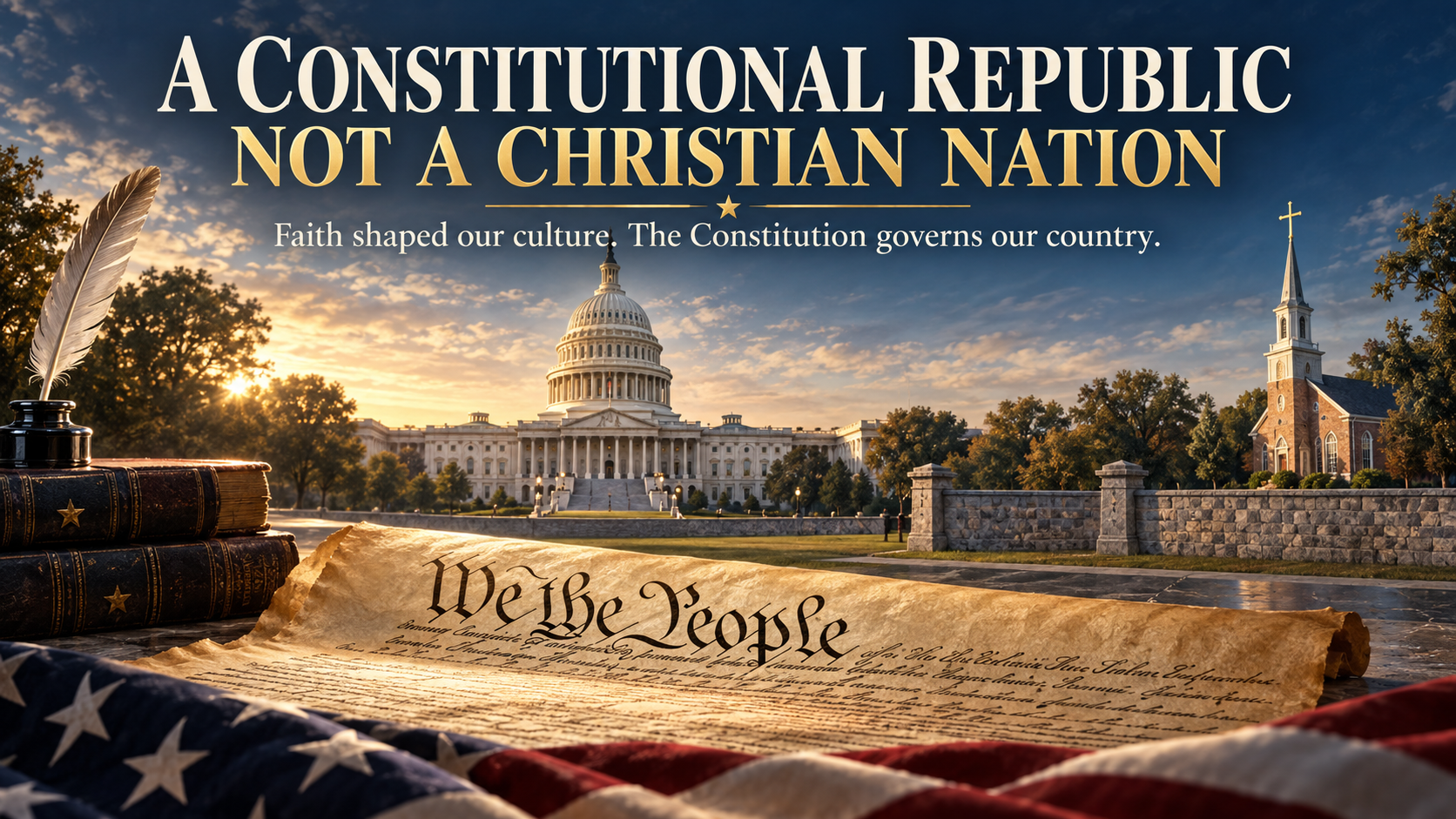
America's secular constitutional framework is not anti-religious. It is the arrangement that protects every religion from every other religion and protects every individual from religious coercion by the state. Defending that framework aggressively is not bigotry toward Muslims. It is the same principle that protects them.
The Failure of Cultural Relativism Here
There is a strain of progressive Western thought that treats any criticism of Islamic governance as Islamophobia, that responds to cases like Saleh Mohammadi's by pivoting immediately to American foreign policy or Western colonialism and that treats the demand for universal human rights standards as a form of cultural imperialism. This position has always been intellectually dishonest. Today it is visibly obscene.
A 19-year-old wrestler was hanged this morning because he protested a government that has been killing its own people for nearly five decades. The Iranian people in the streets - millions of them, at the cost of tens of thousands of lives in the most recent wave alone - are not asking for Western cultural values to be imposed on them. They are asking for what every human being asks for when a state points a gun at them: the right to exist, to speak, to dissent and to live. Calling that a Western construct is not sophisticated analysis. It is a way of looking away from a hanging.
Universal human rights are not a Western invention that Muslim people are too culturally primitive to deserve. They are what Saleh Mohammadi was demanding when he went into the street. The regime called that war against God. We should call it what it was - courage.
What America Should Actually Do
The policy position worth defending is not blanket suspicion of Muslim immigrants. It is a clear, consistent and non-negotiable insistence that the secular constitutional framework is the floor of American civic life - for everyone, regardless of religion, regardless of origin. That means immigration policy that screens for ideological commitment to theocratic governance rather than religious identity. It means refusing to treat religious law as a parallel legal system with civic authority. It means standing without apology with the Iranian people, and with every people, who are paying in blood for the right to live under something other than a theocracy.
None of that requires treating Muslim Americans as suspects. It requires treating the political ideology of theocratic governance - wherever it appears, in whatever religious tradition - as incompatible with constitutional democracy. That is a principled position. It is also the position that Saleh Mohammadi died holding.
My Bottom Line
The Islamic Republic of Iran hanged a 19-year-old wrestler this morning and called it God's justice. The same machinery is processing hundreds more cases linked to the January protests. The regime's supreme leader is dead but the system he built is still running, still executing, still extracting confessions under torture and announcing the results through state media before families can even confirm the deaths.
America does not have to be neutral about this. Neutrality in the face of theocratic execution is not tolerance. It is indifference dressed up as sophistication. The right response to Saleh Mohammadi's death is to say his name, to understand clearly what kind of political system killed him and to protect, without apology and without exception, the secular constitutional framework that makes his kind of death impossible here. That framework is not the enemy of Muslim Americans. It is their protection - the same as it is for everyone else.
His name was Saleh Mohammadi. He was 19. He wrestled for Iran and died for Iran's future. The least we can do is be honest about what killed him.
References
- Iran International. (2026, March 19). Wrestler's execution raises fears for detained athletes in Iran. Iran International. https://www.iranintl.com/en/202603191432
- Euronews. (2026, March 19). Iran hangs three men, including 19-year-old wrestler, in first executions over January protests. Euronews.
- Daily Wire. (2026, March 19). 'Massacring Youth': Iran hangs 19-year-old wrestling champion after protest arrest. The Daily Wire.
- IranWire. (2026). Saleh Mohammadi: Will the tragedies of Navid Afkari and Mohammad Mehdi Karami repeat? IranWire.
- Iran Human Rights (IHR). (2026). Statement on mass execution risk amid ongoing conflict. IHR.
- Kim, W. C., & Mauborgne, R. (2015). Blue Ocean Strategy (expanded ed.). Harvard Business Review Press. [referenced for series context only]
- Alinejad, M. [@AlinejadMasih]. (2026, March 19). [Statement on execution of Saleh Mohammadi]. X (formerly Twitter).
- U.S. State Department. (2026, January). Statement on Saleh Mohammadi and Iranian protest executions. U.S. Department of State.
Disclaimer: The views expressed in this post are the personal opinions of the author and are offered for educational, commentary and public discourse purposes only. They do not represent the positions of any institution, employer, organization or affiliated entity. Nothing in this post constitutes legal, financial, medical or professional advice of any kind. References to public figures, institutions, historical events and current affairs are based on publicly available sources and are intended to support analysis and argument, not to state facts about any individual's character, intent or conduct beyond what the cited sources support. Commentary on religious, political and cultural subjects reflects the author's independent analysis and is protected expression of opinion. This post distinguishes between Muslim people as individuals and political Islam as an ideology of governance, and does not attribute the conduct of any government to any religious group as a whole. Readers are encouraged to consult primary sources and form their own conclusions. Any resemblance to specific individuals or situations beyond those explicitly referenced is coincidental.