
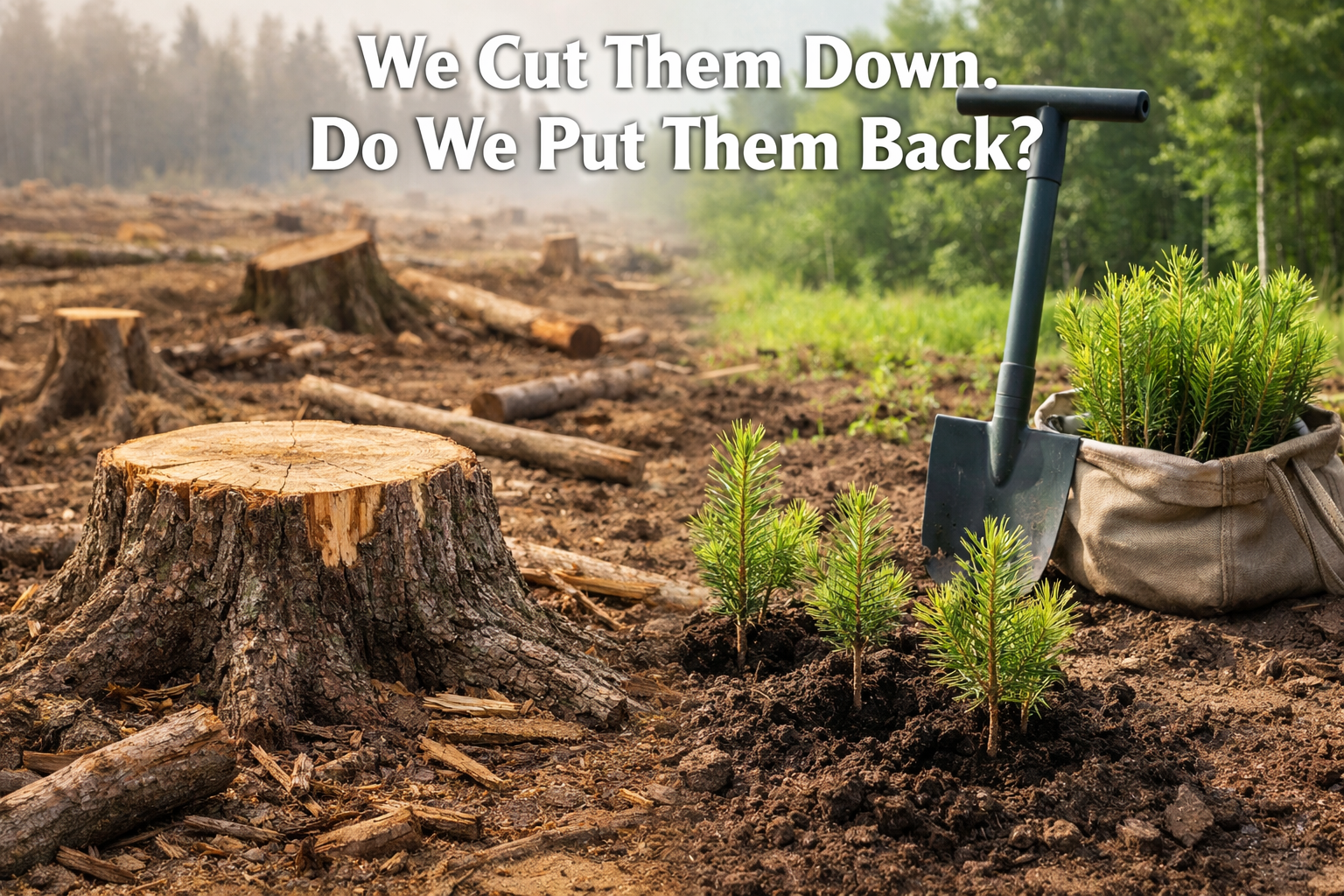
The United States harvests roughly 900 million trees a year. That number sounds catastrophic until you look at what goes back in the ground. About 2.5 billion trees are replanted annually - a ratio of two and a half for every one removed. North America has maintained more than 50 consecutive years of net forest growth exceeding annual harvests. That is not an accident. It is the result of regulatory infrastructure, sustained investment and a timber industry that figured out decades ago that killing the forest kills the business. The FAO reports that US forest cover increased by about 5 percent between 1990 and 2020 - roughly 18 million additional acres. The East Coast has seen tree numbers roughly double over the last seven decades, largely because farmland abandoned after agricultural consolidation reverted to forest. By the aggregate numbers, the US is doing something right.
The caveat is fire and it is a large one. Post-wildfire planting now accounts for more than 80 percent of reforestation demand on National Forest lands. Over the past decade the Forest Service has met only about 6 percent of annual post-fire replanting needs. The West is running a deficit that volunteer programs and federal funding have not yet closed. The 2021 REPLANT Act unlocked significantly more reforestation funding and directed the Forest Service to eliminate its replanting backlog within ten years. Whether that timeline holds is a different question.
Species Matter More Than Numbers
Aggregate replanting ratios tell you almost nothing about ecological health. The commercial timber industry replants heavily with fast-growing softwoods - loblolly pine across the South, Douglas fir in the Pacific Northwest. These are crop trees. They grow fast, they pull carbon and they support some wildlife. What they do not do is replace a mixed hardwood stand or an old-growth forest that took centuries to develop.
A 200-year-old white oak is not replaced by a pine seedling. You can plant a million loblolly pines where a hardwood stand stood and the number looks fine on paper. The biodiversity picture looks nothing like what was lost. This is not an argument against replanting. It is an argument for being honest about what replanting actually restores versus what it merely counts.
The math of 2.5 trees planted per harvested obscures what is actually going in the ground. Counting seedlings is not the same as restoring an ecosystem. A pine plantation is not a forest. It is a crop that happens to be tall.
The US plants over 1 billion trees annually. The Forest Service oversees 7.4 million acres of federal land with reforestation potential. Private landowners hold the largest share of that potential at 114 million acres - more than all federal and state land combined. The South has the highest regional opportunity at 63 million acres. Scaling to meet the nation's full reforestation goal would require US nurseries to produce an additional 1.8 billion seedlings per year beyond current capacity.
The Global Picture Is a Different Problem Entirely
What the US has learned, much of the tropics has not - or more precisely, cannot afford to act on. In 2024, tropical primary forest loss hit record highs globally. The Amazon biome alone saw a 110 percent increase in tree cover loss from 2023 to 2024, with 60 percent of that driven by fires. Total tropical primary forest loss reached roughly 6.7 million hectares - nearly twice the area lost in 2023 and approximately the size of Panama. Brazil accounted for 42 percent of all tropical primary rainforest loss worldwide.
Bolivia experienced its worst drought on record in 2024. Government statistics show nearly 12 percent of the country burned, including large areas of forest. Most of those fires were set deliberately - to clear land for cattle ranching and monoculture crops like soy and sugarcane. Without early warning systems or adequate firefighting resources, the fires ran unchecked. The countries sitting on the world's most biologically irreplaceable forests are often the ones with the least economic incentive to preserve them. That is not a coincidence. That is the structural problem.
Brazil's situation is more complicated than it looks from the outside. Deforestation in the Brazilian Amazon fell by over 30 percent between 2023 and 2024 under President Lula's administration, reaching its lowest level in nine years. That improvement is real and it came directly from strengthened law enforcement and reactivation of the Amazon Fund. Then the drought hit, fires exploded and the progress was partially erased in a single season. Policy can shift the baseline. It cannot fireproof a continent in a record drought year.
In 2021 more than 100 countries pledged to halt and reverse deforestation by 2030. Deforestation rates in 2024 were 63 percent higher than the trajectory required to meet that target. Of the 20 countries with the largest area of primary forest, 17 have higher primary forest loss today than when that pledge was signed.
The Bright Spots Are Real but Narrow
China and Russia have both added significantly more forest cover than they have removed in the past decade through active afforestation programs. Indonesia and Malaysia showed meaningful improvement in 2024 - their forest loss rates are well below where they were a decade ago. Colombia saw Amazon deforestation drop by more than 60 percent in 2023 under policy changes from the Petro administration. These are genuine achievements and they demonstrate that policy works when governments commit to it.
The problem is scale. The countries making progress are not the countries with the most to lose. The Amazon, the Congo Basin and the forests of Southeast Asia together represent an irreplaceable share of the planet's biodiversity and carbon storage. The progress in China's northern reforestation programs, while significant, does not offset what is being lost in Brazil's cerrado or the forests of Borneo. These are not equivalent ecosystems and treating them as interchangeable in the accounting is its own form of institutional blindness.
The US and Canada have regulatory infrastructure, economic alternatives to deforestation and a timber industry that depends on sustainable supply. Tropical nations facing the worst losses often have none of these. The global commodity demand for beef, soy and palm oil flows largely from wealthy nations to developing ones. Asking Brazil to stop clearing the Amazon while the developed world buys Brazilian beef at scale is a policy problem as much as an environmental one. The deforestation is partly outsourced demand. That does not excuse the clearing. It does complicate who bears responsibility for stopping it.
The Easter Island Question Gets Misread
The Easter Island comparison gets invoked regularly as a lesson about civilizational blindness - the idea that a society can watch itself destroy the foundation of its survival and keep going anyway. It deserves more precision than that. The islanders did not simply fail to see what was happening. Historians and ecologists now believe a combination of factors drove the collapse, including rat populations that arrived with Polynesian settlers and consumed palm seeds before trees could regenerate. The humans accelerated the problem. They did not create it alone. And they responded to local pressures with the tools they had.
That is the honest version of the parallel. The world is not choosing forest destruction out of ignorance. It is choosing short-term economic survival out of necessity, bad incentive structures and inadequate enforcement capacity. The lesson of Easter Island is not that people are stupid. It is that systems collapse when the gap between short-term reward and long-term cost is wide enough and the institutions bridging that gap are weak enough. The US closed that gap over a century of painful experience - the Lacey Act, the National Forest System, state replanting mandates and a timber industry that internalized the cost of depletion the hard way. The tropics are being asked to close it in a decade, under severe economic pressure, without equivalent institutional capacity, while the developed world sets the commodity prices driving the clearing.
The trees are the symptom. The incentive structures are the disease. Until the developed world stops outsourcing its consumption to places that cannot afford to say no, the pledges will keep running ahead of the outcomes.
Why This Matters
Forests are not a conservation hobby. They regulate the water cycle, stabilize soils, store roughly a third of all carbon held in terrestrial ecosystems and support the biodiversity that underpins food security and pharmaceutical discovery. When primary tropical forests go down they release stored carbon that took centuries to accumulate, they eliminate species that have never been catalogued and they destabilize regional rainfall patterns that millions of people depend on for agriculture. These are not reversible losses on any human timescale. A seedling planted today will not restore what a 500-year-old rainforest provided for another several centuries.
The policy stakes are equally serious. The 2030 deforestation pledge represents one of the most significant multilateral environmental commitments in history. If it fails - and the current trajectory suggests it will - the credibility of international environmental governance fails with it. Countries will conclude that pledges are performance rather than commitment and the next round of negotiations will start from an even weaker baseline. The US record demonstrates that the problem is solvable when institutions are built to solve it. The global record demonstrates that good intentions without enforcement architecture, economic alternatives and shared accountability produce impressive announcements and catastrophic outcomes.
Consumers in wealthy nations have more leverage than they typically exercise. The beef, soy and palm oil supply chains driving tropical deforestation are not anonymous. They are traceable, certifiable and in many cases already subject to regulatory pressure in the EU and elsewhere. Demanding supply chain transparency from the industries that source from deforested land is not a radical position. It is the same expectation applied to every other product we buy. The forest does not know the difference between a chainsaw and a hamburger. Both cost trees. Only one comes with a receipt.
References
- Food and Agriculture Organization of the United Nations. (2020). Global Forest Resources Assessment 2020. FAO.
- Global Forest Watch. (2024). Forest Loss Data: Tropical Primary Forest Loss 2024. World Resources Institute.
- Hansen, M. C., et al. (2013). High-resolution global maps of 21st-century forest cover change. Science, 342 (6160), 850-853.
- U.S. Forest Service. (2022). Reforestation Need Assessment: Post-Wildfire Planting Demand. USDA.
- U.S. Congress. (2021). REPLANT Act, Consolidated Appropriations Act of 2021. Public Law 116-260.
- Instituto Nacional de Pesquisas Espaciais (INPE). (2024). Amazon Deforestation Data: PRODES System. Brazil.
- Souza, C. M., et al. (2020). Reconstructing three decades of land use and land cover changes in Brazilian biomes. Remote Sensing, 12 (17), 2735.
- Hunt, T. L., & Lipo, C. P. (2011). The Statues That Walked: Unraveling the Mystery of Easter Island. Free Press.
- Diamond, J. (2005). Collapse: How Societies Choose to Fail or Succeed. Viking.
- World Resources Institute. (2023). The State of the World's Forests. WRI.
Disclaimer: The views expressed in this post are the personal opinions of the author and are offered for educational, commentary and public discourse purposes only. They do not represent the positions of any institution, employer, organization or affiliated entity. Nothing in this post constitutes legal, financial, medical or professional advice of any kind. References to institutions, data sources and historical events are based on publicly available sources and are intended to support analysis and argument. Readers are encouraged to consult primary sources and form their own conclusions. Any resemblance to specific individuals or situations beyond those explicitly referenced is coincidental.