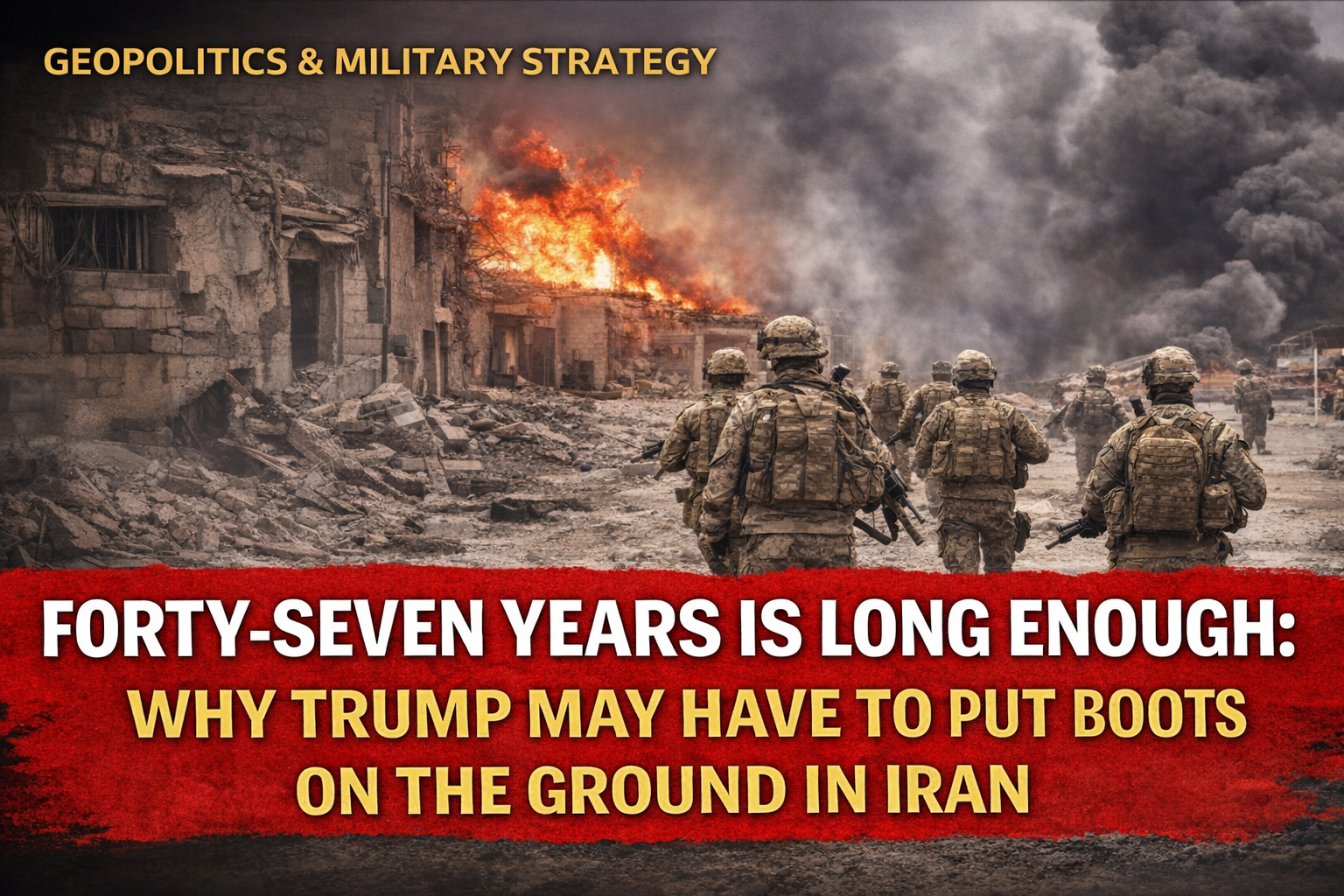
Let me say the uncomfortable thing plainly, because nobody in Washington seems willing to. If the United States is genuinely committed to ending the Islamic Republic of Iran and not merely to degrading its hardware, bombing alone will not finish the job. It has never finished a job like this. And the longer the air campaign runs without producing the political collapse Trump said he wanted, the more the logic of the situation points toward a ground component - not a full occupation, not another Iraq, but a targeted, purposeful military presence on Iranian soil sufficient to break the regime's internal coercion apparatus and create the conditions for the Iranian people to do what many of them have been trying to do for years.
I support that. Not cheerfully, not without serious reservations about execution, and not without acknowledging that the costs are real and the risks are significant. But I support it - because the alternative is to watch the world's most durable state sponsor of terror reconstitute itself for the fifth time under a new Supreme Leader, rearm, regroup and resume a nearly half-century campaign of hostility against the United States, Israel and every stable government in the Middle East.
Forty-seven years is long enough. The Islamic Republic that seized American hostages in 1979, bombed the Marine barracks in Beirut in 1983, built and funded Hezbollah, armed Hamas, sent weapons to kill American soldiers in Iraq and spent decades chasing a nuclear weapon while threatening to wipe Israel off the map - that regime does not deserve another chance to rebuild. And air power alone will not make sure it doesn't get one.
What Forty-Seven Years of Survival Actually Means
The Islamic Republic was born in February 1979 when Ayatollah Khomeini returned from exile to a crowd of millions and the Pahlavi dynasty collapsed almost overnight. What followed was not a clean revolutionary government that gradually went bad. It was from the beginning a theocratic system built on suppression, ideological rigidity and the institutionalization of hostility toward the West as a core governing principle. The hostage crisis was not an aberration. It was a declaration of intent that the regime spent the next four and a half decades honoring with remarkable consistency.
What makes the Islamic Republic so difficult to destroy from the air is precisely what has kept it alive this long. It is not a conventional government held together by one man at the top. Khamenei's assassination in the opening strikes of Operation Epic Fury on February 28 demonstrated that even killing the Supreme Leader does not collapse the system - his son Mojtaba assumed the position within days, and the Revolutionary Guard, the Basij, the clerical council and the vast patronage networks that hold the apparatus together continued to function. Robert Pape of the University of Chicago put it correctly when he wrote that regimes are networks, not individuals. Security services, political elites, patronage structures and ideological institutions do not simply dissolve when you remove the figurehead. They consolidate. They adapt. They wait.
Experts across the political spectrum agree on this point with rare unanimity. Senator Chris Murphy stated there is no historical example of an air campaign alone producing positive regime change. University of Chicago political scientist Robert Pape wrote that air power is extraordinarily effective at destroying infrastructure but far less reliable as a tool for reshaping political systems. Kelly Grieco of the Stimson Center told Al Jazeera that achieving regime change will be difficult if not impossible without troops on the ground. Matthew Duss of the Center for International Policy said plainly: you can damage buildings, you can damage the regime, but we do not have examples of air power alone achieving regime change.
This is not left-wing opposition to the war. This is the strategic consensus of people who study how states fall.
The Islamic Republic survived the Iran-Iraq War, which killed roughly one million people and ran for eight years. It survived the Green Movement of 2009. It survived the 2017-18 protests, the 2019-20 protests, the Mahsa Amini uprising of 2022-23 and the mass killings of demonstrators in January 2026 that helped trigger the current conflict. Each time, the regime did the same thing: it deployed the Revolutionary Guard and the Basij, it killed enough people to frighten the rest back into silence, and it waited for the pressure to subside. The Islamic Republic's core competency is not military power. It is internal coercion. It is the ability to turn the state's violence apparatus against its own population with sufficient speed and brutality to prevent organized opposition from reaching critical mass.
Air strikes from 35,000 feet do not break that apparatus. They destroy missile batteries, naval vessels, nuclear facilities and command structures. They do not dismantle the checkpoint networks in Tehran's neighborhoods, the Basij units posted in every city, the Revolutionary Guard intelligence officers who identify dissidents before they can organize or the clerical and financial structures that sustain the regime's control over ordinary Iranian life. Those are ground-level problems. They require a ground-level answer.
The Distinction That the Debate Keeps Avoiding
The loudest objections to ground operations in Iran invoke Iraq and Afghanistan as proof that American military intervention in Muslim-majority countries inevitably produces prolonged quagmire, national humiliation and strategic failure. That comparison is worth taking seriously - and then distinguishing carefully from the situation at hand.
The Iraq War of 2003 involved the full-scale invasion and occupation of a country of 25 million people with no clear post-war plan, insufficient forces for stabilization, a decision to disband the Iraqi army that instantly created hundreds of thousands of armed, unemployed and furious men and a fantasy that democracy would spontaneously emerge from the rubble of a dismantled state. Afghanistan involved two decades of nation-building in a country that had never had a functioning central government and where the tribal, ethnic and religious complexity of the population made any unified political outcome essentially impossible to impose from outside. Those failures were real. They were also specific. They were the product of particular decisions made by particular administrations pursuing particular fantasies about what military force could accomplish.
What I am arguing for here is not that. It is not the occupation of Iran. It is not the installation of a puppet government. It is not the attempt to rebuild a 90-million-person nation from the ground up at American expense and American lives over twenty years. The Iranian situation offers a fundamentally different set of conditions - and ignoring those differences to score rhetorical points about Iraq is not strategic thinking. It is intellectual laziness dressed as hard-won wisdom.
Iran already has an organized opposition, a diaspora with political leadership, a population that has been protesting the regime at mortal risk for years and a former crown prince in exile who commands genuine support. The question is not whether there is anyone to hand power to. The question is whether the regime's internal coercion machine can be broken sufficiently to let that transition happen.
Iran in 2026 is not Iraq in 2003. The Iranian people do not need to be taught democracy by American occupiers. They have been demanding it themselves, in the streets, at the cost of their lives, for nearly two decades. The regime that has been shooting them for doing so is not some expression of organic Iranian political culture - it is a 47-year-old theocratic system that polls and protests alike suggest a substantial majority of Iranians would be glad to see gone. Reza Pahlavi, the former crown prince, has stated publicly that he is prepared to lead a transitional government and has the backing of significant elements of the Iranian opposition. Kurdish Iranian dissidents have said they would support a ground operation. The internal conditions for a post-regime transition - messy, incomplete and uncertain as they would inevitably be - are considerably more favorable than anything that existed in Iraq or Afghanistan.
What the Air Campaign Has and Has Not Accomplished
Operation Epic Fury began on February 28 with strikes that, by any military measure, were extraordinarily effective. Tens of thousands of pieces of ordnance were delivered. Khamenei was killed along with 49 senior officials. Iran's navy has been largely destroyed. Its nuclear facilities have been struck repeatedly. Its ballistic missile program has been degraded. The Revolutionary Guard's command-and-control infrastructure has taken serious damage. By the metrics of tactical air power, this has been a successful campaign.
And yet the regime has not collapsed. Mojtaba Khamenei assumed his father's position. The Islamic Republic's constitution and institutional structure remain in place. The Basij and the Revolutionary Guard are still operational, still manning checkpoints across Iranian cities, still capable of turning their weapons on the population that would otherwise rise against the government. The regime has absorbed the strike on its leadership and kept the coercion apparatus running. That is exactly what regimes do when they have been built over nearly five decades specifically to survive external pressure.
Trump claimed in June 2025 that Operation Midnight Hammer had obliterated Iran's known nuclear facilities. Then in late February 2026, intelligence showed Iran had moved its enrichment program to a different site entirely - which was the stated trigger for the current campaign. The lesson is direct: a regime with 47 years of experience evading international pressure and hiding its most sensitive programs is not going to be permanently denuclearized by strikes alone. The only reliable way to ensure Iran does not eventually develop a nuclear weapon is to ensure that the regime capable of pursuing one no longer exists.
Trump has said the operation is running ahead of schedule and dismissed the need for ground troops on more than one occasion. I take that seriously as a political statement. I take it less seriously as a strategic one. The same Trump who said there would be no need for boots on the ground also said - explicitly, to the New York Post - that he would not rule them out if necessary. That is not a contradiction. That is a president who understands that the situation may force his hand regardless of what he prefers to say publicly. Democratic Senator Richard Blumenthal emerged from a classified briefing more fearful than ever that ground troops may become necessary. An Iranian Kurdish leader assessed a ground operation as highly likely. These are not war hawks looking for an excuse to escalate. These are people who have looked at the strategic situation honestly and reached the same conclusion the evidence supports.
The Case for a Limited, Purposeful Ground Component
What I am describing is not an army of occupation. It is a surgical ground presence - special operations forces, ranger-qualified units, intelligence assets and liaison capacity - sufficient to accomplish three specific things that air power cannot.
First, to degrade and disrupt the Basij and Revolutionary Guard's ability to suppress civilian uprising at the neighborhood level. The regime's survival depends on its capacity to deploy armed men to specific locations in specific cities faster than popular resistance can organize. Targeted ground operations against those units - their staging areas, their command infrastructure, their ability to move and communicate - would create windows of opportunity for the Iranian people to act that the air campaign has not been able to open.
Second, to establish and protect liberated zones, initially in Kurdish and other minority areas where opposition is most organized and military conditions most favorable, that could serve as the physical and political foundation for a transitional authority. You cannot hand power to an opposition government that has nowhere to stand. A ground presence, even a limited one, creates that space.
Third, to provide the credible backstop that Trump himself gestured toward when he told the Iranian people their moment of freedom had come and instructed them to take over their government. That call is not credible if the regime's coercion apparatus remains intact and fully functional. The Iranian people know better than anyone that they have risen before and been slaughtered for it. They will not rise again in the numbers required without reason to believe this time is different. A visible, capable American presence on Iranian soil is what makes this time different.
The Iranian people have done their part. They have protested at mortal risk for years. They have buried their children, defied the hijab laws, gone on strike and been shot for doing so. What they have never had is a moment when the regime's coercion machine was simultaneously damaged from outside and challenged from within. This is that moment - but only if the outside pressure is sufficient to actually break the machine, not merely dent it.
The Honest Accounting of Costs and Risks
I am not going to pretend this argument comes without costs. It does not. Americans will die. The number will depend on the scope, duration and intelligence quality of the operation, but any honest advocate for ground operations has to look that fact in the face and say plainly that they believe the objective justifies the price. I believe it does - because the alternative is a reconstituted Islamic Republic, rearmed, re-motivated and more committed than ever to developing the nuclear capability that has been the regime's strategic goal since the 1980s. The cost of that outcome - measured in future American lives, Israeli lives, regional stability and the continued export of Iranian-backed terrorism across the world - is higher than the cost of finishing the job now.
There is also the legitimate concern about what comes after. Iran is a country of 90 million people with a complex ethnic, religious and political landscape. A post-regime transition will be difficult, contested and messy. There will be power struggles, regional tensions and the inevitable gap between what the Iranian diaspora imagines the country will become and what the population inside Iran actually wants. None of that is a reason not to act. It is a reason to act with a serious plan for what follows - something the Bush administration catastrophically failed to produce in Iraq and something the Trump administration would be foolish to repeat.
The good news is that the conditions for a managed transition in Iran are genuinely better than they were in Iraq. There is an organized opposition with recognized leadership. There is a substantial educated middle class that has been pushing for secular democratic governance for decades. There is a diaspora with technical capacity, financial resources and political experience that Iraq's did not have in anything like comparable measure. None of that guarantees success. It does mean the starting conditions are not as bad as the pessimists claim.
What Happens If We Stop Short
The strongest argument for accepting the discomfort of a ground component is what the alternative actually looks like. If the air campaign ends without regime collapse - if Mojtaba Khamenei's government stabilizes, if the Revolutionary Guard reconstitutes, if the nuclear program resurfaces at yet another hidden facility in five years - then what has been accomplished? Iran's military has been degraded. Its navy is gone. Some of its nuclear infrastructure has been destroyed. The regime has absorbed serious damage and emerged on the other side. And because it survived, it will draw exactly the lesson that surviving regimes always draw: that it needs a nuclear deterrent more urgently than ever, that the United States cannot be trusted to stop short of regime change, and that any future negotiation is conducted under an existential threat that makes compromise irrational.
A damaged but surviving Islamic Republic is in some ways more dangerous than an undamaged one. It has every incentive to accelerate its nuclear program, to reconstitute its proxy networks with greater urgency and to treat any future diplomatic engagement as a delay tactic rather than a genuine opportunity. The United States and Israel will have spent enormous military resources and political capital, taken casualties and inflicted civilian harm - and the regime will still be there, telling its remaining supporters that it defeated the Great Satan and survived to fight another day.
Every time the Islamic Republic has faced serious internal or external pressure - the Iran-Iraq War, the 2009 Green Movement, the 2019 protests, the 2022 Amini uprising, the January 2026 crackdown - it has done the same thing. It absorbs the blow. It kills enough people to suppress immediate resistance. It waits for external attention to move elsewhere. Then it reconstitutes. Forty-seven years of successful survival is not evidence that the regime is indestructible. It is evidence that incomplete pressure has been applied repeatedly and that the regime has learned to outlast it. The lesson is not to apply less pressure. It is to apply enough pressure to actually finish the job.
My Bottom Line
I support Donald Trump's decision to confront the Islamic Republic directly. The air campaign has been militarily impressive and strategically necessary. But military impressiveness is not the same as strategic sufficiency, and the evidence - from history, from the current battlefield and from every serious analyst who has looked at this honestly - suggests that air power alone will not produce the regime change that Trump announced as his objective on February 28.
If the goal is genuinely to end the Islamic Republic - and I believe it should be - then the logic of the situation points toward a limited, purposeful ground component targeted at the regime's internal coercion apparatus and designed to create the conditions under which the Iranian people can finish what they started. That is not a call for occupation. It is a call for the kind of decisive, targeted military commitment that makes the difference between a war that ends the threat and a war that merely postpones it.
The Iranian people have been trying to free themselves from this regime for nearly two decades. They have been shot, imprisoned, tortured and executed for the attempt. They deserve a moment when the outside pressure is sufficient to actually break the machine that has been holding them down. That moment is now - but it requires the willingness to pay the price that finishing this job actually costs.
We went this far. The question is whether we go far enough to make it mean something - or whether we stop short, declare victory over the wreckage and wait for the regime to climb back out of it. I know which choice the next forty-seven years will thank us for.
References
- Al Jazeera. Trump's Endgame in Iran: Regime Change Without US Boots on the Ground. March 4, 2026.
- Al Jazeera. Will the US Put Boots on the Ground in Iran? March 4, 2026.
- Axios. Trump Campaign Peace Promises Loom Large Over Iran War. March 2, 2026.
- Atlantic Council. Forty-Four Years of an Islamic Republic: Many Now Regret the 1979 Revolution. February 11, 2023.
- Boston Globe. Opinion: Regime Change Could Happen in Iran Without Ground Troops. March 13, 2026.
- Christian Science Monitor. Initial Iran Strikes Over: What Strategy Defines the Next US Military Moves? March 2, 2026.
- Iran International. Trump Says Regime Change in Iran Will Happen But Not Immediately. March 13, 2026.
- Northeastern University News. Could a Congressional War Powers Resolution Stop Trump's War in Iran? March 2, 2026.
- Pape, Robert A. Khamenei Is Dead. Regime Change Will Be Much Harder. March 1, 2026.
- PolitiFact. Have Missile Strikes Without Ground Troops Ever Brought About Regime Change? March 2, 2026.
- St. Louis Public Radio. Hawley Doesn't See Trump Asking for US Ground Troops to Enter War Against Iran. March 12, 2026.
- Wikipedia. 2026 Iran War. Retrieved March 16, 2026.
- Wikipedia. History of the Islamic Republic of Iran. Retrieved March 16, 2026.
Disclaimer: The views expressed in this post are the personal opinions of the author and are offered for educational, commentary and public discourse purposes only. They do not represent the positions of any institution, employer, organization or affiliated entity. Nothing in this post constitutes legal, financial, medical or professional advice of any kind. References to public figures, institutions, historical events and current affairs are based on publicly available sources and are intended to support analysis and argument, not to state facts about any individual's character, intent or conduct beyond what the cited sources support. Commentary on political and military subjects reflects the author's independent analysis and is protected expression of opinion. Readers are encouraged to consult primary sources and form their own conclusions. Any resemblance to specific individuals or situations beyond those explicitly referenced is coincidental.