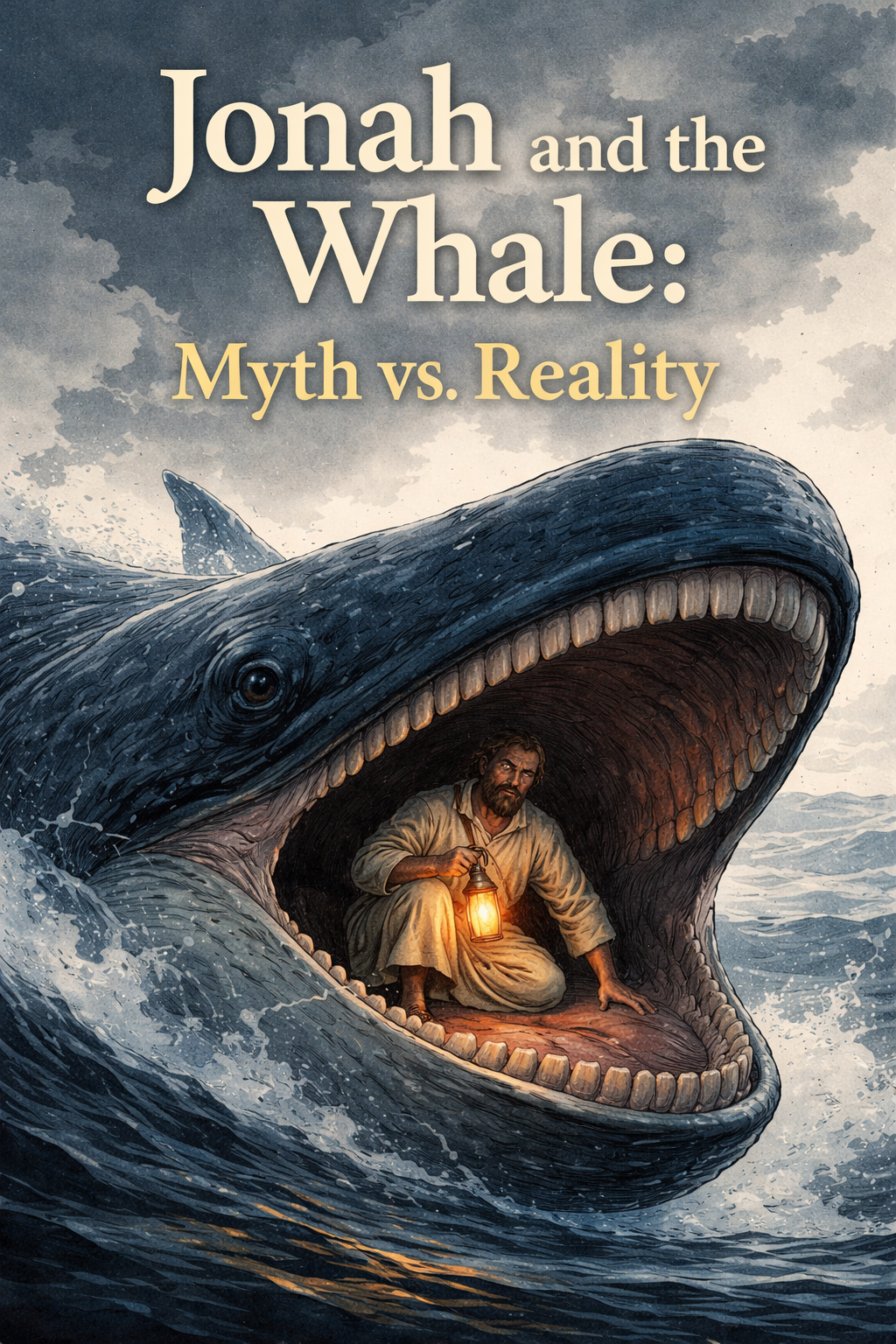
The story of Jonah is one of the most famous in the Hebrew Bible. It has survived for centuries because it is vivid, dramatic and morally compact. A prophet flees from God. A storm rises. Sailors panic. Jonah goes overboard. A great fish swallows him whole, holds him for three days and three nights, then deposits him back on dry land where he finally does what he was told. It is a powerful story. It is also almost certainly a myth. That is not an insult. It is a classification. And the refusal to make that classification honestly is doing more damage to religion than any secular critic ever could.
The Book of Jonah says great fish, not whale. That detail matters less than it seems. Whether one says whale, fish or sea creature, the biological claim is the same: a human being survived inside a marine animal for three days and walked away. A person in that situation faces oxygen deprivation, crushing pressure, digestive chemistry, infection, dehydration and shock. None of that is survivable under ordinary natural conditions. The story is not historical reportage. It is a theological argument dressed in narrative. It belongs in philosophy, theology, literature and private conscience - not in science classrooms, not in courtrooms and not in secular governance as privileged truth.
The Story Works Better as Myth
Jonah is not valuable because it happened. It is valuable because of what it is trying to say. It is about reluctance and guilt and the absurd lengths a person will travel to avoid a moral burden they already know they cannot outrun. That staying power across centuries is not evidence of historical accuracy. It is evidence that the story is doing something true about human psychology even if it never happened at all. A myth does not need to be historically true to reveal something psychologically true. The image of a man swallowed by a great fish is more memorable than any lecture about moral obligation, and the image carries the argument. That is what myth does when it is working properly.
The trouble starts when people drag myth out of the symbolic register and defend it as literal history. At that point the story leaves the realm where it has genuine power and enters the world of empirical claim, where it cannot survive. If Jonah must be treated as a factual event it becomes fair game for factual criticism, and factual criticism destroys it immediately. The defender has two options from that position. He can retreat into miracle language, which simply exempts the claim from evidence, or he can pretend the biological problem does not exist. Neither is intellectually serious. Both invite the contempt they are trying to avoid.
Treating Jonah as literal history does not strengthen religion. It hands its critics the easiest argument they will ever make. Myth forced into the empirical register collapses on contact. That is not the fault of secular critics. It is the fault of literalism.
What the Story Is Actually About
Strip away the fish and the moral architecture of Jonah is sophisticated. A prophet is ordered to go to Nineveh - the capital of the Assyrian empire, the occupying power, the enemy - and call it to repentance. He refuses and runs the opposite direction. The consequences of that refusal escalate until reversal becomes unavoidable. He goes. He preaches. The city repents. And then Jonah sulks outside the city walls, furious that the mission succeeded and the enemy was spared the judgment he wanted delivered.
God's response to that sulking is one of the sharpest lines in the entire Hebrew Bible. He asks Jonah, in effect: should I not be concerned about Nineveh? That is not rhetorical decoration. It is a direct challenge to the tribal moral logic that says mercy belongs to your people and judgment belongs to the enemy. The God of this story does not accept that framework. The moral obligation runs past ethnic and political boundaries to a foreign city that Jonah wanted destroyed. That is a harder position than most of the people who claim to believe this book are actually willing to defend in their own lives.
The Book of Jonah ends without resolution. Jonah is sitting outside the city, still angry, still convinced the Assyrians deserved what they did not get. The text closes on God's question and does not record Jonah's answer. That is a deliberate literary choice. The reader is left holding the question. The story is not simply teaching obedience to divine command. It is asking whether your moral concern stops at the edge of your tribe. For a text produced in the context of Israelite religion under Assyrian shadow, that is a radical proposition. It has nothing to do with whether a man can survive inside a fish.
Christianity Shaped the West - It Does Not Get to Rule It
There is no point denying the obvious. Christian stories shaped Western civilization in ways that run deep enough that even people who reject Christianity entirely still live inside the moral vocabulary it produced. That influence is real and worth acknowledging without apology. But influence is not entitlement. The fact that Christianity helped build the culture does not mean Christian doctrine sits above secular reasoning or that biblical narratives get privileged access to law and policy. A society built from many kinds of people cannot organize itself around supernatural claims that cannot be tested and cannot be shared except through an act of faith.
A secular society is not anti-Christian. It is unwilling to grant any tradition a governing authority it has not earned on rational grounds open to everyone. Christians can believe, worship, gather, argue and vote as citizens. What they cannot do is claim that Jonah or Genesis or Revelation settles a public question because the text says so. In secular life, claims need public reasons - arguments that do not require supernatural loyalty as the price of entry. A Christian citizen whose faith shapes his conscience votes that conscience like everyone else votes theirs. That is legitimate democratic participation. Claiming that sacred text is public authority is a different thing entirely, and the difference is not negotiable in a free society.
The Secular Boundary Protects Believers Too
The line that keeps religious doctrine out of public law is not an attack on religion. It is what keeps religion free. It protects the atheist from being governed by doctrine he never accepted. It protects the Jew from Christian majoritarianism. It protects the Christian from whatever rival tradition might one day hold political power and decide to return the favor. Most importantly it forces every citizen - religious or not - to translate private conviction into public argument. That disciplines passion. It rewards clarity. It requires claims to survive scrutiny from people who do not share your premises. That is a healthy constraint on everyone.
A person can attend church every Sunday, believe Jonah literally happened and live fully and peacefully in a secular society. What he cannot demand is that the state, the school or the courtroom treat that belief as knowledge. There is a meaningful difference between freedom of religion and rule by religion. The two get blurred constantly, and the blurring is almost never accidental.
My Bottom Line
The story of Jonah survives because it is memorable and because the questions it is actually asking - about moral obligation, tribal loyalty and the limits of conscience - do not age. It does not survive because it is credible biology. Calling it myth is not a dismissal. It is the accurate classification that lets the argument inside the story breathe. Literalism suffocates it. When you insist the fish is real, you are defending the least interesting thing in the book while conceding the most important ground in the argument.
Two things can be true at once. Christian stories shaped the civilization many of us inherited - that is historically accurate and worth saying plainly. And those stories do not govern secular life unless individual citizens translate their moral convictions into arguments that stand without supernatural authority behind them. Religion has a place. It always will. But that place is philosophical, cultural, communal and personal. It is not sovereign over people who do not share the faith. It is not scientifically authoritative. It is not entitled to rule public life because it came first.
Jonah belongs in the study of myth, faith and literature. He does not belong in the machinery of secular truth. That distinction is not hostile to religion. It is the condition under which religion stays honest.
References
- The Holy Bible, Book of Jonah, chapters 1-4.
- Berlin, A., Brettler, M. Z., & Fishbane, M. (Eds.). (2014). The Jewish Study Bible (2nd ed.). Oxford University Press.
- Coogan, M. D. (Ed.). (2018). The New Oxford Annotated Bible with Apocrypha (5th ed.). Oxford University Press.
- Kugel, J. L. (2007). How to Read the Bible: A Guide to Scripture, Then and Now. Free Press.
- Alter, R. (2019). The Hebrew Bible: A Translation with Commentary. W. W. Norton & Company.
Disclaimer: The views expressed in this post are the personal opinions of the author and are offered for educational, commentary and public discourse purposes only. They do not represent the positions of any institution, employer, organization or affiliated entity. Nothing in this post constitutes legal, financial, medical or professional advice of any kind. References to public figures, institutions, historical events and current affairs are based on publicly available sources and are intended to support analysis and argument, not to state facts about any individual's character, intent or conduct beyond what the cited sources support. Commentary on religious, political and cultural subjects reflects the author's independent analysis and is protected expression of opinion. Readers are encouraged to consult primary sources and form their own conclusions. Any resemblance to specific individuals or situations beyond those explicitly referenced is coincidental.