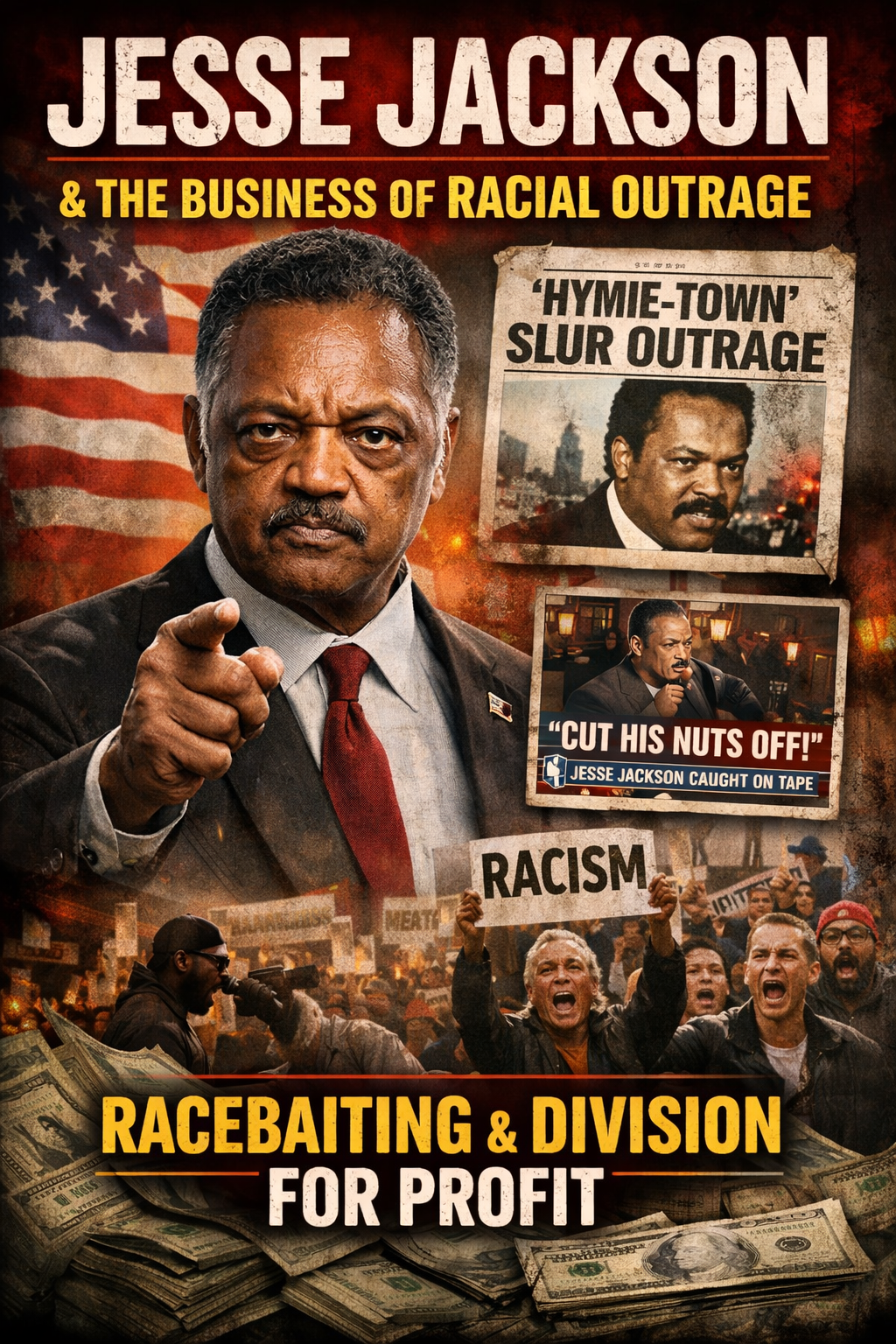
Jesse Jackson died on February 17, 2026, and right on schedule the tributes rolled in: "icon," "giant," "trailblazer," "civil-rights hero." He was undeniably present in the civil-rights era, he was visible, and he helped mobilize people, especially in expanding political participation and building organizations like Operation PUSH and the Rainbow Coalition.
But I've never been able to separate Jesse Jackson the historical figure from Jesse Jackson the political operator, the man who made a long, lucrative, decades-long career out of keeping America emotionally stuck on race. Not solving it. Not cooling it. Not moving people toward shared rules and shared citizenship. Keeping it hot.
That's what I mean when I say "racebaiting." Not "talking about racism," not "acknowledging history," not even "advocating for Black Americans." I mean taking every social tension, every hardship, every disagreement, and turning it into an identity grievance machine, because grievance is power, grievance is fundraising, grievance is relevance.
If that sounds harsh, fine. I'm not asking anyone to adopt my view. I'm asking a simpler question:
"Over time, did Jackson's style reduce racial temperature, or did it monetize it?"
What "Racebaiting" Looks Like in Real Life
Racebaiting isn't always a single dramatic moment. It's a pattern. Using moral language like a club. Implying that disagreement is bigotry. Positioning yourself as the referee of who's "authentically" Black, "properly" allied or "on the right side of history." Turning politics into permanent group conflict, where the public is trained to interpret everything through race first, facts second and character last.
Jackson was brilliant at that kind of politics. Even friendly retrospectives acknowledge the controversies and the self-promotional gravity that followed him over the decades.
The Moments That Give the Game Away
In 1984, during his presidential run, Jackson admitted using the slur "Hymie" and referring to New York City as "Hymietown" in reference to Jews, something that became national news and caused significant backlash. You can call it a mistake. You can point to his apology. You can argue intent. But here's what I take from it: this wasn't a teenager mouthing off. This was a national civil-rights leader who was comfortable enough with ethnic contempt to speak it casually.
It exposes something people hate admitting: "civil-rights leadership" doesn't automatically equal moral clarity. Sometimes it equals political leverage. Sometimes it equals a license to say ugly things while still being treated like a saint.
In 2008, Jackson was caught on a hot mic making a crude remark about Barack Obama, then issued a public apology as the story spread. You can call it a "hot mic moment." I see it as a glimpse into what identity politics breeds behind the curtain: internal policing, dominance behavior and punishment for anyone who won't stay in the approved lane. That wasn't leadership. That was tribal enforcement.
A Career Built on Dividing Lines, Not Shared Lines
Even the respectful biographies describe a man who inspired millions, built organizations, ran historic campaigns and also carried a persistent trail of tensions and controversies. I'm not arguing he never did anything useful. I'm arguing that the style he helped normalize, permanent racial framing as the master key to American life, has downstream consequences.
It trains people to see themselves as tribes first, citizens second. It turns outcomes into identity scoreboards, not problems to solve. It rewards grievance entrepreneurs and punishes coalition-builders.
"If your whole political identity is 'America is structurally racist and here's today's proof,' then you can never allow the situation to truly improve, because improvement reduces the market value of your role."
That's the industry. Jackson was one of its early masters.
To Be Fair: What People Admire About Him
If you admire Jesse Jackson, you're not crazy. He worked closely in the orbit of Martin Luther King Jr.'s era, founded major organizations and ran serious presidential campaigns in 1984 and 1988 that expanded what many Americans thought was politically possible. History will mark him as significant.
Significance is not the same thing as goodness. And "helped mobilize people" is not the same thing as "helped heal the country."
My Bottom Line
In my view, Jesse Jackson's long-term legacy is less about civil-rights progress and more about normalizing a politics of accusation, where race becomes the default lens, the default weapon and the default explanation.
That approach keeps people angry, suspicious and psychologically outsourced. It gives them a villain. It gives them a script. It gives them a reason nothing is ever their responsibility. And it creates exactly the kind of society where opportunists thrive on every side, because emotionally divided people are easy to steer.
If that's "justice," it's a strange kind: one that never seems to arrive, but always seems to need another donation, another march, another headline, another outrage.
Why This Matters
If we want a country that actually holds together, we have to stop rewarding the grievance economy, whether it's preached from a pulpit, shouted from a campus, packaged by a nonprofit or sold by a media outlet.
You can acknowledge history without living inside it. You can address discrimination without turning every issue into tribal war. And you can pursue equal rights without needing a permanent class of professional referees who get paid to keep the temperature high.
That doesn't mean pretending racism never existed or doesn't exist. It means refusing to let race become the only story we're allowed to tell, especially when some people have built entire careers telling it in the most combustible way possible.
References
- Reuters. (2026, February 17). Jesse Jackson, civil rights leader and U.S. presidential hopeful, dies at 84.
- The Washington Post. (2026, February 17). Jesse Jackson, a leading voice for civil rights, dies at 84.
- The Washington Post. (1984, February 27). Jackson admits to ethnic slur.
- The Washington Post. (1984, March 1). The cost of Jackson's slur.
- The Guardian. (2008, July 10). Jackson apologises for crude attack on Obama.
- TIME. (2008, November 3). Jackson goes "nuts."
Disclaimer: The views expressed in this post are the personal opinions of the author and are offered for educational, commentary and public discourse purposes only. They do not represent the positions of any institution, employer, organization or affiliated entity. Nothing in this post constitutes legal, financial, medical or professional advice of any kind. References to public figures, institutions, historical events and current affairs are based on publicly available sources and are intended to support analysis and argument, not to state facts about any individual's character, intent or conduct beyond what the cited sources support. Commentary on religious, political and cultural subjects reflects the author's independent analysis and is protected expression of opinion. Readers are encouraged to consult primary sources and form their own conclusions. Any resemblance to specific individuals or situations beyond those explicitly referenced is coincidental.