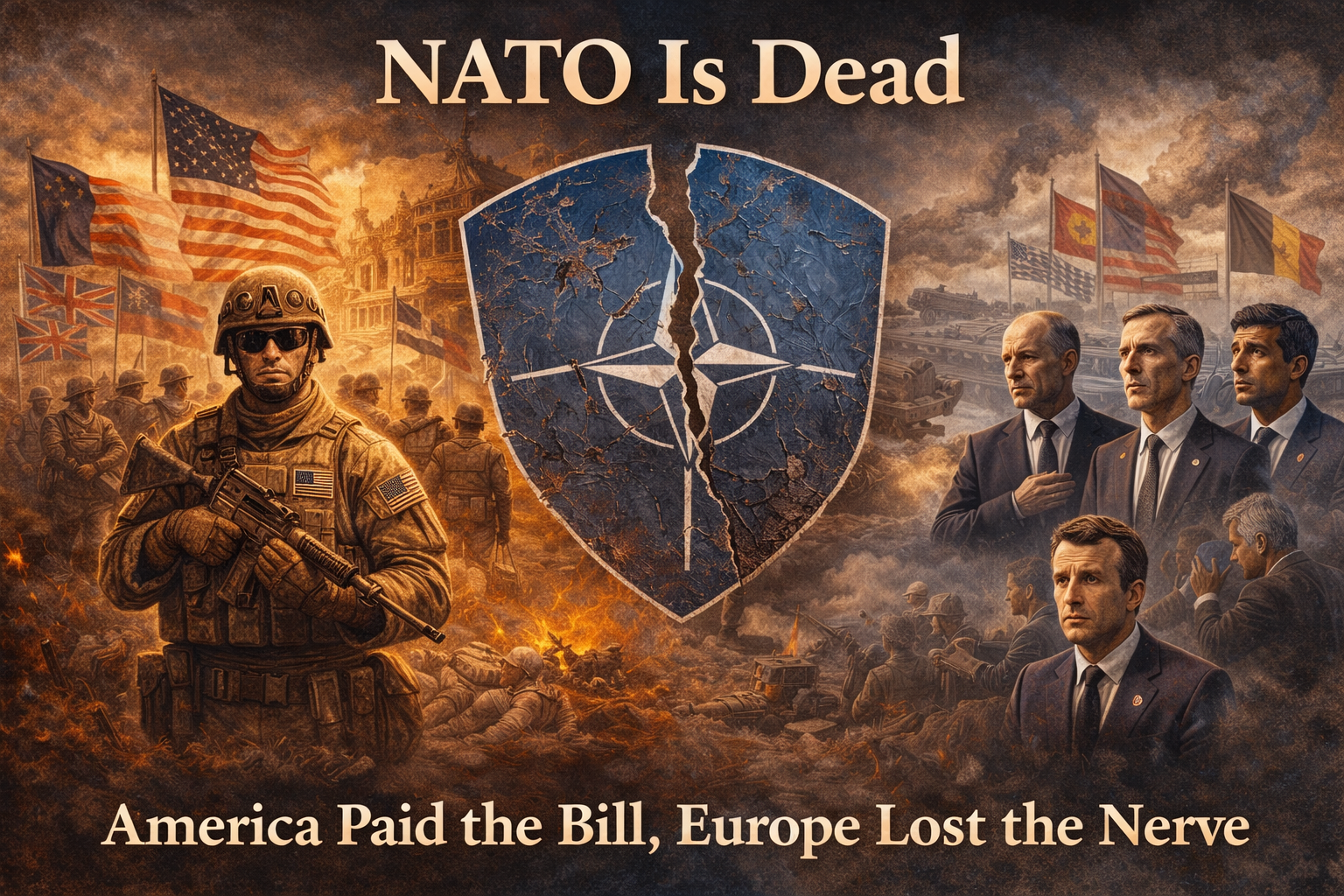
We are watching the quiet collapse of an institution that once defined Western power. There is no formal announcement, no ceremony, no moment you can point to and say that is when it ended. Just drift, hesitation and a widening gap between what NATO says and what NATO does. The organization still exists. It still holds summits. It still issues communiques. But the function that justified its existence - credible, unified deterrence - has eroded to the point where the structure and the substance have separated. This is not about one decision, one conflict or one administration. It is about a pattern that has been building for three decades, a long slow shift from resolve to reluctance, from shared burden to uneven dependency, from clarity to managed ambiguity. At some point you stop calling that a phase. You call it what it is.
The Original Bargain and How It Worked
NATO was born out of necessity in 1949. Europe was shattered, the Soviet threat was real and the United States stepped in as the backbone of collective defense. The concept was simple: an attack on one is an attack on all. That only works if all members are both willing and able to respond, and during the Cold War they largely were, because the cost of failure was existential. Western Europe understood that. The United States understood that. There was no room for comfortable ambiguity when the alternative was Soviet tanks in Paris.
The United States did not merely participate in this arrangement. It sustained it. After the war it financed European recovery through the Marshall Plan, stationed troops across the continent for decades and extended a nuclear umbrella that guaranteed deterrence even when European conventional forces were insufficient. This was not symbolic support. It was material, strategic and constant. And it created an incentive structure that, once established, proved very difficult to reverse. When one partner carries most of the weight, the others adjust. They spend less on defense, they prioritize domestic programs and they assume the backstop will hold because it always has. Over time dependence replaces partnership and the partner doing the carrying starts asking why.
The Spending Problem Is Not Just About Money
In 2014, NATO members agreed to spend at least two percent of GDP on defense. It was not an arbitrary target. It was a baseline for maintaining credible military capability in a membership that had been coasting on American guarantees for a generation. According to NATO's own defense expenditure data, the United States has consistently accounted for more than 65 percent of total alliance defense spending, a ratio that persisted for decades after the Cold War ended and the threat supposedly receded. The two percent commitment was meant to address that imbalance. Nearly a decade later many members still fall short, and the pattern is familiar: commitments are made publicly and diluted privately, targets become aspirations and aspirations become talking points at the next summit.
The problem is not just the numbers. Defense spending is a measure of seriousness. An alliance member unwilling to invest in its own defense raises a fundamental question about how committed it is to collective defense when the cost becomes real rather than theoretical. An alliance that tolerates chronic underinvestment is sending a signal whether it intends to or not. Adversaries read that signal. They have been reading it for years.
Deterrence is not built on caution alone. It is built on the perception that action will follow provocation. When adversaries see hesitation, they test boundaries. That is not speculation. That is how strategic behavior works.
Ukraine: Where the Structural Weakness Became Visible
The war in Ukraine has exposed NATO's internal contradictions more clearly than any policy paper ever could. The alliance is not formally at war with Russia, and that is understood. But it has been deeply involved in supporting Ukraine through funding, training, intelligence and equipment since 2022. What has characterized that involvement is incrementalism so consistent it looks like policy. Weapons systems are debated for months before approval. Commitments are announced with simultaneous emphasis on what will not be provided. Red lines are drawn, tested by Russia and then quietly adjusted without acknowledgment. The result is a response that appears reactive rather than decisive and that provides enough support to sustain the conflict without enough resolve to end it efficiently.
Lawrence Freedman, writing in Survival in 2023, noted that the West's approach has been characterized by gradual escalation that reflects both genuine support and deliberate restraint. That balance may be intentional statecraft in some quarters. It also signals, to anyone watching carefully, that the alliance will absorb risk slowly rather than confront it directly. In matters of deterrence, perception is not secondary to reality. It is part of reality. An adversary who concludes that the West will hesitate has been given information about how far it can push before facing a serious response.
NATO is a collection of sovereign states with different interests, different threat perceptions and different domestic political pressures. That diversity can strengthen collective judgment when it produces genuine deliberation. It weakens the alliance when it produces visible disagreement about whether to act at all. In recent years member states have publicly diverged on energy policy, sanctions enforcement, military commitments and the appropriate level of engagement with adversaries. Some members push for stronger and faster action. Others urge restraint for reasons that are sometimes strategic and sometimes commercial. Consensus becomes harder to reach, decisions take longer and public messaging becomes inconsistent. An alliance that cannot project a unified front struggles to project strength. And strength in this context is not primarily about military capability. It is about cohesion under pressure, which is the only kind of cohesion that actually matters to an adversary doing threat assessment.
The Dependency Model and What It Produced
Stanley Sloan describes the transatlantic relationship as a bargain in which the United States provided security while Europe focused on integration and economic development. That bargain was rational under the specific conditions of the Cold War. Both sides got something they valued. The problem is that the behavior shaped by that bargain persisted long after the conditions that justified it changed. Why invest heavily in defense when the United States provides a backstop? Why take domestic political risks on defense spending when the alliance has held for seventy years without testing that commitment? The answer is that you do not, until the conditions suddenly require it and you discover that decades of underinvestment have left you structurally unprepared.
Europe's response to Russia's 2022 invasion of Ukraine has accelerated some genuine rearmament, particularly in countries along NATO's eastern flank that have no illusions about the threat. Germany announced a substantial increase in defense spending, Finland and Sweden joined the alliance, and the Baltic states have consistently exceeded the two percent target. Those are real changes. They do not yet offset the structural imbalance built over thirty years of strategic comfort, and they do not resolve the question of whether the alliance as a whole has the political will to act decisively when action is costly rather than just rhetorically supported.
What "Dead" Actually Means
Saying NATO is dead is not a literal statement. The treaty still exists. The organization still operates. Military cooperation across member states remains real and valuable. What is dead is the original model: unified, credible, collective defense backed by roughly equivalent commitment and the clear shared understanding that the alliance would act when tested. What remains is an alliance uneven in capability, inconsistent in resolve and structurally dependent on a single dominant member whose domestic political support for that dependency is no longer guaranteed. That is not what NATO was designed to be, and pretending the gap between the design and the current reality does not exist is not reassuring. It is how alliances become irrelevant without anyone formally declaring them so.
The risk to the United States is specific. Anchoring strategy to an alliance that may not act with the urgency the moment requires ties American resources to partners whose commitments vary in ways that are not always predictable. It creates strategic assumptions that may not survive contact with an actual crisis. If American policymakers assume NATO will function as designed, they may not account for its limitations until those limitations become critical. That is not a position of strength. It is a position of comfortable assumption, and comfortable assumptions are what adversaries plan around.
My Bottom Line
NATO was one of the most successful alliances in modern history. It prevented large-scale war in Europe for decades during a period when large-scale war was a genuine possibility. That record is real and it deserves acknowledgment. Success in the past does not guarantee relevance in the present. An alliance that hesitates consistently, tolerates chronic imbalance and struggles to act decisively when the cost of action is real is not functioning as intended, regardless of how many communiques it produces or how many summits it holds.
There are two paths. Reform means enforceable spending commitments with actual consequences for noncompliance, clearer strategic alignment across the membership and a genuine willingness to share risk rather than defer it. Reset means acknowledging that the current structure no longer reflects the current reality and building arrangements that do. Neither path is comfortable. Both require political will that has been conspicuously absent. What is not viable is maintaining the current performance of unity while the substance beneath it continues to erode. Alliances shape strategy. Misjudging the strength of an alliance produces miscalculations that adversaries exploit. Getting honest about NATO's actual condition is not about abandoning allies. It is about understanding what the United States is actually working with and making decisions accordingly.
At some point reluctance to act in the face of clear threats stops being prudence and starts being avoidance. Avoidance is not a strategy. It is a choice to let someone else make the decision about when the crisis becomes unavoidable.
References
- Freedman, L. (2023). The war in Ukraine and Western strategy. Survival, 65(2).
- Kaplan, L. S. (2004). NATO Divided, NATO United. Praeger.
- North Atlantic Treaty Organization. (1949). The North Atlantic Treaty.
- NATO. (2023). Defence Expenditure of NATO Countries (2014-2023). nato.int.
- Sloan, S. R. (2016). Defense of the West: NATO, the European Union and the Transatlantic Bargain. Manchester University Press.
- Walt, S. M. (2018). The Hell of Good Intentions: America's Foreign Policy Elite and the Decline of U.S. Primacy. Farrar, Straus and Giroux.
Disclaimer: The views expressed in this post are the personal opinions of the author and are offered for educational, commentary and public discourse purposes only. They do not represent the positions of any institution, employer, organization or affiliated entity. Nothing in this post constitutes legal, financial, medical or professional advice of any kind. References to published scholarship, treaty documents and government data are based on publicly available sources cited above and are intended to support analysis and argument. Commentary on foreign policy and national security subjects reflects the author's independent analysis and is protected expression of opinion. Readers are encouraged to consult primary sources and form their own conclusions.