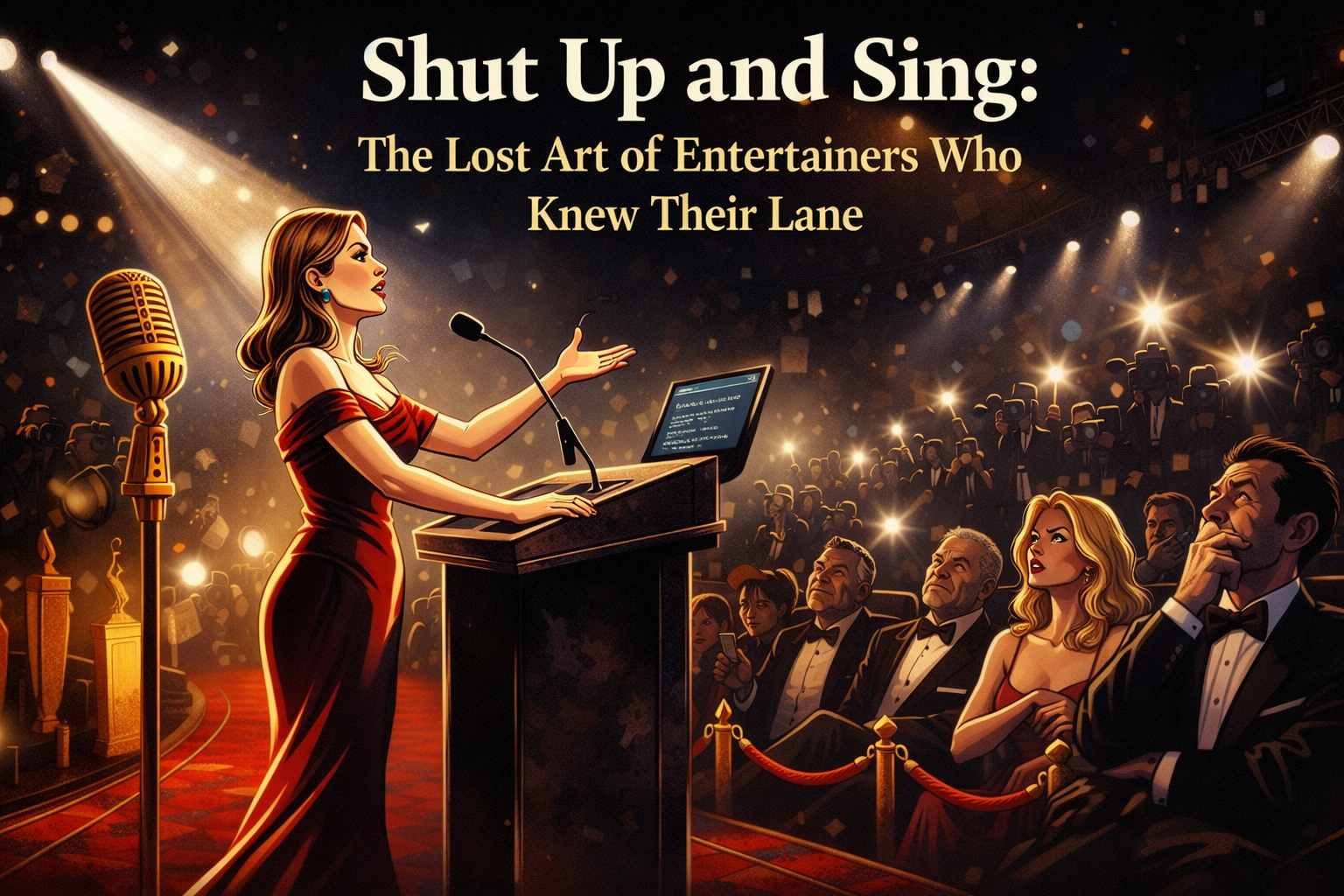
There was a time when you could watch a John Wayne movie, listen to a Frank Sinatra record or sit through a Dean Martin special without being lectured about your political failures. Wayne had opinions. Sinatra had opinions. Martin almost certainly had opinions. What they mostly did not do was weaponize their platforms to tell paying audiences that anyone who disagreed with them was a threat to civilization. They entertained. You watched. The arrangement worked because everybody understood what they were there for. That arrangement is gone now, and the entertainment industry has been strip-mining whatever goodwill it had left ever since the moment it decided that a Screen Actors Guild card was a credential for geopolitical analysis.
What Changed and When It Changed
The transformation did not happen overnight. There have always been politically engaged entertainers - Paul Robeson, Charlie Chaplin, Jane Fonda. But the scale is different now and so is the tone. What used to be the exception is now the ambient condition. Awards shows are extended sermons. Concert tours double as voter registration campaigns. Actors accept roles in popcorn franchise films and then spend the press tour explaining why half the country is morally irredeemable. The celebrity political opinion is no longer a notable event. It is wallpaper. And like most wallpaper it is ugly, unavoidable and impossible to remove once it is up.
The driver is social media, and the mechanism is simple. Platforms that reward engagement reward outrage, and outrage on political topics generates more engagement than anything else. A celebrity with ten million followers discovers that a hot take on immigration policy gets three times the likes of their latest project announcement. The incentive is obvious. The result is a culture where entertainers are essentially running perpetual political campaigns between projects, and the audience is expected to follow along or be cast as the villain.
A Screen Actors Guild card is not a credential for geopolitical analysis. Neither is a Grammy. The audience did not hire these people to tell them how to think. They hired them to entertain.
The Current Cast of Characters
The modern roster of celebrity political commentators reads like a fever dream. Robert De Niro has delivered so many unhinged public denunciations of Trump that his actual filmography has become secondary to his performance as a professional rage exhibit. He has called the president a fool, a disaster, a total loser and expressed wishes for physical violence, all while collecting lifetime achievement awards in rooms full of people who found it inspiring. Barbra Streisand has announced that she cannot breathe in Trump's America, apparently from her Malibu estate with ocean views. Cher threatened to move to Jupiter. Amy Schumer announced Spain. Madonna said she thought about blowing up the White House. Bette Midler suggested that voters in red states are illiterate. These are the people who simultaneously lecture the country about decency, civility and the importance of democratic norms.
Then there is the Jeff Daniels variety - the celebrity who plays a serious person on television and concludes from this that he has earned the right to deliver sweeping moral verdicts on the rest of the country. Daniels recently declared that Trump is "everything that is wrong with being a human being." Not some things. Not many things. Everything. This was received by his audience with the gravity of a papal encyclical rather than as the opinion of a man who once starred in Dumb and Dumber. To be clear, Dumb and Dumber is a fine film. It does not qualify anyone to issue comprehensive assessments of human wrongness.
There is nothing legally or constitutionally preventing an entertainer from having political opinions. The issue is not the right to speak. The issue is the assumption that fame confers expertise. A surgeon who becomes a celebrity does not suddenly become less qualified to discuss medicine. An actor who becomes a celebrity has not acquired any additional qualification to discuss trade policy, immigration law, military strategy or constitutional interpretation. What they have acquired is a large audience and the illusion that the audience's attention is agreement. Those are different things. The old entertainers understood this instinctively. The current generation has largely forgotten it, or never learned it.
What the Old Guard Understood
The entertainers of the mid-twentieth century were not saints and they were not apolitical. They had views. Some of them were privately quite passionate. What the best of them understood was that their audience was not a monolith and that their job was to serve that audience, not to divide it. Cary Grant was not going to ruin North by Northwest by spending the curtain call explaining why you were morally obligated to vote a certain way. Humphrey Bogart was not going to turn Casablanca into a campaign commercial. Even when these figures did wade into politics they largely did so as private citizens rather than as performers leveraging their platform as a condition of the audience's continued engagement.
The result was that their work was allowed to stand on its own. You did not have to sort out your feelings about an actor's political positions before deciding whether to enjoy their film. You could simply watch the film. The entertainer and the political figure were two different people. That separation was not hypocrisy. It was professionalism. It was an understanding that the audience had paid for one thing and deserved to receive it without a side order of ideological obligation. That understanding produced better art and better relationships between entertainers and their audiences. It also produced fewer situations where a beloved film is now unwatchable because its star spent the last decade making half the potential audience feel like the enemy.
The Cost the Entertainers Do Not Count
The celebrity political activist rarely accounts for what their activism costs. When De Niro delivers another unhinged press conference denunciation, he is not just expressing a view. He is telling a significant portion of his potential audience that he holds them in contempt. When Taylor Swift issues a voter guide, she is not just participating in democracy. She is informing roughly half her fanbase that she views their political choices as a problem she is trying to correct. Some portion of those people will simply stop buying tickets, streaming albums or watching films. The entertainer will not notice because their core audience applauds. The broader audience quietly walks away. The career narrows. The cultural footprint shrinks. And the entertainer wonders why their last project did not connect the way the earlier ones did.
There is also a credibility cost that compounds over time. When every awards show, press tour and social media post is saturated with political messaging from people who live in gated communities and travel by private jet, the lectures about inequality and systemic injustice start to land differently than intended. The audience is not stupid. They can see the gap between the sermon and the lifestyle. They notice when the people demanding sacrifice from the working class are not making any themselves. That gap does not generate respect. It generates contempt, and contempt is very difficult to reverse.
When the sermon and the lifestyle are that far apart, the audience notices. Contempt is the natural result. And contempt is very difficult to reverse once it sets.
My Bottom Line
Nobody is asking celebrities to be robots. Nobody is saying entertainers have forfeited their citizenship because they can sing or act. The argument is simpler than that. Fame is not expertise. A platform is not a credential. And treating your audience as a congregation that requires conversion rather than a group of people who paid to be entertained is both arrogant and strategically stupid. The entertainers who understood this built careers that lasted for decades and left work that people still watch and listen to without the distraction of political baggage attached to it. The entertainers who cannot separate their craft from their activism are building something different - a brand that plays well in one half of the country and alienates the other, sustained by an echo chamber that mistakes applause for agreement.
John Wayne made Westerns. Frank Sinatra made records. Cary Grant made films. You could disagree with everything they privately believed and still love what they made, because what they made was offered to you as entertainment rather than as a test of your political loyalty. That was a better deal. The audience knew what they were buying and the entertainer knew what they were selling. Somewhere in the last twenty years that clarity got lost, and the entertainment culture has been paying the price ever since.
The audience did not hire celebrities to tell them how to think. They hired them to entertain. The ones who remember that distinction still have audiences. The ones who forgot it are wondering why the room got smaller.
Disclaimer: The views expressed in this post are the personal opinions of the author and are offered for educational, commentary and public discourse purposes only. They do not represent the positions of any institution, employer, organization or affiliated entity. Nothing in this post constitutes legal, financial, medical or professional advice of any kind. References to public figures are based on publicly reported statements and are intended to support commentary and cultural analysis. This post critiques a pattern of public behavior and does not constitute personal attacks on the individuals mentioned. Readers are encouraged to consult primary sources and form their own conclusions.