
Signature Power: A Path for Ordinary Americans to Run for Office
How Signature-Based Public Funding Could Break the Donor Class Grip and Open Federal Office to Everyday Americans
Introduction
American politics has become a gated community.
If you are wealthy, connected, famous, or backed by donors, you can run a serious campaign. If you are a normal citizen with a job, a family, bills, and no political machine behind you, your odds are slim before you even start.
That is not a healthy republic. It is a system built to protect insiders.
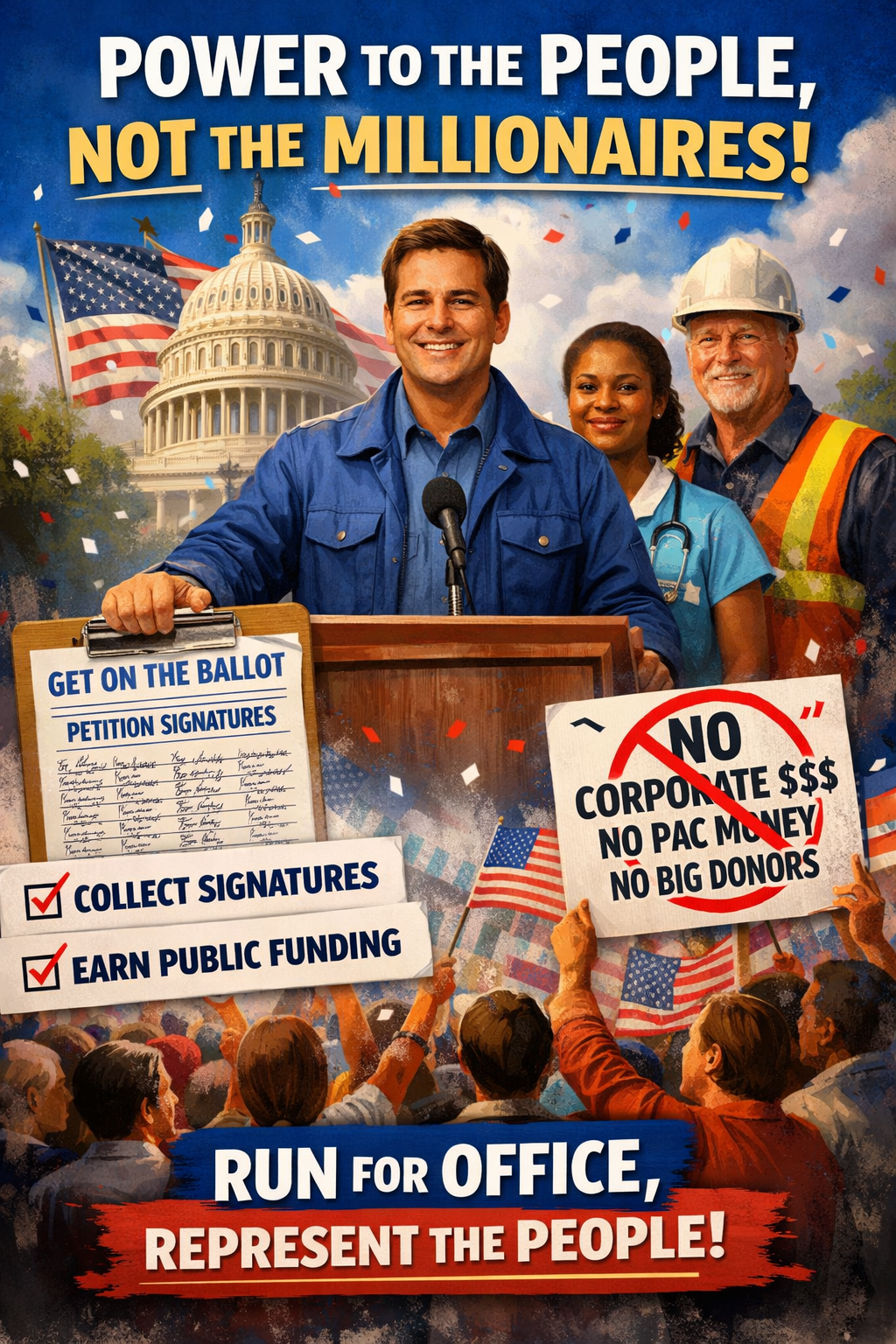
We need a better path, and it starts with a simple idea: if a citizen can gather enough verified signatures to earn a place on the ballot, that citizen should qualify for a publicly funded campaign.
No donor class. No corporate money. No special-interest checks.
Just signatures, public support, and a fair shot.
The Core Problem
For federal office, money is the gatekeeper.
A person can have good ideas, strong character, and broad local support, but none of that matters if they cannot raise enough money to compete. Campaigns are expensive. Consultants are expensive. Media is expensive. Travel is expensive. Compliance is expensive.
That is why so many good people never run.
And the people who do run often spend more time chasing money than talking to voters. The system trains candidates to become fundraisers first and public servants second.
That is backwards.
The result is obvious: too many politicians come from the same circles, answer to the same interests, and live in a different world than the people they represent.
A Better System: Signatures Unlock Public Funding
Here is the reform:
If a candidate gathers enough verified signatures from real voters, the campaign is publicly funded.
That is the test. Not donor access. Not party loyalty. Not family money.
If you can prove real support from real people, you earn the right to compete.
This would create a practical path for average Americans to run for office, including people who actually live the problems politicians talk about:
teachers, truck drivers, small business owners, electricians, nurses, mechanics, veterans, single parents, and working families trying to stay afloat.
If they can organize, collect signatures, and meet the threshold, they get funded.
That is democracy.
How It Would Work
The system does not need to be complicated.
First, a candidate would meet the legal ballot requirements and submit verified signatures.
Second, once the signature threshold is met, the candidate qualifies for a public campaign grant.
Third, that candidate enters a clean-campaign lane with strict rules and full transparency.
The amount of funding should be enough to run a real campaign, not a symbolic one. A serious candidate needs enough money for staffing, voter outreach, travel, compliance, and communication.
If the grant is too small, the system becomes fake reform.
If the grant is realistic, then a normal citizen can actually compete.
One Rule That Makes It Real: No Private Money
This part matters most.
If a candidate takes public funding, that candidate cannot take private money from anyone.
No donations from individuals.
No corporate money.
No PAC money.
No backdoor support.
No “bundlers.”
No shadow financing through friendly organizations.
Nothing.
If we are serious about cleaning up politics, this cannot be optional.
The point is not to give candidates another stream of money. The point is to replace the corrupting money culture with a citizen-based system.
The signature threshold becomes the proof of support. Public funding becomes the fuel. Voters become the focus.
Why Signatures Are the Right Standard
Signatures are not perfect, but they are far better than donor money as a test of legitimacy.
Money measures access to wealth.
Signatures measure public effort.
Money rewards people with networks.
Signatures reward people with volunteers.
Money pulls candidates toward donors.
Signatures push candidates toward voters.
A signature system also forces candidates to engage with real communities. You cannot fake your way through it from a private dinner or donor retreat. You have to show up, talk to people, answer questions, and persuade citizens face to face.
That is how a republic is supposed to work.
Pay Politicians Well and Ban the Money Culture
You also made an important point: pay politicians enough so they do not need outside money.
That is exactly right.
Public office should be a well-paid job with strict rules, not a stepping stone to wealth.
If we want clean government, we need a clear trade:
high compensation for public service in exchange for zero financial influence.
That means no fundraising while in office, no gifts, no paid speeches, no hidden consulting deals, and no financial games tied to powerful interests.
A member of Congress should not spend half the week dialing for dollars.
A member of Congress should do the job.
If the country wants honest lawmakers, then the country should pay them well and prohibit everything else.
That is cleaner, simpler, and more honest than what we have now.
What This Would Change
This reform would change who runs, who wins, and who gets heard.
Right now, a lot of ordinary Americans look at politics and think, “That world has nothing to do with me.”
They are not wrong.
But if signature-based public funding existed, citizens would know there is an actual path:
build support, collect signatures, qualify, run.
That would bring a different type of candidate into politics. Not just career politicians and donor favorites, but people who understand what inflation feels like, what payroll stress feels like, what health insurance costs, what rent costs, and what it means to choose between groceries and repairs.
We say we want leaders who understand everyday life.
Then we need a system that lets everyday people get elected.
The Objection You Will Hear
The political class will say this is unrealistic, too expensive, or too risky.
But the current system is already expensive. Taxpayers just pay for it indirectly through corruption, bad policy, waste, and laws shaped by people with money and access.
The current system is also risky. It creates distrust, cynicism, and a growing belief that elections are controlled by insiders.
That distrust is poison.
A public funding system tied to signatures would cost money, yes. But it would buy something valuable: a government that is harder to buy.
That is a good trade.
A Simple Standard for a Better Republic
This is not about left or right. It is about who gets to participate.
A republic cannot stay healthy if public office is only realistic for the rich, the powerful, and the connected.
Average Americans should not have to beg donors for permission to run.
They should be able to earn it from the people.
Collect the signatures.
Get on the ballot.
Get a funded campaign.
Take no private money.
Run on ideas.
Answer to voters.
That is the path.
And it is long overdue.
Why This Matters
Most Americans already feel the system is tilted toward insiders. A signature-based public campaign model would not fix every political problem, but it would break the money barrier that keeps ordinary citizens out.
If we want better politicians, we need a better way to get them on the ballot in the first place.
References
Federal Election Commission. Ballot access and federal campaign rules.
Federal Election Commission. Public financing framework for presidential campaigns.
National Conference of State Legislatures. Ballot petition and initiative processes.
Congressional Research Service. Congressional pay and compensation overview.
House and Senate ethics guidance on outside income and financial restrictions.
Disclaimer
The views expressed in this post are opinions of the author for educational and commentary purposes only. They are not statements of fact about any individual or organization, and should not be construed as legal, medical, or financial advice. References to public figures and institutions are based on publicly available sources cited in the article. Any resemblance beyond these references is coincidental.