
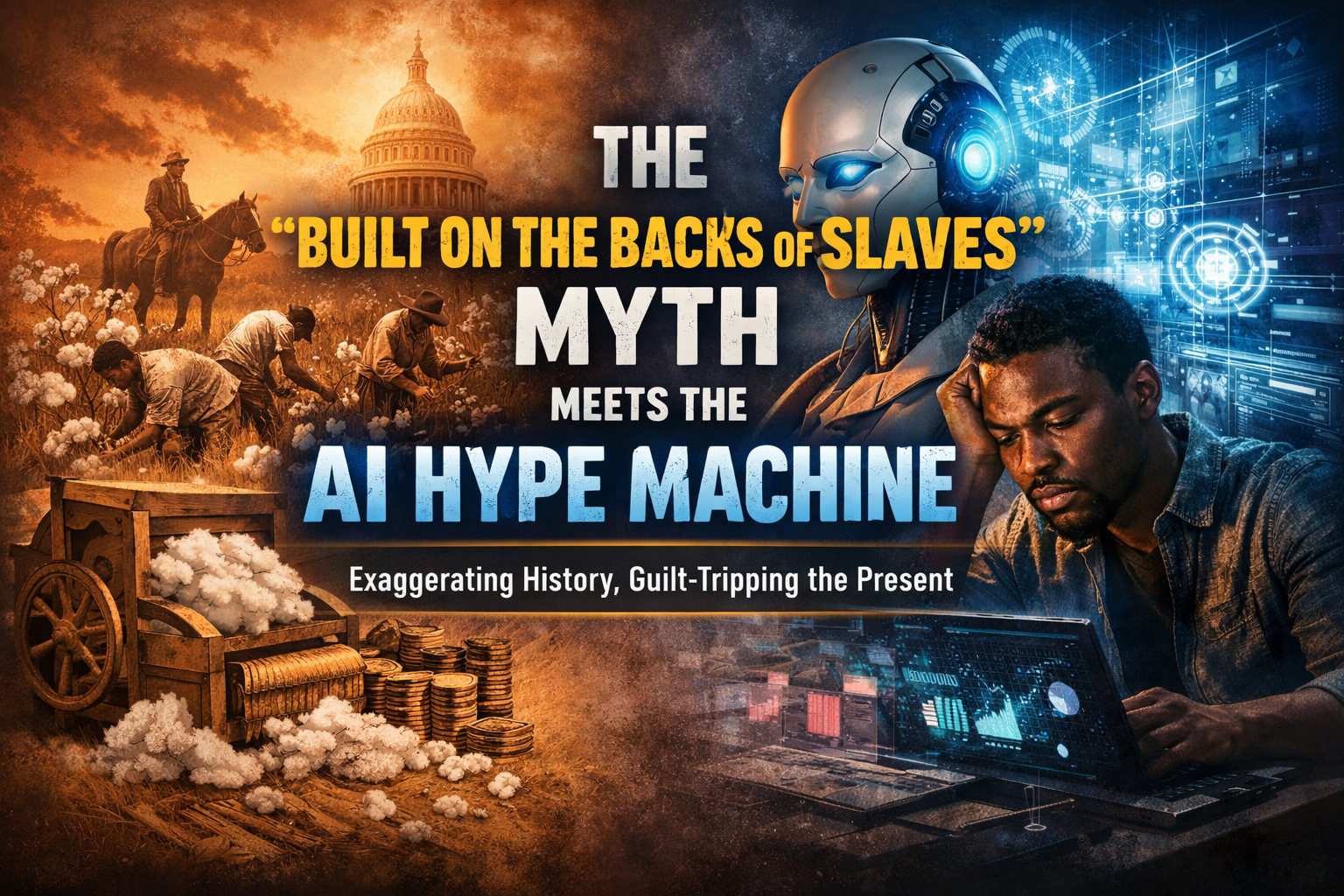
Every few years the same argument gets repackaged with new vocabulary and a fresh coat of moral vanity. The old version said America was built on the backs of slaves. The updated version says America's most revolutionary technologies all follow the same formula: white America gets the benefits, black America absorbs the harm. From the cotton gin to generative AI, the pattern is presented as fixed, the guilt as inherited and the conclusion as obvious. America innovates. Black Americans suffer. White Americans profit. End of story.
That is not serious history and it is not serious analysis of technology. It is ideological storytelling. It takes one of the worst moral crimes in American history and stretches it into a total explanation for the American past, then takes modern anxieties about artificial intelligence and shoves them into the same racial script so the same emotional verdict can be delivered again. The result is not clarity. It is propaganda with academic-sounding vocabulary.
"Slavery was evil. It was a monstrous institution that inflicted immeasurable suffering. But the slogan that the United States was simply built on the backs of slaves is historically hyperbolic, and the AI update is just the same bad argument dressed for a different audience."
A recent economic history estimate places the output of enslaved labor at roughly 12.6 percent of U.S. national product in 1860. That is a significant share and it deserves honest acknowledgment. The same research explicitly evaluates and rejects the inflated claim that enslaved people produced more than half of U.S. national product. The point is not to minimize slavery's evil. The point is to stop people from weaponizing it into a catch-all political myth that substitutes a slogan for a reckoning.
Slavery Was a Southern Economic System, Not the Whole American Story
One of the most consistently dishonest moves in this debate is geographic sleight of hand. Slavery's heaviest economic concentration was in the South, above all in plantation agriculture and cotton production. EH.net notes that by the mid-1830s, cotton accounted for more than half the value of all U.S. exports and that enslaved labor was central to that Southern cotton economy. That is a major historical fact and it belongs in any honest account of antebellum America.
But it does not prove that the entire United States, in all its industry, law, infrastructure, commerce, invention and growth, was built on slavery. That phrase survives because it deliberately blurs distinctions. It blurs the South with the nation. It blurs export value with total national output. It blurs moral horror with total causal explanation. Once those distinctions are erased the slogan does its work, sounding grand and devastating while being historically imprecise. Slavery was central to the Southern plantation economy and important to certain trade networks. That is true. True is not the same as total, and activists who collapse that distinction are not doing history. They are manufacturing a narrative.
Peak-Year Numbers Do Not Define the Whole Period
A second dishonest move is temporal cherry-picking. When the largest possible claim is needed, commentators reach for late antebellum cotton-era numbers and then speak as though those figures define American slavery across its entire history from colonial times through 1865. They do not. The 12.6 percent estimate is for 1860, near slavery's late peak in national economic significance. Using a peak-year number and then speaking as though the whole American system across centuries rested on slave labor is exactly the kind of rhetorical trick that passes for serious analysis in activist circles.
If 1860 was the peak, then the average share across the full slavery period was necessarily lower. That does not diminish slavery's importance. It simply destroys the slogan's all-encompassing pretension. America was not simply built on slavery any more than modern America is simply built on oil or simply built on finance or simply built on railroads. Dominant sectors matter. They are not synonymous with a whole civilization, and the distinction between important and foundational to everything is not a minor quibble. It is the difference between history and myth.
The Slave South Was Not the Superior Economic Model
There is another problem with the foundational myth that receives far too little attention: the slave South did not emerge as the superior model of modernization. It lagged behind the North and newer economic research continues to reinforce that point. A 2024 NBER paper examining the free-slave border found evidence of lower population density, less intensive land use and lower farm values on the slave side of that border. The authors explicitly state that their results do not support the view that abolition was a costly constraint for landowners. That is a striking finding and it is devastating for the romanticized notion that slavery was some great engine of broad-based prosperity.
Slavery enriched a planter elite. It tied labor and capital to a rigid agricultural order, discouraged broader modernization, concentrated wealth rather than diffusing it and left the South structurally unprepared for the industrial economy that followed. Even in strictly economic terms, slavery is better understood as a powerful but regionally concentrated and developmentally deforming institution than as the single master key to American greatness. That is an uncomfortable conclusion for people whose argument depends on painting slavery as the indispensable foundation of everything that came after it.
The economic record supports these conclusions: slavery was morally monstrous, economically significant in the South and in cotton-linked trade networks, and also a system that distorted development, concentrated wealth narrowly and left the regions that relied on it least prepared for the modernization that followed. Important and foundational to everything are not the same claim and the difference matters for anyone interested in honest history rather than ideological convenience.
The Cotton Gin to Generative AI Comparison Is Not Analysis
Now add the contemporary update to the story: America's most disruptive technologies all share the same racial strategy, white America reaps the benefits and black America absorbs the risks. This is where the argument stops being overstated and becomes cartoonish.
The cotton gin and generative AI are not morally, historically or structurally equivalent. The cotton gin expanded the productivity of slave-based cotton agriculture in an economy where chattel slavery already existed as a legal institution and where enslaved labor was violently coerced. Generative AI is a general-purpose digital technology with broad labor-market effects that cut across industries, occupations and demographic groups. Brookings reported in 2024 that more than 30 percent of workers could see at least half of their occupation's tasks disrupted by generative AI and that 85 percent of workers could see at least 10 percent of their tasks affected. That is a broad workforce story, not a simple racial script with a predetermined winner and loser.
None of this means black workers cannot face disproportionate harm in specific sectors or that AI systems cannot produce discriminatory outcomes. They can. Brookings launched an AI Equity Lab precisely because AI raises genuine concerns in employment, housing, health care, criminal justice and other domains where discriminatory effects are historically documented and require ongoing vigilance. Those are legitimate issues that deserve rigorous examination. They are not the same thing as proving that American technological innovation follows one eternal racial formula in which white Americans win and black Americans lose by design.
"The phrase 'white America reaps the benefits, black America absorbs the risks' is not analysis. It is a conclusion in search of examples. Once someone begins with that premise, every technology becomes a pre-written morality tale with the verdict already entered before the evidence is considered."
This Is About Guilt Politics as Much as History
It is worth being honest about what this rhetoric is doing beyond its stated historical claims. It is not merely trying to explain the past. It is trying to assign moral status in the present. The reason activists reach for the line that America was built on the backs of slaves is that it does several things simultaneously. It condemns the past, simplifies the present and guilt-trips modern Americans by implying that everything they have inherited is inseparably stained by exploitation they did not commit but must nonetheless answer for.
Then the same framework gets extended to modern technology. AI is no longer a labor-market shock, a productivity question or a civil-rights problem requiring specific evidence and specific remedies. It becomes another chapter in the same permanent racial indictment. Every new innovation goes on trial. Every disparity becomes proof of the same design. Every critic of the framework gets accused of refusing to close the knowledge gap, as though disagreement with the narrative is itself evidence of complicity.
Time spent reading is not the same as rigor. Passion is not proof. Narrative confidence is not historical accuracy. When the underlying framework is this rigid, closing the knowledge gap too often means forcing reality to cooperate with a predetermined verdict rather than following the evidence to wherever it actually leads.
My Bottom Line
The claim that America was built on the backs of slaves is not serious history. It is an inflated slogan that takes a genuine moral evil and stretches it into a false total explanation for American development. The newer claim that America's major technologies all share one racial strategy is just the same argument repackaged for a different technological moment.
Slavery was economically important, especially in the South and in cotton export networks. It was also a system that distorted development rather than proving itself the superior model of modernization. Generative AI may disrupt broad swaths of the workforce and may create real civil-rights concerns requiring serious attention and policy response. Neither of those true statements supports the conclusion that every American innovation is rooted in black exploitation and designed to perpetuate racial hierarchy.
The honest account of American history includes slavery's evil and its importance. It also includes the complexity, regional variation, contested development and multiple contributing factors that the slogan version erases in the interest of a cleaner moral story. A serious country should be able to carry both of those truths at once without collapsing one into a weapon against the other.
When slogans replace history, citizens stop thinking and start performing morality. That is bad for truth and it is bad for the actual work of addressing the real inequities that remain.
References
- Bleakley, H. & Rhode, P. W. (2024). Tests at the Border (NBER Working Paper No. 32640). National Bureau of Economic Research.
- Brookings Institution. (2024, October 10). Generative AI, the American Worker and the Future of Work.
- Brookings Institution. (2024, February 29). Introducing the AI Equity Lab and the Path Toward More Inclusive Tech.
- EH.net. (n.d.). Cotton Gin.
- EH.net. (n.d.). The Economics of the Civil War.
- Rhode, P. W. (2024). What Fraction of Antebellum U.S. National Product Did the Enslaved Produce? Explorations in Economic History.
Disclaimer: The views expressed in this post are the personal opinions of the author and are offered for educational, commentary and public discourse purposes only. They do not represent the positions of any institution, employer, organization or affiliated entity. Nothing in this post constitutes legal, financial, medical or professional advice of any kind. References to public figures, institutions, historical events and current affairs are based on publicly available sources and are intended to support analysis and argument, not to state facts about any individual's character, intent or conduct beyond what the cited sources support. Commentary on religious, political and cultural subjects reflects the author's independent analysis and is protected expression of opinion. Readers are encouraged to consult primary sources and form their own conclusions. Any resemblance to specific individuals or situations beyond those explicitly referenced is coincidental.