The Temptation of Speed
In business, there is a constant temptation to worship speed. Faster production. Faster delivery. Faster throughput. Faster decisions. Faster everything. Speed looks impressive on dashboards, in meetings and in presentations. It gives managers something clean to point at. It creates the appearance of momentum. It feels modern. It feels disciplined. It feels like progress.
But speed by itself is not progress.
A company can move faster in the wrong direction just as easily as it can move slower in the right one. In fact, many organizations do exactly that. They streamline tasks that should not have existed in the first place. They automate broken systems. They redesign products to make them cheaper or easier to produce, only to discover they have quietly stripped away the very features customers loved. They celebrate output while ignoring scrap, rework, overtime, machine strain and customer disappointment. They confuse motion with value.
That confusion is one of the most common operational mistakes in business. It is also one of the most expensive.
The real goal of operations management is not simply to make things faster. It is to make things better in a way that preserves or increases value for the customer while improving the business's use of time, labor, materials, equipment and capital.
That is a far more serious and useful objective. It requires judgment, not just metrics. It requires discipline, not just activity. It requires asking the uncomfortable question many organizations avoid: are we becoming more productive or are we merely getting more efficient at doing the wrong things?
A business that becomes highly efficient at producing a product customers no longer want is not winning. A plant that raises output by leaning harder on overtime, chewing through more materials and increasing defects is not becoming healthier. The smarter approach is to put effectiveness first and efficiency second — not ignoring cost or productivity, but ensuring those gains happen in service of customer value rather than at its expense.
Effectiveness Comes First Because the Customer Decides What Matters
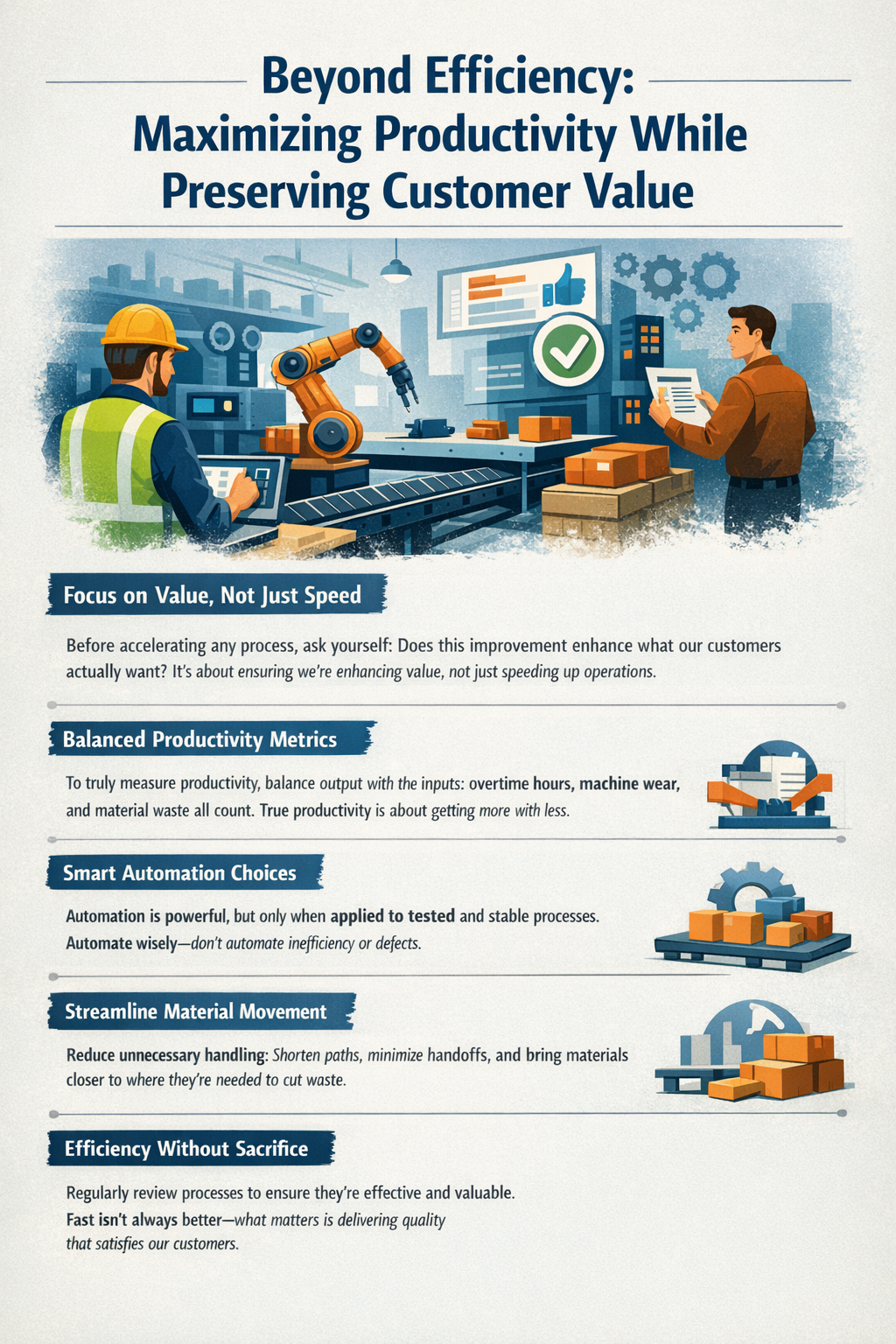
The cleanest way to think about operations is this: the customer is the final judge of value — not the production floor, not engineering, not accounting and not management's desire to hit a short-term metric.
That sounds obvious, but companies forget it all the time. A product can be redesigned to reduce complexity, use fewer components, shorten assembly time or lower direct labor. On paper, that looks responsible. But if the redesign removes durability, convenience, aesthetics, features or performance characteristics customers actually care about, then the company has not improved the product. It has cheapened it.
Operations people are supposed to improve systems, but the system only matters because it exists to create a product or service someone wants. Once that relationship is forgotten, improvement efforts become inward-looking — optimizing around what is easiest for the business instead of what is most valuable to the market.
The better mindset is to ask a harder question before every major process or product change: does this improve the customer's experience, preserve it or quietly erode it? That question should sit at the center of design reviews, cost reduction initiatives, value engineering efforts, automation projects and layout decisions.
A good operations leader understands that effectiveness is not some soft, vague concept. It is brutally practical. It means the system produces an output that satisfies demand in a way that protects revenue, brand trust and competitive position. Efficiency matters, but only after effectiveness is secured. Otherwise, you are just polishing the wrong machine.
Productivity Means More Than Producing More
One of the most persistent mistakes in operations is thinking output alone tells the story. It does not.
A plant can produce more units this month than last month and still be performing worse. It can hit record throughput while burning money. This is where productivity is often misunderstood. Real productivity is a relationship between outputs and inputs. If output rises while labor hours rise even faster, scrap increases, maintenance problems multiply and quality slips, then the headline number is misleading.
This matters because organizations often reward visible volume. Managers get excited by shipments, unit counts and production records. But the cost side of the equation tells you whether that output is being produced intelligently. Overtime is not free. Scrap is not free. Rework is not free. Expedited material is not free.
The healthiest operations are usually not the ones that look dramatic. They are the ones that look controlled. They produce steadily. They measure honestly. They understand tradeoffs.
Smart operations leaders need metrics that go beyond gross output: labor productivity, material yield, scrap rates, machine uptime, cycle time stability, first-pass quality and the hidden costs of pushing the system harder than it should be pushed. They want more from the system, but they want it without unnecessary waste, instability or deterioration in customer value.
Automation Is Powerful, but Only When Applied to the Right Process
Automation has become one of those magic words in business. Machines do not call in sick. Software scales. Robotics can increase consistency, reduce labor dependence and improve throughput. In the right context, automation is one of the most effective productivity tools a company can deploy.
But there is a catch. Automation does not fix a bad process. It multiplies it.
If the underlying workflow is poorly designed, unstable, defect-prone or disconnected from customer value, automating it may simply hardwire the problem deeper into the organization. Instead of one employee making preventable mistakes, the system makes them faster and in larger volumes. That is not transformation. That is mechanized foolishness.
The first question should never be: what can we automate? The first question should be: what process is stable, necessary, value-producing and mature enough to deserve automation? That ordering matters enormously.
There is another issue companies often miss: automation can make a system less flexible if implemented carelessly. A poorly chosen automated system can lock the company into rigid assumptions about volume, product mix, tolerances, staffing and maintenance support. That may work until demand shifts or the product line evolves — then the expensive solution becomes a constraint.
The right mindset is simple: automate excellence, not confusion. Standardize what matters. Stabilize what varies unnecessarily. Remove obvious waste. Confirm that the process supports customer value. Then automate where the return is real.
Layout Matters: Motion Is Not the Same as Work
A good layout makes an operation feel calmer. A bad layout makes it feel busy. That is one of the easiest ways to spot the difference.
When people, tools, parts and finished goods are constantly being moved around, there is usually a problem. Material handling is one of the least appreciated sources of waste in operations because movement can look productive. A forklift is active. An employee is carrying something. A pallet is being relocated. To the casual observer, the plant is humming. In reality, much of that motion may be cost without value.
Customers do not usually pay more because a part was moved six times instead of two. Those activities consume time, labor, equipment and floor space, but they do not improve the product. At best, they are necessary burdens. At worst, they are avoidable waste built into the layout.
Good layouts accomplish several things simultaneously:
- Reduce unnecessary travel, touches, delays, congestion and handoffs
- Place materials closer to the point of use and align workflow with process sequence
- Reduce opportunities for damage, confusion, waiting and miscommunication
- Make it easier to see the status of work and simplify supervision
- Reduce fatigue and improve flow across the operation
Layout reviews should not be treated as a one-time design exercise. Operations change, volumes shift, product mix evolves and temporary solutions become permanent habits. The simplest improvements are often the most valuable: bring fast-moving materials closer to where they are used, reduce backtracking, organize tools at the point of use and eliminate staging areas that exist only because of bad flow.
The Real Enemy Is Efficient Waste
There is a phrase that deserves more attention in operations: efficient waste.
It captures a problem many businesses struggle to see. Waste is easy to identify when it is obvious, slow and clumsy. It is harder to identify when it is fast, disciplined and wrapped in nice-looking metrics. But waste does not stop being waste just because the organization got better at performing it.
Efficient waste is still waste. In some ways it is worse than ordinary waste because it is harder to challenge. It wears the costume of competence.
A company reduces the cycle time of a step that should not exist. It gets very good at producing a version of the product customers like less. It automates a defect path. It moves materials more quickly through a building that still requires too much movement. In each case, the company can point to an improvement — but the improvement is local, not strategic. The machine got faster while the system remained wrong.
This is why operational maturity requires more than technical skill. It requires the ability to ask whether the target itself is worth optimizing. It is easier to say "we cut this step from nine minutes to six" than to ask "should this step exist at all?" Businesses that want durable performance cannot afford that kind of self-deception.
What Smart Leaders Actually Do
The best leaders in operations do not romanticize hustle. They do not treat chaos as a badge of honor. They do not confuse exhausted people with productive systems. And they do not fall in love with metrics that flatter the business while hiding the truth.
Instead, they tend to do a few things consistently:
- They start with the customer. They want to know what features, outcomes, quality standards and service expectations actually matter — and they understand that internal convenience is not the same thing as market value.
- They measure honestly. Outputs matter, but inputs matter too. Labor, materials, machine wear, scrap, quality and delay all belong in the picture. They do not allow one impressive number to erase five ugly ones.
- They improve the process before they automate it. They standardize, simplify and stabilize first. Technology comes after thinking, not instead of it.
- They examine layout and flow with fresh eyes. They do not assume movement equals progress. They look for distance, handling, waiting, congestion and handoffs that can be reduced or eliminated.
- They challenge efficient waste. They are willing to ask whether the thing being optimized deserves optimization at all.
This is not flashy leadership, but it is effective leadership. It produces healthier businesses because it respects reality — accepting that operational success is not just about speed, but about disciplined value creation.
Conclusion
Efficiency matters. Productivity matters. Automation matters. Layout matters. But none of them matter in the right way if the organization forgets the central question: does this create value for the customer in a way the business can sustain?
A company should never be satisfied merely because it got faster. Faster can mean more scrap, more strain, less value and worse decisions made at higher speed. The real aim is not motion — it is intelligent performance.
Businesses fail slowly before they fail obviously. They start by trimming the wrong things, measuring the wrong things and praising the wrong things. They call it improvement because the dashboards look cleaner and the meetings sound sharper. Then they wonder why customers become less enthusiastic, margins remain under pressure and the operation always feels like it is working harder than it should.
The answer is often simple: the company optimized for speed before it optimized for value. The cure is to step back, re-anchor improvement efforts to what the customer values and make sure productivity gains are real rather than cosmetic. Businesses that learn that lesson build stronger systems. Businesses that ignore it eventually pay for their own confusion.
Effectiveness should come first. Once the company is sure it is doing the right things, it can focus on doing those things with greater efficiency and productivity. Get it backward and the business may become excellent at undermining itself.
References
- Heizer, J., Render, B., & Munson, C. (2017). Operations management: Sustainability and supply chain management (12th ed.). Pearson.
- Jacobs, F. R., & Chase, R. B. (2021). Operations and supply chain management (16th ed.). McGraw-Hill.
- Ohno, T. (1988). Toyota production system: Beyond large-scale production. Productivity Press.
- Slack, N., Brandon-Jones, A., & Johnston, R. (2022). Operations management (10th ed.). Pearson.
- Womack, J. P., & Jones, D. T. (2003). Lean thinking: Banish waste and create wealth in your corporation (2nd ed.). Free Press.
Disclaimer: The views expressed in this post are the personal opinions of the author and are offered for educational, commentary and public discourse purposes only. They do not represent the positions of any institution, employer, organization or affiliated entity. Nothing in this post constitutes legal, financial, medical or professional advice of any kind. References to public figures, institutions, historical events and current affairs are based on publicly available sources and are intended to support analysis and argument, not to state facts about any individual's character, intent or conduct beyond what the cited sources support. Commentary on religious, political and cultural subjects reflects the author's independent analysis and is protected expression of opinion. Readers are encouraged to consult primary sources and form their own conclusions. Any resemblance to specific individuals or situations beyond those explicitly referenced is coincidental.