
Every now and then a religious believer says the quiet part out loud. Not the polished version, not the church-friendly version, not the God-loves-you-and-is-waiting-patiently version. The raw version. The one where faith drops its public face and shows what too much of it really is beneath the varnish: insecurity, resentment, anti-intellectualism and a desperate need to convert disagreement into moral failure.
I recently received one of those messages. Its central claim was familiar enough: unless you come as a child, you will never know God. Wrapped around that claim was the standard arsenal of insults, condescension, threats of damnation, credential envy and smug certainty about another person's standing before the divine. I was told that a five-year-old who knows Jesus is wiser than I am, that I know nothing of lasting value, that I should stay in my lane and that God is not for me.
This is not theology. It is not argument. It is not evidence. It is emotional intimidation dressed as piety and it deserves to be called exactly what it is.
"Come as a Child" Is Not a License to Stop Thinking
The biblical language being deployed here appears in Matthew 18 and Matthew 19. In both passages the point is plainly about humility, dependence and status, not about praising ignorance or elevating credulity as a virtue. That distinction matters considerably and the email I received collapses it entirely.
Humility means admitting you might be wrong, remaining open to correction and recognizing the limits of your own perspective. Infantilization means being told to stop questioning, stop analyzing, stop trusting your judgment and surrender your mind to inherited authority. Those are not the same instruction. One is a disposition worth cultivating. The other is a demand for intellectual surrender dressed up in the language of the first.
The moment you ask for evidence, you are accused of pride. The moment you point out a contradiction, you are told you are leaning too hard on your own understanding. The moment you refuse to accept the claim on faith alone, you are informed that you must become like a child. Children are not ideal epistemic models because they are irrational. They are trusting and dependent, and those traits are not virtues in the search for truth. They are vulnerabilities. Which is precisely why nearly every religion wants access to them early.
What this rhetorical strategy does is take the most important faculty we possess for separating truth from fantasy and paint it as rebellion. Skepticism becomes arrogance. Credulity becomes wisdom. Critical inquiry becomes the symptom of a moral defect. That is not spiritual depth. It is epistemological surrender and it is designed to be immune to examination because any examination of it gets redefined as further evidence of the examiner's failure.
If You Do Not Believe, They Will Tell You It Is Your Fault
One of the laziest moves in religious apologetics is the insistence that unbelief is never the result of inadequate evidence, weak arguments or implausible claims. The problem is always moral or emotional. You are too proud. Too bitter. Too committed to sin. Too enamored with your own intellect. Too rebellious to humble yourself before the truth.
The message I received never engages a single argument. It never addresses the question of evidence. It never explains why an all-powerful God would choose to remain hidden while demanding worship under threat of eternal punishment. It simply announces that I refuse to humble myself and therefore cannot know God.
This is convenient for obvious reasons. If belief must rest on evidence, then evidence can be examined, challenged and found wanting. But if disbelief is blamed on character, the believer never has to defend the belief itself. The burden shifts entirely. The question is no longer whether Christianity is true. The question becomes whether the skeptic is sufficiently broken and compliant to receive the truth that is already assumed. That is not argument. It is psychological evasion and you can keep any delusion alive indefinitely with that kind of logic.
It is also circular in a way that should be immediately visible. If I ask why I should believe, I am told that belief requires childlike faith. If I decline, that refusal becomes proof that I lack the humility required to believe. The absence of belief is thus treated as evidence that I deserve the absence of belief. The claim requires no defense because every challenge to it gets absorbed as confirmation.
Hell: The Final Refuge of the Losing Argument
Then comes the threat. Not persuasion. Not reason. Not evidence. Hell. A hundred years from now, I am told, the child believer will be wiser than I am because I will be burning in eternal fire, remembering all our conversations with regret. Strip away the religious framing and what remains is a taunt. A fantasy of cosmic revenge. A believer imagining with evident satisfaction the eternal suffering of someone who disagrees with him.
Consider carefully how sick that is. A grown adult tells himself that everlasting agony awaits another person and instead of recoiling from the barbarism of that doctrine, he deploys it as a rhetorical flourish. He tosses it into the conversation as though it constitutes an argument, as though the claim that I will suffer forever somehow demonstrates that his position is correct.
"This is one of religion's dirtiest habits: teaching people to call barbarism holy. The hell doctrine desensitizes believers to cruelty by laundering it through divine authority. It turns vengeance into justice. I am not threatening you, the implication runs. God is. But the person delivering the line is the one with the smirk."
The Appeal to Authority Is Still Just an Appeal to Authority
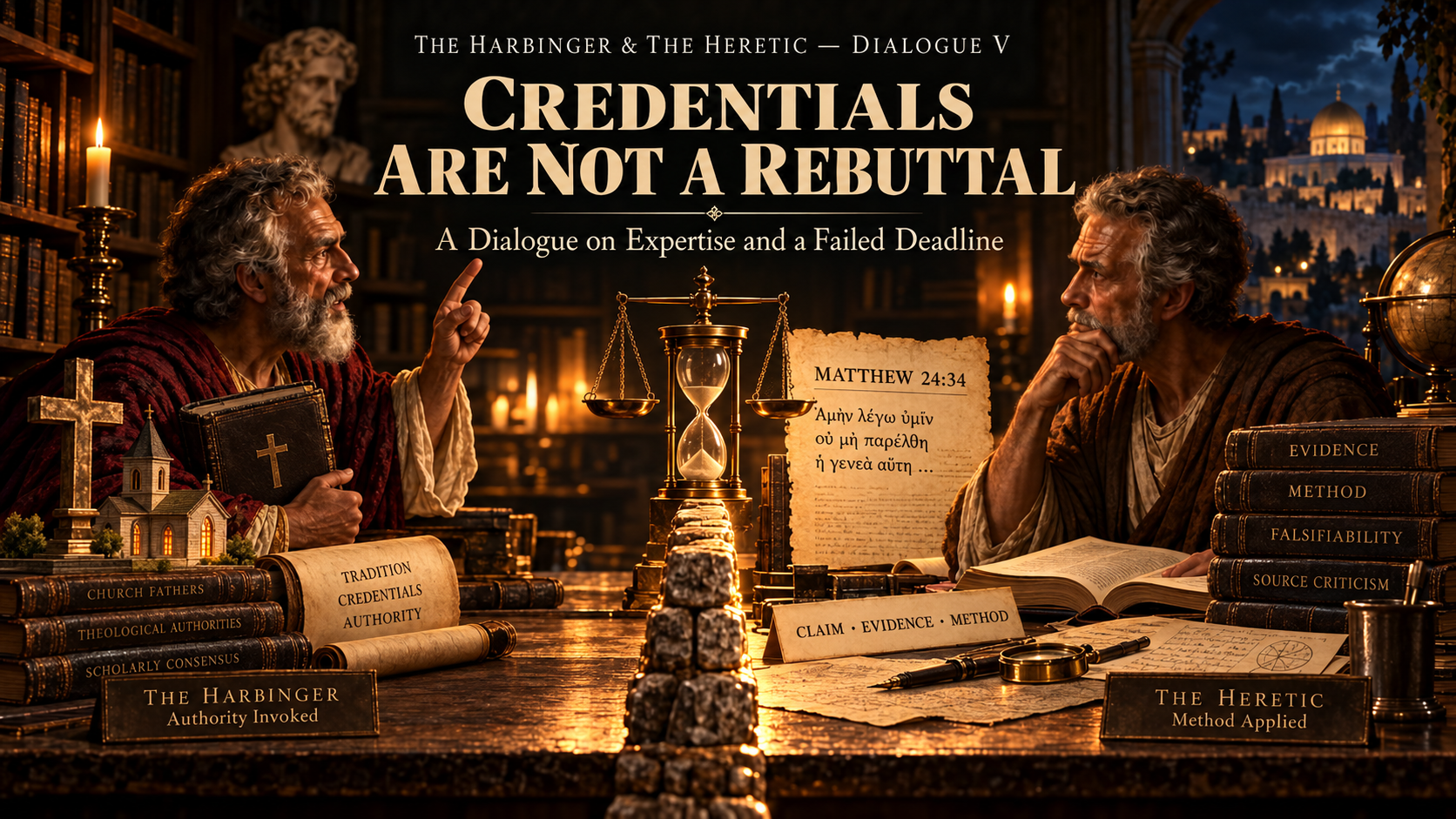
The message also leans on a familiar move. There are people smarter than you, with more degrees than you, who believe. Then it lists names and institutions as though stacking credentials can resolve metaphysical questions. But truth is not established by résumé and this gambit fails for reasons that should be obvious to anyone who has spent time thinking about how knowledge actually works.
Yes, highly educated people are religious. Highly educated people are also wrong about all sorts of things, regularly and confidently. Intelligence does not immunize against inherited belief. It sometimes makes inherited belief more elaborate and harder to dislodge because the same capacity that enables careful reasoning also enables the construction of sophisticated defenses around weak premises. Invoking famous believers does not establish the existence of God any more than invoking famous skeptics would disprove it.
The internal contradiction here is worth naming. In one paragraph I am mocked for arrogance and excessive confidence in my own intellect. In the next paragraph the writer cites scholars, scientists and historians to validate his beliefs. So which is it? Is intellect a liability when it challenges doctrine and an asset when it can be conscripted to support it? That is not respect for scholarship. It is selective deployment of scholarship, and the selection criterion is whether the conclusion was already determined in advance.
Stay in Your Lane Is What People Say When Their Lane Cannot Hold Up
The message informs me that I am a roofer with a business doctorate and a part-time online professorship who wants to play with the big boys. That line is almost too revealing to require extended commentary. It is not an argument against anything I have said. It is a social put-down designed to reduce my standing before the imagined court of religious authority. And what it actually exposes is the anxiety underneath the performance.
If your faith rests on truth, you do not need to belittle someone's occupation or sneer at his credentials to defend it. The sneer is what people reach for when the argument is not available. It is also an accidental concession of something important: ordinary people are entitled to assess religious claims. You do not need a seminary degree to notice when a miracle story lacks supporting evidence or when a doctrinal claim rests on circular reasoning. The truth, if it is truth, survives outside the guild.
Certainty Curated in Advance Is Not Faith
One of the more revealing passages in the message is the instruction that I should stop sending articles, books and references because the writer already has his approved list of authorities and does not need mine. He has his scholars. He does not wish to read anyone else's. That is not confidence. That is curation as self-protection. It is the intellectual equivalent of building a sealed room and calling the act of staying inside it conviction.
When someone announces that he has pre-selected the gatekeepers permitted to reassure him and intends to read nothing that might challenge those gatekeepers, he is not demonstrating the strength of his faith. He is admitting that his faith requires management. Real confidence can hear disagreement. Real confidence can examine competing claims and remain standing. Faith that needs to be protected from scrutiny by refusing to engage scrutiny is not faith in truth. It is faith in the comfort of a closed system.
Believers love accusing skeptics of arrogance. The skeptic says: I do not see sufficient evidence to accept your supernatural claims and I might be wrong, but I need better reasons. The religious absolutist says: I know the mind of the creator of the universe. I know what he wants. I know who belongs to him. I know who will suffer forever. I know your motives better than you do. Examine those two positions honestly and ask which one sounds more arrogant. The skeptic is at least admitting uncertainty. The fundamentalist is claiming privileged access to the mind of God while insulting everyone who declines to share the vision.
The Cruelty Is Not Incidental
What struck me most about the message was not its intellectual weakness. That was expected. It was the spite. The mockery. The laughter at the idea of someone questioning. The desire to wound. The thrill of telling another human being that he is worthless, ignorant, damned and beyond the reach of the divine. That cruelty matters because it exposes something that gets discussed too rarely about religious certainty.
Doctrine, when it hardens into tribal identity, becomes a permission structure for contempt. Once a believer places himself definitively on the side of God, basic decency becomes optional. Empathy weakens. Curiosity dies. The people outside the faith stop being people in the full sense and become props in a moral drama that exists to confirm the saved in their chosenness. Disagreement becomes rebellion. Rebellion becomes wickedness. Wickedness becomes something deserving of punishment, eternal if possible. By the end, a person can say something genuinely monstrous and experience himself as righteous while saying it.
That is not the accidental corruption of religion by bad actors. In many cases it is the predictable result of believing that infinite truth has been entrusted exclusively to your tribe and that everyone outside it has chosen their own damnation.
My Bottom Line
The message I received is not persuasive, profound or brave. It is a petty sermon from someone who mistakes certainty for wisdom and insult for insight. Its essential demand is this: do not think too hard, do not ask for evidence, do not challenge the emotional architecture of my belief, and become childlike, meaning compliant. Accept threats as expressions of love. Accept condescension as truth. Accept authority as proof. And if you refuse, then your refusal itself will be submitted as evidence against you.
That is not a path to knowledge. It is a demand for surrender.
I reject it for the same reason I reject every worldview that tells me the highest virtue is to distrust my own mind and hand my judgment over to inherited claims, ancient texts and self-appointed interpreters of the divine. If God exists and gave human beings the capacity for reason, then using that capacity cannot be rebellion. If using reason is rebellion, then what the faith actually wants is not truth. It wants obedience. Those are not the same thing and the difference between them is worth defending.
Faith that cannot tolerate scrutiny is not strong faith. When that fragility turns cruel, it should be exposed rather than excused.
References
- The Holy Bible, Matthew 18:3. BibleGateway.
- The Holy Bible, Matthew 19:14. BibleGateway.
- The Holy Bible, Psalm 14:1. BibleGateway.
- The Holy Bible, 1 Corinthians 1:25-29. BibleGateway.
Disclaimer: The views expressed in this post are the personal opinions of the author and are offered for educational, commentary and public discourse purposes only. They do not represent the positions of any institution, employer, organization or affiliated entity. Nothing in this post constitutes legal, financial, medical or professional advice of any kind. References to public figures, institutions, historical events and current affairs are based on publicly available sources and are intended to support analysis and argument, not to state facts about any individual's character, intent or conduct beyond what the cited sources support. Commentary on religious, political and cultural subjects reflects the author's independent analysis and is protected expression of opinion. Readers are encouraged to consult primary sources and form their own conclusions. Any resemblance to specific individuals or situations beyond those explicitly referenced is coincidental.