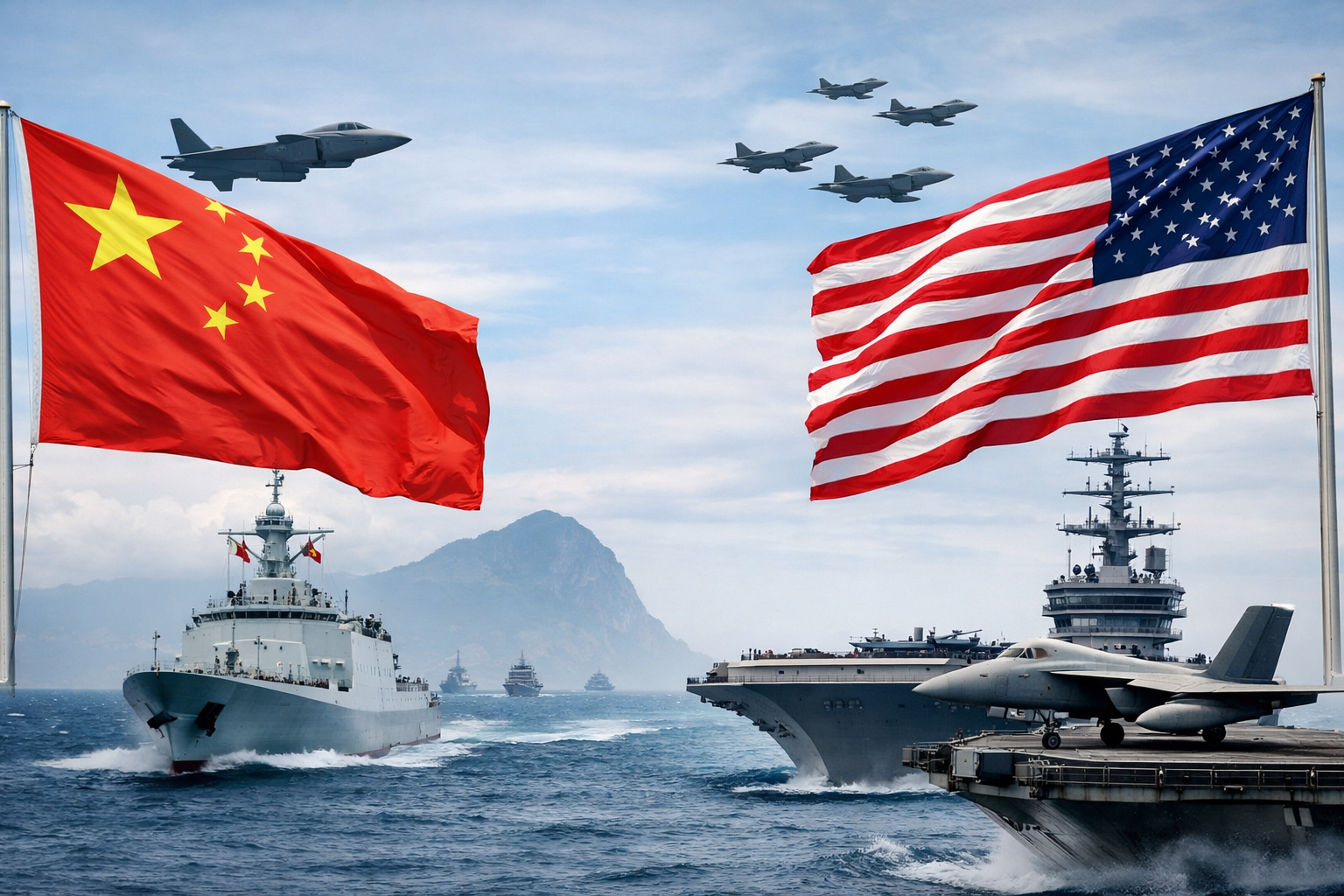
China is a real competitor. It is an economic heavyweight, a technological rival and a disruptive geopolitical actor that can make life genuinely difficult for the United States, our allies and anyone doing business in the Indo-Pacific. None of that is in dispute. What does not survive contact with reality is the popular narrative that China is about to run the world, that America is finished and that the PRC is an unstoppable global superpower on the verge of displacing Western dominance. If you zoom out from the scare headlines and look at what China actually does - where it applies pressure and where it holds back - a pattern emerges. China is loud where it can dominate cheaply, near its coast and inside gray zones. It is quiet where the price tag is sky-high. That quiet gets misread as strategic genius. Sometimes it is not genius. Sometimes it is just constraint.
China Is Not Quiet - It Is Selective
Let's be clear about one thing first: China is not some restrained, peaceful actor that simply wants to trade and be left alone. If you live next door to China, you do not experience quiet. You experience pressure. In late December 2025, China launched its largest-ever military drills around Taiwan - exercises openly described as rehearsals for blockade-style operations and strikes. Reuters reported Justice Mission 2025 as China's biggest war games around Taiwan to date, involving major naval and air assets and live-fire activity. That is not restraint. That is coercion designed to wear Taiwan down psychologically, test international reactions and signal that Beijing is willing to keep raising the temperature.
In the South China Sea, China has continued systematic confrontations with the Philippines throughout 2025 - water cannon incidents, harassment of fishermen, vessel ramming accusations and the steady effort to make disputed waters feel like Chinese territory by default. None of this is accidental. It is a deliberate strategy: apply force below the threshold of war, keep the opponent off-balance and make the international community tired of paying attention. China is not quiet. China is careful. Those are different things, and conflating them produces badly wrong strategic assessments.
China can pressure neighbors and bully smaller states at manageable risk. China cannot confidently smash head-on into the United States and its allies without risking catastrophe. That is not moral restraint. That is arithmetic.
Why the Ceiling Against the United States Is Where It Is
A great-power war between nuclear states is not like 1941. It is not even like Korea or Vietnam. It is a game where the worst case is not losing a battle - it is losing civilization. This is why you see so many almost moves from China: near misses, probes, harassment, airspace incursions, naval shadowing. The entire gray zone playbook is designed to be aggressive without triggering the one thing nobody can control once it starts. Nuclear reality caps the ceiling and both sides know it.
Below the nuclear threshold, the United States' advantage is not just aircraft carriers. It is the ability to project and sustain force across oceans for long periods, with mature joint command structures, treaty alliances, forward bases, refueling networks, ISR capability and a logistics spine that has been built and stress-tested over decades of actual operations. China has improved its military substantially. But much of its structure remains oriented toward near-seas and regional contingencies, not long, expensive, messy expeditionary operations across hostile ocean. You do not become a global military superpower just by building ships. You become one by proving you can coordinate, supply and command complex operations under sustained pressure - repeatedly, far from home. China has not done that. The United States has done little else for eighty years.
The United States has a network of treaty alliances built on decades of shared interest, institutional trust and military interoperability. China has clients, trade partners and coerced relationships. When China pushes too hard, neighbors balance against it rather than toward it - which is why Beijing's coercion in the South China Sea consistently strengthens regional alignment rather than dissolving it. China can intimidate individual states. Intimidation at scale builds the coalitions that make the next confrontation more expensive. That feedback loop is a structural disadvantage China has not solved.
The Economic Picture Does Not Scream Juggernaut
If you want to understand China's strategic caution, follow the domestic constraints. At China's annual political meetings in early 2026, Beijing set its GDP growth target at 4.5 to 5 percent - widely reported as an unusually modest target compared to the prior decades of high-single and double-digit growth. That matters because regime legitimacy in China remains tightly tied to stability and prosperity. The CCP's modern bargain is explicit: we deliver growth and order, you do not challenge our rule. Slower growth compresses that bargain and makes the leadership more cautious about external adventures that could backfire at home.
At the same time, China announced a defense spending increase of around 7 percent while publicly describing the security environment as grave. That combination - lower growth expectations and higher defense spending - is revealing. Beijing is trying to maintain military momentum while the economic engine slows. That does not describe an unstoppable juggernaut. It describes a government under pressure trying to manage two hard problems simultaneously. Add China's heavy dependence on imported energy - which means any major conflict that disrupts shipping lanes or triggers broad sanctions hits hard and fast - and the picture that emerges is of a country with real power and real constraints, not an unencumbered rising hegemon with a clean runway ahead of it.
Internal Purges Are Not a Sign of Strength
In late February 2026, China removed 19 deputies from its legislature, including nine military officers, amid ongoing anti-corruption actions. Whatever the specific motives - actual corruption, factional control or loyalty enforcement - the effect on institutional culture is the same. The CCP is still dealing with internal trust problems inside critical institutions including the PLA. A military preparing for high-risk, high-complexity operations needs confidence, continuity and the willingness to exercise initiative at the senior command level. Constant purges create fear, caution and risk-aversion in exactly the ranks where initiative matters most. This does not mean China cannot fight. It means China may not fight as smoothly and cohesively as its propaganda suggests, which is a significant variable when contemplating operations as complex as a Taiwan contingency.
Threatening Taiwan and Taking Taiwan Are Very Different Problems
China can surround Taiwan with ships and aircraft. It can simulate blockades. It can impose enormous psychological pressure on the island's population and government. All of that is real and documented. But actually forcing reunification by invasion or sustained blockade is a categorically different problem - one that comes with military, economic and political risks that have no clean resolution.
A blockade is not a contained operation. It is an escalatory act that forces third parties to respond, creates a test of will across multiple governments simultaneously and drags in consequences that block logic cannot control. Does Taiwan break, does the United States intervene, do regional allies join, do financial sanctions kick in, does global energy supply convulse? China may want coercion without war but blockade logic tends to drag you into wider consequences regardless of original intent. The amphibious invasion scenario is harder still. Taking Taiwan is not crossing a street. It is a complex assault campaign across contested water against a prepared defender in a modern battlefield saturated with sensors, missiles, drones and anti-ship capability. Every mile of ocean becomes a kill zone if the defender is ready and supported. Even for a modernized PLA that is not a guaranteed win. It is a gamble with regime-level stakes at a moment when the regime cannot easily absorb a catastrophic failure.
The most realistic China play against Taiwan is not necessarily invasion. It is pressure plus infiltration plus economic coercion plus information warfare plus political manipulation over years and decades. That is exactly why the quiet narrative is so misleading. China's biggest offensives often do not look like offensives until years later when the damage has already accumulated. The gray zone is where China is most capable and most patient. Treating that as restraint is a strategic error.
Why the Hype Machine Keeps Running Anyway
If China is not the globe-spanning military superpower the narrative describes, why does the story persist? Because fear sells. Media incentives reward drama and worst-case framing. Think tanks and defense commentary drift toward catastrophism because catastrophism gets attention and funding. Politicians use the China threat to justify industrial policy, surveillance expansion, budget priorities and anything else that needs a compelling rationale. China is real. The hype is a product. The adult position is to treat China as a serious rival requiring a serious response - without turning it into a comic-book monster that demands panic rather than strategy.
What a Serious China Strategy Actually Looks Like
A serious strategy is not panic and noise. It is boring, disciplined and coalition-based. It starts with rebuilding industrial capacity, because if the United States cannot make things it cannot sustain great-power competition regardless of how many carrier groups it deploys. It continues with strengthening alliances consistently and quietly, because alliances are leverage multipliers and China's greatest structural disadvantage is the absence of genuine ones. It requires credible deterrence paired with diplomatic clarity - capability and readiness without provocation that hands Beijing a propaganda win. And it demands serious attention to gray zone tactics because China's most effective playbook lives entirely below the threshold of conventional war, and a strategy that only thinks in tanks and carrier groups is already fighting the wrong fight.
None of that requires believing China is about to collapse or that the threat is overblown to the point of irrelevance. China is dangerous. China is ambitious. China has real tools and has demonstrated the patience and discipline to use them. The point is that it operates within constraints - military, economic, nuclear and internal - that the hype machine consistently ignores. Knowing where those constraints are is not naivety. It is the foundation of a strategy that can actually work.
China is a serious rival with real constraints. That is exactly the kind of opponent you can deter and outcompete - if you stop falling for your own propaganda about them.
References
- Associated Press. (2026, February 27). 19 Deputies of China's Legislature, Including 9 Military Officers, Removed Before Annual Meeting.
- Barron's. (2026, March 6). China's GDP Target Hits Record Low. But New Stimulus Isn't on the Table.
- Reuters. (2025, September 16). China Fires Water Cannon at Philippine Ships in South China Sea.
- Reuters. (2025, December 28-30). China Stages Record Drills Designed to Encircle Taiwan.
- The Guardian. (2025, December 29). China Launches Live-Fire Drills Around Taiwan Simulating a Blockade.
- The Washington Post. (2026, March 5). China Lowers Growth Forecast, Boosts Military, Citing "Grave" Environment.
Disclaimer: The views expressed in this post are the personal opinions of the author and are offered for educational, commentary and public discourse purposes only. They do not represent the positions of any institution, employer, organization or affiliated entity. Nothing in this post constitutes legal, financial, medical or professional advice of any kind. References to public figures, institutions, historical events and current affairs are based on publicly available sources and are intended to support analysis and argument, not to state facts about any individual's character, intent or conduct beyond what the cited sources support. Commentary on political and military subjects reflects the author's independent analysis and is protected expression of opinion. Readers are encouraged to consult primary sources and form their own conclusions. Any resemblance to specific individuals or situations beyond those explicitly referenced is coincidental.