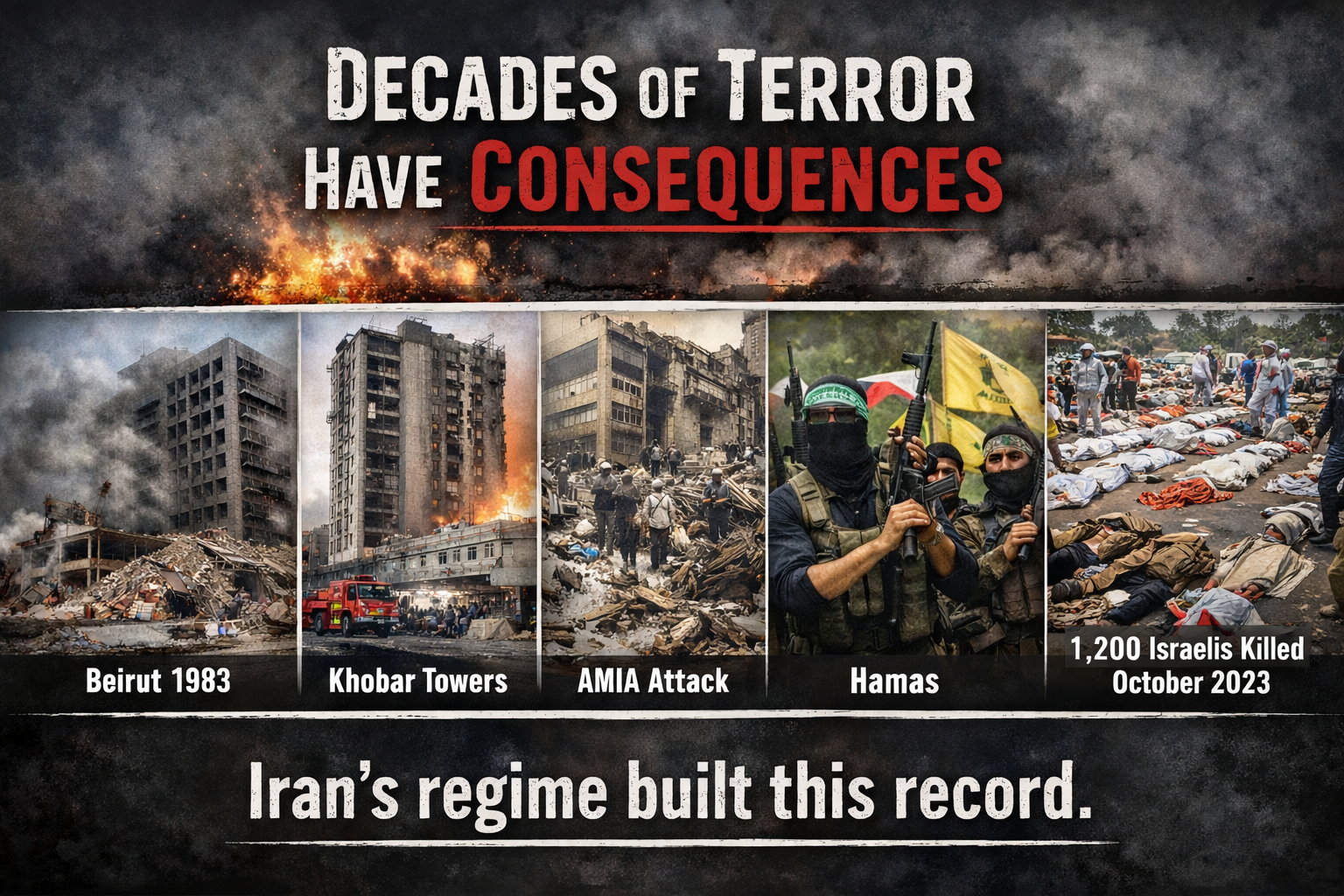
For nearly half a century, the Islamic Republic of Iran tried to wear two masks at once. One was diplomatic - a sovereign state demanding respect, sanctions relief and a seat at every negotiating table. The other was operational - a regime that armed, financed, trained and sheltered violent proxies across the Middle East and beyond. The United States has designated Iran as a State Sponsor of Terrorism since 1984, and the State Department continues to describe it as the world's leading state sponsor of terrorism. That is not a fringe claim. That is the standing position of the U.S. government, and it is grounded in a public record that goes back decades. Iran's rulers did not merely tolerate terrorism. They integrated it into statecraft.
Tehran backed Hizballah in Lebanon, supported Hamas and Palestinian Islamic Jihad and sustained a network of militias and armed clients stretching through Iraq, Syria, Yemen and Gaza. Treasury and State Department materials repeatedly describe financial, logistical and military links between the Iranian regime - especially the IRGC-Qods Force - and groups already designated by the United States as terrorist organizations or terror-linked armed proxies. This is not ambiguous. It is documented, sanctioned and on the public record.
The Record Written in Body Counts
The record is not abstract. The 1983 Beirut barracks bombing killed 241 U.S. service members, including 220 Marines, and the CIA's historical account ties those attacks to Hizballah and the Islamic Jihad Organization. The 1992 bombing of the Israeli embassy in Buenos Aires killed 22 people. The 1994 AMIA bombing killed 85. The 1996 Khobar Towers bombing killed 19 U.S. airmen. These are not internet rumors or partisan talking points. They are part of the long public record of Iran-linked terrorism and proxy violence, documented by American intelligence, prosecuted in courts and confirmed by multiple governments. Even when the regime was not directly detonating bombs, it was building and feeding the infrastructure that made them possible. Treasury has documented networks moving money from the IRGC-Qods Force to Hamas and Hizballah, and more recent sanctions actions continue to describe Iran-financed channels supporting Hizballah, the Houthis and other armed actors. Tehran did not cheer from the sidelines. It paid the bills.
While the regime exported violence abroad, it brutalized its own people at home. Human Rights Watch has estimated that Iranian authorities executed between 2,800 and 5,000 prisoners in at least 32 cities during the 1988 mass executions. Amnesty International and Human Rights Watch documented hundreds of unlawful killings during the "Woman, Life, Freedom" uprising that followed Mahsa Amini's death in 2022, alongside mass arrests, torture, disappearances and continuing crackdowns. The UN human rights office reported at least 901 people executed in Iran in 2024 alone. Amnesty reported that executions surpassed 1,000 in 2025. This is not merely an aggressive regime with regional ambitions. It is a regime that has been systematically vicious to its own citizens for nearly five decades.
The Failure of Strategic Patience
That is why the usual Western posture toward Iran always rang hollow. For years, too many policymakers treated Tehran like a difficult but ordinary government that could be domesticated through enough meetings, enough waivers, enough euphemisms and enough strategic patience. The premise was that engagement would moderate the regime's behavior - that economic integration and diplomatic normalization would gradually pull Iran toward the community of responsible nations. It did not work. The regime took the engagement when it was offered and continued operating its proxy network and its internal repression without meaningful modification.
The problem was never that the world failed to understand the Iranian regime. The problem was that too many powerful people understood it perfectly well and chose to manage it instead of confront it. Managing a regime that uses terror as a tool of statecraft does not moderate it. It teaches it that terror is a cost-effective instrument. The mullahs learned that lesson early and applied it consistently across four and a half decades.
A government that treats terror as leverage is not simply misunderstood. A government that bankrolls proxies while hanging dissidents at home is not simply complicated. Those are descriptions designed to make evasion sound like sophistication.
Where Trump's Approach Mattered
Whatever one thinks of his style, the Trump administration did something previous administrations often hesitated to do: it treated the regime itself - not just this or that incident - as the core problem. Trump withdrew the United States from the 2015 nuclear deal in 2018, reimposed sanctions on Iran's oil and banking sectors and pursued what became known as maximum pressure. Those sanctions targeted Iran's oil revenues and international banking transactions and were designed to curb Tehran's missile program, nuclear ambitions and regional influence through armed militias. That was not diplomatic nicety. It was strategic clarity about what kind of actor the Islamic Republic actually was.
The same pattern showed up in the killing of Qassem Soleimani in January 2020. Soleimani was the commander who helped Iran fight proxy wars across the Middle East. He was one of the chief architects of the militia network that spread Iranian power through deniable violence across Iraq, Syria, Lebanon and Yemen. Taking him off the board was a direct strike at the machinery of proxy war - not at a symbol but at the operational brain of the system. You can question the timing or the strategic calculation and still acknowledge what he was and what his removal meant for the network he ran.
It is too neat to say Trump already ended a 46-year scourge as a settled historical fact. That is more claim than proof. Iran's regime has been wounded, sanctioned, isolated and repeatedly exposed. But whether its project is over or merely weakened depends on what happens next. Recent reporting shows the regime's power structure still attempting to reconstitute itself after major shocks, while Treasury continues to announce fresh sanctions tied to oil sales, weapons programs and terror-linked financing. The accurate version is this: Trump was far more willing than many of his predecessors to confront the regime as the source of the problem, and that harder line changed the strategic environment. Whether it proves to be the final chapter remains to be seen.
The Iranian People Are Not the Regime
One moral distinction should not be blurred in any of this. The Iranian people are not the regime. That distinction matters and deserves to be stated plainly. Millions of Iranians have paid the price for the ambitions of clerics, security services and revolutionary institutions that claim to speak in their name. The women who risked their lives in the streets after Mahsa Amini's death. The wrestlers, karate champions and ordinary citizens executed for protesting. The families who lost children to a judicial system that calls dissent a war against God. These people are not the enemy. They are the regime's first and most sustained victims.
The proper target of moral condemnation is the ruling apparatus: the Supreme Leader system, the IRGC, the Qods Force, the terror-financing networks and the repressive internal security state that has operated without accountability for nearly five decades. A freer Iran would not be a geopolitical tragedy. It would be an improvement for Iranians first and very likely for the stability of the region as well. The regime and the people it has governed by force are not the same thing, and the distinction should inform every conversation about what comes next.
My Bottom Line
The world did not invent the Islamic Republic's reputation. The regime earned it - through Beirut, through Buenos Aires, through Khobar Towers, through proxy militias funded from Tehran's oil revenues, through prison massacres, through hangings and crackdowns and the routine destruction of its own citizens' liberty across nearly five decades. A regime with that record does not deserve romanticism. It does not deserve the benefit of the doubt. It deserves to be named clearly for what it has been: one of the modern world's most durable engines of state-backed terror and domestic repression.
Bad ideas survive on soft language. When a regime spends decades using proxies, terror finance, hostage politics and domestic repression, calling it "complex" is not sophistication. It is evasion. Clarity matters because public language shapes public tolerance. The more plainly the regime is described, the harder it becomes for policymakers, media figures and institutions to launder brutality into diplomacy-by-habit. That clarity is not aggression toward Iran. It is honesty about what the ruling apparatus has been - and what the Iranian people have had to survive.
The regime earned its reputation one bombing, one execution and one proxy militia at a time. The world was never obligated to pretend otherwise. It was only ever asked to - and too often it complied.
References
- U.S. Department of State. State Sponsors of Terrorism.
- U.S. Department of State. Country Reports on Terrorism 2021: Iran.
- U.S. Department of State. Country Reports on Terrorism 2023.
- Congressional Research Service. U.S.-Iran Conflict and Implications for U.S. Policy.
- U.S. Department of the Treasury. Treasury Targets Facilitators Moving Millions to HAMAS in Gaza from Iran.
- U.S. Department of the Treasury. Treasury Designates Illicit Russia-Iran Oil Network Providing Funds to IRGC-QF, HAMAS, and Hizballah.
- U.S. Department of the Treasury. Treasury Targets Qods Force, Houthi, and Hizballah Financing Network.
- Human Rights Watch. Iran: 1988 Mass Executions Evident Crimes Against Humanity.
- Human Rights Watch. Iran: Tsunami of Arbitrary Arrests, Enforced Disappearances.
- Amnesty International. Iran: One year after uprising, international community must combat impunity for brutal crackdown.
- Amnesty International. Iran: Authorities must halt executions after horrifying increase.
- UN Human Rights Office. Iran 2024 Executions.
- Reuters. Soleimani was Iran's celebrity soldier, spearhead in Middle East proxy wars.
- Reuters. U.S. expands sanctions on Iran over oil sales, weapons programs.
Disclaimer: The views expressed in this post are the personal opinions of the author and are offered for educational, commentary and public discourse purposes only. They do not represent the positions of any institution, employer, organization or affiliated entity. Nothing in this post constitutes legal, financial, medical or professional advice of any kind. References to public figures, institutions, historical events and government reports are based on publicly available sources and are intended to support analysis and argument. Commentary on geopolitical and foreign policy subjects reflects the author's independent analysis and is protected expression of opinion. Readers are encouraged to consult primary sources and form their own conclusions. Any resemblance to specific individuals or situations beyond those explicitly referenced is coincidental.