"The most sublime and benevolent code of morals which has ever been offered to man."Thomas Jefferson, 1813
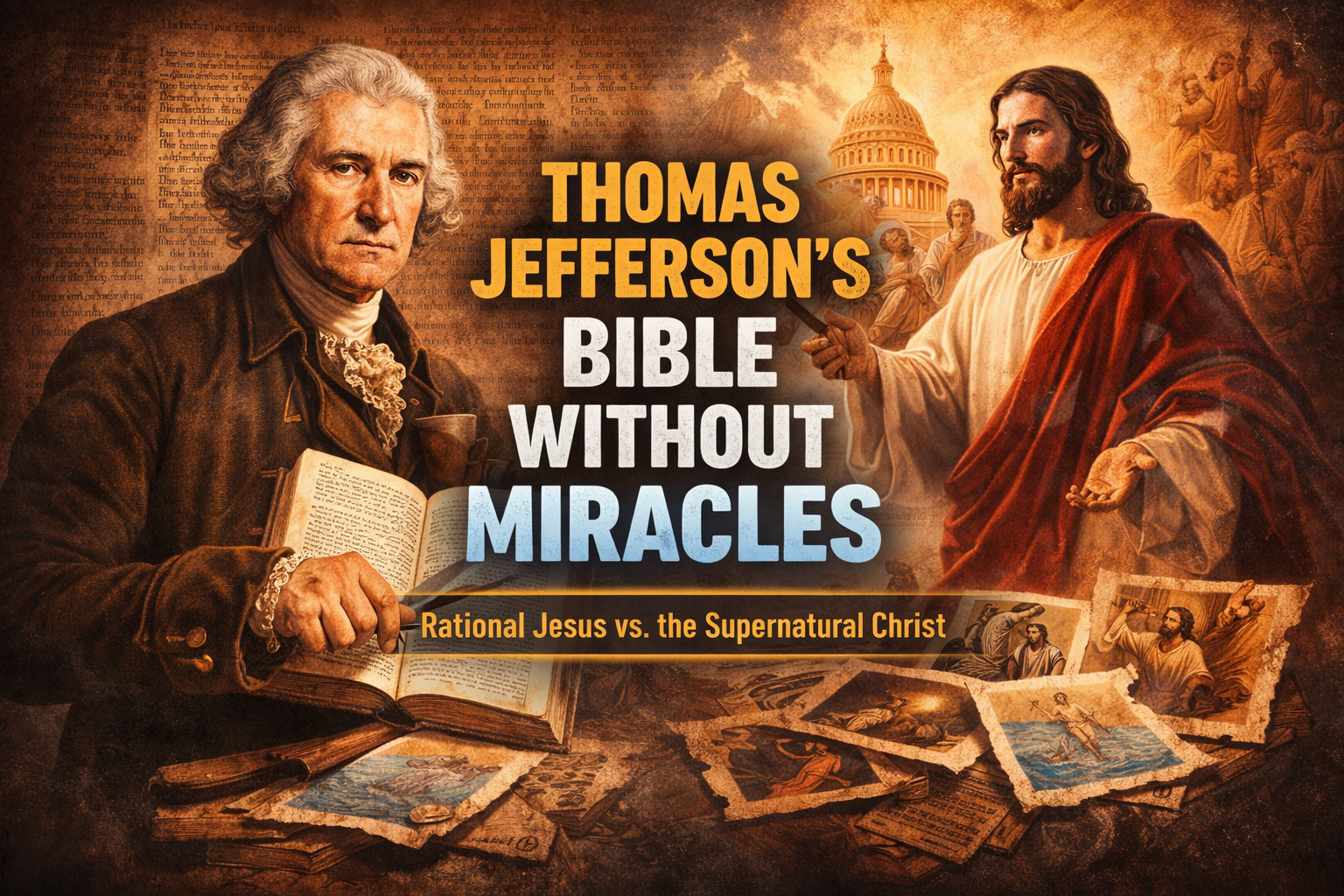
Thomas Jefferson did something that still irritates Christians, fascinates skeptics and exposes a basic divide in how people approach religion: he took the Gospels and cut out the miracles.
Not symbolically. Literally.
With razor and glue, Jefferson assembled what became known as the Jefferson Bible, formally titled The Life and Morals of Jesus of Nazareth. He drew from the four Gospels in English, French, Latin and Greek and in the process removed the virgin birth material, angelic visitations, miracles, divinity claims and the Resurrection. What remained was the Jesus Jefferson wanted: not the supernatural Son of God of orthodox Christianity, but a moral teacher whose ethical sayings could stand on their own.
What Jefferson Kept — and Cut
Monticello describes the work as Jefferson's effort to create a chronological account of Jesus's life and teachings, while the Smithsonian explains that he was trying to distill Jesus' ethics from miracle stories and other elements he saw as corruptions or additions.
That matters because Jefferson was not casually trimming for convenience. He was making a philosophical statement — saying, in effect, that the real value of Jesus was not supernatural power, not divine status, not resurrection hope, but moral insight. In an 1813 letter to John Adams, Jefferson wrote that after stripping away what he regarded as corruptions, there remained "the most sublime and benevolent code of morals which has ever been offered to man."
Jefferson's edited Gospel did not remain some private curiosity hidden in a drawer. In 1904, Congress authorized a photolithographic reproduction of The Life and Morals of Jesus of Nazareth for members of Congress — and the Smithsonian says that practice continued for nearly fifty years. Jefferson's miracle-free Bible became a public symbol of a certain American elite instinct: respect Jesus, keep the morality and leave the supernatural at the door.
Jefferson Did Not Reject Jesus. He Recast Him.
One of the easiest mistakes to make is to say Jefferson simply rejected Jesus or despised Christianity. That is too crude. Jefferson did not discard Jesus. He recast him.
Britannica, Monticello and the Smithsonian all describe Jefferson's project as one centered on preserving Jesus' moral teachings while excluding miracles and doctrines Jefferson did not accept, especially divine claims and supernatural events. His quarrel was not with Jesus as a moral figure. It was with the theological and miraculous framework surrounding him in the New Testament and later church tradition.
That distinction matters. Jefferson was not saying Jesus had nothing to offer. He was saying Jesus' real worth lay in ethical instruction rather than divine identity. That is a classic Enlightenment move. It takes religion and submits it to reason. It keeps what seems noble, rational and useful. It discards what seems mystical, irrational or impossible.
"Jefferson represents a familiar impulse: admiration for Jesus without submission to Christianity. He is the patron saint of the 'great moral teacher' argument."
The Jefferson Bible Was a Blade Taken to the Supernatural
The basic facts are not in dispute. Jefferson's compilation removed miracles and supernatural claims. History.com summarizes it plainly: Jefferson's Bible omitted the Resurrection, Ascension and famous miracles such as turning water into wine and walking on water.
That means Jefferson was not editing for brevity. He was editing for worldview. Miracles were not left out by accident. They were the point of the exclusion.
And the ending of the Jefferson Bible says everything. Jefferson's version ends with Jesus placed in the tomb and the stone rolled to the entrance. It stops there. No resurrection. No triumph over death. No central claim of historic Christianity. Britannica and Smithsonian accounts both reflect that Jefferson's version reduced Christianity to an ethical narrative without the supernatural climax orthodox believers regard as essential.
Jefferson's version ends at the tomb. No resurrection. No empty grave. No risen Christ. That is not Christianity in any traditional sense. It is Christianity with the engine removed.
Jefferson Wanted Morality Without Metaphysics
Jefferson's religious outlook was shaped by Enlightenment rationalism. Smithsonian materials describe him as a Deist who believed in a Creator but did not accept Christ's divinity and Monticello's overview of his religious beliefs likewise emphasizes his suspicion of dogma, mystery and priestly authority.
That is why his project was so surgical. He wanted morality without miracle, ethics without incarnation, teaching without theology. He wanted the Sermon on the Mount without the empty tomb.
That kind of religion is attractive because it feels tidy. It keeps the parts modern people like — compassion, humility, mercy, neighbor-love and moral seriousness. It discards the parts rationalists find embarrassing: angels, healings, exorcisms, virgin births and resurrection. It offers Jesus as philosopher rather than redeemer.
"Jefferson was hardly the last to do this. In many ways he anticipated a long modern habit of domesticating religion so it fits comfortably inside secular respectability."
The Jefferson Bible in Congress
One of the most revealing twists in the story is that Jefferson's edited Bible did not remain merely a private artifact. According to the Smithsonian, the original stayed in Jefferson's family until it was acquired for the national collection in 1895. Then, in 1904, Congress authorized a photolithographic reproduction for distribution to senators and representatives — and that practice continued for nearly half a century.
That fact is worth pausing over.
For decades, members of Congress were given Jefferson's stripped-down, miracle-free Gospel as a kind of respectable civic artifact. Not the full New Testament. Not the Resurrection-centered Christianity that has defined the faith for two thousand years. Jefferson's edited version. His rationalized Jesus. His moral teacher without divine mystery.
The Jefferson Bible was moral without being doctrinal. Religious without being too religious. Civilized, elevated and safe for the political class. It let public figures honor Jesus as a teacher without requiring them to submit to Christianity as a supernatural faith. For a time, it became a national symbol of a very American elite instinct: keep the ethics, keep the prestige, keep the moral vocabulary, but trim away the miracles so educated people do not have to blush.
The Problem With Jefferson's Approach
The problem is not that Jefferson admired Jesus. The problem is that Jefferson acted as though he could preserve Jesus' authority while deleting the framework in which the Gospels themselves present him.
The Gospels do not depict Jesus merely as a dispenser of ethical sayings. They present him as inseparable from supernatural claims. The miracles are not decorative side stories. They are tied to his identity, authority and mission. Strip them out and you do not simply shorten the text. You change its meaning.
Jefferson clearly believed he was uncovering the pure core of Jesus beneath later corruption. In that same 1813 letter to Adams, he described Jesus' authentic teachings as "diamonds in a dunghill." That phrase says a great deal. Jefferson thought the Gospels contained a mixture of moral brilliance and accumulated nonsense — and he believed he had the judgment to sort one from the other.
"That is an audacious claim. It puts Jefferson above the text as editor, judge and philosophical gatekeeper. He was no longer receiving Scripture. He was curating it."
To modern rationalists, that sounds sensible. To traditional Christianity, it sounds like dismantling the faith while pretending to honor it.
Jefferson's Jesus Is Useful, but Smaller
There is something undeniably respectable about Jefferson's version of Jesus. A moral teacher who emphasizes benevolence, humility, justice and human decency is easier for many modern people to admire than a miracle-working Messiah who rises from the dead and demands belief. Jefferson's Jesus is intellectually manageable.
But he is also smaller.
- He can inspire — but he cannot save
- He can instruct — but he cannot conquer death
- He can sharpen conscience — but he cannot remake the world in the way Christianity claims
- He can satisfy a deist — but he is not enough for a Christian
Once Jesus is reduced to ethics, he becomes one more admirable thinker in history. An elevated one, perhaps, but still one among others. Jefferson's project reveals something important about the modern mind: many people want the moral prestige of Jesus without the metaphysical scandal of Christianity.
What Jefferson Really Shows Us
What Jefferson ultimately shows is that religion can be admired morally and aesthetically while being rejected doctrinally. He respected Jesus enough to preserve him, but not enough to believe him on his own terms.
That is a very familiar modern posture. It is the posture of people who say Jesus was a wise man, a social reformer, a moral revolutionary or a spiritual genius, while rejecting the supernatural claims at the center of the Christian story. Jefferson got there early and he got there cleanly.
His Bible is not just an artifact. It is a worldview in book form.
The Jefferson Bible is not merely a curiosity from a Founding Father. It is a confession of what happens when Enlightenment rationalism takes a knife to revelation. What survives is a usable Jesus, a civilized Jesus, a respectable Jesus. But it is no longer the full Gospel Jesus.
My Bottom Line
Thomas Jefferson did dismiss the miracles, the supernatural and the divinity claims that define orthodox Christianity — and he did so intentionally. His Life and Morals of Jesus of Nazareth preserved Jesus as a moral leader while removing the virgin birth, miracles, Resurrection and other supernatural elements. Jefferson admired Jesus as a teacher of what he called the most sublime moral code ever offered to man, but he did not accept Jesus as the divine Christ of the New Testament.
And the story became even more revealing when Congress later reproduced and distributed Jefferson's edited Gospel for nearly fifty years, turning his private act of rationalized religion into a public symbol of respectable American belief.
"The Jefferson Bible shows how a brilliant Enlightenment mind tried to save Jesus from Christianity by turning him into ethics alone."
Why This Matters
Jefferson framed a debate that still exists right now. Can you keep Jesus as a moral authority while rejecting the supernatural claims that give Christianity its distinct meaning? Many people today think the answer is yes. Jefferson certainly did.
But his razor-and-glue Bible makes the issue impossible to miss: once you start cutting away miracles, divinity and resurrection, you are not simplifying Christianity. You are rebuilding it into something else. And once you notice that Congress handed out that edited version for decades, you also see how deeply appealing that trimmed-down, respectable, miracle-free religion became to elite American culture.
References
- Britannica. (2026). Jefferson Bible | Description, History, & Facts.
- History.com. (2019, July 31). Why Thomas Jefferson rewrote the Bible without Jesus' miracles.
- Monticello. (n.d.). The Life and Morals of Jesus of Nazareth.
- Monticello. (n.d.). Extract from Thomas Jefferson to John Adams, 12 Oct. 1813.
- Monticello. (2012, August 10). Jefferson's religious beliefs.
- Smithsonian Institution. (n.d.). Thomas Jefferson, The Life and Morals of Jesus of Nazareth.
- Smithsonian Institution. (2011, November 1). National Museum of American History displays Thomas Jefferson's book The Life and Morals of Jesus of Nazareth.
- Smithsonian Magazine. (2020, September 8). Why Thomas Jefferson created his own Bible.
Disclaimer: The views expressed in this post are opinions of the author for educational and commentary purposes only. They are not statements of fact about any individual or organization and should not be construed as legal, medical or financial advice. References to public figures and institutions are based on publicly available sources cited in the article. Any resemblance beyond these references is coincidental.