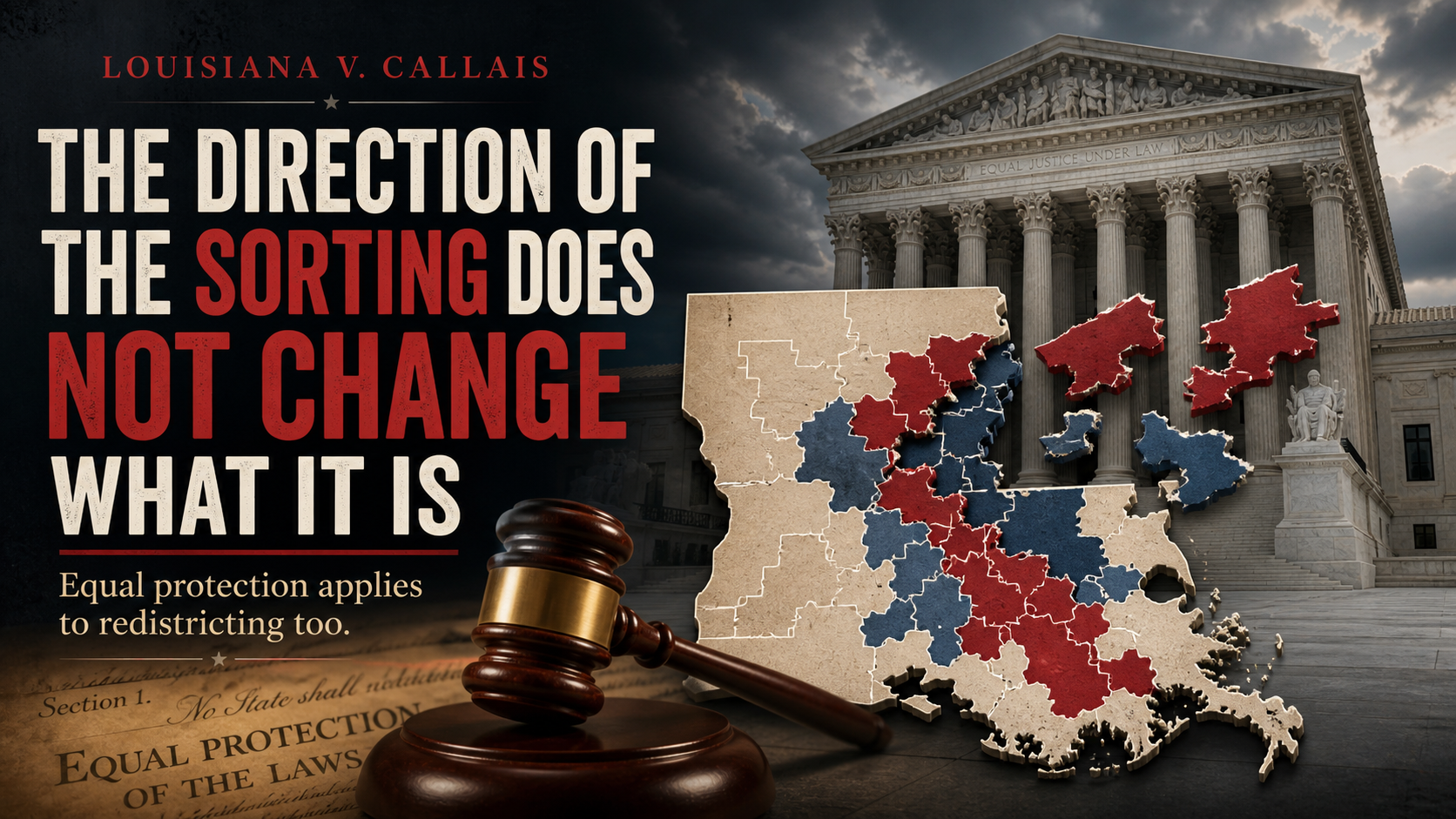
The Supreme Court handed down Louisiana v. Callais on April 29, 2026, and the left has been screaming about it ever since. Justice Kagan called it a betrayal of the Court's duty. Stacey Abrams said it tells a lie to America. Democracy Docket declared the VRA gutted. Justice Thomas, in his concurrence, wrote what he has been writing for thirty years: Section 2 of the Voting Rights Act should never have been interpreted to give racial groups an entitlement to roughly proportional representation. The 6-3 majority, written by Justice Alito and joined by the Court's five other conservatives, held that Louisiana's 2024 congressional map was an unconstitutional racial gerrymander under the Fourteenth Amendment. The opinion's core principle is straightforward: the Constitution almost never permits the government to discriminate on the basis of race, and drawing congressional districts with race as the predominant factor is racial discrimination regardless of the direction the discrimination runs. I have been saying this for years on this site. The Court finally got there. The Supremes got it right and the people screaming about it most loudly need to be asked one simple question: do you actually believe the government should sort Americans into electoral categories by skin color, or do you just believe that when it benefits your party?
What the Court Actually Held
The Louisiana case had an appropriately convoluted path to the Supreme Court. After the 2020 census Louisiana drew a congressional map with one majority-Black district out of six. Black voters representing roughly a third of the state's population went to federal court, won a ruling that the map violated Section 2 of the VRA and got a court order requiring a second majority-Black district. Louisiana drew the new map - SB8 - and then a different group of voters challenged that map as an unconstitutional racial gerrymander, arguing the state had used race as the predominant factor in drawing it. The lower court agreed. The Supreme Court affirmed, 6-3, in Alito's 36-page majority opinion.
What the ruling does not do is equally important for understanding what the left's hysteria is actually about. The Court did not strike down Section 2 of the VRA. Section 2, which prohibits intentional racial discrimination in voting, remains on the books. What the ruling does is reinterpret what Section 2 requires: challengers must now prove that a state intentionally drew its districts to give minority voters less opportunity because of their race. They must disentangle race from political considerations. They must show an objective likelihood of intentional discrimination. Under the prior interpretation - which lower courts had applied in ways that effectively required proportional racial representation in congressional maps - states were being ordered to create majority-minority districts to comply with Section 2, and then being told that the resulting race-based maps were themselves unconstitutional. Alito's opinion cuts through that circle by holding that Section 2 was not designed to collide with the Constitution and should not be applied to require racial sorting that the Constitution prohibits.
The Constitution almost never permits the government to discriminate on the basis of race. That principle does not have an exception for congressional districts. If sorting people by skin color is wrong in education, employment and contracting, it is wrong in electoral map-drawing too. The direction of the sorting does not change what it is.
The Proportional Representation Problem
The deeper issue that Callais addresses is one the left has never wanted stated plainly: the version of Section 2 that lower courts had been applying required, in practice, that congressional maps produce roughly proportional racial representation. If Black voters constitute a third of a state's population, the emerging doctrine held they were effectively entitled to roughly a third of the congressional seats, and maps that did not produce that outcome could be challenged under the VRA regardless of intent. Justice Thomas has argued for decades that this interpretation transforms the VRA from a statute prohibiting discrimination into a mandate for racial proportionality in political outcomes - and that the Constitution does not permit such a mandate any more than it permits its opposite. The majority in Callais did not go as far as Thomas wanted - it left Section 2 on the books rather than striking it down - but it applied the constitutional standard that should have been applied all along: states cannot use race as the predominant factor in drawing maps, period, whether the purpose is to dilute minority representation or to manufacture it.
The practical implications are significant. An NPR analysis estimated that the ruling puts at risk at least 15 House districts currently represented by Black members of Congress - districts drawn specifically to create majority-Black constituencies for the purpose of electing Black representatives. The left is treating this as the loss of Black representation. The more honest framing is that these districts represent a system in which Black voters were sorted into designated electoral containers by skin color, told these containers were for their benefit and then asked to vote inside them. Whether that system actually advances the interests of Black Americans as a political community - rather than the career interests of the specific politicians who benefit from guaranteed minority-majority districts - is a question the left has been remarkably uninterested in examining.
The shift in the legal standard from discriminatory effect to intentional discrimination is the operational heart of the Callais ruling and the source of most of the left's objections. Under the prior standard, a plaintiff challenging a redistricting map needed to show that the map had a discriminatory effect on minority voting power - that it diluted the ability of minority voters to elect candidates of their choice relative to their proportion of the population. Under the new standard, plaintiffs must show the state intentionally drew its districts to give minority voters less opportunity because of their race. Critics argue proving intent is practically impossible since no state legislature is going to put racist motivations in writing. That criticism has merit as a practical matter. But the alternative - a standard under which any map with racially disparate outcomes is presumptively a VRA violation regardless of intent - is a standard under which states are compelled to engage in explicit racial sorting to avoid liability, which is itself a constitutional violation. The Court chose the standard that aligns with the Constitution's text over the standard that produces racial proportionality. That is the correct choice regardless of the political inconvenience.
The VRA Was Great. What Lower Courts Did to It Was Not.
I said it in my earlier post on this topic and I will say it again because it still needs saying: the Voting Rights Act of 1965 was a landmark achievement. It targeted specific documented evil - poll taxes, literacy tests, organized intimidation, outright exclusion of Black Americans from the ballot - with specific targeted tools and it worked. Minority voter registration surged. Turnout increased dramatically. The barriers the Act was designed to eliminate were eliminated. The Civil Rights movement's legislative triumph deserves its place in American history and nobody serious disputes that. What lower courts did with Section 2 over the subsequent sixty years is a different matter. They took a statute designed to prevent the government from using race to deny people the vote and interpreted it to require the government to use race to guarantee electoral outcomes. That is not what the statute says, it is not what Congress intended when it passed the Act and it is not what the Constitution permits. The Supreme Court's correction in Callais is not an attack on voting rights. It is a return to what voting rights actually means: the right to vote without being discriminated against on the basis of race, not the right to have your skin color determine which electoral category you vote in.
The "Jim Crow" Comparison Is Lazy and Insulting
Democrats reached for the Jim Crow comparison within hours of the ruling. Senator after senator compared Callais to the poll taxes and literacy tests of the 1950s and early 1960s. This comparison is both analytically lazy and genuinely insulting to the people who lived through actual Jim Crow. Jim Crow used law to prevent Black Americans from voting at all - through violence, economic coercion, bureaucratic obstruction and legal mechanisms designed with the explicit purpose of disenfranchisement. Louisiana v. Callais held that states cannot use race as the predominant factor in drawing congressional maps. These are not the same thing. One denied Black Americans the franchise. The other held that the franchise must operate on race-neutral terms. Calling the requirement of race-neutral map drawing Jim Crow is not a serious historical comparison. It is a political escalation designed to produce emotional responses that bypass analysis. The people whose parents and grandparents were actually denied the right to vote deserve better than having their history invoked as a rhetorical cudgel every time the Supreme Court applies the Constitution's guarantee of equal protection without a racial exception.
My Bottom Line
Louisiana v. Callais is the right decision for the right reasons. The Constitution says the government almost never gets to sort people by race. That principle does not stop at the schoolhouse door and it does not stop at the congressional redistricting map. If sorting people by skin color is wrong when it is used to exclude, it is wrong when it is used to include too. The direction of the sorting does not change what it is. The left has spent years defending race-conscious redistricting as a necessary protection for minority voting rights while simultaneously condemning race-conscious admissions and employment as discrimination. The Supreme Court has now applied the same constitutional principle consistently across both contexts. That consistency is not a rollback of civil rights. It is what civil rights actually means: equal protection under the law for everyone, not protection that changes character depending on which racial group is being sorted and in which direction. Kagan's dissent argues the majority betrayed Congress's intent. What it actually means is that Section 2 must be applied in a way that does not require states to do what the Constitution prohibits. That is not betrayal. That is constitutional law operating as designed.
A colorblind Constitution is not the enemy of Black Americans. A Constitution that permits the government to sort people by race whenever the sorting is framed as beneficial is the enemy of everyone - because the same power that sorts for benefit today can sort for exclusion tomorrow, and the Constitution does not ask which direction the sorting runs. It asks whether the sorting is constitutional. In Callais , the Court correctly answered: it is not.
References
- Louisiana v. Callais, 608 U.S. ___ (April 29, 2026). Majority opinion by Justice Alito, joined by Roberts, Thomas, Gorsuch, Kavanaugh and Barrett. Dissent by Justice Kagan, joined by Sotomayor and Jackson. supremecourt.gov.
- SCOTUSblog. (2026, April 29). In major Voting Rights Act case, Supreme Court strikes down redistricting map challenged as racially discriminatory. scotusblog.com.
- NPR. (2026, April 29). In Louisiana case, the Supreme Court strikes new blow to VRA. npr.org.
- The Hill. (2026, April 30). Supreme Court roils 2026 midterms with Voting Rights Act ruling. thehill.com.
- Washington Post. (2026, April 29). Supreme Court limits key provision of the landmark Voting Rights Act. washingtonpost.com.
- Allen v. Milligan, 599 U.S. 1 (2023). (Prior Section 2 ruling upholding VRA challenge to Alabama redistricting.)
- Shelby County v. Holder, 570 U.S. 529 (2013). (Striking down the Section 4(b) coverage formula.)
- Students for Fair Admissions v. Harvard, 600 U.S. 181 (2023). (Race-conscious admissions ruling cited in Callais majority.)
Disclaimer: The views expressed in this post are the personal opinions of the author and are offered for educational, commentary and public discourse purposes only. They do not represent the positions of any institution, employer, organization or affiliated entity. Nothing in this post constitutes legal advice of any kind. References to Supreme Court opinions, legal scholarship and published news coverage are based on publicly available sources cited above. Commentary on constitutional law and political events reflects the author's independent analysis and is protected expression of opinion. Readers are encouraged to consult primary sources and form their own conclusions.