
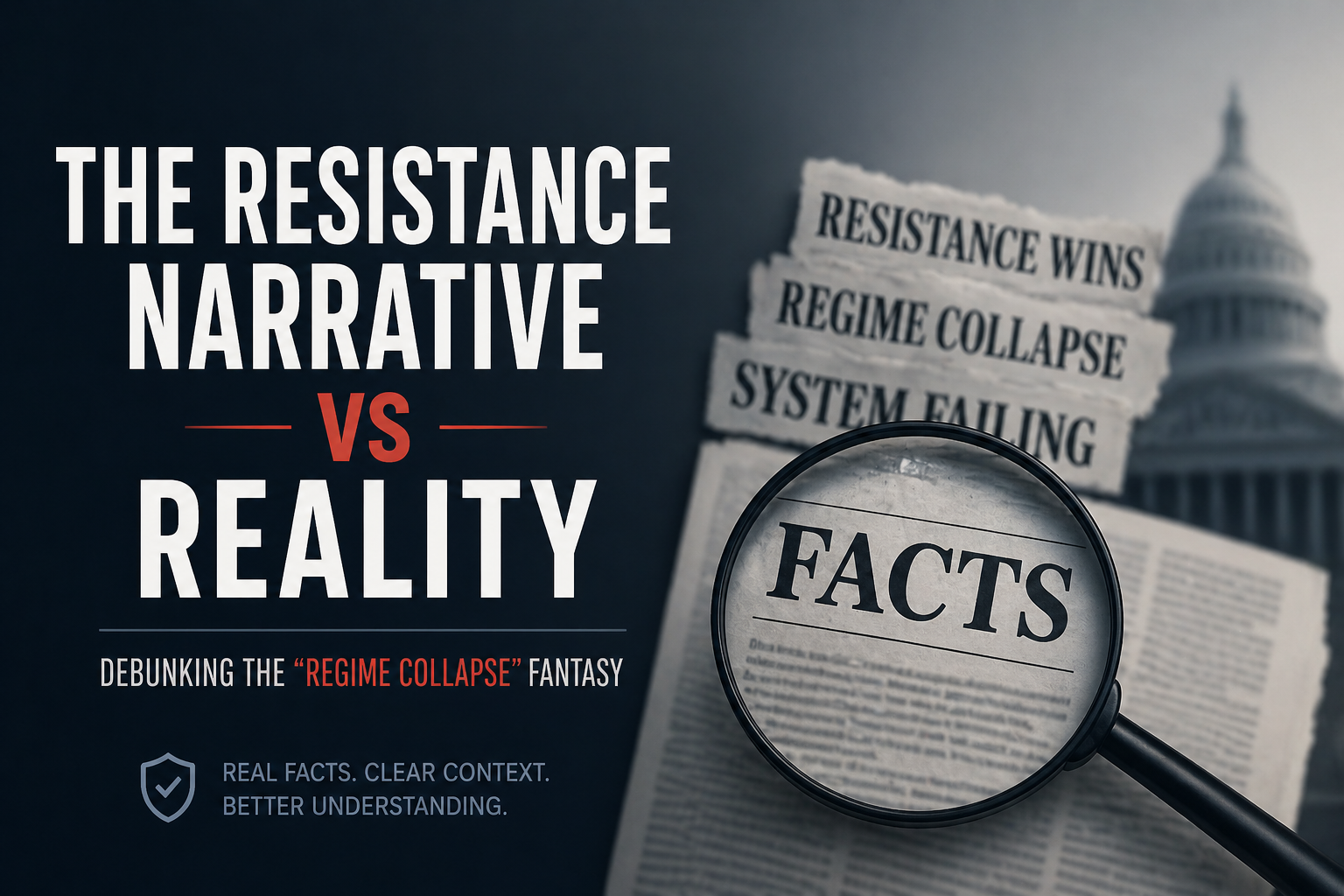
Every political cycle produces its share of exaggerated narratives, but the current wave of resistance journalism has taken it to another level. A recent article claims to document a series of victories against what it calls "the regime," presenting a patchwork of state-level decisions, court rulings and local policies as evidence that a broader political collapse is underway. It is a compelling story if you already believe it. It is also deeply misleading. What the article actually does is take isolated, often routine policy actions and stitch them together into a dramatic narrative that does not hold up under scrutiny. The pattern is consistent: take a real event, strip it of context, assign a convenient villain and then declare a symbolic victory. This is not analysis. It is activism dressed as reporting, and the individual claims deserve to be examined against what actually happened rather than what the narrative requires.
Oregon Housing: A Long-Standing Problem, Not a Political Plot
The article points to Oregon's recent housing legislation as evidence of resistance to federal influence, framing it as a corrective response to policy failures tied to national leadership. That framing collapses under basic scrutiny. Oregon's housing crisis did not begin in the last election cycle. It has been building for years, driven by well-documented structural problems: restrictive zoning laws, limited land availability, slow permitting processes, rising material and labor costs and sustained underbuilding relative to population growth. These are not partisan talking points. They are the same constraints that economists, planners and developers have been identifying for over a decade. The legislation itself - including limits on large institutional investors purchasing single-family homes within the first 90 days of listing - is a modest intervention aimed at increasing access for individual buyers. Whether it will meaningfully affect prices is genuinely uncertain. Many analysts are skeptical because supply, not investor activity, remains the dominant driver of housing affordability. What the article does is attribute the necessity of this policy to a single political figure, effectively rewriting a complex multi-year housing shortage into a simple cause-and-effect narrative. That is not how housing markets work. That is how political messaging works.
Domestic Violence Grants: Legal Nuance Replaced with Emotional Framing
The article then shifts to a court-related development involving federal grant conditions for domestic violence services, portraying it as an attempt to transform shelters into immigration enforcement tools. That is a serious accusation and a distortion of what occurred. The actual dispute was over conditions tied to federal funding. The Department of Justice had explored limitations related to services for individuals without lawful immigration status, raising questions about compliance with existing statutory frameworks governing programs like the Violence Against Women Act and the Victims of Crime Act. The government subsequently clarified that immigration-related restrictions would not apply to current grant programs given existing regulations and legal constraints. That is a bureaucratic and legal disagreement over how federal funds can be administered. It is not immigration enforcement being conducted inside shelters. The article replaces that nuance with imagery designed to produce outrage, suggesting scenarios that were never implemented and presenting them as if they were imminent policy realities. That is not factual correction. It is emotional amplification in service of a predetermined conclusion.
The problem is not that the events are fabricated. The problem is that their significance is misrepresented. Real events, stripped of context, assigned a convenient villain, then declared symbolic victories - that is the formula, and it works for persuasion in ways it does not work for understanding.
Oklahoma City Data Centers: Planning, Not Resistance
The article highlights a decision by Oklahoma City to implement a moratorium on new data center development, framing it as a stand against the expansion of AI infrastructure. The reality is considerably more mundane. The moratorium is temporary and exists to give the city time to evaluate zoning, infrastructure capacity, energy demand and water usage before approving additional large-scale developments. It is set to expire once updated regulations are in place or by a specific deadline. Cities routinely pause development to reassess long-term impacts - with housing, industrial projects and commercial expansion. Data centers, given their significant energy and resource requirements, are no exception to that standard municipal practice. There is no sweeping anti-AI movement embedded in this decision and no coordinated resistance effort. There is a local government doing what local governments are supposed to do: evaluate infrastructure capacity before approving major projects that will stress it. The article inflates a planning pause into a symbolic victory because it fits the narrative. Planning is not rebellion. It is governance.
The article criticizes a tax arrangement between a major technology company and the city of Tulsa, presenting it as an example of political favoritism and corporate overreach. There is a legitimate conversation to be had about tax incentives and corporate subsidies - these deals involve real tradeoffs and reasonable people can disagree on whether any specific arrangement is worth it. What the article does is present only one side of that equation. The company receives favorable tax treatment, which is common in large-scale economic development projects. Cities compete for investment by offering incentives, particularly when projects promise job creation, infrastructure improvements and long-term economic activity. The article ignores those factors entirely and treats the agreement as pure concession with no potential upside. That simplifies a complex policy decision into a moral judgment while omitting the half of the analysis that does not serve the narrative. This is not an argument for or against the specific deal. It is an argument against analysis that works by selective omission.
Delaware Immigration Policy: The Limits of State Authority
Finally, the article points to Delaware legislation as evidence that states are successfully pushing back against federal immigration enforcement. This is where the narrative becomes legally incoherent. States do not have the authority to nullify federal immigration law. That principle has been established repeatedly in federal court. What states can do is regulate their own agencies, restrict the use of state resources and set policies for state-owned facilities - which is what Delaware's legislation actually addresses. Limiting civil arrests in certain state buildings or preventing state funding from supporting private detention facilities does not eliminate federal enforcement authority. It changes the level of state cooperation within a well-defined constitutional framework. The article presents this as a sweeping victory because that sounds more dramatic than the accurate description: a narrow adjustment in state policy within established legal limits that leaves federal enforcement authority entirely intact. Calling it a systemic pushback against federal power misrepresents both what the legislation does and what it legally can do.
My Bottom Line
The article is not reporting on a collapsing system. It is constructing a narrative of collapse using selective interpretation. Every example follows the same formula: start with a real policy action or legal development, remove historical and structural context, assign a politically convenient cause, amplify the emotional stakes and declare a symbolic victory. That approach is effective for persuasion and ineffective for understanding. Oregon's housing policy addresses a multi-year structural problem that predates the current administration. The domestic violence grant dispute was a legal clarification, not enforcement inside shelters. Oklahoma City's data center pause is routine municipal planning. Delaware's immigration legislation is a narrow adjustment in state cooperation, not a nullification of federal law. These are real events with real policy significance. None of them constitute evidence of a coordinated regime collapse, and presenting them as such is not journalism. It is a predetermined narrative in search of supporting material. Once you start accepting narrative as fact you stop asking questions. When you stop asking questions, you stop understanding anything at all.
The events cited are real. The conclusions drawn from them are not. That gap is not a minor distinction. It is the entire difference between analysis and propaganda, and it matters more than the individual claims because it describes how the argument works when the facts stop cooperating.
References
- Kotek signs housing bills focused on lowering costs and increasing supply. Oregon Governor's Office. (2026).
- Department of Justice statements on VAWA and VOCA grant conditions. U.S. Department of Justice. (2026).
- Oklahoma City Council moratorium on data center development. Oklahoma City Council proceedings. (2026).
- Tulsa data center economic development reporting. Tulsa World and local economic development reporting. (2026).
- Delaware House legislation on administration of justice and civil arrest limits. Delaware General Assembly. (2026).
Disclaimer: The views expressed in this post are the personal opinions of the author and are offered for educational, commentary and public discourse purposes only. They do not represent the positions of any institution, employer, organization or affiliated entity. Nothing in this post constitutes legal, financial, medical or professional advice of any kind. References to news reporting, legislative actions and policy decisions are based on publicly available sources cited above. Commentary on political narratives and policy analysis reflects the author's independent analysis and is protected expression of opinion. Readers are encouraged to consult primary sources and form their own conclusions.