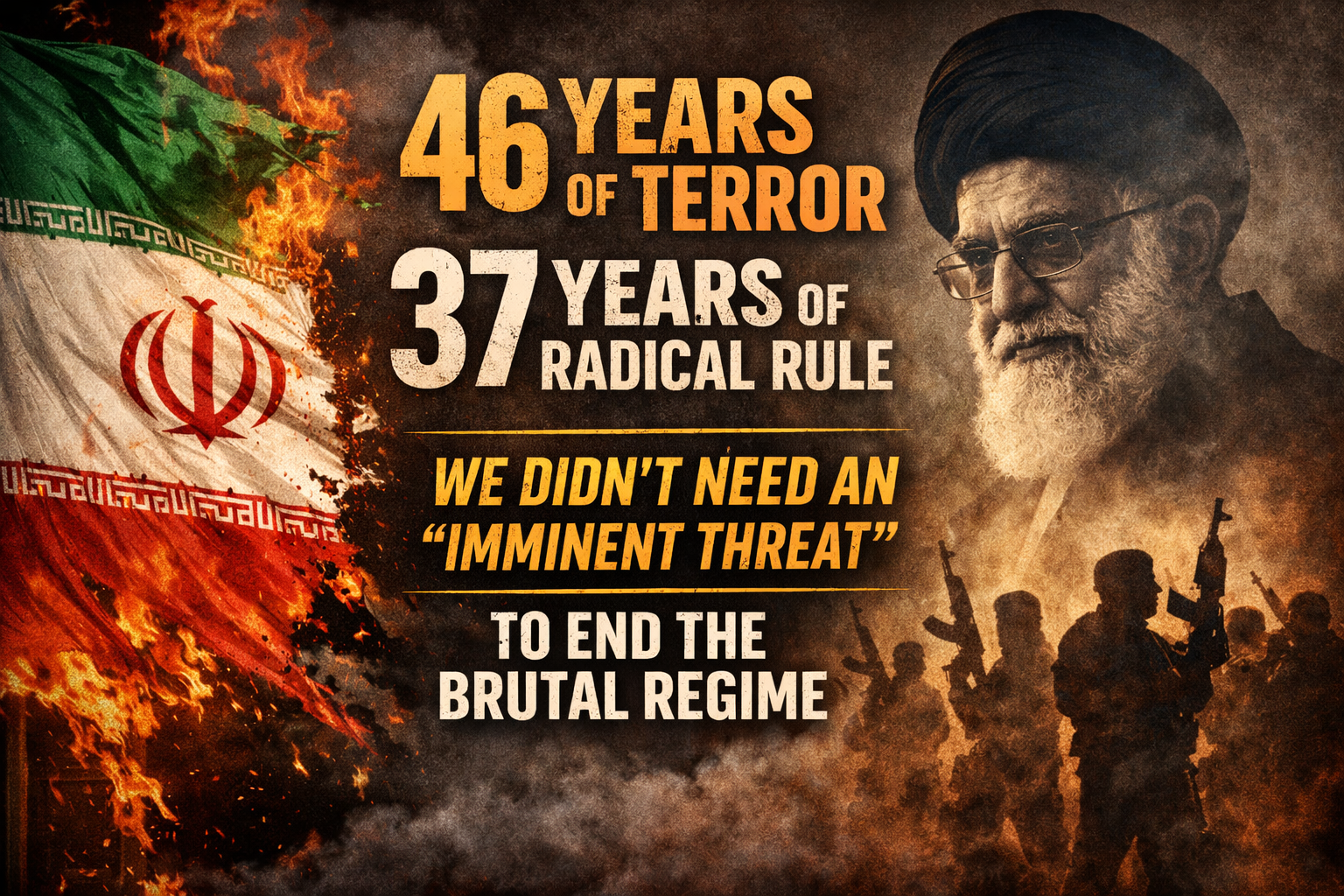
Every time direct action against Iran's ruling regime enters serious discussion, the same demand erupts across media and political circles: was there an imminent threat? The question is treated like a courtroom requirement, as though the world must produce a ticking clock, a countdown timer or intercepted attack plans before it is permitted to confront the Islamic Republic. That standard has been applied to this regime selectively and consistently, and it is worth examining what it actually does.
It resets the clock. Every time. It demands fresh proof of immediate danger while the accumulated record of forty-six years of state-sponsored terrorism sits quietly in the background, treated as though it expired at midnight when the previous news cycle ended.
That is not a rigorous analytical standard. It is a way of protecting a regime from the weight of its own history.
"The world never needed an imminent threat to justify confronting one of the longest-running state sponsors of terrorism in modern history. The record was always sufficient. The question was always whether anyone had the will to read it honestly."
The Regime Born in Hostage-Taking
The Islamic Republic came to power in 1979 when the Islamic Revolution replaced the Iranian monarchy with a theocratic state under Ayatollah Ruhollah Khomeini. Within months, the new government made its intentions unmistakable. Iranian militants seized the United States Embassy in Tehran and held 52 American diplomats hostage for 444 days. This was not a rogue action carried out against the regime's wishes. It was the opening act of the Islamic Republic on the world stage and the regime embraced it.
From its very first year, the Islamic Republic demonstrated a willingness to use intimidation, hostage-taking and direct confrontation with Western governments as instruments of state policy. That willingness did not diminish over time. It was institutionalized.
Forty-Six Years of Deliberate Export
Iran did not sponsor terrorism occasionally or opportunistically. It built an entire foreign policy architecture around it. Through the Islamic Revolutionary Guard Corps and its elite Quds Force, the regime spent decades funding and directing militant organizations across the Middle East and beyond. Hezbollah in Lebanon became Iran's most powerful and durable proxy, capable of operating across multiple continents and responsible for some of the most lethal attacks on American targets in the twentieth century. The 1983 bombing of the United States Marine barracks in Beirut killed 241 American service members. The simultaneous bombing of the United States Embassy killed more. These were not the acts of independent rogue militants. They were tied directly to Iranian-backed networks operating under IRGC direction.
The pattern extended across decades and geography. Iran backed Hamas and Palestinian Islamic Jihad in Gaza. It supported Shia militias across Iraq that repeatedly targeted American forces. It armed and funded Houthi rebels in Yemen whose campaigns threatened Red Sea shipping lanes and launched attacks on Saudi territory. It sustained the Assad regime in Syria through the civil war using Iranian forces and aligned militias. It built militant networks in Afghanistan. In every case the operating logic was the same: project Iranian power and ideology through proxies while maintaining enough distance to deny direct accountability.
Unlike a conventional military, the Islamic Revolutionary Guard Corps was created specifically to protect the revolutionary ideology of the regime rather than defend national territory in any traditional sense. Over time it became something far larger: a parallel state controlling foreign military operations, intelligence networks, proxy militia coordination and significant sectors of Iran's domestic economy. The Quds Force, its external operations arm, turned Iran into a central command hub for militant movements stretching from Lebanon to Yemen and produced decades of coordinated regional destabilization that no conventional military force could replicate at the same cost.
The Ideology Is Not Incidental
What distinguishes the Islamic Republic from other authoritarian regimes is not merely its military capacity. It is the doctrinal foundation that makes sustained confrontation with the West a constitutional feature of the state rather than a policy choice that a new government might reverse. The regime was built around Velayat-e Faqih , the doctrine of clerical rule, under which political authority rests with religious jurists claiming divine legitimacy. The hostility toward the United States and Israel embedded in that ideology is not rhetorical decoration. It is structural.
"Death to America" and "Death to Israel" are not fringe chants confined to the margins of Iranian political life. They are regularly heard at state-sponsored events and endorsed by senior officials as expressions of the regime's foundational commitments. A government that organizes public events around those declarations and has spent forty-six years acting on them is not a government that can be fully understood through the imminent threat framework. The threat is not a future event being planned. It is an ongoing condition being maintained.
The Nuclear Dimension
For years international negotiations attempted to constrain Iran's ability to develop nuclear weapons. Supporters of the diplomatic approach argued that agreements like the Joint Comprehensive Plan of Action could slow the program and reduce the risk of escalation. Critics argued the deal deferred the problem while leaving Iran free to continue funding its proxy network and expanding its regional influence. The debate over that tradeoff was and remains legitimate.
But the larger issue was never resolved by either position. A regime with a forty-six year record of state-sponsored terrorism, an ideological framework that demands confrontation with the West and a persistent drive toward advanced nuclear capability represents a combination that neighboring governments and Western security establishments were right to treat as qualitatively different from ordinary geopolitical competition. The nuclear program did not create the threat. It added a dimension to a threat that already existed and had already produced a body count measurable in thousands.
The Regime Against Its Own People
The international record does not capture the full scope of the Islamic Republic's violence. The regime has directed comparable energy toward suppressing the population it governs. Major protest movements in 2009, 2019 and 2022 were met with systematic crackdowns involving mass arrests, lethal force and the targeting of journalists, activists and organizers. The 2022 uprising, sparked by the death of Mahsa Amini in morality police custody, drew millions of Iranians into the streets across dozens of cities. The regime's response was to kill, imprison and terrorize its way back to stability.
The U.N. fact-finding mission on Iran documented a pattern of repression that may amount to crimes against humanity. Many Iranians have made clear through repeated protest that they do not regard the clerical leadership as legitimate representatives of their interests. The regime's survival depends on internal violence as much as it depends on the external projection of power that occupies most of the international discussion.
"The imminent threat standard treats Iran's forty-six year record as though previous acts of terrorism expire. They do not. History does not reset every news cycle and a serious foreign policy analysis should not pretend that it does."
My Bottom Line
The debate over whether Iran posed an imminent threat at any specific moment has always missed the larger point. The Islamic Republic has spent forty-six years engaged in state-sponsored terrorism, proxy warfare, nuclear ambition and the systematic repression of its own population. From the hostage crisis in 1979 to the proxy networks active today across Lebanon, Iraq, Yemen, Syria and Gaza, the record is long, well documented and continuous.
When a regime maintains that pattern across nearly half a century, the threat is not theoretical and it does not require fresh intelligence to establish. It is woven into the structure of the state itself. Evaluating Iran through the imminent threat framework while ignoring the accumulated historical record is not rigorous analysis. It is a choice to look away from evidence that has been accumulating for longer than most of the people debating it have been politically aware.
A country that has spent forty-six years as the world's leading state sponsor of terrorism does not need to be planning an imminent attack to constitute a serious and sustained threat. The record is the evidence. It always was.
Why This Matters
Policy debates about Iran consistently focus on short-term headlines rather than long-term patterns. That habit is not accidental. It benefits the regime by ensuring that each incident is evaluated in isolation rather than as part of a decades-long strategy. When governments repeatedly sponsor militant groups, destabilize neighboring states and suppress their own populations, the consequences accumulate whether or not the international community is paying attention to the full scope of the record. Understanding Iran requires looking at all of it, not just the most recent intelligence report, and drawing conclusions proportionate to what that record actually shows.
References
- Council on Foreign Relations. (2024). Iran's Revolutionary Guards.
- U.S. Department of State. (2023). State Sponsors of Terrorism.
- Levitt, M. (2013). Hezbollah: The Global Footprint of Lebanon's Party of God. Georgetown University Press.
- Byman, D. (2005). Deadly Connections: States That Sponsor Terrorism. Cambridge University Press.
- Office of the United Nations High Commissioner for Human Rights. (2026). Statement by the Independent International Fact-Finding Mission on the Islamic Republic of Iran, March 4, 2026.
Disclaimer: The views expressed in this post are the personal opinions of the author and are offered for educational, commentary and public discourse purposes only. They do not represent the positions of any institution, employer, organization or affiliated entity. Nothing in this post constitutes legal, financial, medical or professional advice of any kind. References to public figures, institutions, historical events and current affairs are based on publicly available sources and are intended to support analysis and argument, not to state facts about any individual's character, intent or conduct beyond what the cited sources support. Commentary on religious, political and cultural subjects reflects the author's independent analysis and is protected expression of opinion. Readers are encouraged to consult primary sources and form their own conclusions. Any resemblance to specific individuals or situations beyond those explicitly referenced is coincidental.