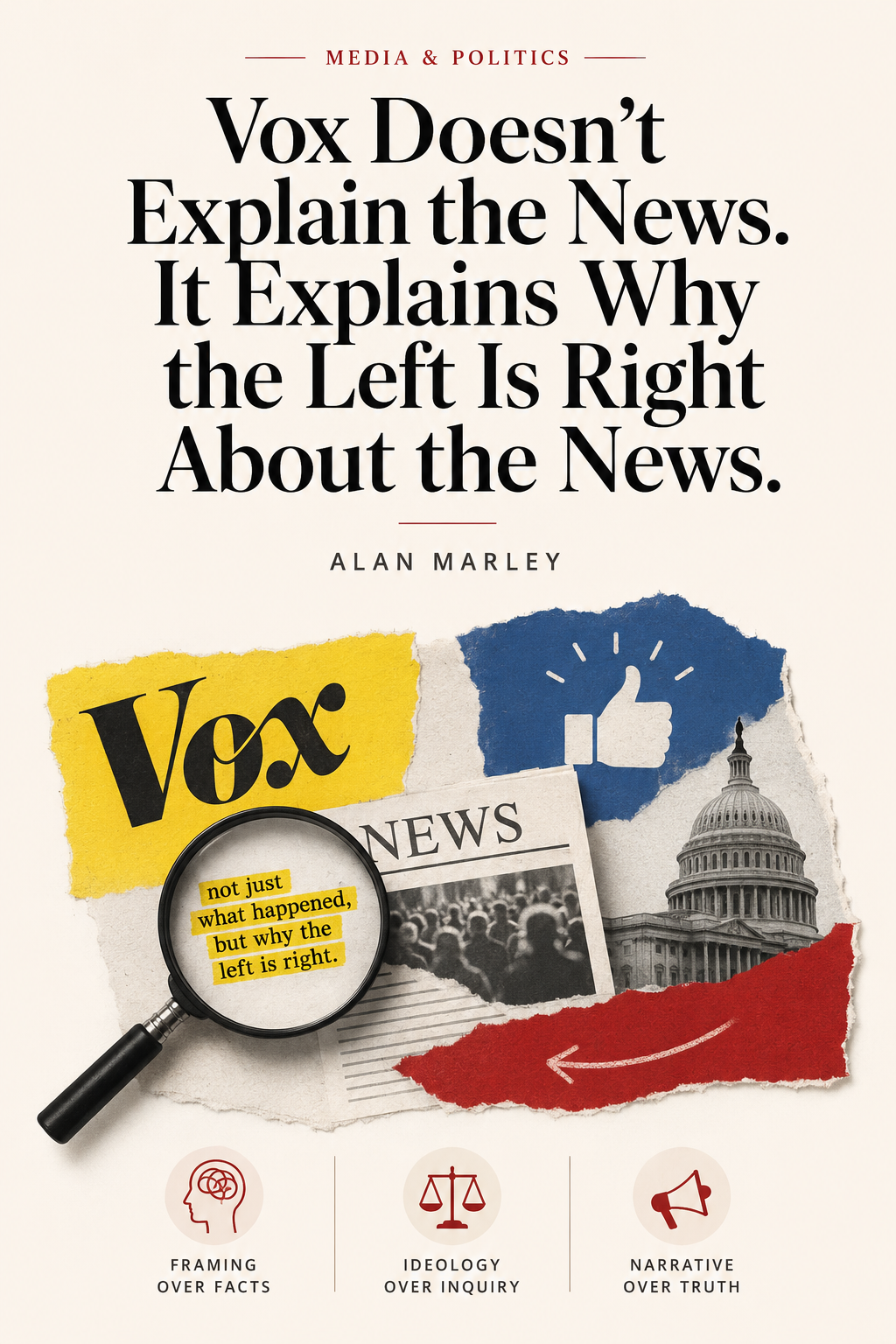
Vox was founded in 2014 by Ezra Klein, then a Washington Post columnist, with a stated mission to "improve the technology of news" by explaining things rather than just reporting them. The founding premise was that the media's real failure was not bias but context. People did not understand the news because nobody was explaining it properly. Vox would fix that. It would be the outlet that helped you understand why things were happening, not just what was happening. It was a clever founding story because it positioned the outlet above the partisan fray before it had published a single article. We are not biased. We are just more helpful than everyone else. Twelve years later, Vox has a well-funded operation, a credentialed staff and a clean factual record certified by multiple media watchdog organizations. It also has an editorial posture that AllSides rates at the leftmost end of its scale with high confidence, affirmed by multiple independent reviews. Both things are true simultaneously and the combination is exactly the problem. Vox is not dishonest. It is something more sophisticated and more misleading than that. It is accurate progressive advocacy wearing the institutional clothing of neutral explanation.
The "Explainer" Frame Is the Bias
The genius of Vox's founding concept is that the explainer format itself encodes a political stance before the first word of any article is written. Explanation requires a framer. Someone has to decide what needs explaining, which context is relevant, which experts to consult, which historical parallels are instructive and which conclusions naturally follow from the evidence assembled. At a genuinely neutral outlet those choices would reflect a range of perspectives on what matters and why. At Vox those choices consistently reflect one perspective. The outlet decides what the important context is, selects the experts who agree with that framing and then presents the result as simply what an informed person would conclude after understanding the full picture.
That is not neutral. That is a specific editorial position presented as the natural conclusion of being well-informed. The reader who absorbs Vox's explanation does not come away thinking "I now understand the range of perspectives on this issue." They come away thinking "I now understand the issue," which means they have absorbed the progressive framing as settled fact rather than as one analytical framework among several. It is more effective as propaganda than a straightforward editorial because it removes the reader's defensive instinct. You put your guard up when you read an opinion piece. You do not put it up when someone is helpfully explaining things to you.
AllSides rates Vox at the leftmost position on its scale with high confidence, affirmed by independent reviews in 2018, 2022 and 2023. Media Bias Fact Check rates it Left Biased due to editorial positions and story selection that routinely favor the left. Biasly's analysis identifies consistent patterns in phrasing and source selection reflecting a medium-to-strong left bias across political coverage. These are not conservative critics. These are media monitoring organizations applying consistent methodologies across the political spectrum. The consensus is clear and consistent.
Story Selection Is the Most Powerful Form of Bias
The most effective form of media bias is not inaccuracy. It is selection. An outlet that reports only accurate facts but chooses which facts to report, which stories to cover and which angles to pursue can produce a profoundly distorted picture of the world without ever printing a false sentence. Vox has mastered this form. AllSides' April 2025 "Shaping the Narrative" analysis examined which topics Vox covered most frequently and found that story choice consistently reflected progressive priority-setting. The stories that advance a progressive narrative get covered. The stories that complicate it get ignored or receive significantly less attention.
Consider what a Vox reader learns about regularly and what falls through the cracks. Climate change gets extensive and alarmed coverage. The economic costs of aggressive climate policy get minimal coverage. Immigration enforcement gets covered through the lens of its humanitarian costs. The public safety costs of immigration non-enforcement get minimal coverage. DEI programs in institutions get covered as equity initiatives. The documented outcomes of those programs, including declining academic standards and workforce allocation distortions, get minimal coverage. This is not lying. It is curating. The picture that emerges from the curation is progressive. The reader who relies on Vox as a primary news source is not being lied to. They are being shown a carefully selected portion of reality and told it is the whole thing.
The Expert Problem
Vox's explanatory format relies heavily on expert sourcing. This is presented as evidence of rigor. Read any Vox explainer on a contested policy question and you will find multiple credentialed sources, academic citations and institutional data. What you will rarely find is a balance of credentialed perspectives that reflects the actual range of expert opinion on the subject. Vox's experts are predominantly drawn from academia and nonprofit institutions that are themselves heavily left-leaning. When those experts are used to explain contested policy questions, their framing gets presented as what the evidence shows rather than as one credentialed perspective among several.
On immigration policy, Vox consistently sources from academics and advocacy organizations that view enforcement as harmful. On climate, it sources from scientists who favor aggressive regulatory responses and rarely from economists who study the cost-benefit tradeoffs of specific policies. On criminal justice, it sources from reform advocates and rarely from criminologists who study the public safety consequences of specific reform policies. Each individual source is credentialed. The selection of which credentials appear in which stories is not neutral. It is editorial. And it consistently points in one direction.
Accurate facts plus selective framing plus progressive expert sourcing, presented as neutral explanation, is not journalism. It is the most sophisticated form of advocacy money can buy. Vox has raised $447 million doing exactly that.
The Ezra Klein Problem
Ezra Klein left Vox in 2021 to join the New York Times as an opinion columnist and podcast host. His departure from the outlet he founded did not change its editorial DNA because that DNA was never neutral to begin with. Klein is a gifted writer and a serious thinker who is also transparently and consistently progressive in his policy views. He built Vox in his own intellectual image. The outlet's coverage of healthcare reflects his longstanding advocacy for single-payer systems. Its coverage of economic policy reflects his skepticism of market solutions to social problems. Its coverage of political institutions reflects his view that those institutions require significant progressive reform. Klein's personal politics are coherent and honestly held. The problem is that they were embedded in an outlet whose founding premise was that it was above politics.
Matthew Yglesias, another co-founder, eventually departed Vox after finding even its progressive consensus too restrictive for honest analysis, launching his own Substack where he has written pieces critical of progressive orthodoxy on housing, education and criminal justice. When one of your co-founders leaves because the outlet he built is too ideologically constrained for honest analysis, that tells you something about the constraint.
The Sam Bankman-Fried Connection
Vox's "Future Perfect" vertical, which covers global health, animal welfare and long-term risk, received grant funding from FTX Foundation, which was connected to Sam Bankman-Fried. When Bankman-Fried was arrested in December 2022 on eight counts of fraud and conspiracy, Vox Media acknowledged the relationship and stated that $14,000 of the funds had been suspended prior to his resignation and that it intended to return the balance to any restitution fund created. This episode does not prove Vox's journalism was corrupted by the relationship. It does illustrate that the outlet presenting itself as pure explanatory journalism has funding relationships with donors whose interests it was simultaneously covering. That is not a neutral position and it deserved more scrutiny than it received from Vox's admirers in the media ecosystem.
What Honest Explanatory Journalism Would Look Like
There is nothing wrong with the explanatory journalism concept in principle. Context genuinely matters. Background genuinely helps readers understand complex issues. The problem is not the format. The problem is executing the format from a single ideological vantage point and calling the result neutral. Honest explanatory journalism on immigration would explain the economic arguments on multiple sides, the public safety evidence on multiple sides and the humanitarian considerations on multiple sides, then let the reader weigh them. Honest explanatory journalism on climate policy would explain the scientific evidence on warming, the genuine uncertainty ranges in climate models, the economic costs of different response frameworks and the distributional effects of specific policies. Honest explanatory journalism on criminal justice would explain both the civil liberties arguments for reform and the public safety evidence on what specific reforms have produced in specific cities.
Vox does none of that consistently. It explains one side and presents the explanation as the full picture. That is advocacy. Calling it explanation is the deception, and it is a more effective deception than raw opinion because it strips the reader of the skepticism they would bring to an openly labeled opinion piece.
My Bottom Line
Vox is a well-produced progressive advocacy outlet that has convinced a significant portion of its audience that consuming it makes them better informed rather than differently informed. Its facts are generally accurate. Its sourcing is generally credentialed. Its writing is generally clear. All of that professionalism is in service of a consistent ideological project that its founding frame was specifically designed to obscure. The "we just explain things" premise is the most important piece of content Vox has ever published because it inoculates the reader against noticing the bias in everything that follows. If you already believe you are reading neutral explanation, you do not look for the framing. You absorb it.
Reading Vox is not the same as being uninformed. It is the same as being informed from one direction while believing you have seen all directions. That is a specific epistemic condition and it is worse than simply being ignorant, because ignorance knows what it does not know. A reader who has been comprehensively explained to by Vox does not know what they have not been told. They think they understand. They understand one carefully curated version of the truth. The lab coat is the tell. Genuine neutrality does not need to announce itself. The outlets most insistent on their own objectivity are almost always the ones with the most to hide.
Vox does not explain the news. It explains why, if you understood the news properly, you would agree with the left. That is a different service. They should advertise it honestly.
Why This Matters
It matters because millions of educated, engaged Americans use Vox as a primary source for understanding complex policy questions. Those readers are not stupid. They are being given a sophisticated product designed to produce a specific set of conclusions while feeling like independent analysis. A reader who has been through a Vox explainer on healthcare, immigration, criminal justice and climate change has not been lied to. They have been shaped. The shaping is invisible by design. That is more dangerous to honest public discourse than a straightforwardly partisan outlet that announces what it is, because at least the partisan outlet lets you know to bring your own skepticism. Vox takes your skepticism at the door and hands you a credential instead.
References
- AllSides. (2026). Vox media bias rating: Left, high confidence. allsides.com.
- Media Bias Fact Check. (2024). Vox: Left biased, high factual reporting. mediabiasfactcheck.com.
- Biasly. (2025). Vox media bias analysis. biasly.com.
- AllSides. (2025, April). Shaping the narrative: Story choice bias analysis across the political spectrum. allsides.com.
- Influence Watch. (2023). Vox Media: Funding, ownership and editorial history. influencewatch.org.
- PitchBook. (2026). Vox Media company profile: $447M raised, investors include NBCUniversal and Rockefeller Foundation. pitchbook.com.
- Klein, E. (2014). Vox founding statement: Explaining the news. vox.com.
- Yglesias, M. (2021). Why I'm leaving Vox. slowboring.com.
Disclaimer: The views expressed in this post are the personal opinions of the author and are offered for educational, commentary and public discourse purposes only. They do not represent the positions of any institution, employer, organization or affiliated entity. Nothing in this post constitutes legal, financial, medical or professional advice of any kind. References to public figures, institutions and media organizations are based on publicly available sources cited above. Commentary on media bias reflects the author's independent analysis and is protected expression of opinion. Readers are encouraged to consult primary sources and form their own conclusions.