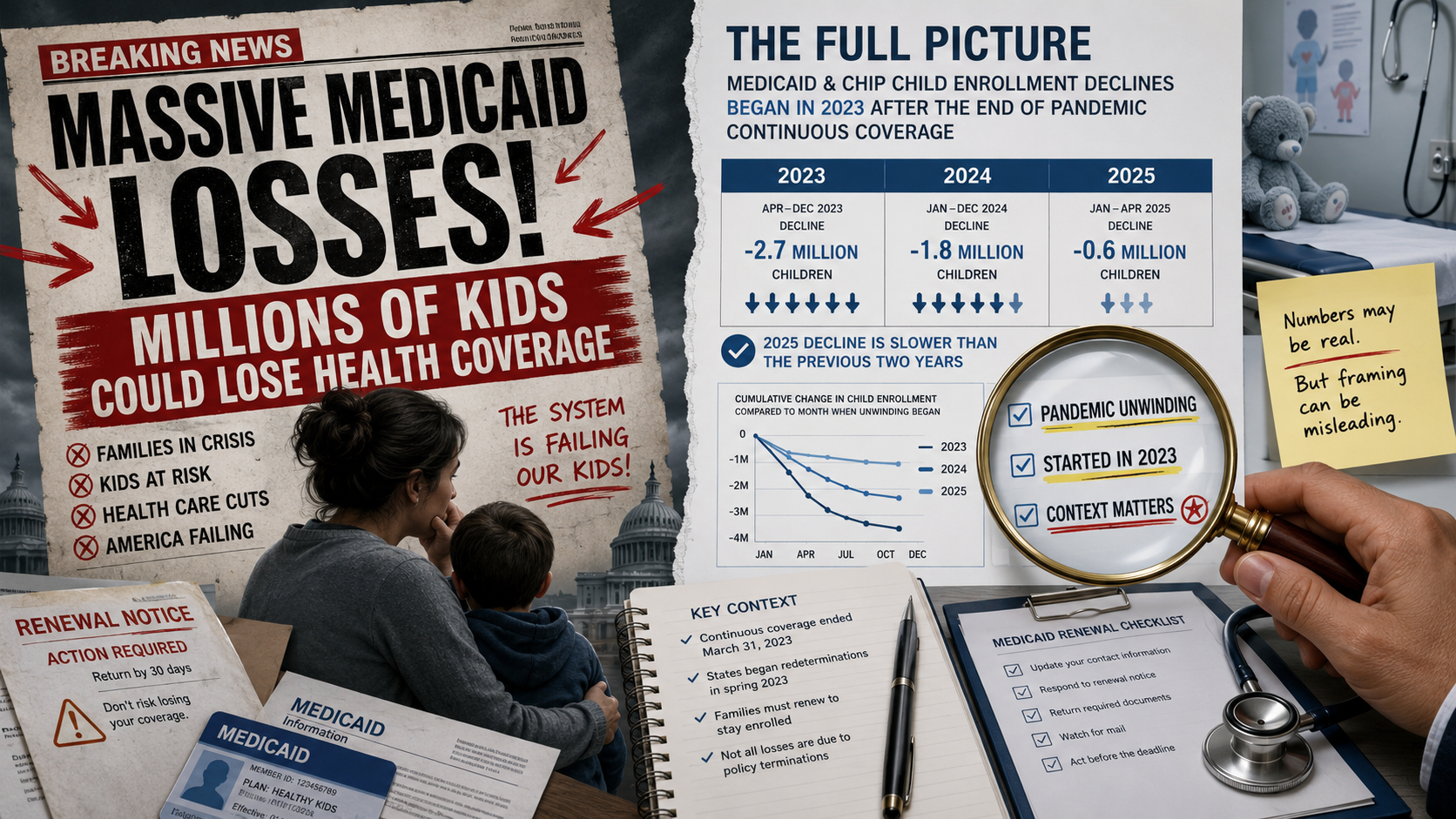
A June 5 KFF Health News piece carries a headline designed to produce maximum alarm: "Millions of Kids Could Lose Insurance as GOP Healthcare Cuts Start To Bite." The source for its central claim, that nearly 2 million children have lost insurance, is a Georgetown University Center for Children and Families analysis of Medicaid and CHIP enrollment data. KFF and Georgetown have a long-standing research partnership. The numbers are real. The enrollment decline is real. What is not real is the article's implicit claim that this enrollment decline is primarily a story about Republican cuts biting children. When you read what Georgetown's own data actually shows, the article's framing falls apart in ways the headline does not prepare you for.
What Georgetown's Own Data Actually Says
The Georgetown CCF tracker Georgetown itself acknowledges that Medicaid and CHIP enrollment declined by approximately 3.3 million individuals across all age groups during 2025, though it also notes this was a more modest rate of decline than the previous two years. More importantly for the KFF story's framing, Georgetown explicitly states this is the third straight year of enrollment declines following the unwinding of pandemic-era continuous coverage protections that began April 1, 2023. Nationally, enrollment declined by about 8 percent between December 2022 and December 2023, and by 7 percent between December 2023 and December 2024. Those are Biden-era declines. The 4 percent decline in 2025 that the KFF article treats as evidence of GOP cuts biting is actually slower than the two preceding years under Democratic leadership.
Georgetown makes this explicit in its own published analysis: "This is the third straight year of enrollment declines following the unwinding of pandemic-era continuous coverage protections." The pandemic continuous coverage requirement forced states to keep people enrolled in Medicaid regardless of eligibility from 2020 through April 2023. When that requirement ended, states began redetermining eligibility and millions who had been automatically kept on the rolls, many no longer eligible, were removed. That unwinding process was mandated by bipartisan legislation and began while Biden was president. It is the dominant driver of Medicaid enrollment declines across the entire period the KFF article covers.
Medicaid enrollment peak: early 2023, at the end of pandemic continuous coverage. Unwinding begins April 2023 under Biden. Enrollment declines 8% in calendar year 2023. Enrollment declines 7% in calendar year 2024. Trump takes office January 2025. Enrollment declines 4% in calendar year 2025, slower than either prior year. Georgetown explicitly notes the 2025 decline is occurring "largely prior to the impacts of H.R. 1." KFF's article presents this third year of a pre-existing trend as evidence of GOP cuts biting. That is not what the data shows.
Georgetown's Own Admission: The Cuts Have Not Kicked In Yet
This is the most important fact in the entire story and it appears in Georgetown's own source material rather than in the KFF article. Georgetown writes explicitly that the current enrollment declines are "happening largely prior to the impacts of H.R. 1." The work reporting requirements that are the primary mechanism for the future enrollment reduction the article worries about do not take effect for most states until January 1, 2027. Only Nebraska, Montana and Iowa are implementing early. The article's headline says cuts are "starting to bite." Georgetown's own analysis says they have barely started.
The gap between those two things matters. If enrollment has declined by 2 million children before the primary mechanism of the cuts being blamed has even taken effect, the most intellectually honest question is: what is actually causing the current decline? The KFF article does not answer that question directly. It implies the answer is Republican policy. Georgetown's data points to the pandemic unwinding as the dominant driver, with immigration enforcement contributing an additional factor. Both of those are worth covering honestly. Attributing the decline primarily to cuts that Georgetown acknowledges have not yet taken full effect is not honest coverage. It is anticipated-outcome journalism presented as current-fact reporting.
The Pandemic Unwinding: The Cause the Article Minimizes
From April 2023 through the end of the Biden administration, states processed millions of Medicaid redeterminations that had been suspended during the pandemic. People who were no longer income-eligible, people who had moved, people who had obtained employer coverage and people who simply did not respond to renewal notices were all removed from the rolls. Academic research published in the journal Health Services Research found that during the unwinding period from April 2023 through September 2024, Medicaid enrollment declined from 48.1 percent to 41.2 percent of children, a drop of nearly 7 percentage points. CHIP enrollment remained stable at around 8.7 percent, meaning the children leaving Medicaid were not being absorbed into CHIP at offsetting rates.
This unwinding process was the product of a policy decision made by a Democratic Congress in the Consolidated Appropriations Act of 2023, the legislation that ended the continuous enrollment requirement. States were given flexibility in how they conducted the unwinding, and some did it better than others. Blue states and red states both had significant problems. The fundamental driver was a return to normal eligibility determination after three years of automatic enrollment. That return was always going to produce a significant enrollment decline. Presenting that decline as evidence of GOP cuts requires ignoring the three years of context that produced it.
A Medicaid enrollment decline that began in April 2023 under Biden, accelerated through 2023 and 2024 under Biden, and slowed in 2025 is not primarily a story about Republican cuts. It is a story about the end of pandemic emergency policy. KFF knows this. The article's framing depends on the reader not knowing it.
The Immigration Factor and the Chilling Effect
Georgetown's analysis does identify one genuine Trump administration contribution to the current enrollment decline: the chilling effect of immigration enforcement on Medicaid enrollment and renewal among immigrant families. CMS granted ICE access to Medicaid data and proposed changes to the public charge rule that created fear and confusion among mixed-status families, meaning households where some members are citizens or lawful residents and some are not. Georgetown notes this as a factor in enrollment declines in states with large immigrant populations. That is a real and documentable effect that deserves honest coverage. The KFF article mentions it briefly.
The question is proportionality. How much of the 2 million child enrollment decline is explained by the immigration chilling effect versus the ongoing pandemic unwinding versus routine eligibility redetermination versus children aging out of CHIP versus administrative processing delays? The article does not answer that question because the answer would require parsing a decline that has multiple causes, some of which predate the current administration and some of which have nothing to do with the cuts being blamed. Mixing those causes together under the headline "GOP cuts starting to bite" is the same rhetorical move the Pennsylvania Families Over Billionaires graphic used. Combine real trends with anticipated consequences and present the combination as current Republican culpability.
What the Article Gets Right
The concern about H.R. 1's future impact is legitimate and should not be dismissed. The work reporting requirements taking effect in 2027 have a documented history of reducing Medicaid enrollment. Arkansas implemented work requirements before the courts struck them down and saw rapid enrollment drops that affected eligible people, not just those failing to meet the work requirement. The ACA premium subsidy changes in H.R. 1 will produce higher marketplace premiums that price some families out. The eligibility restrictions for certain immigrant categories take effect in October 2026 and will remove people who were previously eligible. These are real policy consequences worth reporting seriously. Georgetown's concern that the enrollment declines currently underway will accelerate significantly when H.R. 1 provisions take full effect is a reasonable projection based on historical evidence.
The problem is not that KFF covered this story. The problem is that it covered a future concern as a present fact, attributed a pre-existing trend primarily to a cause that has not yet fully materialized and presented the result under a headline designed to maximize outrage rather than maximize understanding. A story that said "Medicaid enrollment has declined by 2 million children since the pandemic unwinding began in 2023, and experts warn H.R. 1 provisions taking effect in 2027 could produce significantly larger declines" would be accurate, fair and genuinely informative. That is not the story KFF told.
My Bottom Line
The KFF Health News article is not fabricated. The enrollment numbers are real. The Georgetown data is real. The concern about H.R. 1's future effects is legitimate. What is not accurate is the article's causal framing, specifically its presentation of a pre-existing, multi-year enrollment decline driven primarily by the end of pandemic emergency policy as evidence that Republican cuts are currently biting children. Georgetown's own data contradicts that framing. The 2025 decline is slower than either of the two preceding Biden-era years. Georgetown explicitly states the cuts have not yet taken full effect. The dominant driver of the current decline is the pandemic unwinding that began in 2023. These are not Republican talking points. They are what the article's own primary source says when you read it carefully rather than accepting the headline's conclusion at face value.
The numbers are real. The framing is not. A Medicaid decline that started in 2023, accelerated in 2024 and slowed in 2025 is not evidence of cuts biting in 2026. It is evidence of a trend being renamed for political convenience.
Why This Matters
Health coverage for children is a serious policy issue that deserves serious coverage. When credentialed outlets with genuine expertise produce coverage that systematically attributes pre-existing trends to new causes, mixes current declines with projected future declines and presents anticipated consequences as current facts, the public's ability to evaluate actual policy tradeoffs is damaged. People who read the KFF article and share it believe they are sharing facts about what Republican cuts are currently doing to children. They are sharing a projection about what Republican cuts may eventually do to children, wrapped in a framing that obscures how much of the current decline predates those cuts. The difference matters when the goal is informed democratic debate about healthcare policy.
References
- KFF Health News / Rovner, J. (2026, June 5). Millions of kids could lose insurance as GOP healthcare cuts start to bite. kffhealthnews.org.
- Georgetown University Center for Children and Families. (2026, May 28). Two million fewer children are enrolled in Medicaid since Trump took office. ccf.georgetown.edu.
- Georgetown University Center for Children and Families. (2026, May 8). Drop in child Medicaid and CHIP enrollment even before HR 1 policies take full effect is troubling sign. ccf.georgetown.edu.
- Georgetown University Center for Children and Families. (2026, February 26). New state-by-state Medicaid and CHIP tracker shows declining enrollment as H.R. 1 cuts loom. ccf.georgetown.edu.
- Eliason, E.L., et al. (2025). Children's enrollment in CHIP coverage during the Medicaid unwinding. Health Services Research. DOI: 10.1111/1475-6773.70078.
- KFF / Georgetown CCF. (2026, April 30). Medicaid and CHIP eligibility, enrollment, and renewal policies as states prepare for major Medicaid policy changes. kff.org.
- Consolidated Appropriations Act of 2023. (2023). Pub. L. 117-328, provisions ending continuous coverage requirement.
Disclaimer: The views expressed in this post are the personal opinions of the author and are offered for educational, commentary and public discourse purposes only. They do not represent the positions of any institution, employer, organization or affiliated entity. Nothing in this post constitutes legal, financial, medical or professional advice of any kind. References to policy research, legislation and current affairs are based on publicly available sources cited above. Commentary on political and policy subjects reflects the author's independent analysis and is protected expression of opinion. Readers are encouraged to consult primary sources and form their own conclusions.