
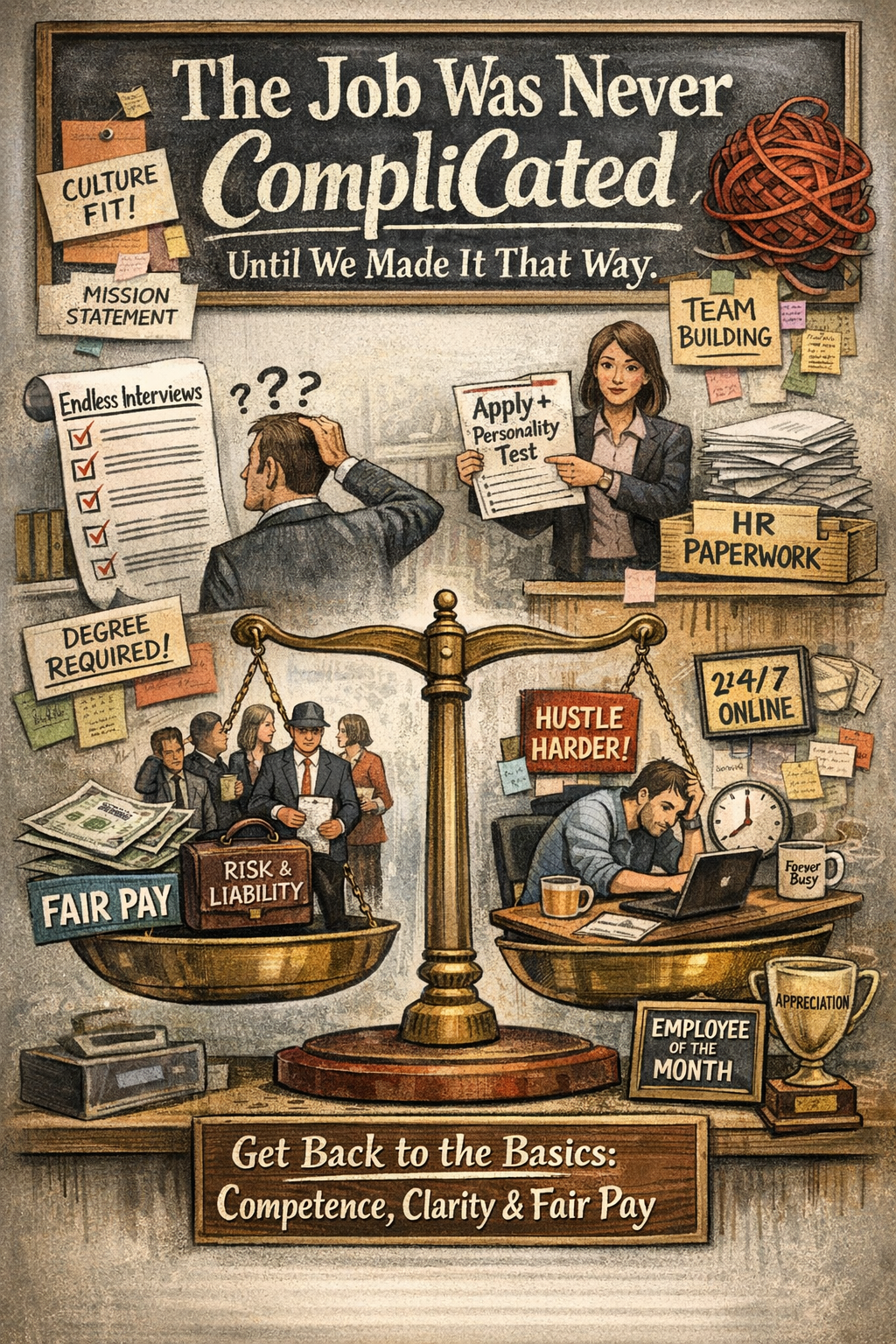
I have been on both sides of the employment relationship. I have been the person trying to get the job and the person trying to fill it. I have run a business, managed people and watched the American workplace transform itself over the last thirty years in ways that have made it simultaneously more elaborate and less functional. The tools are better. The communication is faster. The language around work has become richer, more therapeutic, more carefully calibrated. And yet the fundamental transaction - you show up, you do the work, you get paid - has become buried under so much philosophical scaffolding that many employers can no longer clearly state what they need and many employees can no longer honestly say why they are there. Both sides are operating under a set of cultural myths about work that have accumulated since the 1990s and that have produced, together, a workplace culture in desperate need of an honest overhaul. This is not a call for harshness. It is a call for clarity. Those are different things, and right now clarity is the rarer quality.
What the Employee Is Actually Dealing With
Being an employee is genuinely hard in ways that do not get acknowledged honestly. Not hard in a victim sense - working for a living is the normal condition of adult life and nobody owes anyone an apology for it. Hard in the sense that the employment relationship is fundamentally asymmetrical in ways that require constant navigation. The employer sets the terms. The employer can change the terms. The employer can end the relationship with legal notice. The employee can do the same, but the practical consequences of doing so are far more severe for most workers than the practical consequences of losing one employee are for most employers. That asymmetry is not evil. It is structural. But it is real, and pretending it does not exist in the name of positive workplace culture does not make it go away. It just prevents honest conversation about it.
Employees today are also dealing with a hiring process that has become absurdly complicated relative to the actual information it produces. Five rounds of interviews. Personality assessments. Culture fit evaluations. Panel interviews with people who will have nothing to do with the candidate once they are hired. Skills tests administered to people who already have ten years of experience doing the job in question. Work samples requested for free before an offer is made. The process has expanded massively while the outcomes have not improved proportionally, and in many cases employers are losing strong candidates to competitors who are willing to make a decision in three weeks rather than three months. The hiring process has become a bureaucratic performance of diligence rather than an efficient system for identifying qualified people, and the people absorbing most of the cost of that performance are the candidates who have to participate in it repeatedly, often while employed full-time somewhere else.
The hiring process has become a bureaucratic performance of diligence rather than an efficient system for identifying qualified people. The people absorbing most of that cost are the candidates who have to participate in it repeatedly.
What the Employer Is Actually Dealing With
The employer's position is also genuinely difficult in ways the culture of worker advocacy tends to understate. Finding someone who can do the work is only the beginning. That person also has to show up reliably, communicate honestly when something is not working, accept feedback without treating it as an attack on their identity and exercise reasonable judgment in the situations that no job description anticipated. Those qualities are not rare but they are not universal either, and the ability to screen for them before making a hiring commitment is genuinely limited. References have been neutered by liability concerns. Probationary periods are a legal minefield in some states. And the cultural pressure to be a good employer now includes requirements to be emotionally supportive, professionally developmental, physically flexible and philosophically aligned with a constantly shifting set of expectations about what a positive workplace environment looks like.
Small business owners feel this especially acutely because they do not have HR departments to absorb the compliance burden, employee assistance programs to outsource the support function or legal teams to navigate the regulatory environment. When a small business owner hires someone, they are betting a significant share of their productive capacity on one person's reliability, competence and judgment. A bad hire at a large corporation creates paperwork. A bad hire at a ten-person company can threaten the business. That reality rarely appears in the workplace culture conversations that are primarily conducted from the vantage point of large organizations with professional HR functions. The small employer is often the most vulnerable party in the employment relationship but is rarely treated as such in the public discourse about work.
The regulatory environment surrounding employment has expanded continuously for decades and shows no signs of contraction. Federal and state requirements around classification of workers, overtime eligibility, leave entitlements, accommodation obligations, anti-discrimination law, documentation requirements and termination protocols have created a system in which the administrative cost of employment is substantial even before anyone does any actual work. A Society for Human Resource Management survey found that small businesses spend significantly more per employee on HR compliance than large companies because they cannot spread fixed costs across a large workforce. That compliance burden is not primarily felt by corporations with dedicated legal and HR teams. It is felt by the restaurant owner, the contractor, the clinic operator and the small manufacturer trying to grow a business without a law degree. The conversation about making employment work better has to account for this reality or it produces policy that helps large employers while crushing small ones.
What Happened to Qualified
Somewhere in the last two decades, qualification became almost a secondary consideration in hiring. The primary consideration became fit - cultural fit, values fit, team fit, mission fit and a dozen other varieties of fit that are genuinely difficult to define, nearly impossible to measure and perfectly calibrated to introduce subjective bias into a process that is supposed to be about competence. I understand where this came from. The research on organizational culture and its effects on performance is real. Teams that communicate well, share basic operating assumptions and trust each other do produce better outcomes than teams that do not. Culture matters. The problem is that culture fit has become a filter applied before qualification is assessed, which inverts the correct priority. A person who is highly qualified and slightly different in style or personality from the existing team is generally a better hire than a person who is perfectly culturally matched and marginally qualified. The first problem - integrating a capable person - is manageable. The second problem - compensating for inadequate capability with cultural warmth - is not.
Credential inflation has compounded this problem. Requiring a four-year degree for jobs that do not require the knowledge a four-year degree provides has narrowed the qualified applicant pool, increased employer costs, increased the debt burden on workers and produced no measurable improvement in job performance for the affected roles. The Harvard Business School's research project on credential inflation - what it termed degree inflation - documented that employers frequently listed bachelor's degree requirements for roles that the same employers' existing workforce performed successfully without them. The requirement was not about competence. It was about risk reduction, signal quality and the comfort of institutional credentialing. It was, in other words, a substitute for actually evaluating whether someone could do the job. A company that requires a degree for a role that does not genuinely need one is not making a careful hiring decision. It is outsourcing its judgment to a different institution.
The 40-Hour Week and What Replaced It
The 40-hour workweek was not a gift from benevolent capitalism. It was the result of decades of organized labor pressure, codified in the Fair Labor Standards Act of 1938, and it represented a hard-won standard that recognized human beings have limits on productive concentration and that work beyond those limits produces diminishing returns and human costs. The research base on this is substantial and consistent. Productivity per hour worked declines sharply after approximately 50 hours per week. Quality deteriorates. Error rates increase. The costs of fatigue accumulate in ways that show up eventually in turnover, health outcomes and the kind of catastrophic errors that tend to happen to exhausted people in complex environments.
What replaced the 40-hour week in much of the professional economy was not a better alternative. It was the elimination of the boundary combined with the introduction of a new vocabulary for talking about its elimination. Unlimited PTO sounds generous until you notice that research consistently shows it produces less vacation taken on average than accrued PTO because the psychological permission to take time off is weaker without an explicit entitlement. Remote work sounds flexible until the boundary between work time and personal time dissolves so completely that people are answering emails at ten on Sunday night because the laptop is in the kitchen and there is no commute to mark the end of the working day. Hustle culture dressed work beyond reasonable limits in the language of passion, commitment and entrepreneurial identity. The workers who were most susceptible to this framing tended to be the younger and more ambitious ones - precisely the people whose sustained performance over a long career the organization most needed to protect.
Unlimited PTO sounds generous until you notice it produces less vacation taken on average than accrued PTO. The boundary was the benefit. Removing the boundary and calling it freedom was not an upgrade.
Appreciation Is Real. It Is Not the Point.
I want to be careful here because the cultural overcorrection in one direction does not justify overcorrection in the other. Employees are human beings and human beings respond to recognition, respect and the sense that their contribution is visible to the people who benefit from it. That is not a soft management philosophy. It is a documented finding in organizational psychology that traces back at least to Elton Mayo's Hawthorne studies in the 1920s and has been replicated in various forms across a century of workplace research. Acknowledgment, reasonable autonomy and a sense of meaningful contribution do affect performance, retention and wellbeing in ways that show up in measurable outcomes. None of that is the problem.
The problem is the substitution of appreciation theater for adequate compensation. Companies that install ping-pong tables, bring in catered lunches, hold quarterly recognition ceremonies and build elaborate cultural programming around purpose and belonging while paying below-market wages have not figured out how to be good employers. They have figured out how to spend less money on compensation than their competitors while generating enough ambient positivity that employees feel rude for noticing. The research is clear on this too: among the factors that affect employee satisfaction and retention, compensation is foundational. It does not replace meaning or recognition, but it is the floor that everything else rests on. An employee who feels appreciated but cannot pay their rent is not a satisfied employee. They are a flight risk with good manners.
Gallup's State of the Global Workplace report has consistently found that pay and benefits rank among the top reasons employees leave organizations, with compensation being the most commonly cited factor in both voluntary turnover and job search behavior. A 2023 McKinsey survey found that inadequate compensation was the leading reason workers left jobs during and after the pandemic period described as the Great Resignation. Meanwhile the factors employers most commonly believe drive retention - flexible schedules, purpose-driven culture and learning opportunities - ranked lower in employee self-reports than employers anticipated. This gap between what management believes motivates workers and what workers actually report motivating them is not new. It has appeared consistently in employment research for decades. Employers tend to overweight the non-monetary factors because those are cheaper to provide. The employees keep telling them the honest answer. The gap persists because closing it costs money.
What an Overhaul Actually Looks Like
The overhaul I am arguing for is not a return to the command-and-control management of the mid-twentieth century. That model produced compliance without engagement, tolerated abuse as a feature and left entire categories of workers outside its protections. The answer to the current excess of therapeutic workplace philosophy is not authoritarian management. It is honesty about what the employment relationship actually is and what both sides actually owe each other. That honesty has to be operational, not philosophical. Here is what it looks like in practice.
On the hiring side, cap the process at three rounds for any role below the senior leadership level. First round screens qualification. Second round assesses judgment and situational problem-solving. Third round, if needed, involves the direct manager and one peer. After that, you are not learning more. You are stalling because you are uncomfortable making decisions, and the discomfort is costing you good candidates who accept elsewhere while you schedule round four. Reinstate skills testing for roles where skills are objectively measurable and stop requiring four-year degrees for roles where the work itself does not require what a four-year degree provides. Make the offer in writing with a clear compensation figure, not a range so wide it functions as a negotiating ambush. Tell rejected candidates why in one sentence. It costs nothing and it is the decent thing to do.
On hours, write a policy and hold to it. If the role is 40 hours, mean it. If it regularly runs 50, either staff it correctly, pay overtime or reclassify it honestly. Stop using flexibility as a substitute for adequate compensation and stop treating employees who leave at five as lacking commitment when you hired them for a 40-hour role. The manager who routinely emails at nine at night and expects responses is not demonstrating work ethic. They are demonstrating poor planning and importing that planning failure into everyone else's evening. Availability outside core hours should be negotiated explicitly and compensated explicitly, not assumed and absorbed silently.
On feedback, tell people what is not working before it becomes a termination conversation. A performance problem that surprises an employee at the termination meeting is a management failure, not an employee failure. It means the manager avoided the discomfort of an honest conversation for months while the situation deteriorated. The honest conversation is uncomfortable for about twenty minutes. The termination is uncomfortable for considerably longer and costs the organization recruiting fees, training time and institutional knowledge. The math strongly favors the twenty-minute conversation. Most managers choose the termination anyway because the culture around feedback has become so fragile that honest assessment feels like aggression. It is not aggression. It is the job.
My Bottom Line
The employment relationship is a transaction. That does not make it cold or dehumanizing. Transactions can be conducted with respect, fairness and genuine regard for both parties. But calling it what it is - an exchange of labor for compensation, governed by agreed conditions, enforceable by both parties - does not diminish it. It clarifies it. The person who shows up reliably, does the work competently and keeps their commitments is not failing to have a profound relationship with their employer. They are being a professional. That is enough. It should be honored as enough.
The employer who pays fairly, states expectations clearly, evaluates performance honestly and treats departures - in both directions - with dignity is not failing to build a transformative organizational culture. They are running a functional workplace. That is enough. It should be recognized as enough. The workplace philosophy industry has spent thirty years telling both sides that enough is not enough - that what is needed is meaning, belonging, psychological safety, servant leadership, authentic self-expression and a dozen other constructs that are not wrong in themselves but that have been used to complicate what is fundamentally a practical arrangement between people who need work done and people who need to get paid. Bring qualification back to the center of hiring. Restore the 40-hour boundary as a norm rather than an embarrassing relic. Pay people what the work is worth. Be decent about the rest. That is not a radical program. It is just a sensible one.
Appreciate your people. Respect their time. Pay them fairly. Then trust that the job will get done. If it does not, fix it honestly. The rest is decoration.
References
- Gallup. (2023). State of the Global Workplace: 2023 Report. Gallup Press.
- McKinsey & Company. (2022). The Great Attrition is making hiring harder. Are you searching the right talent pools? McKinsey Quarterly.
- Fuller, J. B., & Raman, M. (2017). Dismissed by Degrees: How Degree Inflation Is Undermining U.S. Competitiveness and Hurting America's Middle Class. Harvard Business School, Accenture, Grads of Life.
- Society for Human Resource Management. (2022). The Cost of a Bad Hire. SHRM Research.
- Fair Labor Standards Act of 1938. 29 U.S.C. Chapter 8.
- Pencavel, J. (2015). The productivity of working hours. The Economic Journal, 125(589), 2052-2076.
- Mayo, E. (1933). The Human Problems of an Industrial Civilization. Macmillan.
- Pink, D. H. (2009). Drive: The Surprising Truth About What Motivates Us. Riverhead Books. (Cited for the autonomy/mastery/purpose framework and its limits.)
Disclaimer: The views expressed in this post are the personal opinions of the author and are offered for educational, commentary and public discourse purposes only. They do not represent the positions of any institution, employer, organization or affiliated entity. Nothing in this post constitutes legal, financial, medical or professional advice of any kind. References to research, surveys and published works are based on publicly available sources cited above and are intended to support analysis and argument. Commentary on business and workplace subjects reflects the author's independent analysis and experience and is protected expression of opinion. Readers are encouraged to consult primary sources and form their own conclusions.