The Inquisitions: Torture, Fear and the Architecture of Heresy Control
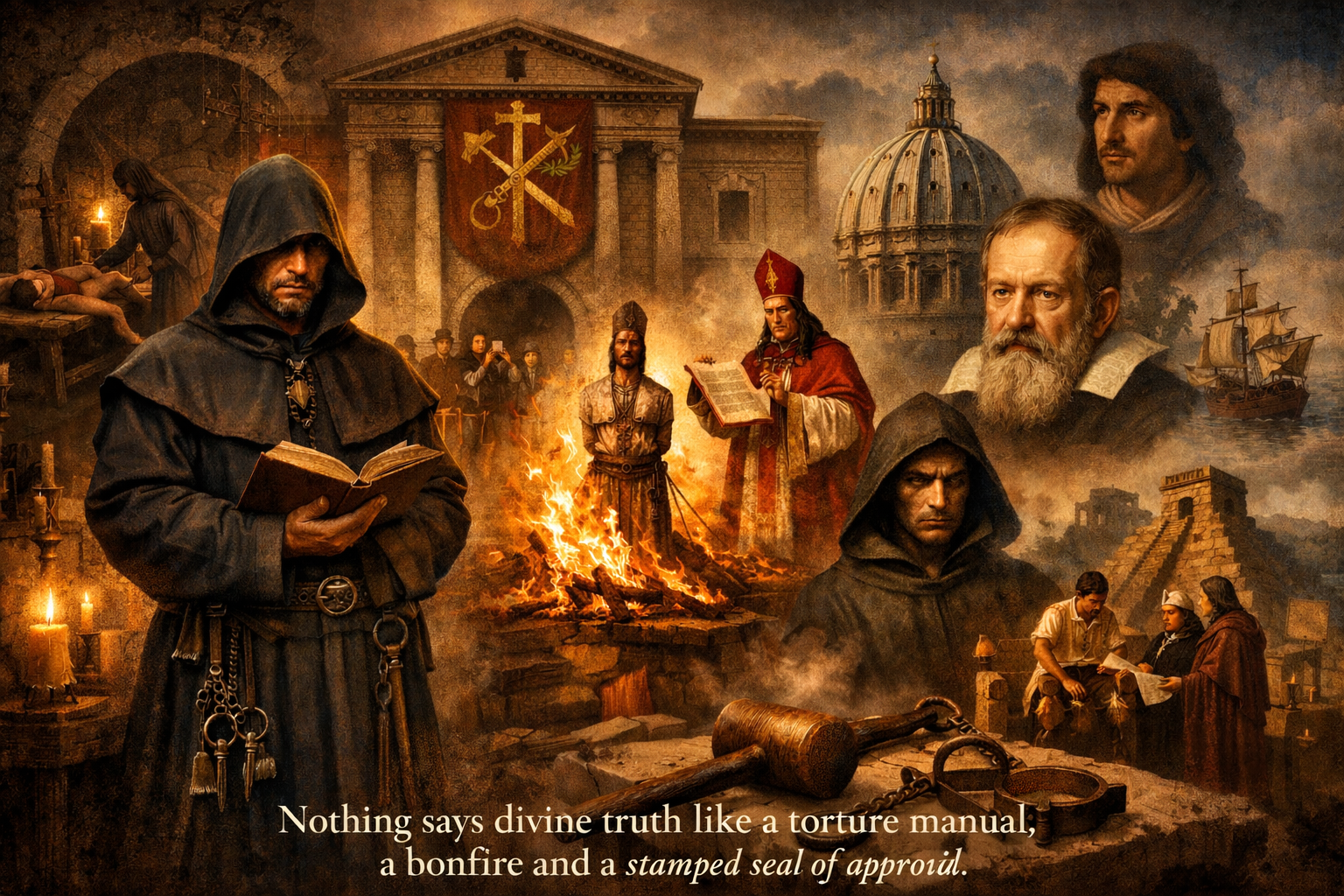
The Inquisitions were not passionate outbursts or medieval aberrations. They were organized, procedurally detailed, judicially structured systems for using terror to enforce theological conformity. The Church did not stumble into this. It built it.
The Crusades could be explained away as battlefield excess. Violence breaks loose in war. Mobs do terrible things. Armies under pressure commit atrocities. Those explanations are insufficient, as Part 3 made clear, but they are at least available. The Inquisitions cannot be explained away the same way. The Inquisitions were not eruptions of violence. They were legal systems. They had courts, judges, prosecutors, procedures, written manuals and appeal processes. They kept meticulous records. Torture was not something that happened in the chaos of a siege. It was a tool authorized by papal decree, scheduled into the interrogation calendar, performed by designated officials and documented in court transcripts. When you are looking for evidence that institutional Christianity behaves like every other power-hungry human institution when given sufficient authority, the Inquisitions are the clearest example available. Not because they were uniquely evil by the standards of their era — comparable secular courts were hardly gentle — but because they were organized, sustained and theologically authorized by an institution that claimed to represent the moral order of the universe.
The Medieval Inquisition: Building the Machine
The Inquisition did not begin with the Spanish Inquisition, and it did not begin with torture chambers. It began with a bureaucratic problem. By the early thirteenth century, heretical movements had become a significant challenge to Church authority across southern France, northern Italy and parts of the Rhineland. The Cathars in particular had developed a substantial following in the Languedoc — an alternative Christian theology that rejected the Church's authority, its sacramental system and its claim to be the necessary mediator between humanity and God. The Albigensian Crusade, discussed in Part 3, was the violent response to the Cathar presence in the Languedoc. But military campaigns could kill populations. They could not, by themselves, identify individuals, extract confessions and ensure that heretical ideas were not quietly reconstituting themselves in surviving communities. That required a different kind of machinery.
Pope Gregory IX established the formal papal Inquisition in 1231, authorizing Dominican and Franciscan friars to conduct systematic investigations into heresy independent of local bishops. The logic of the institution was straightforward: local bishops had local loyalties, local political entanglements and local incentives that might interfere with vigorous prosecution. A corps of trained inquisitors reporting directly to Rome would be insulated from those pressures. This was not an irrational organizational design. It was exactly the kind of centralization that any bureaucratic institution would develop when local enforcement proved unreliable. The fact that the institution being centralized was a theological terror apparatus does not change the administrative logic. It illustrates it.
The procedures the medieval Inquisition developed were detailed and, by the standards of the era, legally elaborate. Accusations could come from informants whose identities were withheld from the accused. The accused had no right to confront witnesses against them. Confession was the evidentiary gold standard, which created obvious incentive structures around how confessions were obtained. Torture was formally authorized by Pope Innocent IV in 1252 in the bull Ad extirpanda , which permitted inquisitors to use physical coercion to extract confessions, with the caveat that it should not cause permanent injury or death — a limitation that proved porous in practice. The theological rationale was coherent within its own premises: if a heretic's soul was in danger and confession was necessary for salvation, then physical suffering to produce that confession was an act of mercy. The body could be harmed to save the soul. This was not cynicism dressed as theology. It was theology that had been worked through carefully and come out somewhere that justified systematic torture.
Penalties ranged from required pilgrimage and the wearing of penitential crosses — public humiliation devices that marked a person as a convicted heretic for years — to imprisonment, confiscation of property and, for the unrepentant or relapsed, death. The Inquisition did not itself carry out executions. It handed convicted heretics to the secular authorities for burning, a procedural distinction the Church maintained allowed it to say it did not shed blood. This separation was not a moral scruple. It was a legal construction that maintained a fiction of institutional distance from the killing that its own verdicts mandated. Secular authorities who failed to carry out the executions the Inquisition requested could themselves face charges of protecting heresy. The distinction between the Church's role and the state's role in the burning was procedural. The outcome was collaborative.
The Spanish Inquisition: The Most Misunderstood Institution in Western History
The Spanish Inquisition was established by papal bull in 1478 at the request of King Ferdinand and Queen Isabella, and it operated until 1834 — a span of 356 years. That duration alone is worth sitting with. This was not a crisis measure. It was a permanent institution that outlasted the Ottoman Empire's classical period, the entire history of English colonization of North America and the French Revolution by several decades. It became a fixture of Spanish civic and religious life across more than three and a half centuries.
It has also been the subject of a sustained and largely successful apologetic campaign that began in the twentieth century and produced what historians call the "Black Legend" revisionism — the argument that the Spanish Inquisition has been unfairly demonized by Protestant propaganda and that its actual record was far more moderate than popular imagination suggests. Some of that revisionism contains accurate correctives. The total number of executions was lower than nineteenth-century estimates claimed. Torture was used in a minority of cases rather than universally. The Inquisition's courts were in some procedural respects more regularized than contemporary secular courts. These corrections are real. But the revisionism, taken too far, produces a picture that is nearly as distorted as the legend it claims to correct.
The Spanish Inquisition's primary initial target was the conversos — Jewish and Muslim converts to Christianity who were suspected of secretly continuing their original religious practices. The limpieza de sangre doctrine, the ideology of blood purity, meant that conversion was not necessarily sufficient. Ancestry mattered. A person of Jewish or Moorish descent could be suspected of heresy regardless of how sincere or longstanding their Christian practice appeared. The Inquisition developed elaborate genealogical investigations to establish bloodline and used those investigations as the basis for prosecution. This is not a minor procedural detail. It is institutional racial persecution dressed in theological language, and it operated at scale for generations.
Across its operation the Spanish Inquisition prosecuted an estimated 150,000 people. Scholarly estimates of executions range from roughly 3,000 to 5,000, with some estimates higher. Those numbers, lower than the popular imagination often assumes, do not tell the full story of what the institution produced. The primary currency of the Inquisition was not death. It was fear. The auto-da-fé — the public ritual of judgment, penance and punishment — was a theatrical instrument of social control. Crowds attended. Penitents processed in humiliating garments. The condemned were burned in public view. The whole ceremony was an announcement to every person watching that the Church knew who you were, could reach you anywhere and would destroy your reputation, property and family before it destroyed your body. Communities informed on each other. Neighbors reported neighbors. The denunciation culture the Inquisition created was as damaging to social fabric as its formal proceedings.
The Spanish Inquisition also operated in the Americas almost from the moment of conquest. Tribunals were established in Lima in 1570 and Mexico City in 1571. In the colonial context the Inquisition's reach extended to scrutiny of indigenous populations who had been baptized and then exhibited any sign of continuing indigenous religious practice. The institution that had been built to police conversos in Castile became a tool for enforcing theological conformity across an entire hemisphere, in populations that had been converted by force within living memory and were then prosecuted for imperfect conversion.
The Roman Inquisition and the War on Knowledge
The Roman Inquisition was established by Pope Paul III in 1542, partly in response to the Protestant Reformation and partly as a general instrument for maintaining doctrinal control over an increasingly fractious European intellectual environment. It was reorganized in 1588 as the Supreme Sacred Congregation of the Roman and Universal Inquisition, a body that still exists today under its current name: the Dicastery for the Doctrine of the Faith.
The Roman Inquisition is best known for two things. The first is the trial of Galileo Galilei in 1633, in which one of the most significant scientists in human history was forced to recant his support for the heliocentric model of the solar system, placed under house arrest for the remaining nine years of his life and had his works placed on the Index of Forbidden Books. The second is the execution of Giordano Bruno in 1600, a philosopher and cosmological theorist who had proposed, among other things, that the universe was infinite and contained other inhabited worlds. After eight years of imprisonment and interrogation, Bruno was burned at the stake in Rome's Campo de' Fiori. He refused to recant.
The Bruno case is sometimes described as exceptional. It was not typical of the Roman Inquisition's general operations, which more commonly produced imprisonment, forced recantation and book banning than execution. But it illustrates something important about what happens when a religious institution controls the boundaries of acceptable knowledge. Bruno was not killed for a crime against a person. He was killed for thinking the wrong things about the structure of the universe. The Galileo case did not end in execution, but it produced a decades-long suppression of scientific work that the Church found theologically inconvenient. The Index of Forbidden Books, which the Roman Inquisition maintained and which included works by Copernicus, Galileo, Kepler, Descartes, Locke and many others, was not abolished until 1966. It was an active instrument of intellectual control for more than four centuries.
The Colonial Extension: Inquisitions Without Borders
The export of inquisitorial authority to the colonial world is the least discussed chapter of this history and in some ways the most revealing. When the Spanish and Portuguese empires expanded across the Americas, Africa and Asia, the ecclesiastical machinery of heresy control traveled with them. The Goa Inquisition, established in 1560 in the Portuguese colony on the western coast of India, operated until 1812 and targeted not only crypto-Jews and crypto-Muslims among the Portuguese settler population but Hindu converts to Christianity who were suspected of continuing Hindu religious practice.
The Goa Inquisition was documented by contemporaries as among the most brutal of the colonial inquisitions. The Dutch physician Jan Huyghen van Linschoten, who lived in Goa in the late sixteenth century, left detailed accounts of the proceedings. Alexandre Herculano, a nineteenth-century Portuguese historian, drew on Inquisition archives to document the scale of the institution's activity. The combination of religious enforcement, colonial racial hierarchy and the targeting of populations who had been converted by force within a generation produced an institution that illustrates the full logic of the system: the Church claimed the right to dictate the interior religious life of populations it had conquered, converted by compulsion and then prosecuted for insufficient sincerity in their compelled conversion.
The colonial inquisitions also extended to New Spain, Peru and Brazil, where Inquisition tribunals prosecuted indigenous converts, African slaves who had been baptized as part of the slave trade and settler populations accused of various heresies. In the context of colonial society, the Inquisition served functions beyond pure theological enforcement. It regulated social hierarchy, controlled the behavior of populations that colonial administrators found threatening and provided a judicial mechanism for eliminating people whose wealth or property made them attractive targets for confiscation. The religious and the political were not separable in these institutions. They never had been.
The Pattern Across All Four
The Medieval, Spanish, Roman and colonial inquisitions differed in their specific targets, their procedural details and their geographic reach. What they share is more important than what distinguishes them. In every case, a religious institution with access to coercive authority used that authority to control belief, punish dissent, eliminate rivals and maintain institutional power. In every case, the theological rationale was elaborate and internally coherent. In every case, the institution resisted reform and outlasted the political circumstances that originally justified it. And in every case, the victims were not primarily powerful enemies of the Church. They were ordinary people — farmers, merchants, scholars, converts, women, minorities — who had the misfortune of being identifiable as theologically suspicious by an institution with the power to act on that suspicion.
The apologetic tradition's strongest argument is that you cannot judge medieval institutions by modern standards. That argument has some validity when applied carefully. But it proves less than its proponents believe. The question this series is asking is not whether medieval people were morally inferior to modern people. The question is what patterns emerge when religious authority controls political and military power. The Inquisitions answer that question across four hundred years and four continents. The answer is consistent: the institution builds enforcement machinery, the machinery expands its targets, the victims multiply and the theological justification remains intact throughout. The Church did not accidentally develop the Inquisition. It built it deliberately, defended it theologically and maintained it operationally for centuries. That is the record.
Why This Matters Beyond Medieval History
The Inquisitions matter for this series for the same reason the Crusades matter, and the suppression of paganism before them. They demonstrate what happens consistently when religious authority acquires coercive power and defines theological dissent as a problem requiring institutional force. The Crusades were partly driven by genuine popular religious energy that the papacy organized and directed. The Inquisitions were something different. They were the product of deliberate institutional design. Someone sat down and wrote the manuals. Someone organized the courts. Someone trained the interrogators. Someone maintained the records. Someone kept the institution running for centuries across multiple continents. This was not religion gone wrong under pressure. This was religion operating as a coercive institution the way coercive institutions operate — protecting its authority, eliminating challenges and using the tools available to it.
The argument this series keeps making is not that Christianity is uniquely evil among the world's religions or uniquely evil among human institutions. It is that there is nothing unique about Christianity that makes it immune to the dynamics that corrupt every institution given sufficient power. The Inquisitions are two hundred years of evidence for that claim in the medieval period alone, with the Spanish Inquisition extending it into the nineteenth century and the Roman institution into the twentieth. Left alone with enough authority, the institution that claims to represent the moral order of the universe does exactly what every other power-hungry institution does. It builds courts. It writes manuals. It identifies enemies. It makes examples. It keeps records. And it calls it the will of God.
My Bottom Line
Most people who know the phrase "the Inquisition" have only the vaguest sense of what it actually was. They know it was bad. They may know the Monty Python sketch. They probably do not know that it operated continuously for over 350 years in Spain, that its colonial branches reached India and the Americas, that it had formal torture authorization from the papacy, that it kept meticulous written records of everything it did and that its direct institutional successor is still a functioning office in Rome today. They do not know this because the Church has been very effective at managing the memory of these institutions — encouraging contextualization, emphasizing the lower-than-popular execution totals and treating the whole subject as an unfortunate episode from a more primitive time rather than as evidence of what religious power reliably produces.
The Inquisitions were not a primitive time's version of justice that we now understand better. They were a case study in what a totalizing institution does when it controls the boundaries of permissible thought and has judicial authority to enforce those boundaries. The case study runs for four hundred years. The evidence is not ambiguous. What it requires is not exaggeration. It requires honest acknowledgment and a clear-eyed answer to the question of why anyone would want to rebuild the conditions that produced it.
References
- Innocent IV. (1252). Ad extirpanda. (Papal bull authorizing torture in inquisitorial proceedings.)
- Bernard Gui. (c. 1323). Practica Inquisitionis Heretice Pravitatis. (Dominican inquisitor's operational manual.)
- Lea, H. C. (1888). A History of the Inquisition of the Middle Ages (3 vols.). Harper & Brothers.
- Peters, E. (1988). Inquisition. University of California Press.
- Kamen, H. (2014). The Spanish Inquisition: A Historical Revision (4th ed.). Yale University Press.
- Bethencourt, F. (2009). The Inquisition: A Global History, 1478–1834. Cambridge University Press.
- Grendler, P. F. (1977). The Roman Inquisition and the Venetian Press, 1540–1605. Princeton University Press.
- Finocchiaro, M. A. (Ed. & Trans.). (1989). The Galileo Affair: A Documentary History. University of California Press.
- van Linschoten, J. H. (1598). Itinerario. (Eyewitness account of the Goa Inquisition.)
- Herculano, A. (1854). História da origem e estabelecimento da Inquisição em Portugal (3 vols.). (Portuguese-language history drawing on Inquisition archival records.)
- Greenleaf, R. E. (1969). The Mexican Inquisition of the Sixteenth Century. University of New Mexico Press.
- Rowland, I. D. (2008). Giordano Bruno: Philosopher / Heretic. Farrar, Straus and Giroux.