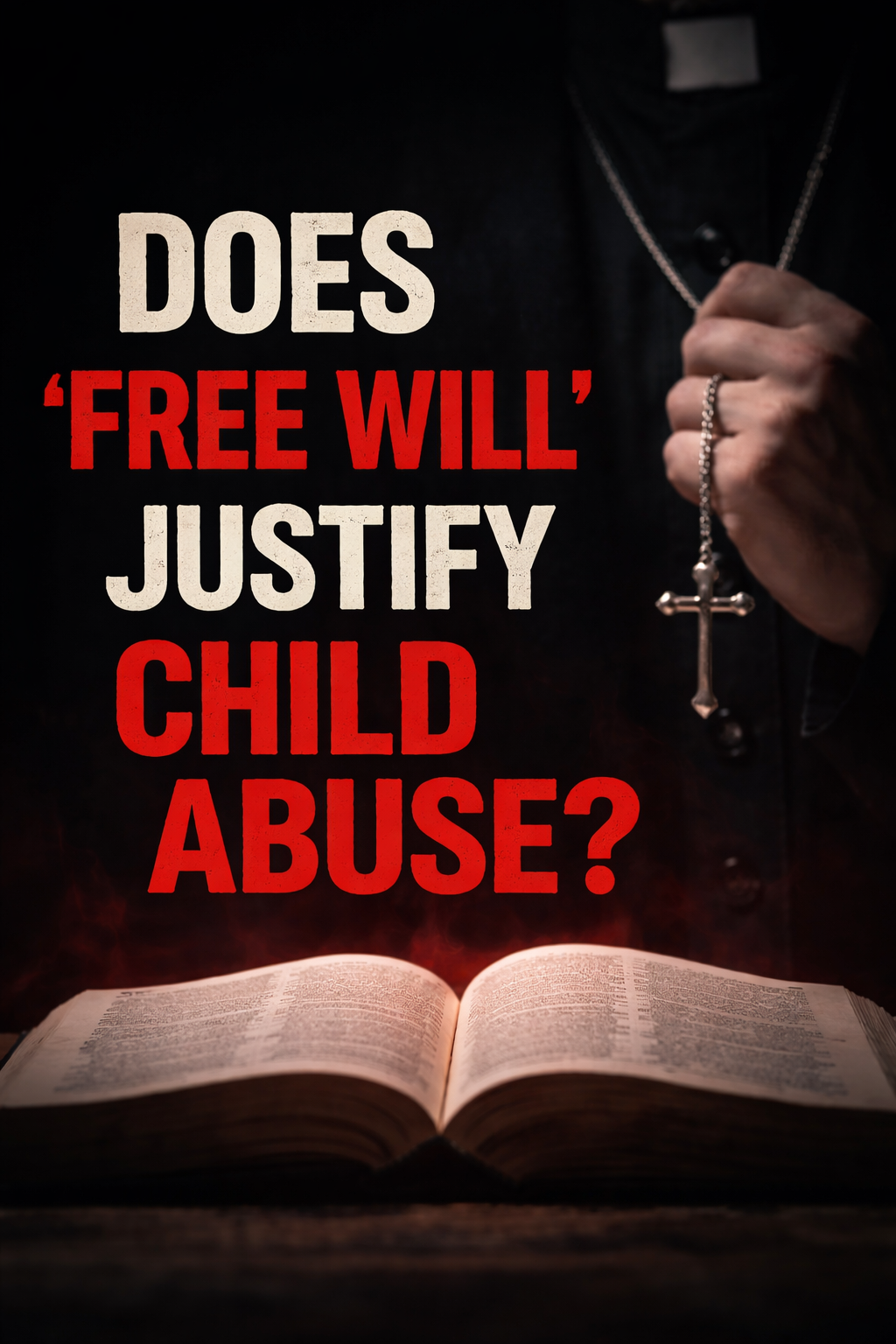
The free will defense is Christianity's most important answer to the hardest question it faces. The question is the problem of evil: if God is all-powerful, all-knowing and perfectly good, why does the world contain the suffering it contains? The answer the tradition reaches for most readily is free will. God gave human beings the capacity to choose, and genuine choice requires the freedom to choose badly. Evil is the price of freedom. Suffering is the cost of a universe in which love and virtue are possible because they are chosen rather than programmed. It is a philosophically serious answer with a genuine intellectual tradition behind it, from Augustine to Alvin Plantinga. And it collapses entirely the moment you place it in the room where a priest rapes a child. Not because the argument is sophisticated and the counterexample is crude. Because the argument assigns the moral weight of the transaction to the one party in that room who actually had a choice - and that party is not the one suffering. The child did not choose to be in that room. The child did not choose that priest. The child did not choose that outcome. The free will that Christianity says God so valued that he permitted evil to exist in order to preserve it belonged entirely to the perpetrator. The victim had none. That asymmetry is not an edge case the argument handles awkwardly. It is a direct refutation of the argument's central premise.
The Argument as Christians Actually Make It
To engage the free will defense honestly you have to state it in its strongest form rather than a caricature. The serious version, developed most rigorously by Alvin Plantinga in God, Freedom, and Evil, goes like this: a world containing creatures who are significantly free and freely perform more good than evil is more valuable than a world of mere automata. God, who is perfectly good, would naturally prefer to create the more valuable world. But creating free creatures means creating creatures who can choose evil as well as good, and God cannot both give genuine freedom and guarantee that freedom will never be misused. Therefore the existence of moral evil in the world is compatible with the existence of an omnipotent, omniscient, perfectly good God. It does not prove God exists. It attempts to show that God's existence and evil's existence are not logically incompatible.
Plantinga is a careful philosopher and this argument has been taken seriously by serious people for decades. The problem is what happens when you move from the abstract formulation - God permits freedom that can be misused - to the concrete application. The abstract formulation treats freedom as a symmetrical property shared equally by all parties in any moral transaction. In reality moral transactions are almost never symmetrical. They almost always involve a more powerful party and a less powerful one, a perpetrator and a victim, someone exercising will and someone absorbing its consequences. The free will defense accounts for the perpetrator. It has nothing to say about the victim that does not ultimately require treating the victim's suffering as the price of someone else's freedom. That is not a defense of God's goodness. It is a description of a universe in which victims are instrumental to a theological purpose they did not consent to serve.
The free will defense accounts for the perpetrator. It has nothing to say about the victim that does not ultimately require treating the child's suffering as the price of the priest's freedom. That is not a defense of God's goodness. It is a description of a God who values the perpetrator's autonomy more than the victim's safety.
The Specific Problem the Clergy Abuse Crisis Creates
The Catholic clergy abuse crisis is not selected here because it is the worst evil in human history. It is selected because it presents the free will defense with the most direct possible challenge on its own theological ground. The perpetrators are not strangers or secular actors. They are men who have taken vows of celibacy, submitted themselves to spiritual formation, accepted the authority of a church that teaches the theology being deployed to explain their behavior and presented themselves to their victims' families as men of God whose access to children should be trusted precisely because of their religious commitment. The free will they exercised was exercised in direct contradiction to every theological, moral and institutional claim they were making about themselves simultaneously.
The children they abused were in that situation because their parents trusted the theological framework. The child brought to a priest for spiritual guidance, the altar server, the student in the Catholic school - none of these children were in a morally neutral position from which they freely chose to engage. They were placed there by a system of religious authority that their parents believed in and that the church presented as safe. The priest's free will operated within that system of institutional trust. The child's vulnerability was created by that same system. To say that God permitted the abuse because he values free will is to say that God values the priest's freedom to abuse more than he values the child's freedom from abuse. That is what the argument actually requires when applied to this case. The free will of the victim - including the freedom from violation that is the most basic form of freedom - is not in the equation at all.
The free will defense has a companion problem that receives less attention but is equally fatal when applied to specific cases. Christian theology does not claim God is merely powerful enough to intervene. It claims God is omniscient - that he knows all things, including future events. A God who is omniscient knew, before the priest was ordained, before the child was born, before the family joined that parish, exactly what would happen in that room. He knew which men would abuse and which children they would target. The free will defense requires that God permit the abuse in order to preserve the priest's freedom of choice. But omniscience means God was not choosing between freedom and safety in some uncertain future. He was choosing between those things with complete foreknowledge of every specific consequence. A parent who hired a known pedophile to babysit their child, knowing in advance exactly what would happen, would not be excused by saying they valued the babysitter's freedom of choice. The same logic applies to an omniscient God. Knowledge changes the moral calculus entirely. The defense requires ignorance or uncertainty in the one making the choice. God, by Christian theology's own account, had neither.
What the Defense Requires You to Believe About Children
The free will defense, applied consistently to the abuse of children, requires a position about the moral status of children that its defenders rarely state explicitly because stated explicitly it is monstrous. It requires that the suffering of children be treated as an acceptable cost of a universe in which adult human beings have genuine moral freedom. The child who is raped by a priest did not participate in the cosmic arrangement that made this possible. She did not consent to being the price of someone else's free will. She did not agree that the value of human freedom in the abstract was worth the specific destruction visited on her specific body and her specific development. She was not consulted. She had no more say in the theological economy that used her suffering as the cost of another person's freedom than she had say in the abuse itself.
This is the point Dostoevsky's Ivan Karamazov makes in the form that has never been answered in the century and a half since it was written. Ivan does not say that God does not exist. He says he will not accept a harmony that costs children's tears as its admission price. The free will defense, applied to children who are by definition not yet agents of meaningful moral choice, does not provide an answer to Ivan's objection. It deepens it. Ivan is asking why children must suffer for the freedom of adults. The defense answers: because freedom is valuable. Ivan already knew that. His question was about the children. The defense changes the subject.
The Asymmetry That Destroys the Argument
The free will defense works only if you accept that free will is symmetrically distributed across all parties in any moral situation. In the case of child abuse it is not. The priest has free will. The child has vulnerability. The priest's freedom is real and exercised. The child's freedom is structurally nonexistent in this situation - not as a philosophical abstraction but as a practical fact of power, size, authority and cognitive development. A seven-year-old child does not have the cognitive equipment to evaluate, resist or escape the authority of an adult in a position of institutional trust. This is not a contingent feature of the specific case. It is the defining characteristic of what makes abuse of children categorically different from abuse of adults. The victim's will is not merely overridden. It is not yet fully formed as an instrument of self-protection against this kind of violation.
An omnipotent God who values free will could have constructed free will in a way that did not extend to the violation of people who do not yet have the capacity to exercise it in their own defense. The theological response that God cannot limit free will without destroying it is not self-evidently true. God is supposed to be omnipotent. An omnipotent being constrained by the logical requirements of libertarian free will is a God who has either chosen to be so constrained or is less than omnipotent. Neither version supports the defense as stated. Either God could have designed freedom differently and chose not to, which implicates his goodness directly, or God could not have designed it differently, which implicates his omnipotence. The defense requires both simultaneously and has never resolved the tension.
Why the Institutional Response Made It Worse
The free will defense, even in its weakest form, might provide some cold comfort if the institution that produced the abuse had responded to it with the moral seriousness the crime demanded. It did not. The Catholic Church's documented response to the clergy abuse crisis - moving predators between parishes, suppressing evidence, intimidating victims, prioritizing institutional reputation over child safety - was not the response of an institution that believed the free will of the perpetrators was a tragedy to be grieved and addressed. It was the response of an institution protecting itself. The same theology that the church used to explain why God permitted the abuse - the freedom of the human will - was apparently insufficient to produce an institutional obligation to prevent the next abuse when the identity of the perpetrator was already known. The priest who had abused in one parish was moved to another, where his free will was exercised again, against new children, with the institutional knowledge of the bishops who moved him. The free will defense, if it means anything at all, should have produced the institutional conclusion that known predators should be removed from access to children. It did not produce that conclusion. It produced transfer letters and non-disclosure agreements.
The same church that invokes free will to explain why God did not stop the abuse made institutional decisions to ensure the next child would have no better protection than the last one. The theology explained God's inaction. It apparently also explained theirs.
My Bottom Line
The free will defense is the most serious philosophical attempt to reconcile the existence of evil with the existence of an omnipotent and perfectly good God. It deserves serious engagement rather than dismissal, and it receives that here. But serious engagement requires following the argument to its conclusions in the specific cases where it is most directly tested, not just in the abstract scenarios where it performs best. Applied to the abuse of children by clergy, the argument requires accepting that God values the freedom of predators more than the safety of their victims, that omniscience does not create moral responsibility to prevent foreknown harm and that children who cannot yet exercise meaningful free will in their own defense are acceptable casualties of a cosmic arrangement designed for the benefit of adult moral agency. Those conclusions are not peripheral to the defense. They are what the defense requires. Stated plainly, they describe not a perfectly good God but a God whose goodness has been so philosophically qualified that the word no longer means what it means in any other context. An argument that requires that much qualification to survive contact with a single real case is not an argument. It is a retreat dressed as a response.
The priest had free will. The child had none. The defense that explains the first does nothing for the second except make her suffering theologically necessary. That is not comfort. That is doctrine eating itself.
References
- Plantinga, A. (1974). God, Freedom, and Evil. Harper & Row. (The definitive philosophical statement of the free will defense.)
- Mackie, J. L. (1955). Evil and omnipotence. Mind, 64(254), 200-212. (The classic philosophical challenge the free will defense was constructed to answer.)
- Dostoevsky, F. (1880/1990). The Brothers Karamazov, Book V: Rebellion. Vintage Classics.
- Rowe, W. L. (1979). The problem of evil and some varieties of atheism. American Philosophical Quarterly, 16(4), 335-341.
- Swinburne, R. (1998). Providence and the Problem of Evil. Oxford University Press. (For the theodicy that attempts to incorporate suffering into divine purpose.)
- John Jay College Research Team. (2004). The Nature and Scope of the Problem of Sexual Abuse of Minors by Catholic Priests and Deacons in the United States. United States Conference of Catholic Bishops.
- Cornwell, J. (1999). Hitler's Pope: The Secret History of Pius XII. Viking. (On institutional silence and moral calculation.)
- van Inwagen, P. (2006). The Problem of Evil. Oxford University Press. (For a sophisticated contemporary defense of free will theodicy.)
- Augustine of Hippo. (c. 395 AD). On Free Choice of the Will (De Libero Arbitrio). (The foundational patristic treatment of free will and evil.)
Disclaimer: The views expressed in this post are the personal opinions of the author and are offered for educational, commentary and public discourse purposes only. They do not represent the positions of any institution, employer, organization or affiliated entity. Nothing in this post constitutes legal, financial, medical or professional advice of any kind. This post engages critically with philosophical and theological arguments and with documented institutional behavior and does not make claims about individual believers or the sincerity of individual faith. References to the clergy abuse crisis are based on publicly available reports and scholarship cited above. Commentary on religious and philosophical subjects reflects the author's independent analysis and is protected expression of opinion. Readers are encouraged to consult primary sources and form their own conclusions.