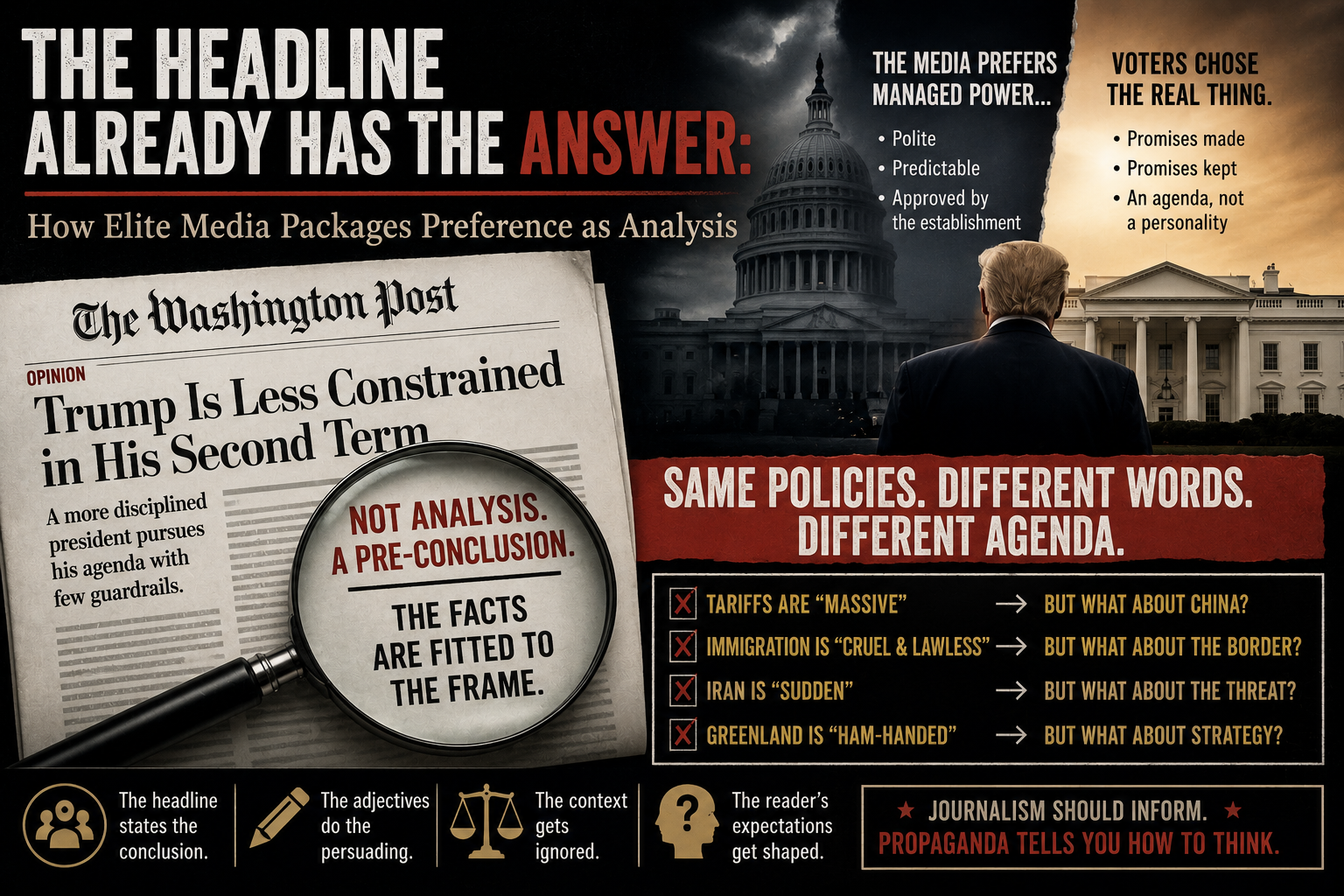
There is a method to how elite media covers the Trump presidency and once you see it, you cannot unsee it. It begins with the conclusion — dangerous, reckless, unconstrained, authoritarian — and works backward, gathering adjectives and examples that fill out the predetermined picture. It does not ask whether a policy is working. It does not compare the current approach to historical norms across administrations. It does not grant that the voters who chose this presidency might have had defensible reasons. It simply characterizes, alarm by alarm, until the characterization feels like analysis. The Washington Post opinion piece from May 22 arguing that Trump is less constrained in his second term is a textbook case. Strip away the specific policy complaints and the argument reduces to this: Trump is governing like Trump, without the moderating influence of people who disagreed with his voters' preferences, and this is dangerous. Everything after that is decoration.
What "Unconstrained" Actually Means in This Context
When the Post and outlets like it describe Trump as unconstrained, they mean something specific that they do not say directly. They mean he is no longer being managed by the establishment consensus. In the first term, Paul Ryan shaped the legislative agenda. Traditional national security figures pushed back on foreign policy instincts. Career officials slowed implementation of directives they found objectionable. Lawyers inside agencies drafted compliance memos that softened executive orders. Chief of staff cycles produced friction that delayed action. All of that is what the Post is calling discipline and maturity when it describes the first term favorably.
The voters who elected Trump twice understood exactly what that management structure was. They did not want it. They did not vote for Paul Ryan's version of the presidency. They did not vote for career national security officials exercising a quiet veto over the commander in chief's foreign policy instincts. They voted for the agenda the candidate stated in plain language, and they voted for it twice after watching the first term produce a constrained version of it. The Post's argument that the unconstrained version is dangerous is, at its foundation, an argument that the voters chose wrong. That is not an analysis of executive power. That is an argument against election results dressed in constitutional language.
The "Trump was more disciplined in his first term" argument concedes, without meaning to, that the first term's restraint was largely imposed rather than chosen. That is exactly the complaint conservatives have been making for years about the administrative state — that unelected staff, career officials and establishment gatekeepers functioned as a parallel executive, overriding the elected one. The Post frames this as a feature. Conservatives call it the problem. The same facts, two opposite conclusions. Which one you reach depends entirely on whether you think the voters' choice should govern or whether you think the management class should.
How Tone Becomes Evidence
The mechanism by which preference becomes analysis in elite media coverage is worth examining closely because it is not crude or obvious. It does not involve fabrication. It operates through word selection, context omission and the asymmetric application of alarm. Every Trump policy action gets the most alarming adjective available. Tariffs are not aggressive or controversial or debated among economists. They are "massive." Immigration enforcement is not strict or accelerated or record-setting. It is "cruel and lawless." The Iran conflict was not anticipated, argued over in policy circles or the product of a multiyear nuclear standoff. It was "sudden." The Greenland discussion was not a geopolitical argument with serious strategic backing. It was "ham-handed."
None of those adjectives is necessarily false. Tariffs are large. Some enforcement actions have been legally challenged. The speed of the Iran decision surprised observers. The Greenland diplomacy was blunt. But each adjective is chosen from the most alarming end of the available range, and the cumulative effect of applying that choice consistently to every action by the same president is a portrait that feels like evidence but is actually editorializing. A reader who saw the same facts described as "ambitious tariffs," "accelerated enforcement," "decisive military action" and "unconventional diplomacy" would form a very different picture from the same underlying events. The picture the Post paints is not wrong because the facts are wrong. It is misleading because the framing is never neutral and never varies.
Tone is not analysis. Adjectives are not evidence. When every action by the same person gets the most alarming available description, the pattern reveals a conclusion that preceded the reporting — not one that followed from it.
The Questions That Never Get Asked
The most revealing thing about establishment media coverage of this presidency is not what it says. It is what it never asks. The column does not ask whether the tariff level was appropriate given China's documented trade practices, intellectual property theft and market distortion over three decades. It does not ask whether alternative approaches to the trade deficit had been tried and failed. It does not ask what the negotiating logic of aggressive tariff positioning might be or what outcomes the strategy is designed to produce. It simply calls the tariffs massive and moves on.
The column does not ask whether immigration enforcement was overdue after the Biden years produced the highest illegal crossing numbers in recorded history. It does not ask what the communities along the border, who voted in significant numbers for Trump, experienced during those years. It does not ask whether a credible deterrent required visible, consistent enforcement or whether symbolic gestures had been tried and produced the record numbers. It simply calls the crackdown cruel and lawless and moves on.
The column does not ask whether Iran's nuclear program, left on its trajectory, represented a genuine threat to regional stability or whether years of diplomatic engagement had produced meaningful constraint on that program. It does not ask what the intelligence assessment of Iran's timeline was or what the administration's stated strategic objective was. It simply notes the absence of UN authorization — a standard applied to no previous administration — and calls the conflict sudden.
Consider what the same outlets asked when the Obama administration launched operations in Libya, Yemen and Syria without UN authorization. Consider how they covered the Biden administration's border numbers when they reached historic highs. Consider how they treated the trade relationship with China during the decades when manufacturing hollowed out of American communities. The coverage was not characterized by the same alarm vocabulary, the same constitutional anxiety or the same pattern of describing every action in its most negative available framing. That asymmetry is not a minor stylistic difference. It is the story.
The Establishment Consensus and Who It Serves
The Post's argument for the first term's superiority is an argument for the establishment consensus that shaped it. It is worth being direct about what that consensus is and who it serves. It is the foreign policy posture of the national security professional class that has presided over two decades of inconclusive Middle Eastern wars, an expansion of NATO that outpaced the security rationale for it and a China relationship that produced massive trade deficits and technology transfer while the managing class declared it a strategic success. It is the immigration management posture that produced record border crossings while describing enforcement as inhumane. It is the trade policy that declared free trade agreements with countries running persistent surpluses a net positive while the communities experiencing the manufacturing losses drew different conclusions.
The voters who rejected that consensus did not reject it because they were uninformed or manipulated. They rejected it because they experienced its outcomes. The factory worker in Ohio did not need a foreign policy think tank to explain to him what the China trade relationship produced in his community. The family in a border state did not need a Washington editorial board to explain what record crossing numbers meant for their neighborhood. The veteran who watched two decades of nation-building produce nothing durable did not need a credentialed national security expert to explain whether the strategy had worked. They made their own assessment and they voted accordingly. Twice.
Preference Disguised as Constitutional Concern
The most corrosive feature of this style of coverage is its appropriation of constitutional language for what are fundamentally policy preferences. When the Post calls Trump unconstrained, it is not making a specific legal argument that a specific power has been exceeded in a specific way that would not survive judicial scrutiny. It is expressing a preference for the kind of presidency that defers to the established order of things — to the consensus of the professional class, the norms of the editorial board's milieu, the instincts of the foreign policy establishment and the immigration management posture of the administrative state. All of that is legitimate preference. None of it is a constitutional argument.
The distinction matters enormously because constitutional arguments have consequences. They shape judicial decisions, legislative responses and public understanding of what government can and cannot do. When constitutional language is used to describe policy disagreements, it dilutes the language available for genuine constitutional violations. It trains the public to treat normal political contestation as emergency. It exhausts the vocabulary of crisis before any actual crisis arrives. And when a genuine constitutional violation does occur — when a president does act outside legal authority in a way that courts find impermissible — the alarm vocabulary is already spent, already discredited, already dismissed by half the country as the same noise they heard about tariffs and immigration enforcement and Greenland.
What Honest Coverage Would Look Like
Honest coverage of an aggressive presidency would ask the hard questions on both sides of every policy decision. It would acknowledge when enforcement produces measurable results alongside the costs of that enforcement. It would apply the same constitutional standard to executive military authority regardless of which party's president is exercising it. It would note when voters who chose the policy had defensible reasons for doing so rather than treating every Trump voter as a problem to be explained rather than a citizen to be understood. It would distinguish between actions that are aggressive and actions that are illegal, between decisions that are controversial and decisions that are unconstitutional.
Most importantly, it would be honest about what the column is actually arguing when it argues for constraint. It would say plainly: we preferred the version of this presidency where establishment figures moderated the agenda voters chose. It would make that case openly and let readers evaluate whether the moderating establishment has earned the authority it is claiming. That would be honest. The Washington Post is capable of honest. It chooses, on this subject, something else.
My Bottom Line
The Post's argument is not about executive power. It is about whose preferences should govern. The column prefers a presidency managed by people who share the editorial board's world view, shaped by the consensus of institutions the voters have repeatedly rejected, operating within the comfort zone of a professional class that has presided over a series of expensive failures and called them successes. That preference is coherent and even arguable on the merits. But it should be argued on the merits, not laundered through constitutional alarm language that it does not earn and does not deserve.
Americans are not stupid. They can see when analysis has the conclusion baked in before the first paragraph is written. They can see when adjective selection does the work that evidence is supposed to do. They can see when constitutional concern appears and disappears based on which party is in office. They have been seeing it for ten years. It is part of why the institutions producing that coverage have lost the credibility they once had and are not getting it back through more of the same.
The voters chose this presidency. The column dislikes that choice. Everything else in the argument is packaging. And the packaging gets less convincing every time it is used.
Why This Matters
A republic needs credible journalism. Not journalism that agrees with any particular political position, but journalism that applies consistent standards, asks questions that might produce uncomfortable answers and distinguishes between what it can demonstrate and what it prefers to believe. When major outlets systematically package preference as analysis, they do not merely fail at their own stated mission. They accelerate the public's retreat from shared factual ground. Half the country dismisses what the Post says about Trump because the Post has made itself easy to dismiss. The other half accepts it uncritically because it confirms what they already believe. Neither outcome serves the republic. That is not Trump's fault. It is the fault of the people running the newsrooms who made it this way and have not found the honesty to reckon with what they built.
References
- Washington Post. (2026, May 22). Trump is much less constrained in his second term. washingtonpost.com.
- Gallup. (2026). Media trust polling: American confidence in newspapers and television news. gallup.com.
- Pew Research Center. (2024). News platform fact sheet: Trust and partisan differences in media consumption. pewresearch.org.
- Reuters Institute for the Study of Journalism. (2025). Digital news report: Trust in news by country. reutersinstitute.politics.ox.ac.uk.
- War Powers Resolution (1973). 50 U.S.C. §§ 1541–1548.
Disclaimer: The views expressed in this post are the personal opinions of the author and are offered for educational, commentary and public discourse purposes only. They do not represent the positions of any institution, employer, organization or affiliated entity. Nothing in this post constitutes legal, financial, medical or professional advice of any kind. References to public figures, institutions and current affairs are based on publicly available sources cited above and are intended to support analysis and commentary. Commentary on political subjects reflects the author's independent analysis and is protected expression of opinion. Readers are encouraged to consult primary sources and form their own conclusions.