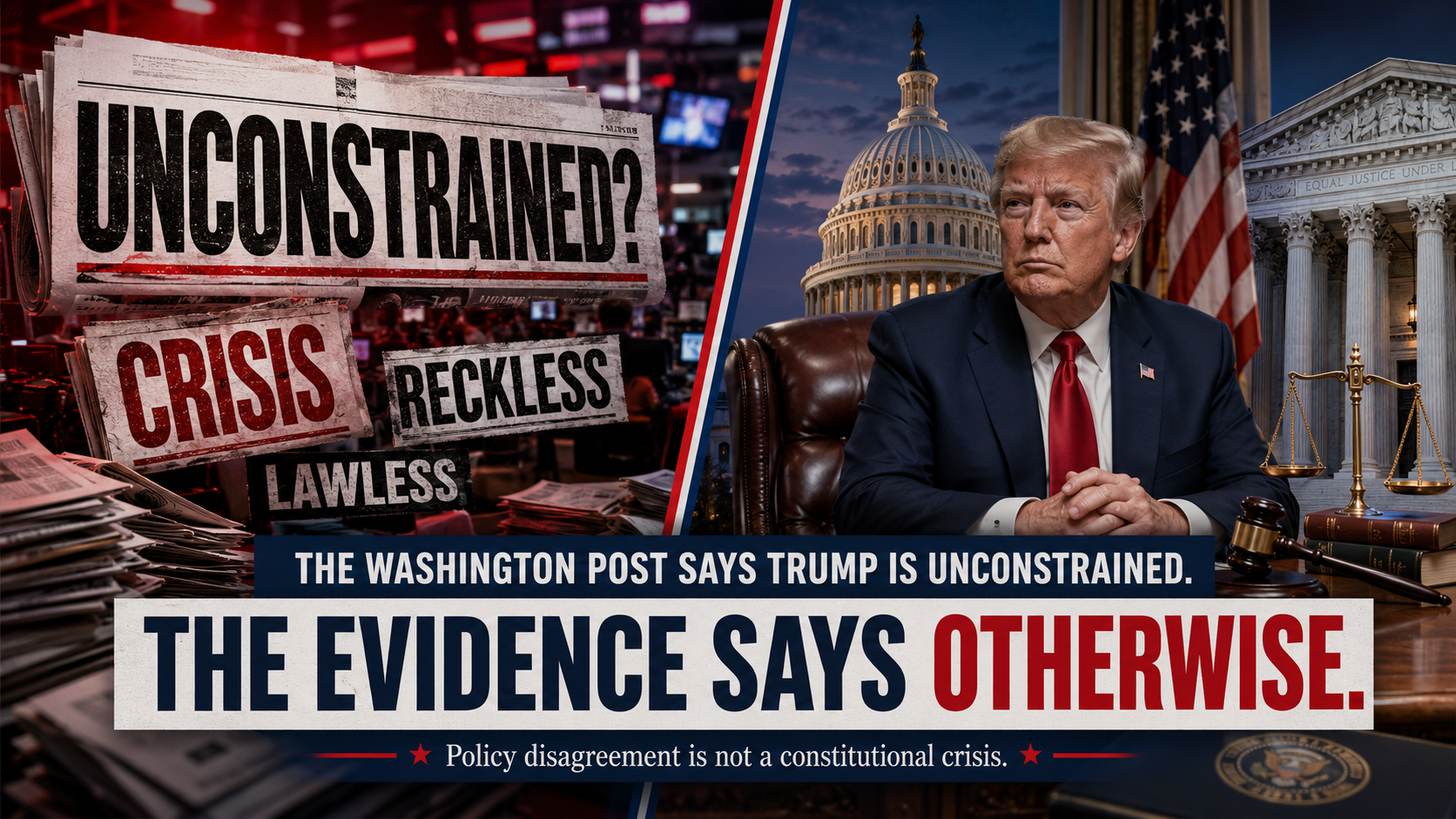
A May 22 Washington Post opinion piece argues that Donald Trump's second term is defined by recklessness and the absence of constraint — that without the guardrails of Republican establishment figures who shaped his first term, he is now governing without discipline, accountability or strategic coherence. The piece cites tariffs, immigration enforcement, the Iran conflict and the Greenland discussion as evidence of a president operating beyond normal limits. Jeff Bezos, the Post's owner, made the opposite argument the same week, calling Trump more mature and disciplined than in his first term. The columnist found this baffling. I do not. What the Post is describing as recklessness is, in most cases, a president executing the agenda he campaigned on, with a mandate he won and through legal authority he possesses. The column mistakes delivery for disorder.
The "Constrained vs. Unconstrained" Frame Is Backwards
The Post's central argument is that Trump's first term was better because he was constrained — by Paul Ryan, by establishment Republicans, by traditional national security advisors who slowed his worst impulses. This is presented as a feature rather than a flaw. Think about what that concedes. The argument from the left is that Trump was more acceptable when unelected aides and party elites were quietly overriding the agenda voters chose. That is not a defense of democratic governance. That is a defense of the administrative class running things regardless of election outcomes. When voters handed Trump a second mandate, they were not asking for the Paul Ryan version of his presidency. They rejected it once already.
The Post's argument admits, without quite realizing it, that the first term's "discipline" was largely resistance by staff to the elected president's agenda. Conservatives have a different word for that: the deep state problem Trump has spent two terms trying to address. What the Post calls guardrails, Trump voters call obstruction. The same disagreement explains why Trump spent his second term hiring differently. He learned from the first term. That is not recklessness. That is competence.
The Tariffs: Policy Dispute, Not Constitutional Crisis
The column describes the tariff policy as reckless. This is a legitimate policy disagreement that deserves honest debate. Tariffs carry real economic risk. The inflationary pressure they introduce is not trivial and the administration's own projections have been challenged by independent economists. Those are fair critiques and worth making. But the Post frames tariffs as evidence of an unconstrained president, which conflates policy disagreement with constitutional overreach. Presidents have broad statutory authority over trade. Congress has delegated that authority through legislation including the International Emergency Economic Powers Act. Courts have generally upheld executive trade authority. Calling tariffs reckless is an economic argument. Calling them unconstrained executive power requires a different level of evidence than the column provides.
Immigration Enforcement: The "Lawless" Claim
The column calls the immigration crackdown "lawless and ineffective." The lawless claim is the more serious one and it deserves direct examination. The Trump administration has executed immigration enforcement under statutory authority that has existed for decades. ICE operations, removal proceedings and border enforcement are authorized by federal law. The administration has faced legal challenges, some of which have succeeded and some of which have not. Courts have blocked specific applications in specific cases while allowing the broader enforcement framework to proceed. That is the constitutional system working as designed — not evidence of lawlessness.
Calling enforcement of existing federal immigration law "lawless" because you disagree with it is not a legal argument. It is a political one wearing legal clothing. The two are different and the distinction matters.
The "ineffective" claim deserves equal scrutiny. Border crossing numbers dropped sharply after January 2025. That is a measurable outcome consistent with the stated policy goal. One can argue about methods, about due process in specific cases or about the humanitarian costs of aggressive enforcement. Those are legitimate debates. But "ineffective" as a blanket characterization of an enforcement operation that produced the most significant drop in illegal crossings in years is not a serious analytical claim. It is a conclusion in search of supporting evidence.
The Iran Conflict: War Powers and Presidential Authority
The column cites the Iran conflict as evidence of recklessness, describing military action launched without UN sanction or congressional consultation. The UN sanction point is the weakest argument in the piece. American presidents have used military force without UN authorization repeatedly across administrations of both parties. Barack Obama conducted operations in Libya, Yemen and Syria without UN authorization. Bill Clinton bombed Kosovo without it. The standard the column applies to Trump is one it never applied to his predecessors and the selective invocation is obvious.
The congressional consultation question is more legitimate. War Powers Act compliance is a genuine constitutional tension that predates Trump and has been debated seriously across decades. But it is a structural argument about presidential war powers generally, not an argument specific to this president's recklessness. If the column wanted to make a principled case for restoring congressional war authority, that case would apply equally to every administration that has expanded executive military action since 1973. The Post did not make that case consistently when the president was named Obama. The constitutional concern surfaces now because the president is named Trump, which tells you something about the principle behind the complaint.
Greenland: Ambition Is Not Recklessness
The column characterizes the Greenland discussion as "ham-handed." This is a matter of diplomatic style, not lawlessness or instability. The strategic rationale for American interest in Greenland is not invented. Greenland sits at a critical position for Arctic navigation, military positioning and resource access. China has made documented attempts to expand its presence there. The argument that the United States should secure Arctic strategic interests is not fringe thinking — it is the position of serious defense analysts across the political spectrum. Whether Trump's approach to raising the issue was diplomatically optimal is a fair question. Whether it represents dangerous unconstrained behavior stretches well past the evidence.
What the Column Is Really Arguing
Strip away the specific policy complaints and the Post's argument reduces to this: Trump is governing like Trump, without the moderating influence of people who disagreed with his voters' preferences, and this is dangerous. That is not a constitutional argument. It is a preference for a different kind of presidency — one managed by the establishment consensus the voters rejected twice. The column does not distinguish between a president acting lawlessly and a president acting in ways the editorial board dislikes. Both get filed under "unconstrained."
Every Trump action in the column is described in the most alarming available terms. Tariffs are "massive." Immigration enforcement is "cruel" and "lawless." The Iran conflict was "sudden." Greenland is "ham-handed." This is not analysis. It is a tone setting exercise. The column does not ask whether the tariff level was appropriate or what alternatives existed. It does not ask whether immigration enforcement was overdue after years of record crossings. It does not ask whether Iran's nuclear program presented a genuine threat. It simply characterizes the outcomes as evidence of the thesis already in the headline.
What Bezos Got Right
Jeff Bezos called Trump more mature and disciplined in his second term than his first. The columnist found this surprising. It should not be. Trump in his second term has been more focused, more strategically consistent and more effective at translating his stated agenda into actual policy than in his first term, when internal resistance, staff turnover and inexperience with government machinery produced a chaotic execution record even when the policy direction was correct. A president who has learned from his first term, staffed his administration with people who share his goals and implemented his agenda more effectively is, by any reasonable definition, more disciplined. That this disciplined execution produces outcomes the Post opposes does not make it reckless.
My Bottom Line
The Washington Post opinion piece is not an analysis of executive overreach. It is a list of policy disagreements presented in the language of constitutional crisis. There is a difference between a president governing aggressively and a president governing unlawfully, and the column never establishes the second because the evidence for it is thin. Courts have checked specific applications. Congress has not been sidelined in ways that exceed historical norms. The administration has operated within statutory authority on trade, immigration and military affairs, even where those actions are controversial.
What the column actually reveals is the discomfort of a media and political class accustomed to the first-term experience of Trump's agenda being softened by internal resistance. That resistance is gone. The agenda is being implemented. Elections have consequences. That is not a malfunction of the constitutional system. It is the constitutional system working exactly as intended.
A president executing his campaign promises with more competence than his first term is not evidence of a constitutional crisis. It is evidence that voters got what they voted for. The people who did not like what they voted for should make that case at the next election — not pretend that effective governance is the same as unchecked power.
Why This Matters
The habit of describing every aggressive use of legitimate executive authority as constitutional overreach has consequences beyond any single presidency. It trains the public to treat normal political disagreement as an emergency, exhausts the language needed to describe genuine constitutional violations and makes honest accountability impossible. When everything is a crisis, nothing is. The Post would serve its readers better by distinguishing between policies it opposes and powers that have actually been exceeded. Right now it is doing the first and calling it the second.
References
- Washington Post. (2026, May 22). Trump is much less constrained in his second term. washingtonpost.com.
- Foreign Policy. (2026, May 22). Donald Trump's incredibly reckless second term. foreignpolicy.com.
- Reuters. (2026, January 19). A year into his return, Trump wields executive power with few restraints.
- International Emergency Economic Powers Act (IEEPA), 50 U.S.C. §§ 1701–1708.
- War Powers Resolution (1973). 50 U.S.C. §§ 1541–1548.
- U.S. Customs and Border Protection. (2025). Southwest border enforcement statistics. cbp.gov.
Disclaimer: The views expressed in this post are the personal opinions of the author and are offered for educational, commentary and public discourse purposes only. They do not represent the positions of any institution, employer, organization or affiliated entity. Nothing in this post constitutes legal, financial, medical or professional advice of any kind. References to public figures, institutions and current affairs are based on publicly available sources cited above and are intended to support analysis and commentary. Commentary on political subjects reflects the author's independent analysis and is protected expression of opinion. Readers are encouraged to consult primary sources and form their own conclusions.