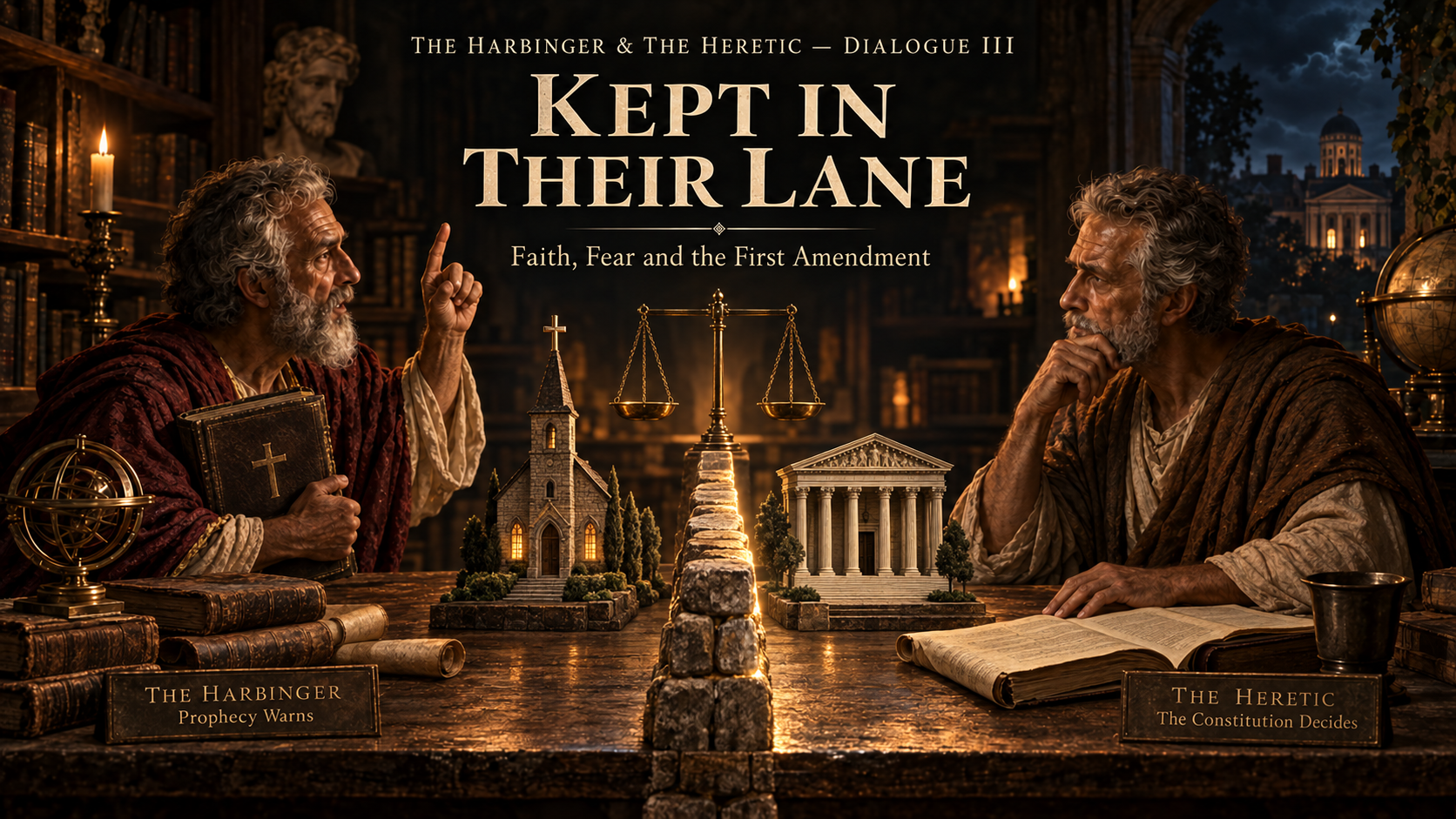
This argument has been running for three decades, through four presidents and one long email chain that never ends. It resurfaces every time the news gets loud, and it always lands in the same place. One friend says he saw it coming. The other asks him to name the thing, the date and the reason. What follows is the conversation almost word for word, cleaned up only where the caps lock needed to come off.
The Harbinger
Thirty years ago I told you we were headed in the wrong direction, that dark times were coming. I didn't know the exact shape of it, but I knew we were headed down. You fought me on it every time. Now look where we are. Woke, DEI, the socialists in office, the world coming apart at the seams. I was right about the direction then, and I'm right about it now, and it's only getting started.
The Heretic
You told me things were going to get dark. That's not a prediction, that's a mood. A prediction has a name attached to it, a date attached to it, a mechanism attached to it, something that can actually be checked against what happened. "Bad things are coming" has been true in every decade since the printing press, because bad things are always coming for somebody. That's not insight. That's the weather report for being alive.
The Harbinger
Of course I didn't know the details. Nobody can know the details. But if I had described exactly what's happening right now thirty years ago, in specific terms, you wouldn't have believed a word of it.
The Heretic
That's the whole problem in one sentence. You're asking me to give you credit for a level of detail you admit you never had, based on your confidence that I would have rejected detail you also never gave me. That's not a claim I can test. That's a claim built specifically so it can never be tested. Meanwhile I remember the actual specifics you did commit to over the years, because you committed to plenty. China was going to dethrone the dollar. The BRICS bloc was going to collapse our currency. China's navy had grown so far past ours that we would not be able to stop them. Every one of those had a name, a mechanism and a timeline, and every one of those failed to happen on schedule. Those are the predictions you actually made. "It's getting dark" is not one of them, it's just the one you remember making because it never had to be wrong.
The Harbinger
You're missing the point entirely. All one has to do is watch the news to feel that the world is coming apart. It doesn't take a Christian to see it.
The Heretic
The world came apart in the 1930s. Two world wars, a depression, genocide on an industrial scale. We have gone eighty years since the last one without another world war, longer than almost any stretch in modern history. If your test for civilizational collapse is a rough news cycle and some cultural fights you don't like, every generation that ever lived qualifies. My grandparents' generation watched actual cities burn. What you're describing is discomfort with change, and discomfort with change is not the same thing as the end of the world, no matter how many decades a preacher has told you it was.
Preachers Have Been Selling This Same Sermon for Two Hundred Years
The Harbinger's argument is not new, and it did not start with him. In 1844, tens of thousands of Americans sold their farms and gave away their possessions because a preacher named William Miller had convinced them Christ would return that October. When the date passed with nothing happening, history remembers it as the Great Disappointment, and the movement it spawned had to reinvent itself to survive the embarrassment. In the 1970s, Hal Lindsey's book The Late Great Planet Earth sold tens of millions of copies predicting an imminent apocalypse tied to the Cold War and the founding of modern Israel, confidently timed to arrive within a generation. That generation came and went. In 2011, radio host Harold Camping told his followers Judgment Day would arrive on May 21, then revised the date when it didn't, then quietly stopped talking about it. Every one of these men had the same tone the Harbinger has. Total certainty, cosmic stakes, a world visibly falling apart in front of them. None of them had a prediction that survived contact with the calendar.
The Millerite movement of the 1840s, Hal Lindsey's bestselling apocalyptic predictions of the 1970s, and Harold Camping's 2011 Judgment Day forecast are all documented, dated, named failures of specific religious prediction. Each one felt certain to the people inside it at the time. That certainty is not evidence the next one is different.
The Harbinger
You still haven't told me why the last thirty years don't count as proof I was right.
The Heretic
Because I can say I knew the Chiefs would beat the Broncos because I had a feeling, and if I'm right it still means nothing, and if I'm wrong nobody remembers I said it. That's not prediction, that's a coin flip with a testimony attached after the fact. If your instincts actually had predictive power, you could point to one specific, dated, falsifiable claim you made that came true on schedule for the reason you gave. Not a feeling. A claim. Thirty years is a long time to have made at least one.
The Harbinger
What, because you read the drivel people write all day, you think you're better than people who went to school? You read what people write. I listen to what people say. What's the difference? I listen to people every bit as read as you, every bit as educated, many even more educated than you. People who aren't roofers or business professors, but actual scientists, scholars, theologians, historians, archaeologists. I can't believe we're doing this again. You genuinely think you know everything because you like to read. That's nonsense. There are people who know more than you, oh mighty one.
Do you know more facts than me? Sure you do. But I'm sixty six years old and I've always known what I need to know, and if I need to know more, I can find out. I don't walk around thinking I know more than everybody about everything just because it makes me feel important. I don't have an ego problem. I'm content, I'm happy, and I know all I need to know. I read what I want and what I enjoy. And I know God. I have a relationship with Him. My sins are forgiven, and He has done things in my life you cannot imagine, better to me than I deserve.
So go ahead and spout your knowledge if it strokes your ego and makes you feel good. But know this. Everything you know and think you know won't mean a plug nickel in thirty years. It's wasted foolishness and it won't mean a thing when you stand before your Creator. Your problem with God and His word isn't intellectual, it's a pride issue, pure and simple. You can't for one second use the scientific method to prove what you believe, so you're not even being intellectually honest with yourself. You're a roofer and a business professor. I listen to real scientists, historians, archaeologists, geologists, biologists, nuclear physicists. So don't pretend you're high and mighty with me. Stay in your lane, brother.
The Heretic
Reading and listening are both just ways of receiving a claim. Neither one makes the claim true by itself. The question was never which method you use to take in information, it's whether you check what you took in against something other than how badly you wanted it to be true. You can listen to a nuclear physicist explain nuclear physics and be listening to genuine expertise. You can also listen to that same physicist talk about biblical archaeology and be listening to someone as unqualified there as I am. A credential is not a passport that clears every claim a person makes in every field they mention. It only covers the field they earned it in.
And notice what you actually did with those credentials. You didn't say you'd weighed the historians, archaeologists and theologians who disagree with you and found them wanting. You said you listen to the ones who agree with you and that this is what listening looks like. That's not humility about your own limits, that's picking a team of experts to stand behind an answer you already had. Plenty of historians, archaeologists and theologians reach the opposite conclusion from yours, with the same degrees and the same access to the evidence. Citing a category of smart people instead of a specific argument isn't an appeal to authority, it's a substitute for having one.
Your relationship with God, your forgiveness, what He's done in your life, I'm not going to argue you out of any of that and I have no interest in trying. That's a private experience and I take you at your word that it's real to you. But a private experience that only you can verify is exactly the kind of claim that can't be tested by anyone standing outside it, which means it can't settle a factual argument between the two of us. You said it yourself. I can't use the scientific method to prove what I believe. Fair enough. Neither can you use it to prove what you believe. The difference is I'm not asking you to accept my side on faith. I'm asking for a claim I can check. That's not pride. Pride is being certain of something you've made sure can never be checked.
Credentials Are Not an Argument
The Harbinger's move here has a name. Logicians call it an appeal to authority, and it has been catalogued as a fallacy since Aristotle, not because expertise is worthless but because expertise is field specific and does not transfer by association. A physicist's doctorate makes their claims about physics worth extra weight. It does not make their claims about scripture, economics or history worth extra weight just because they hold the same doctorate. Pew Research surveyed members of the American Association for the Advancement of Science in 2009 and found a genuinely mixed picture, a majority not affiliated with any religion but a substantial minority who are, which cuts against the idea that "real scientists" line up neatly on one side of a theological argument. The category "scientist" does not vote as a bloc on questions outside science, and naming the category is not the same as winning the argument inside it.
The Double Standard He Never Notices
The Harbinger's argument amounts to this. A modern professional with access to peer reviewed research, cross examined data and two hundred years of scientific method behind him has no standing to question the natural world, while a Bronze Age shepherd with none of those things gets treated as an unimpeachable authority on how that same world began. That is worth sitting with for a second, because it is exactly backward.
The authors of Genesis were not stupid. They were working with the best tools their era had, which were oral tradition, observation with the naked eye and no concept of geology, genetics, astronomy or medicine as we understand them today. Nobody writing in the ancient Near East had access to ice core samples, sediment layers or a genome to sequence. That is not an insult to them, it is a simple fact about when they lived. The problem is not that they got it wrong by the standards of their own time. The problem is expecting their conclusions to hold up against evidence they had no way of collecting, while dismissing anyone alive today who has that evidence.
Take the flood. Genesis describes a global deluge that covered every mountain on earth. Geology has no record of it anywhere, no missing layer of soil, no global sediment deposit, no genetic bottleneck in the fossil record that an event of that scale would leave behind. What the ancient Near East does have is an older flood story. The flood tablet in the Epic of Gilgamesh predates the Genesis account by several centuries and follows nearly the same structure, a warned man, a boat, animals, a bird sent out to find land. That is not two independent eyewitnesses corroborating each other. That is one culture's flood myth getting passed down and reworked by a later one, the same way flood stories show up in dozens of unrelated cultures for the same ordinary reason, those cultures lived near rivers that occasionally flooded badly.
Adam and Eve as the literal first two human beings runs into a wall that has nothing to do with faith and everything to do with population genetics. The human genome carries a record of how much genetic diversity a population needs to produce it, and that record rules out a bottleneck of two individuals. It takes thousands of breeding individuals, not two, to generate the diversity actually present in modern humans. This is not a fringe atheist talking point. Dennis Venema, an evangelical biologist, laid out the genetic case in detail and it cost him his teaching position at a Christian university for saying it plainly. The data does not care what either side of this argument believes about who said it.
The resurrection sits in a different category entirely, because it is not a claim about ancient people misreading a natural process, it is a claim about a one time supernatural suspension of every natural process. That kind of claim cannot be checked by geology or genetics. It can only be accepted or not, which is exactly why it belongs in the category of faith rather than the category of fact, and why citing it as evidence in an argument about evidence does not work.
None of this means the people who wrote these books were fools, or that everything ancient is worthless. It means a shepherd with no telescope does not automatically outrank a professor with a library just because he lived three thousand years earlier. Age is not a credential.
The Mesopotamian flood tradition preserved on the Gilgamesh flood tablet predates the Genesis flood narrative by several centuries, a dating established by Assyriologists independent of any theological argument. Evangelical biologist Dennis Venema's population genetics analysis in *Adam and the Genome* found no point in the human species' history consistent with a two-person bottleneck.
Where the Harbinger Has a Point
Strip away the prophecy and there's a real argument buried in his rant, and it deserves to be named instead of dismissed. Institutional trust has collapsed across the board in the last three decades, not just in religion but in media, government, academia and both political parties. Cultural change has genuinely accelerated faster than a lot of people, religious or not, have had time to process. Feeling disoriented by that pace is not delusional, it's a documented and measurable phenomenon, and dismissing it as pure paranoia gives it less credit than it deserves. Where the argument fails is the jump from "the pace of change feels destabilizing" to "I predicted this exact outcome thirty years ago and only I saw it coming," because that second claim requires a specificity his actual thirty-year record never had.
A Prediction Needs a Name, a Date and a Number
This is the same failure this series covered with Matthew 24, just wearing a secular costume. A real prediction commits in advance to a specific, checkable outcome and accepts the risk of being provably wrong. "Things are getting worse" cannot lose, because worse is always available somewhere if you look hard enough for it. That is not a strength of the claim. It's the tell that it was never really a claim, just a feeling wearing the costume of one.
Why This Matters
Every generation produces someone convinced they are the one watching civilization end in real time, and every generation of preachers, pundits and prophets has been happy to sell them the certainty that comes with that belief. The way to tell the difference between insight and anxiety dressed up as insight is simple and has not changed in two hundred years. Ask for the name, the date and the number. If what comes back is a mood instead of a claim, you are not talking to a forecaster. You are talking to someone who needs the world to be ending, because the alternative is admitting it's just Tuesday, and it has been just Tuesday for as long as people have been predicting otherwise.
- Festinger, L., Riecken, H. W., & Schachter, S. (1956). *When Prophecy Fails.* University of Minnesota Press. [Classic study of the Millerite movement and the psychological aftermath of a failed, dated apocalyptic prediction, known as the Great Disappointment of 1844.]
- Lindsey, H. (1970). *The Late Great Planet Earth.* Zondervan. [Bestselling apocalyptic prediction tying Cold War geopolitics to an imminent, generation-bound end times timeline that did not materialize.]
- Associated Press. (2011, May 23). *Harold Camping's Judgment Day prediction fails to come true.* [Coverage of the dated, named and falsified May 21, 2011 Judgment Day prediction.]
- Popper, K. (1959). *The Logic of Scientific Discovery.* Basic Books. [Falsifiability as the line between a testable claim and one built to survive any outcome.]
- Pew Research Center. (2009, July 9). *Scientists and Belief.* pewresearch.org. [Survey of AAAS members showing religious affiliation among scientists is mixed rather than uniformly absent.]
- George, A. (2003). *The Epic of Gilgamesh.* Penguin Classics. [Scholarly translation and dating of the Mesopotamian flood tablet predating the Genesis flood narrative.]
- Venema, D., & McKnight, S. (2017). *Adam and the Genome: Reading Scripture after Genetic Science.* Brazos Press. [Evangelical biologist's population genetics analysis ruling out a two-person human bottleneck.]