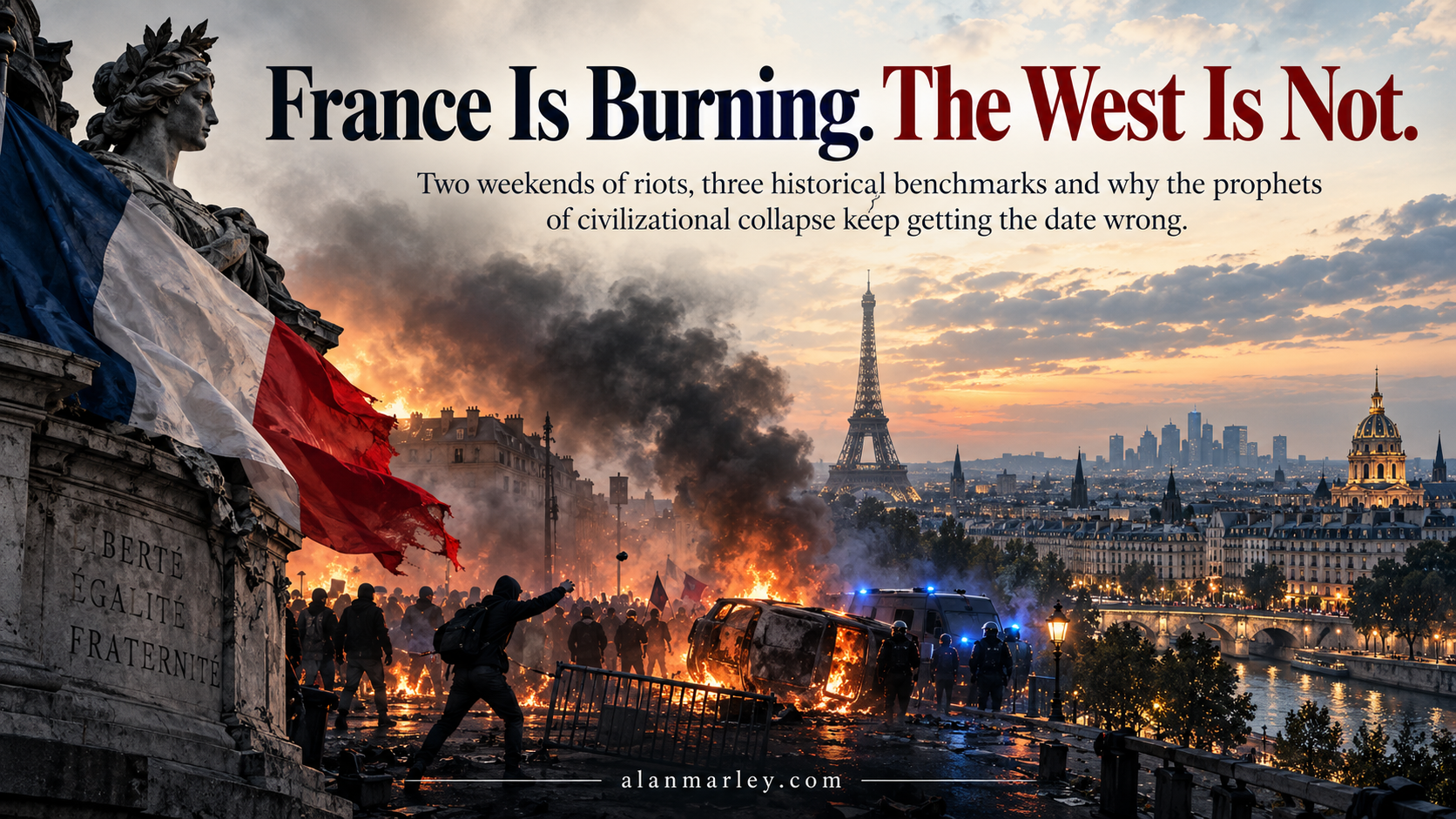
France has had two violent Saturdays in a row. The first one caught the government flat-footed. The second one was met with 70,000 police officers, banned marches and a city center sealed off like a crime scene. Somewhere between those two weekends a familiar chorus started up. The West is finished. Europe is collapsing. We are watching something world-shattering. That chorus is loud. It is also wrong, and the history of France itself is the best evidence against it.
Start with what actually happened. Then measure it against what France has survived before. The numbers tell a different story than the panic.
Last Saturday: The Government Got Caught Flat
The unrest did not start with fuel prices. It started in September in high schools in the working-class suburbs north of Paris, where anger over teacher shortages and crumbling facilities grew into a broader movement about inequality, public spending and the cost of living [1]. By early October the Justice Ministry reported more than 5,000 arrests tied to the student protests, the large majority of them minors [2]. Amnesty International and Human Rights Watch criticized the police response. The government insisted it was proportionate [2].
On October 17 the student movement merged with the unions, a revived Yellow Vest movement, farmers and retirees. The Interior Ministry counted roughly 550,000 demonstrators nationwide. The CGT union claimed more than 800,000 [3]. The marches were largely peaceful during the day. The margins were not.
In Lyon, masked youths set fire to a tourism office. In Marseille, protesters broke into the town hall and smashed furniture before police forced them out. In Lille, they ransacked the mayor's office [4]. Prime Minister Sébastien Lecornu reported about 1,200 arrests and more than 150 injured officers by Saturday night [5]. Clashes resumed in Paris on Sunday, and AFP put the weekend's arrest total at about 2,000 [6]. Officials later conceded they had underestimated the scale of what was coming [7].
This Saturday: A City Under Management
The government did not make the same mistake twice. Interior Minister Laurent Nuñez deployed about 70,000 police and gendarmes, roughly 10,000 more than the week before, backed by helicopters, armored vehicles and water cannons [7][8]. Paris rerouted its main march to the city's southeastern edge, far from the monuments. Police at the original starting point told people to disperse or pay a fine. Lyon banned its rally outright [8]. The Louvre and other cultural sites closed for the day [9].
It mostly worked. Turnout fell to about 410,000 by the ministry's count, though unions claimed twice that [7]. The main marches in Paris and most other cities passed peacefully, and Nuñez said there were no targeted attacks on town halls or police stations this time [10]. That matters. Attacks on the buildings that represent the state were the defining image of last weekend.
It did not fully work. Police used tear gas in Lyon and Clermont-Ferrand [8]. After the rallies ended, youths in Marseille built barricades from metal sheets, set bins on fire and threw rocks and bottles at riot police into the night [7]. In Toulouse a young man was reported to have lost fingers. In Nice, far-right and far-left groups fought each other as the crowd dispersed [10][11]. By evening nearly 1,000 people had been detained nationwide, and Nuñez expected the number to climb [11].
Last weekend drew about 550,000 marchers by official count, roughly 60,000 police, 1,200 to 2,000 arrests and direct attacks on town halls in Marseille and Lille. This weekend drew about 410,000 marchers against 70,000 police, nearly 1,000 arrests by Saturday evening and no reported attacks on public buildings. The violence did not disappear. It moved to the edges of the marches and to the hours after dark. Final arrest and injury totals for October 24 were not yet available at publication.
How Bad Was Last Week, Really?
Reuters called October 17 the worst rioting France had seen in years [1]. That is accurate. It is also a phrase that needs context, because France has a long record of street violence and the recent benchmarks are severe.
The 2005 suburban riots were the worst of the modern era by sheer scale. They began after two teenagers fleeing a police check were electrocuted at a power substation outside Paris. The violence lasted about three weeks. Police counted 8,973 cars burned and 2,888 people arrested over twenty nights [12]. President Jacques Chirac invoked a 1955 emergency law written for the Algerian War, and parliament extended the state of emergency for three months [13][12]. Insurers paid about €204 million in claims [14].
The 2023 riots after the police killing of 17-year-old Nahel Merzouk were the most intense. They lasted only about eight days. They still produced roughly €650 million in insured damage, more than three times the 2005 figure, along with more than 5,600 burned vehicles and over 1,000 damaged buildings [14][15]. Town halls, police stations and schools were singled out as targets. More than 1,300 people were arrested on a single night at the peak [16]. Analysts at Guy Carpenter called them the costliest riots in France in twenty years and noted the damage came in a far shorter window than either 2005 or the Yellow Vests [17]. Order returned only after 45,000 officers were deployed [17].
The Yellow Vest movement of 2018 and 2019 was the most politically disruptive. It ran for months of weekly protests over fuel taxes and living costs. On December 1, 2018, rioters defaced the Arc de Triomphe, torched cars and looted shops in what Reuters described as the worst rioting in Paris since 1968 [18]. The following Saturday the government put about 89,000 police on the streets and detained 1,385 people [18][19]. The violence came in weekend bursts rather than sustained nightly rioting, so it ranks below 2005 and 2023 for raw destruction. It forced Macron to cancel the fuel tax.
So where does October 17 land? Its single-day arrest count sits in the same range as the worst Yellow Vest Saturday. Its attacks on town halls echo 2023. It has not approached the duration of 2005 or the destruction of 2023. Its closest relative is the Yellow Vests, a weekly movement driven by prices with real political weight. The difference this time is breadth. Students, unions, Yellow Vests and the suburbs are moving together, six months before a presidential election.
The Apocalypse Is Not on Schedule
Now to the larger claim. Some people look at burning cars in Marseille and see the end of Western civilization. I understand the impulse. The images are ugly and the anger is real. But the claim does not survive contact with history, and France is the worst possible country to make it about.
In May 1968, about 10 million French workers walked off the job. That was roughly two-thirds of the labor force and the largest general strike in the country's history [20]. Students fought police behind barricades in Paris. President Charles de Gaulle secretly flew to a French military base in West Germany to confirm the army would back him [20][21]. People genuinely believed the Fifth Republic was finished. A month later de Gaulle dissolved the National Assembly and his party won an absolute majority [22]. The Republic is still standing.
Go back further. During the final week of the Paris Commune in May 1871, government troops retook the city street by street. Historians estimate 10,000 to 15,000 Communards were killed, and the Tuileries Palace and the Hôtel de Ville were burned [23][24]. France has also lived through a revolution, two world wars and a Nazi occupation. A weekend of looted storefronts does not belong on that list.
Collapse has a recognizable shape. Elections get canceled. The army picks a side. The state loses the ability to enforce its own laws. None of that is happening in France. People are marching openly. Unions are organizing. A police watchdog is investigating officers [1]. Courts are processing arrests. Candidates for president are fighting over the protesters' votes [4]. And the state put 70,000 officers on the street in a week and largely contained the daytime marches. That is a democracy under strain. It is not a democracy in collapse.
A country that can still hold an election in six months is not a country at the end of history.
The causes are not cosmic either. Teacher shortages. Rundown schools. Fuel prices. Public debt. These are policy failures, and policy failures have policy answers. Governments fall over them. Civilizations do not.
Declinism is also one of the oldest habits in Western thought. Oswald Spengler published The Decline of the West in 1918, arguing that Western civilization had entered its final winter [25]. The West then spent the next century becoming richer, healthier and freer than any society in human history. Every generation has its prophets of collapse. Most of them had worse evidence than burned bins in Marseille. What our generation has that theirs did not is a phone that delivers every fire and every smashed window in real time. That makes unrest feel bigger and newer than it is. Visibility is not the same thing as scale.
What the Declinists Get Right, and Wrong
Modern democracies have problems. That is not news. It is not decay either. It is the permanent condition of free societies that have to govern themselves in public.
The declinists point to real ones. France's borrowing costs have climbed to their highest level in more than two decades as efforts to cut public debt fail to reassure investors [26]. Politics across Europe is polarized and fragmenting. The unrest has spread beyond France, with clashes in Brussels and mass student protests in Albania [26]. Add aging populations, slow growth and falling trust in institutions, and the declinists conclude the riots are the symptom of a civilization rotting from within.
The problems are real. The conclusion is not. Every one of those trends is the kind of problem modern democracies have faced before and worked through. Debt gets restructured. Growth stalls and recovers. Voters throw out governments that fail them, and the next government has to earn back the trust. None of that is comfortable. All of it is normal.
A civilization in decline stops solving its problems. This one is arguing about them in the streets, in parliament and soon at the ballot box. That is not a symptom of decay. It is the ordinary workload of a free society.
Problems are not proof of decline. They are proof of a society still doing the work.
Where This Leaves Us
France had a bad week followed by a better one. The government overreached in places and got some things right. The protesters have real grievances, and some of them committed real crimes. The election next spring will settle more than any riot will.
That is the honest picture. It is less dramatic than the end of the world. It is also true. Anyone who tells you otherwise is not reading the news. They are reading a script they wrote before the first car caught fire.
- Reuters via The Express Tribune. (2026, October 18). Mass protests in France spiral into worst riots in years. tribune.com.pk. [Origins of the movement, police watchdog investigations] Link
- Wikipedia. (2026, accessed October 24). 2026 French student protests. en.wikipedia.org. [Justice Ministry arrest figures, human rights criticism and government response] Link
- AzerNews. (2026, October 18). France arrests 1,200 as mass protests over living standards turn violent. azernews.az. [October 17 turnout estimates] Link
- AFP via The Express Tribune. (2026, October 18). France protests: demonstrators vow to shake government. tribune.com.pk. [Lyon, Marseille and Lille incidents; election context] Link
- CBC News. (2026, October 17). France PM says around 1,200 arrested, 150 police officers injured amid nationwide day of protests. cbc.ca. [October 17 arrests and police injuries] Link
- AFP via The Express Tribune. (2026, October 19). Paris police in new battles with protesters. tribune.com.pk. [Sunday clashes and weekend arrest total] Link
- CNBC. (2026, October 24). Violence flares in Paris after massive, largely peaceful protests across France. cnbc.com. [October 24 turnout, deployment size, Marseille clashes] Link
- Associated Press via The Washington Times. (2026, October 24). France mobilizes thousands of police to curb violence at protests. washingtontimes.com. [Route changes, Lyon ban, Clermont-Ferrand] Link
- The Washington Post. (2026, October 24). France, bracing for new protests, deploys 70,000 police officers. washingtonpost.com. [Closures of the Louvre and businesses] Link
- CNN. (2026, October 24). Clashes in France after day of mostly peaceful protests. cnn.com. [Nuñez on absence of attacks on public buildings; Nice clashes] Link
- CBS News / Associated Press. (2026, October 24). More than 1,000 arrested in France as protestors and police clash in several cities. cbsnews.com. [October 24 arrests and injuries] Link
- BBC News. (2005, November 16). France to vote on emergency laws. Archived at corpora.tika.apache.org. [2005 vehicle and arrest totals] Link
- Al Jazeera. (2005, November 9). France rioters defy state of emergency. aljazeera.com. [Origin of the 1955 emergency law] Link
- The Brussels Times. (2023, July). France riots: Damage from violence cost an estimated €650 million. brusselstimes.com. [France Assureurs figures for 2023 and 2005] Link
- Wikipedia. (accessed 2026, October 24). Nahel Merzouk riots. en.wikipedia.org. [Duration, vehicles burned, buildings damaged] Link
- Reuters via The Japan Times. (2023, July). Arrests fall as France rioting eases. alpha.japantimes.co.jp. [Peak single-night arrests] Link
- Guy Carpenter / Insurance Insider. (2023). French riots of 2023: Strikes, riots and civil commotion. guycarp.com. [Costliest riots in twenty years; 45,000 officers deployed] Link
- Reuters via Egypt Today. (2018, December 8). French police clash with 'yellow vest' protesters in Paris. egypttoday.com. [Arc de Triomphe, 89,000 police deployed] Link
- Al Arabiya. (2018, December 8). Police restore calm in Paris as 1,385 'Yellow Vests' protesters detained. english.alarabiya.net. [December 8, 2018 detentions] Link
- Wikipedia. (accessed 2026, October 24). May 68. en.wikipedia.org. [General strike size; de Gaulle's departure] Link
- Encyclopaedia Britannica. (n.d.). Events of May 1968. britannica.com. [De Gaulle's meeting with General Massu in Baden-Baden] Link
- Wikipedia. (accessed 2026, October 24). 1968 in France. en.wikipedia.org. [June 1968 election result] Link
- Wikipedia. (accessed 2026, October 24). Semaine sanglante. en.wikipedia.org. [Casualty estimates and burned landmarks] Link
- Encyclopaedia Britannica. (n.d.). Commune of Paris. britannica.com. [Overview of the Commune and its suppression] Link
- Wikipedia. (accessed 2026, October 24). The Decline of the West. en.wikipedia.org. [Publication dates and thesis] Link
- Reuters via Daily Sun. (2026, October 17). Clashes erupt across France as cost-of-living protests turn violent. daily-sun.com. [Borrowing costs; Brussels and Albania protests] Link