
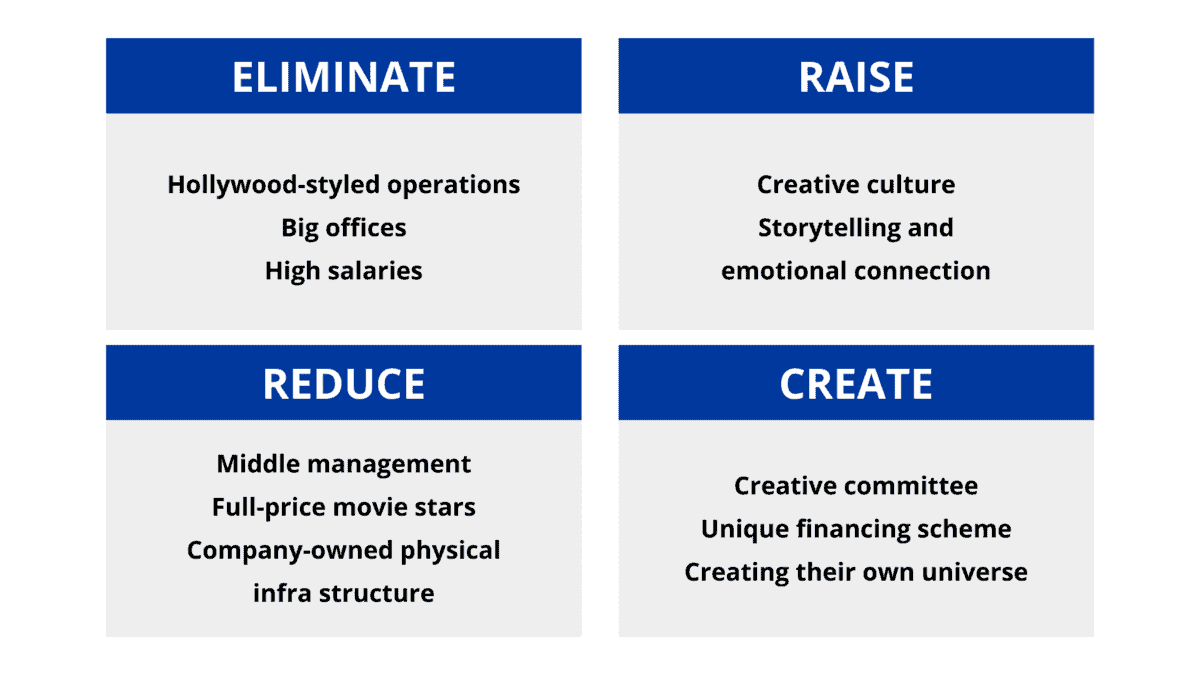
Blue Ocean Strategy is one of those ideas that sounds so clean it is almost addictive. Stop fighting in bloody red oceans, go create your own market space and make competition irrelevant. Who would not want that? The problem is modern business does not sit still long enough to let your uncontested market stay uncontested. And a lot of BOS enthusiasm glosses over the parts that actually kill companies: speed, imitation, distribution, execution, internal politics and the simple fact that creating new demand is expensive. The framework has genuine value. It also has real blind spots that get more dangerous every year. Here is what it gets right and where it breaks down.
What the Framework Actually Claims
The core argument is straightforward. Instead of choosing between differentiation or low cost, companies can pursue both through value innovation, opening new market space and pulling in noncustomers who were never competing for. The classic tools are the strategy canvas and value curve, the Four Actions framework of eliminate, reduce, raise and create, and the discipline of looking across alternatives rather than within existing category boundaries. The promise is not just "be different." It is "rebuild the rules." That is the pitch. Now for the modern reality check.
The Imitation Clock Runs Faster Now
BOS is not blind to imitation. Kim and Mauborgne explicitly acknowledge that blue oceans get copied and turn red over time. The problem is that in 2026 the imitation cycle is brutal in ways the framework did not fully anticipate. Global manufacturing makes copying physical products faster than ever. Software features get cloned in months, sometimes weeks. Marketing angles get copied the second they show traction. If your blue ocean is really just a bundle of features and pricing arranged differently, congratulations - it is now a menu everyone else can order from.
The deeper issue is that BOS often underweights defensibility. The question is not whether you can create something new. The question is what stops everyone from stealing it the moment it works. There is substantial strategy literature on how hard sustained advantage is when imitation is feasible and how firms try to slow it through capabilities, complexity and barriers. BOS fans love the creation story. They talk less about the staying-power problem. AI has made this worse, not better. Competitors can now clone workflows, ship lookalike features quickly, generate marketing copy at scale and run rapid pricing tests. If your blue ocean is essentially a repackaged value bundle, you are not building a moat. You are hanging a sign.
BOS can make leaders feel like they are above competition right when competition is about to get serious. The ocean does not stay blue. It turns purple, then red.
Pretty Thinking Is Not an Operational Plan
A strategy canvas can be a great thinking tool. It can also become a corporate art project. You can draw beautiful value curves, hold workshops and announce you are creating a new category while your supply chain is broken, your sales team cannot sell the new thing, your unit economics do not work and your operations team is quietly praying nobody buys too much of it because the company cannot deliver at scale. This is one of the most common reasons BOS implementations fail: the toolset is clearer than the operational playbook. Even recent academic critiques of the framework point to gaps in implementation protocol and limited guidance on practical execution once the strategy canvas is complete.
BOS can give leaders a rush of certainty. Execution punishes certainty. Creating new demand is also not free. If you are genuinely building a new market space you often have to fund customer education, trust building, onboarding friction, switching costs and distribution access before a single dollar of margin materializes. Big firms can subsidize that investment. Small firms can die doing it. BOS sometimes reads like you can sidestep competition by stepping sideways. In real life you just choose a different battlefield, often one where customers do not yet understand why they should care about what you built.
In many modern categories the market is not just customers. It is a platform. If you are competing against dominant app stores, marketplace incumbents, social distribution channels, payment rails, ad networks or enterprise suites with bundling power, you can create the most innovative value curve on earth and still get choked at the point of distribution. This is the part BOS does not emphasize enough: in platform markets the fight is not product against product. It is system against system. System fights are rarely uncontested. Winning the value innovation argument with customers means nothing if the infrastructure through which customers find and buy things is controlled by someone who benefits from your failure.
Noncustomers Are Not Always Waiting for You
Targeting noncustomers is genuinely smart thinking. It is also where teams lie to themselves most reliably. The failure pattern goes like this: you look at noncustomers, you invent a story about why they are not buying, you build a solution based on that story and then you discover the real reason they were not buying was simpler. They do not care enough, they do not trust you yet or the switching cost is not worth it at any price that preserves your margin. Noncustomer research is hard because it is full of polite answers. People will tell you they would buy. They often will not. Or they will but only at a price that destroys the economics of the whole proposition.
Survivorship bias compounds this problem significantly. The strategy literature on BOS is built largely on a winner's highlight reel. For every Cirque du Soleil or Nintendo Wii there are quiet attempts that did not scale, got copied immediately, failed at distribution, burned cash educating a market that never matured or died internally because the incentive structure rewarded the old business and punished the new one. BOS is not unique in this regard - most business frameworks oversell on examples and undersell on failure rates. But BOS is especially vulnerable because the dream is so seductive. "Competition is irrelevant" is the kind of line that makes smart people sloppy.
Organizational Resistance Is the Hidden Variable
Blue ocean moves almost always require internal conflict. You are cutting legacy features somebody built their career on, challenging assumptions that have been sacred for years, shifting budget away from current revenue producers and asking people to bet on something uncertain with their performance reviews on the line. Most organizations say they want innovation. What they want is innovation that is already approved, already de-risked and already working. They want the fruit of the blue ocean without the cost of swimming to it. BOS asks for courage at the organizational level. Most companies have PowerPoints instead. The strategy canvas gets presented, gets applauded and then gets quietly filed while the quarterly numbers continue to be produced the same way they always were.
How to Use It Without Getting Fooled by It
The answer is not to ignore Blue Ocean Strategy. It is to stop treating it like gospel and start using it as a lens. Every blue ocean claim should be treated as a testable hypothesis, not a declaration of victory. Defensibility has to be built from day one through capabilities, relationships, switching costs, process complexity and trust - not discovered after the competition shows up. Distribution has to be solved early because innovating yourself into invisibility is a real failure mode that the framework does not adequately warn against. Fast imitation should be assumed and the second move planned before the first move launches. Noncustomer research has to be verified against actual willingness to pay, not just expressed interest. And the organization's incentive structure has to be aligned with the new direction before the strategy is announced, not after the resistance surfaces.
BOS is best used to challenge stale thinking about where the boundaries of a market are. It is worst used as an excuse to declare competition irrelevant before the hard work of building defensibility is done. Most business failure is not because the idea was dumb. It is because the timing was wrong, the copying was fast, the distribution was blocked and execution did not match the story. A new value curve is a starting point, not a finish line.
If you want to make competition irrelevant, you need more than a new value curve. You need staying power. And staying power is not on the strategy canvas.
References
- Barney, J. B. (1995). Looking inside for competitive advantage. Academy of Management Executive, 9(4), 49-61.
- Kim, W. C., & Mauborgne, R. (2004). Blue ocean strategy. Harvard Business Review, 82(10), 76-84.
- Kim, W. C., & Mauborgne, R. (2015). Blue Ocean Strategy: How to Create Uncontested Market Space and Make the Competition Irrelevant (Expanded ed.). Harvard Business School Press.
- Mauborgne, R. (2023, May 31). What is Blue Ocean Strategy - and where does it go wrong? Harvard Business Review IdeaCast [Podcast].
- Zander, U., & Kogut, B. (1995). Knowledge and the speed of the transfer and imitation of organizational capabilities. Organization Science, 6(1), 76-92.
- A critique of Blue Ocean strategies: Exploring the limits of creating uncontested markets. (2025).
Disclaimer: The views expressed in this post are the personal opinions of the author and are offered for educational and commentary purposes only. They do not represent the positions of any institution, employer, organization or affiliated entity. Nothing in this post constitutes legal, financial, medical or professional advice of any kind. References to publications, academic research and business frameworks are based on publicly available sources cited above and are intended to support analysis and argument. Readers are encouraged to consult primary sources and form their own conclusions.