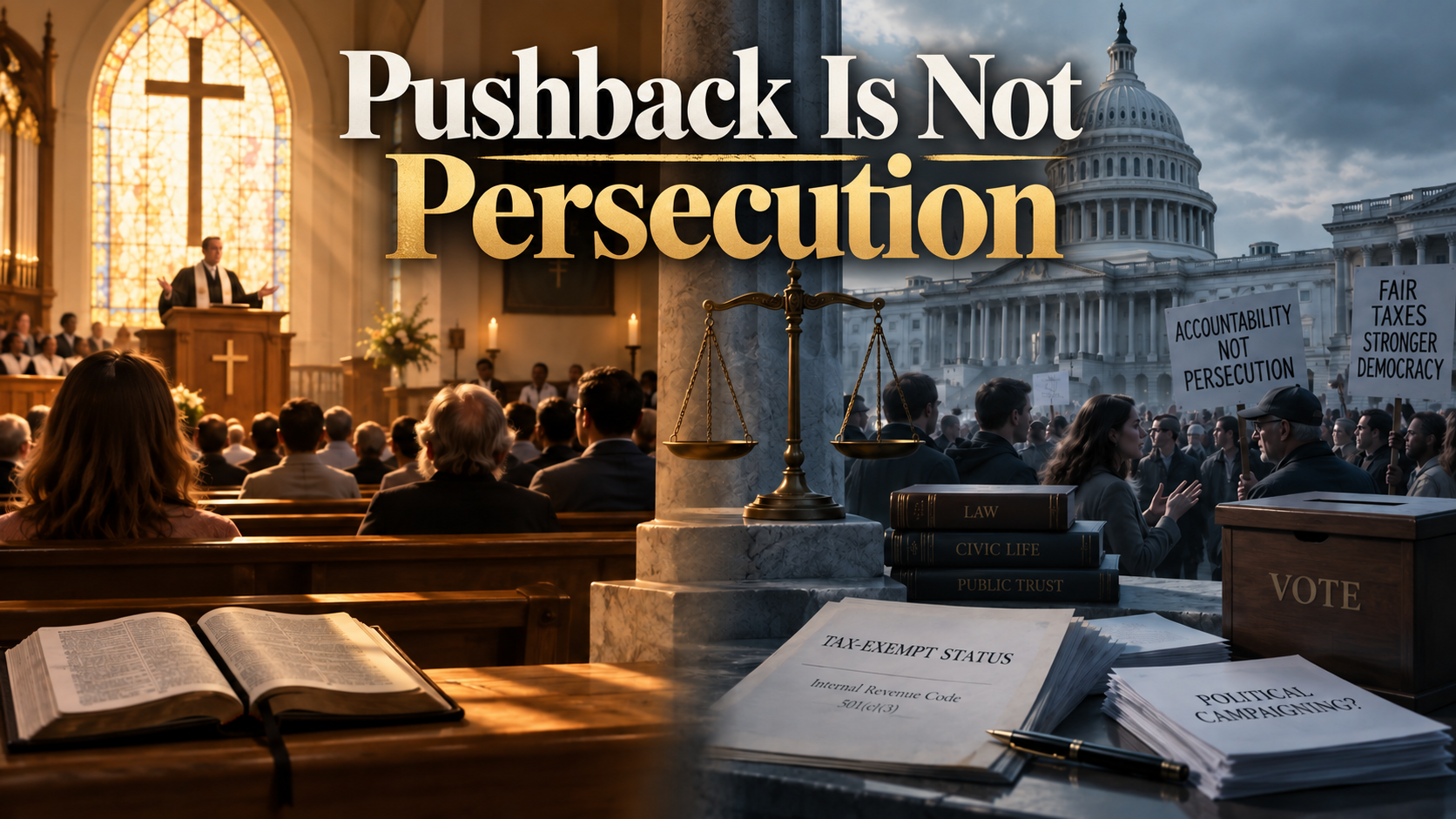
Start with the word itself. Persecution means systematic violence, imprisonment or legal destruction aimed at a group because of what it believes. It does not mean losing a culture war argument. It does not mean a baker facing a lawsuit. It does not mean a school board meeting getting heated. It does not mean someone on the internet calling you a bigot. Words have weight, and persecution is one of the heaviest words we have. Using it carelessly does not honor the people who are actually enduring it. It cheapens their suffering to borrow its name for a disagreement.
American Christians are not persecuted. What some of them are experiencing is pushback, and pushback is not the same thing. Confusing the two is either sloppy thinking or a deliberate rhetorical move, and either way it deserves to be corrected.
What Persecution Actually Looks Like
Open Doors publishes the World Watch List every year, ranking the fifty countries where Christians face the most severe persecution. The most recent reporting period recorded 4,849 Christians killed worldwide for their faith, with 93 percent of those deaths concentrated in sub-Saharan Africa and Nigeria alone accounting for roughly 3,490 of them. North Korea has held the top spot for 23 of the last 33 years. Christians there can be sent to labor camps for owning a Bible. In Somalia, Yemen, Sudan and Eritrea, conversion from Islam can carry a death sentence. In 2025, Syria jumped from eighteenth to sixth on the list after a church bombing in Damascus killed 22 people and wounded 63 more.
More than 380 million Christians worldwide live under high to extreme levels of persecution and discrimination for their faith. That is one in seven Christians on earth. None of them live in the United States.
The United States does not appear on that list. It never has. American Christians can build churches on any corner they can afford. They can broadcast on television, print books, run schools, organize political action committees, run for office and win. They hold the presidency, the majority of state legislatures and a majority of the Supreme Court. Nobody is closing their churches. Nobody is jailing their pastors for preaching. Nobody is killing them for owning a Bible.
Calling that persecution insults the people on the World Watch List who are actually dying for the label.
What Is Actually Happening
What American Christians are experiencing is something else entirely. It is pushback, and it comes from a specific and identifiable place. It is not aimed at belief. It is aimed at the use of tax-exempt institutional power to shape secular law for people who do not share the underlying religious premise.
Since 1954, the Johnson Amendment has barred organizations exempt from taxation under Internal Revenue Code section 501(c)(3), including churches, from participating in or intervening in any political campaign for or against a candidate. The bargain was straightforward. The public subsidizes religious and charitable organizations by exempting them from taxation, and in exchange those organizations stay out of partisan campaign politics. Congregations do not pay taxes so that pastors can endorse candidates from the pulpit.
That bargain shifted in July 2025. In a federal court filing, the IRS stated that communications from a house of worship to its own congregation, through its usual channels and in connection with religious services, do not violate the Johnson Amendment even when they touch on candidates and elections. The filing came out of a settlement with a Christian broadcasting association and two churches that had sued the agency. Legal scholars who track the statute describe this as the first time in seventy years the IRS has taken that position, and note that it applies a carve-out no secular nonprofit receives.
That is the actual source of the friction, and it has nothing to do with whether Christians are allowed to believe what they believe, worship how they worship or vote how they vote. It has to do with whether an institution that does not pay property tax, does not pay income tax and receives donations that are themselves tax deductible should also get to function as a political machine without losing any of those privileges. Every other nonprofit in the country operates under a real constraint here. Churches, as of 2025, effectively do not.
The Best Version of the Christian Argument
A fair treatment of this issue requires taking the strongest version of the opposing case seriously, not the weakest one.
Religiously motivated political engagement has a legitimate history in this country, and it is not automatically theocratic. Abolitionists organized against slavery from the pulpit. The civil rights movement was built inside Black churches, led by pastors and preached from scripture, and nobody reasonably calls Martin Luther King Jr.'s activism a violation of church and state. Religious voters are citizens. They are entitled to bring their convictions into the public square the same way secular voters bring philosophy, self-interest or tradition into theirs. Democracy does not ask anyone to check their worldview at the door before voting or organizing.
There is also a genuine First Amendment argument behind the Johnson Amendment challenge itself. The lawsuit that produced the 2025 settlement argued that barring a pastor from mentioning a candidate during a sermon, while a newspaper editorial board or a labor union newsletter faces no equivalent restriction, treats religious speech as a second-class category. That is not a frivolous argument. Selectively restricting speech because of its religious content sits uneasily with a First Amendment built to protect exactly that kind of speech.
None of that is dismissible, and a fair writer has to say so plainly instead of waving it away.
Where the Analogy Actually Bites
But there is a difference between a religious voter advocating for a policy on grounds anyone can evaluate and a religious institution demanding that secular law encode a specific theological premise simply because the institution's sacred text says so.
Picture a small, intense community of vegans who have organized themselves around a shared conviction that eating animal products is a moral wrong, rooted in a two-thousand-year-old text they treat as sacred. Nobody objects if they refuse meat themselves. Nobody objects if they argue publicly that eating meat is unethical, using arguments about animal suffering or environmental cost that anyone can weigh on the merits. That is ordinary moral advocacy, and it belongs in the public square like anything else.
Now picture that same group lobbying to write a ban on meat into the criminal code, defending the ban by citing their sacred text as the reason, and asking the rest of the population, most of whom reject the text's authority entirely, to live under a law whose only real justification is "our book says so." That crosses a line the first version never came close to. It is no longer moral advocacy addressed to shared reasons. It is an attempt to bind people who never accepted the premise to a rule that only makes sense if you already accept it.
That is the actual philosophical objection buried under the persecution complaint, and it deserves to be named honestly instead of hidden behind a victimhood narrative. Nobody is stopping Christians from believing marriage is between a man and a woman, from believing abortion is a sin, from believing their own children should be raised inside their theology. The objection surfaces when the argument for a law applying to non-Christians rests on nothing but "the Bible forbids it." At that point the disagreement is not about persecution. It is about whether a shared, secular justification exists for a law that binds people who never signed on to the text behind it.
Where the Line Actually Sits
This cuts both directions, and intellectual honesty requires saying that too.
A law against murder does not become illegitimate because the Ten Commandments also forbid murder. Overlapping conclusions are not the problem. Plenty of moral traditions, religious and secular, converge on rules against killing, theft and fraud, and a law does not need to abandon a rule just because scripture happens to agree with it. The test is not whether religion and law ever overlap. The test is whether the law's justification, stripped of the religious premise, still stands on its own. A ban on murder survives that test easily. A ban resting entirely on "this is a sin in our tradition," applied to people outside that tradition, does not.
That is the distinction that gets erased every time this conversation collapses into persecution talk. It lets one side avoid making the actual argument, and it lets the other side avoid hearing it.
Say What You Mean
American Christians are free. They are not jailed for their faith. They are not killed for owning scripture. They are not banned from organizing, preaching, publishing or running for office. Compared to the 315 million Christians facing very high or extreme persecution across fifty countries this year, American Christians are, by any honest measure, among the freest religious populations in the history of the species.
What some of them are actually facing is a country increasingly willing to ask a harder question. Not "why do you believe that," which is nobody's business but their own. The question is "why should I, who does not accept your text as authoritative, be bound by a law whose only real justification is that your text says so." That is not persecution. That is citizenship working exactly as it should.
Call it pushback. Call it disagreement. Call it a fight over what a secular pluralistic country owes to competing moral traditions that do not all draw from the same well. All of those descriptions are honest. Persecution is not one of them, and pretending otherwise does not strengthen the argument. It just tells the room you did not have one.
- Open Doors. (2026). World Watch List 2026 Trends. opendoors.org. [Persecution deaths, regional concentration, North Korea ranking]
- Open Doors. (2025). World Watch List 2025 Overview. opendoors.org.hk. [Global persecution totals, ranking methodology]
- Christianity Today. (2025, January 28). The 50 Most Dangerous Countries for Christians Get More Violent in 2025. christianitytoday.com. [Yemen, Syria, Nicaragua country data]
- The Conversation. (2025, August 8). IRS says churches may endorse political candidates despite a decades-old federal statute barring them from doing that. theconversation.com. [Johnson Amendment history, IRS enforcement record, Lloyd Hitoshi Mayer commentary]
- Greenberg Traurig LLP. (2025, July 14). IRS Announces Churches and Other Houses of Worship May Endorse Political Candidates Without Losing Tax-Exempt Status. gtlaw.com. [Legal analysis of the 2025 settlement and its scope]
- CNBC. (2025, July 8). IRS says churches can endorse political candidates without losing tax-exempt status. cnbc.com. [Court filing details, National Religious Broadcasters litigation]
- U.S. Constitution, First Amendment. [Free exercise and establishment clauses]
- Internal Revenue Code, 26 U.S.C. § 501(c)(3). [Tax-exempt status conditions, the Johnson Amendment]