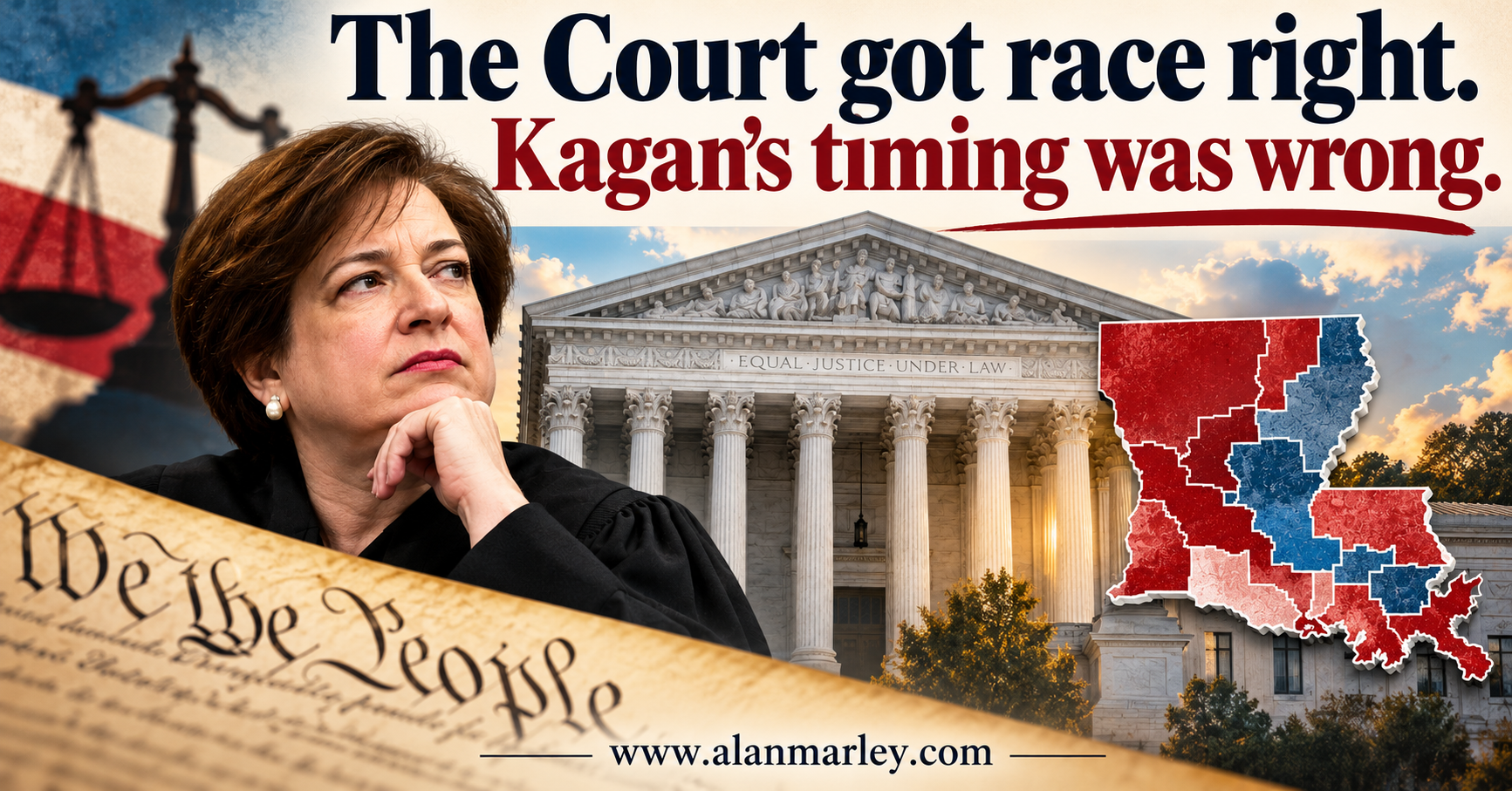
On Tuesday, October 20, Justice Elena Kagan stood in front of students and faculty at Catholic University's law school and told them her conservative colleagues have made American democracy worse. She said the Court has blinded itself to the damage its rulings do to the political system. She went after the campaign finance cases. She went after the partisan gerrymandering cases. Most of all she went after Louisiana v. Callais , the April decision that rewrote how Section 2 of the Voting Rights Act works in redistricting. She said all of this two weeks before an election that will decide control of Congress. Some of what she said deserves an answer. Some of it deserves a concession. And the setting deserves a hard look of its own.
I have written about Callais twice on this site. Once to defend the ruling on the law. Once to push back on the viral claim that it handed Republicans the midterms. Six months later the redistricting dust has mostly settled and a sitting justice has decided to reargue her dissent in public. It is time to put both arguments in one place and check them against what actually happened.
What She Said and What She Conceded
Kagan's central claim, as reported by the Associated Press, is that the Court's election rulings have made the country more polarized and less democratic. She tied that to three lines of cases. The 2019 decision in Rucho v. Common Cause , where the majority held that partisan gerrymandering is a political question federal courts cannot police. The campaign finance rulings that loosened limits on political money. And Callais , which she called in her April dissent the latest chapter in the majority's now-completed demolition of the Voting Rights Act. She dissented in every one of those cases.
Fairness requires noting what she also said. Kagan told the audience it is unfair to claim the majority reflexively sides with the president. She pointed to the tariff case, the birthright citizenship case and the mail ballot case as places where the Court pushed back on the Trump administration. That matters. It means her complaint is about how the Court reads election law. It is not the cartoon version that the Court is a rubber stamp. Critics who want to dismiss her as a partisan should deal with that part of the speech too.
Is It Normal for a Justice to Do This?
More normal than people think. Less normal in this form.
Justices criticize the Court in public all the time. Antonin Scalia spent decades ridiculing majority opinions he disagreed with, from the bench and from the lectern. Samuel Alito used a 2020 Federalist Society speech to criticize pandemic restrictions and the fallout from the same-sex marriage ruling. Sonia Sotomayor has told audiences she sometimes feels despair after losing. Nobody serious thinks a justice gives up the right to explain a dissent when the opinion is published.
In November 2023 all nine justices, Kagan included, signed the Court's first formal Code of Conduct. Canon 3 says a justice should not knowingly make public comment on the merits of a matter pending or impending in any court. Canons 1 and 2 add the broader duties to protect the Court's integrity and independence and to avoid impropriety and its appearance. Callais itself is decided. Criticizing a decided case is not a violation of the pending-case rule.
So on the letter of the rules, Kagan is fine. The problem is the spirit. Callais is decided but the fights it started are not. States redrew maps because of it. Some of those maps are in litigation now. Others will be. Election disputes after November could land on the Court's docket within weeks. A justice who tells the public that the legal framework behind those maps is wrecking democracy is not commenting on a closed chapter. She is commenting on the opening of the next one.
Then there is the calendar. Two weeks before a midterm is the worst possible moment for a member of the Court to tell voters that one side of the bench has degraded the democracy they are about to participate in. She may not have intended a campaign message. It will be received as one anyway. The 2023 Code exists precisely because Americans stopped assuming the justices police themselves. Every justice who pushes against the edge of it, on either wing, makes the next justice's credibility a little cheaper.
Within the rules is not the same as wise. A justice should know that better than anyone.
The fair comparison is Ruth Bader Ginsburg in 2016. She called candidate Donald Trump a faker in press interviews and then publicly apologized, saying a judge should avoid commenting on a candidate for public office. Kagan did not do that. She attacked rulings, not a candidate. That is a real difference and it keeps her inside the line. But it is the same neighborhood, and the timing puts her on the edge of it.
What Callais Actually Held
Before arguing about whether the decision destroyed democracy it helps to know what it did.
After the 2020 census Louisiana drew a congressional map with one majority-Black district out of six. Black voters, roughly a third of the state's population, sued under Section 2 of the Voting Rights Act and won a ruling that the map likely diluted their votes. The legislature drew a second majority-Black district. A different group of voters then sued over that map, arguing race had driven its design. The lower court agreed. On April 29, 2026, the Supreme Court affirmed 6-3 in an opinion by Justice Alito.
The holding is narrower than the headlines. The Court did not strike down Section 2. It held that because the Voting Rights Act did not require Louisiana to create the second majority-minority district, VRA compliance could not justify the state's use of race, and the map was an unconstitutional racial gerrymander. Along the way it added new requirements for vote dilution claims. Plaintiffs trying to show racially polarized voting must now account for party affiliation. And the court's totality-of-the-circumstances review must focus on evidence with real bearing on present-day intentional discrimination.
Section 2 is not only a ban on intentional discrimination. Since Congress amended it in 1982 it has prohibited voting practices that result in diluting minority voting strength, whether or not anyone intended that result. That is exactly why Callais matters. By requiring plaintiffs to separate race from party and to tie their evidence to present-day intentional discrimination, the Court pulled the practical test back toward intent, even though the statute's text still speaks of results.
Why the Majority Got It Right
Here is the principle. The Constitution almost never lets the government sort citizens by race. We apply that principle to college admissions. We apply it to hiring and contracting. The Court applied it to Harvard in 2023. There is no textual exception for congressional maps. If drawing lines by skin color is wrong when it is used to exclude, it is wrong when it is used to include. The direction of the sorting does not change what it is.
Alito put the conflict plainly. Section 2, he wrote, was designed to enforce the Constitution, not collide with it. For years the lower courts had put states in an impossible position. Draw a map without enough majority-minority districts and get sued under Section 2. Draw the districts the courts demanded and get sued under the Equal Protection Clause for using race. Louisiana did exactly what one federal court ordered and was then told by another that it had violated the Constitution. A legal regime that punishes a state for complying with it is not a regime. It is a trap.
A colorblind Constitution is not the enemy of Black Americans. A Constitution that lets government sort people by race whenever the sorting is called beneficial is the enemy of everyone.
Underneath it all sits the question the left rarely wants stated out loud. As lower courts had applied it, Section 2 was drifting toward a rule of rough racial proportionality. If a group is a third of the population it should hold about a third of the seats. Congress never wrote that. Section 2 itself says it creates no right to proportional representation. The majority's correction is not an attack on voting rights. It is a return to what voting rights mean: the right to vote free of racial discrimination, not the right to have your race determine which electoral container you are poured into.
What Kagan Gets Right
An honest argument has to face the best version of the other side. Kagan's dissent is not hysteria. It makes points that deserve real answers.
First, intent is hard to prove. Legislators do not write racial motives into the committee report. Congress amended Section 2 in 1982 precisely because the Court had made intent the test and almost nobody could meet it. When the Court pushes the practical standard back toward intent, it is arguably undoing a choice Congress made deliberately. That is a fair textual criticism, and conservatives who preach deference to statutory text should feel its weight.
Second, disentangling race from party is not easy in the Deep South. Black voters there vote overwhelmingly for one party. Requiring plaintiffs to prove their losses come from race rather than partisanship can make some real dilution claims nearly impossible to win. Reasonable people can believe the majority set the bar too high.
Third, the consequences she predicted were real. Section 2 litigation is how many Southern districts that elect Black members of Congress came to exist. Some of those districts were redrawn this year. If you believe those districts were a lawful remedy for real dilution, you are right to see their loss as a loss.
I still think the majority got the constitutional question right. But the dissent is a serious argument about statutory text and practical effect. It deserves to be answered as one, not waved away.
What Actually Happened After April
In May I wrote that the ruling would move the chessboard but not checkmate the election, and that a district being legally vulnerable is not the same as a district being gone. Half of that held up. Some districts are gone.
Florida redrew its congressional map and Governor DeSantis signed it into law on May 4, five days after the ruling. Tennessee followed. Together, according to Ballotpedia, those two maps aimed to shift five more districts toward Republicans. In Tennessee, Democratic Congressman Steve Cohen announced he would not seek reelection after his Memphis district was split in the new lines. Louisiana's governor suspended the state's congressional primaries so the legislature would have time to draw a new map. South Carolina called a special session. Georgia announced a special session aimed at the 2028 cycle. Alabama went back to court to try to escape its court-ordered map.
None of this happened in a vacuum. The mid-decade redistricting war started in Texas in 2025, when the White House pressed Republicans to redraw for up to five more seats. California's Democrats answered with their own redraw. Virginia's Democrats tried to follow, and the Virginia Supreme Court blocked their plan on procedural grounds in May. Callais did not start the map war. It handed Southern Republican legislatures a new weapon in the middle of it.
Vulnerable was not gone. But in several states, vulnerable became gone in about a week.
Republicans Should Be Careful What They Celebrate
This is where the conservative argument has to prove it is a principle and not a tactic.
The case for Callais is that government should not engineer districts around racial targets. Fine. Then government should not engineer them around partisan targets either. A map drawn to cram one party's voters into as few districts as possible is not more constitutional in spirit because the Court said in Rucho that federal judges cannot stop it. Kagan's point about gerrymandering is not wrong just because she is the one making it.
The Florida example should make conservatives uncomfortable. Florida voters adopted anti-gerrymandering amendments to their state constitution in 2010 by an overwhelming margin. Governor DeSantis has argued those amendments are now invalid, partly on the strength of Callais. That is not colorblind districting. That is using a ruling about race to escape a rule voters adopted against partisanship. If the principle is neutral lines, Florida's own voters already wrote it down.
The defensible conservative position is simple. Districts should be compact, contiguous and built around real communities, not racial quotas and not party math. That position could win broad public support across racial lines. It requires a consistency neither party has shown. Both parties redraw for power when they hold it. Both dress the result up as democracy. Voters are entitled to be skeptical of anyone claiming the high ground on maps this year.
The Jim Crow Comparison Is Still Wrong
Within hours of the April ruling Democratic officials were comparing it to Jim Crow. That comparison was lazy then and it is lazy now. Jim Crow used violence, poll taxes, literacy tests and outright terror to keep Black Americans from voting at all. Callais held that states cannot make race the predominant factor in drawing district lines. One stripped citizens of the ballot. The other said the ballot must be organized on race-neutral terms. Every Black citizen in Louisiana who could vote before April can vote today. People whose parents and grandparents were actually turned away at the courthouse deserve better than having that history spent as a slogan.
To her credit Kagan did not use that comparison at Catholic University. Her argument was about representation and dilution, not disenfranchisement. The politicians who borrowed her dissent for their fundraising emails should take note of the difference.
My Bottom Line
Louisiana v. Callais was the right decision for the right reason. Government should not sort citizens by race, and Section 2 should not be read to require what the Equal Protection Clause forbids. The dissent raised serious objections about the statute's text and the difficulty of proving intent. Those objections deserve answers, and I have tried to give them here.
Justice Kagan has every right to disagree, and her October speech stayed inside the written rules. But a justice telling the country two weeks before an election that her colleagues have broken democracy is spending the Court's credibility. That credibility does not belong to her wing or to the other one. It belongs to the institution, and the institution is going to need every bit of it if the results in November end up in front of it.
The real lesson of the last six months is not that one side won. It is that redistricting is where American democracy gets quietly engineered before anyone casts a ballot. The answer is not more racial engineering and not more partisan engineering. It is neutral lines, applied to everyone, by people willing to accept the result when it costs them. That standard is easy to say. Watch who actually lives by it.
- Louisiana v. Callais, Nos. 24-109 and 24-110, 608 U.S. ___ (2026, April 29). Majority opinion by Alito, J. Dissent by Kagan, J., joined by Sotomayor and Jackson, JJ. supremecourt.gov.
- Associated Press / Whitehurst, L. (2026, October 20). Justice Kagan warns Supreme Court rulings are fueling polarization and undermining democracy. ajc.com. [Coverage of Catholic University remarks]
- Boston Globe. (2026, October 20). Justice Elena Kagan criticizes Supreme Court on election rulings. bostonglobe.com. [Context on Rucho dissent and upcoming midterms]
- NPR / Johnson, C. (2026, October 21). Justice Kagan criticizes the Supreme Court on elections and voting. npr.org.
- Supreme Court of the United States. (2023, November 13). Code of Conduct for Justices of the Supreme Court of the United States. supremecourt.gov. [Canons 1 through 3]
- Faegre Drinker. (2026, April 29). Supreme Court decides Louisiana v. Callais. faegredrinker.com. [Summary of new Section 2 evidentiary requirements]
- National Constitution Center / Bomboy, S. (2026, April 30). The Supreme Court's Callais decision sets new framework for racial gerrymandering. constitutioncenter.org.
- Ballotpedia News. (2026, May 11). New congressional maps in Florida, Tennessee aim to shift five more districts to Republicans ahead of 2026 midterms. news.ballotpedia.org.
- Stateline / Vollers, A. C. (2026, May 15). The redistricting frenzy is scrambling the midterm elections. Here's where things stand now. stateline.org. [Louisiana, South Carolina, Georgia, Alabama, Texas and California redistricting status]
- Rucho v. Common Cause, 588 U.S. 684 (2019). [Partisan gerrymandering held nonjusticiable; Kagan, J., dissenting]
- Students for Fair Admissions v. Harvard, 600 U.S. 181 (2023).
- 52 U.S.C. § 10301. [Section 2 of the Voting Rights Act, as amended in 1982, including the results standard and the proportional representation disclaimer]
- Ginsburg, R. B. (2016, July 14). Statement regarding remarks about presidential candidate. Supreme Court Public Information Office. [Ginsburg's public statement of regret]