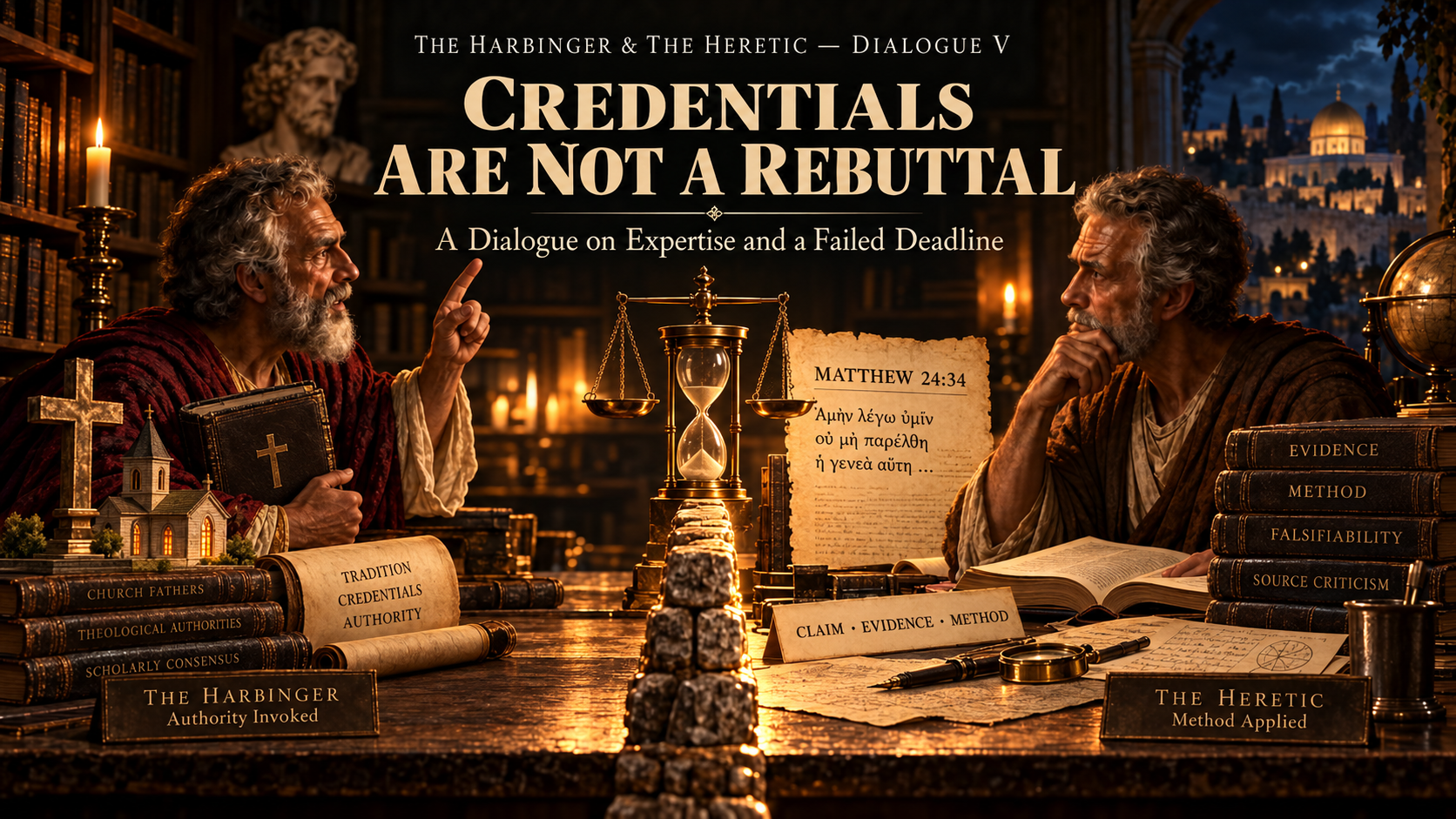
The argument over credentials is older than the argument over the verse. It comes back whenever a believer runs short of evidence and reaches for the other man’s resume instead. What follows is a dramatization of that exchange, built from the points that keep recurring in my own correspondence, with the details of any real person removed.
Two old friends are still arguing. The Harbinger has called the Heretic a roofer more than once. The Heretic has decided to answer that charge with something better than irritation: a method and a test case.
You are a roofer. You teach a little business. You read books and then you lecture people who have given their whole lives to theology, physics and math. Why aren’t you at Oxford?
I do put roofs on houses, and I do hold a doctorate. Neither fact tells us whether a claim is true. A sportscaster does not have to have played or coached professionally to understand the game and offer informed analysis. He studies, he observes and he checks the evidence. Playing experience matters, but it does not settle every disagreement.
Those men have spent their lives in their professions. You have read some books.
Fine. Their years give me a reason to take their work seriously and study it carefully. They do not give me a reason to accept every conclusion they reach. Expertise matters because of the knowledge and methods behind it. We still have to ask how those methods support the particular claim. And since you lean on physicists and mathematicians, notice that their degrees are not in theology either.
You just read books. You think that makes you smarter than the people who wrote them.
I do not think I am smarter than anyone. I think a method is available to anyone willing to use it, and it leaves a trail others can check. In my doctoral program I learned to define a question, review the literature, evaluate the sources, state a hypothesis, analyze the data, consider bias and explain the limits of the findings. That is not a claim of personal superiority. It is a way of letting someone else examine my reasoning and challenge it.
Spare me the lecture. A man who knows what he is talking about does not need a procedure.
Take a research paper I wrote recently for graduate coursework in project management. I did not announce that I knew more than Tesla’s executives. I asked one narrow question: had the company’s annual revenue growth shown a statistically significant downward trend? I found a trend. Then I stated plainly that finding a trend is not the same as explaining its cause, and that the analysis was not a reliable forecast. Understanding research means understanding what your evidence cannot establish.
What does Tesla have to do with the Bible?
The questions carry over. What exactly is being claimed? What evidence supports it? Are the sources reliable, relevant and independent? Does the method address the question? Are there competing explanations? What would count against the conclusion? Does the conclusion go further than the evidence allows? A medical study, a physics experiment, a historical investigation and a philosophical argument use different procedures. I still have to learn enough about the subject to judge it responsibly. Research training does not excuse me from that work.
Fine. Then ask your questions about something real. Ask them about the Word of God.
Gladly. Matthew 24:34 reads: “This generation will not pass away until all these things have taken place.” Let me run the same steps on it, in the open, so you can show me where I go wrong.
You are arrogant, and you are ignorant of how any of this works.
Calling me arrogant does not resolve the deadline. Neither does calling me a roofer. If I misunderstand a source, show me. If I use the wrong method, explain why. If I overlook evidence, bring it forward. Those are substantive criticisms and I owe them an answer. You do not have to think I am brilliant. You have to show where the reasoning fails.
The Heretic lays out the passage and the steps. The Harbinger folds his arms and listens, because there is nothing left to do but listen.
Running the Method on Matthew 24:34
Matthew 24:34 [1]
1. Define the claim. For this example, we start with the determination that “this generation” means the generation Jesus was addressing. That sets a time limit: the events must happen before that generation passes away. A second question follows. What events does “all these things” include? The preceding passage describes cosmic disturbances, the Son of Man appearing and angels gathering the elect. Whether those descriptions refer to observable events or symbolic judgment must also be examined.
2. Establish what would count as fulfillment. If the claim is that Jesus would visibly return during that generation, we need evidence of that event within that period. Wars and disasters cannot be counted as sufficient while the promised return stays outstanding. Every required part of a prediction has to be addressed.
3. Examine the evidence. What historical evidence establishes that the specified return occurred within that generation? How reliable are the sources? Are they independent? Do they document the event itself or merely repeat a belief that it happened? The passage establishes what Matthew reports Jesus saying. By itself it does not establish that the prediction was fulfilled.
Saying “it must be symbolic because Jesus could not have been wrong” assumes the very conclusion that is supposed to be tested. Moving “this generation” to a generation thousands of years later abandons the starting interpretation. Either move may be argued, but each has to be established from the text, not introduced to avoid a failed deadline.
4. Evaluate competing explanations. Someone might argue that the language describes symbolic judgment rather than a visible return. That reading deserves examination through the text, its historical setting and comparable biblical language. It needs supporting evidence like any other.
5. State the conclusion within the limits of the evidence. If the passage predicts a visible return within the lifetime of Jesus’s contemporaries, and that return did not occur, the prediction failed under that interpretation. If someone says it was fulfilled symbolically, we have a different interpretive claim to investigate. If the available evidence cannot establish fulfillment, the responsible conclusion is that fulfillment has not been demonstrated. Lack of documentation alone is not proof that an event never occurred. We must also ask what evidence such an event would reasonably leave.
6. Apply the same scrutiny to my own conclusion. I could be wrong about the intended events, the historical evidence or the interpretation. Show me where. My conclusion has to remain open to correction.
Where the Heretic Is Careful
The method cuts both ways, and it is worth saying what it does not do. If a claim cannot be tested or potentially contradicted by any evidence, I cannot honestly say I have scientifically falsified it. But neither can anyone present its immunity from testing as scientific confirmation. “You cannot disprove it” does not establish that it happened.
Identifying a flaw in an argument also does not prove its conclusion false. It shows only that this argument has failed to establish the conclusion. That distinction applies to my arguments exactly as it applies to the Harbinger’s.
Calling me a roofer does not establish that the event happened. Those questions require evidence.
Philosophy and Science Are Different Departments
Here the Heretic stops being gentle. Much of the confidence on the other side comes from a blurred line between philosophy and science. Philosophy, which is where every religion and every act of faith lives, works by examining premises and logical consistency. Science works by hard evidence tested in the natural world. Both are legitimate. They are not interchangeable, and a conclusion from one does not carry the authority of the other.
The Harbinger has not once produced hard evidence of the kind a laboratory or an archive could check. That still stands, as it has for thousands of years, and it is why religion has been relegated to the philosophy department, not the science department.
Why This Matters
Credentials are a shortcut people reach for when the argument runs thin. They shift the question from “is this claim supported?” to “who are you to ask?” That shift protects the claim from scrutiny, and it works best on people who already doubt their right to question.
Nobody needs a particular degree to ask what a claim says, what supports it and what would count against it. Those questions belong to everyone, and they apply equally to my conclusions and to the Harbinger’s. A claim that survives them does not need the questioner’s resume. A claim that cannot survive them is not rescued by his.
You do not have to think I am brilliant. You have to show where the reasoning fails.
References
- Matthew 24:29–34: Greek text; English translations.
Disclaimer: This dialogue is a dramatization inspired by conversations the author has had with people who hold views like those voiced by the Harbinger. The Harbinger and the Heretic are archetypes, and the dialogue is not a transcript of any specific exchange or an attack on any individual. It does not dispute the right of anyone to hold or practice a faith. It argues that claims of religious authority and of fulfilled prophecy require evidence like any other claim. The views expressed are the personal opinions of the author for commentary and public discourse purposes only. Religious commentary is protected opinion under the First Amendment.