- Part 1 — Why Church and State Must Stay Separate
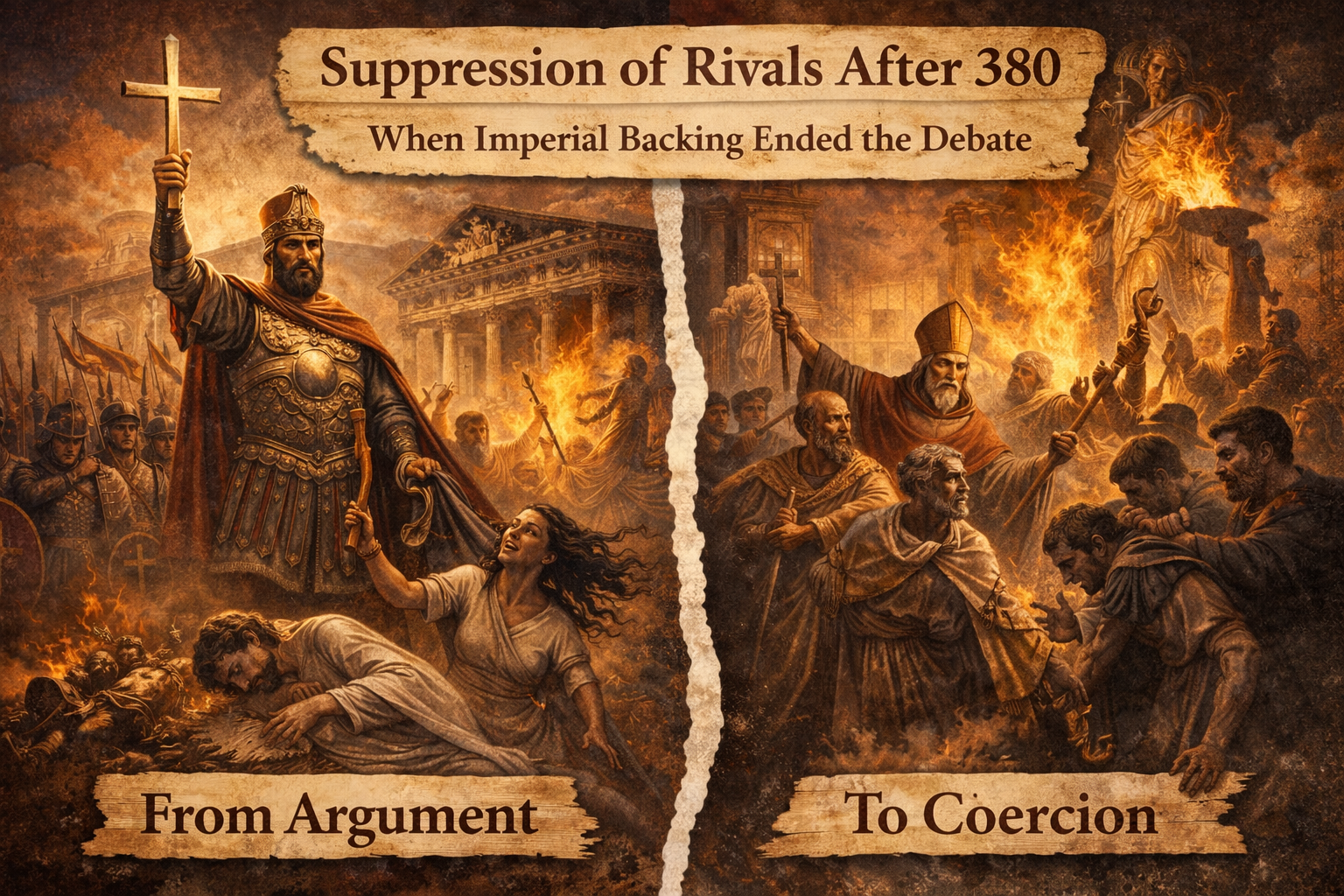
- Part 2 — Suppression of Rivals After 380: When Imperial Backing Ended the Debate
- Part 3 — Holy War and Mob Slaughter: The Crusades in Full (this post)
- Part 4 — The Inquisitions: Torture, Fear and the Architecture of Heresy Control
- Part 5 — Forced Conversion and Expulsion: Spain, Goa and the Colonial World
- Part 6 — The Witch Hunts: Christian Europe's Ugliest Moral Panic
- Part 7 — Colonial Brutality Under a Christian Banner
- Part 8 — Christian-on-Christian Violence: The Confessional Wars
- Part 9 — Moral Cover for Slavery
- Part 10 — Resistance to Modern Liberties: Institutional Christianity vs. the Enlightenment
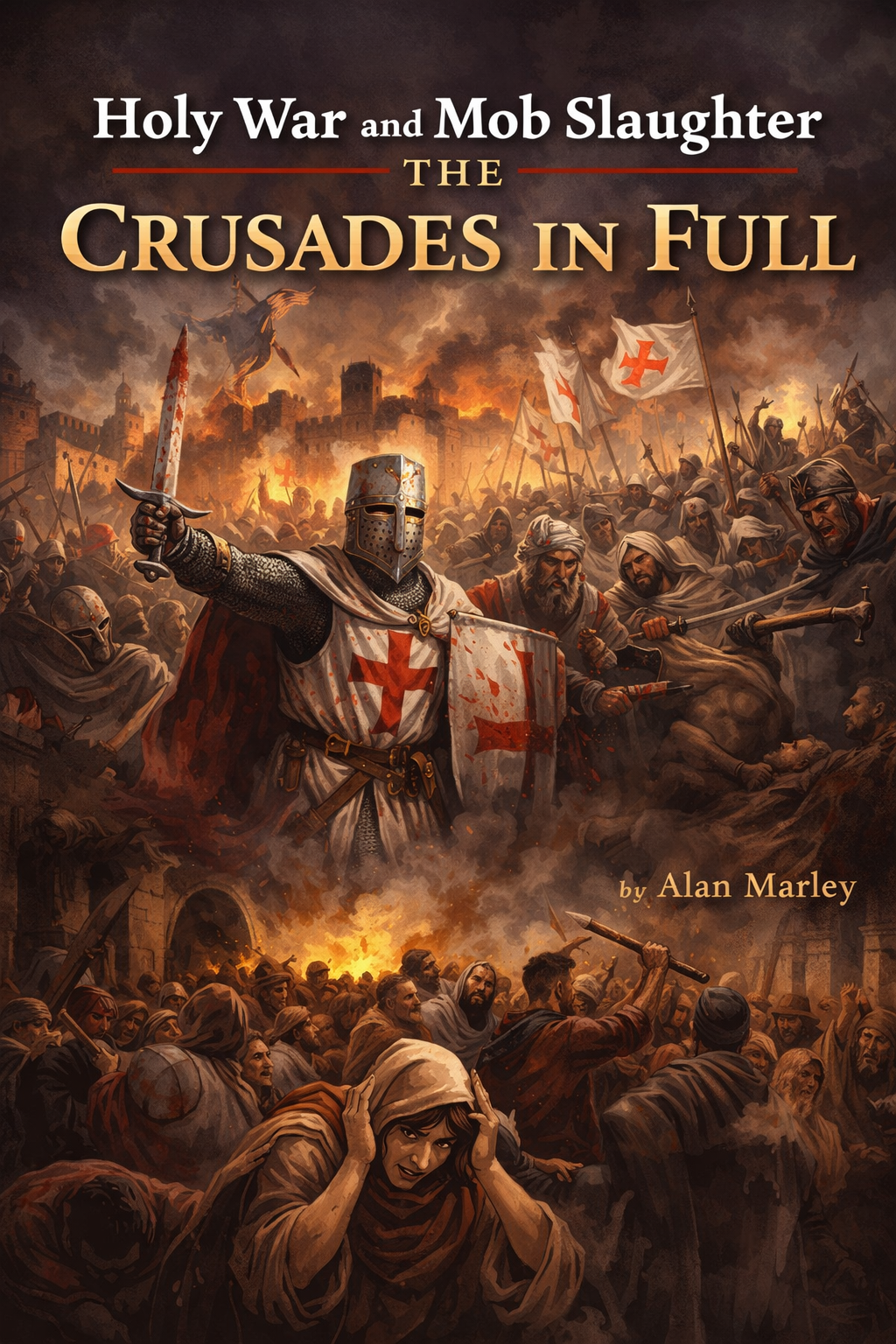
The standard version of the Crusades goes something like this: medieval Christians, motivated by faith and the defense of holy sites, launched military campaigns against Muslim powers that had taken Jerusalem. That version is not entirely wrong. The motivations were genuinely religious for many participants. Jerusalem genuinely mattered to Christian identity. Muslim forces genuinely controlled territory that Rome considered sacred. But the standard version leaves out the parts that matter most for understanding what the Crusades actually were: the systematic massacres of Jewish communities across the Rhine Valley before the armies even left Europe, the slaughter of Muslims and Jews alike when Jerusalem fell in 1099, the Fourth Crusade's sack of Constantinople - a Christian city - in 1204, and two centuries of institutionalized violence that the papacy organized, financed and theologically authorized. The Crusades were not a regrettable deviation from Christian values. They were a direct product of what happens when religious authority controls military force and defines its enemies as enemies of God.
The Call at Clermont and What It Unleashed
In November 1095 Pope Urban II addressed a church council at Clermont in central France and called for an armed expedition to recover Jerusalem from Muslim control. The speech, reconstructed from several accounts that differ in detail but agree on substance, promised spiritual reward to those who took up the cross - the remission of sins, protection of property left behind and a path to salvation through military service. The response exceeded anything Urban had anticipated. Tens of thousands of people across France, the Rhineland, Italy and beyond began preparing for a journey to the Holy Land. The papacy had discovered something important: the language of holy war, combined with the promise of spiritual merit and the social energy of a mobilized population, was extraordinarily effective at generating armed movement on a continental scale.
What Urban had not fully anticipated was what that mobilized population would do before it reached the Holy Land. The official First Crusade, organized under princes and counts, did not depart until August 1096. Before it left, a series of popular mobilizations - the People's Crusade led by Peter the Hermit and others - moved east through the Rhineland. And as they moved, they asked a question that would recur throughout the Crusading era: if we are going to fight the enemies of Christ in the Holy Land, why are the enemies of Christ living among us here at home? The answer they provided was massacre.
In the spring of 1096, Crusading mobs swept through the Jewish communities of Speyer, Worms, Mainz, Cologne, Trier and other Rhineland cities. The casualties were enormous. The Jewish community of Mainz, one of the largest and most prosperous in northern Europe, was essentially destroyed. Contemporary Jewish chronicles describe communities choosing mass suicide over forced baptism. The total death toll across the Rhineland is estimated in the thousands, though precise figures are impossible to establish. Local bishops in several cities attempted to protect Jewish populations by sheltering them in episcopal residences, with mixed success. The violence was not sanctioned by Urban's original call and was not the work of the organized crusading army. It was the spontaneous product of a population that had absorbed the rhetoric of holy war and drawn its own conclusions about who the enemies of God were. The Church's failure to prevent or adequately condemn these massacres, combined with the theological framework that made Jews perpetual suspects in Christian society, established a pattern that would recur at every subsequent major Crusading mobilization.
Jerusalem, 1099: What Happened When the City Fell
The First Crusade succeeded militarily beyond what most contemporary observers would have predicted. After extraordinary hardship crossing Anatolia and the Levant, the Crusading army reached Jerusalem in June 1099 and besieged it. The city fell on July 15. What followed has been documented extensively in both Crusader chronicles and Muslim and Jewish sources, and the accounts converge on the same basic picture: the Christian forces conducted a systematic massacre of the city's population. The Muslim garrison was largely killed. The Jewish population, which had fought in the city's defense alongside the Muslims, retreated to a synagogue and was burned alive. Raymond of Aguilers, a Crusader priest who was present, described men wading through blood up to their ankles and knees in the Temple area. Fulcher of Chartres, another participant chronicler, describes piles of heads, hands and feet in the streets.
The historical debate about scale and exact numbers continues, as it does for most medieval atrocities where documentation is partial and sources have interests. What is not seriously disputed is that the fall of Jerusalem in 1099 was followed by mass killing of non-combatants. What is also not seriously disputed is that the Crusader chroniclers recording these events did not describe them as crimes. They described them as the fulfillment of God's purpose. Raymond of Aguilers wrote that the slaughter was a just and glorious judgment of God. The theological framework that had authorized the campaign also authorized what it produced. That connection is the important one. The violence was not incidental to the religious cause. It was presented as the expression of it.
The Crusader chroniclers recording the Jerusalem massacre did not describe it as a crime. They described it as the fulfillment of God's purpose. The violence was not incidental to the religious cause. It was presented as the expression of it.
The Logic of Indulgence and What It Produced
To understand why the Crusades kept happening across two centuries, you need to understand the theological machinery that powered them. Urban's innovation at Clermont was not the idea of Christian holy war - that concept had been developing for decades. His innovation was the plenary indulgence: the promise that participation in the Crusade would result in the complete remission of the penance due for sins already confessed. For a medieval Christian population that lived in genuine fear of purgatorial punishment, this was not a minor incentive. It was the most valuable spiritual commodity the Church could offer, and the papacy was offering it in exchange for military service. Bernard of Clairvaux, preaching the Second Crusade in 1146, put it with characteristic directness: the Crusade was a unique opportunity for salvation, a market in which God had arranged uniquely favorable terms for the purchase of eternal life.
That framework created a permanent incentive structure for Crusading violence. As long as the papacy could define enemies and attach indulgences to fighting them, it could mobilize military force. The definition of eligible enemies expanded over time. By the thirteenth century indulgences were being offered not just for campaigns in the Holy Land but for the Albigensian Crusade against the Cathar heretics of southern France, for campaigns against pagan peoples in the Baltic, for the suppression of political enemies of the papacy in Italy. The Crusading mechanism, once established, proved remarkably versatile. It could be pointed in almost any direction a sufficiently motivated pope chose, which is exactly what happened.
The Fourth Crusade: Christians Sacking Christians
The Fourth Crusade, launched by Pope Innocent III in 1198, was intended to recover Jerusalem by attacking Egypt. It did not go anywhere near Egypt. Through a combination of financial obligation, political manipulation and opportunism, the Crusading forces ended up attacking Zara, a Christian city on the Adriatic coast that was a subject of the King of Hungary, in 1202 - for which Innocent excommunicated the entire army. Then, diverted by Byzantine political intrigue and the promise of reward, they turned toward Constantinople, the greatest Christian city in the world and the capital of the Byzantine Empire. In April 1204 they sacked it.
The sack of Constantinople lasted three days. Byzantine sources describe the systematic looting of churches and palaces, the desecration of the Hagia Sophia, the melting down of sacred objects and relics for their metal value, the murder of clergy and the assault of women including nuns. Niketas Choniates, a Byzantine official who survived and wrote a detailed account, described the Latin invaders as servants of Satan. The crusaders brought a prostitute into the patriarch's throne in the Hagia Sophia and had her sing lewd songs while they drank the communion wine. The Fourth Crusade destroyed the Byzantine Empire's capacity to defend itself, accelerated the long fragmentation of the Eastern Christian world and permanently poisoned relations between the Latin and Orthodox churches. It was carried out by an army that had been organized under papal authority for a holy purpose, by soldiers carrying crosses, by men who had taken Crusading vows and received spiritual authorization for their campaign. None of that prevented them from sacking the second most important city in Christendom.
The Fourth Crusade is the most dramatic instance of Crusading violence turned against Christians, but it is not the only one. The Albigensian Crusade, launched by Innocent III in 1209 against the Cathar religious movement in southern France, was the first use of the full Crusading apparatus - papal authorization, indulgences, military mobilization - against a heretical Christian population within Western Europe itself. The campaign that followed lasted twenty years and devastated the culture and population of the Languedoc. The massacre at Beziers in 1209, where the entire population of a substantial town was killed regardless of religious affiliation, produced one of the most chilling documented utterances of the Crusading era. When asked how to distinguish Catholic from Cathar among the prisoners, the papal legate Arnaud Amalric reportedly replied: kill them all, God will know his own. Whether the quote is precisely accurate or legendary, it captures accurately the operational logic of a holy war in which the authorization to kill was categorical and the responsibility for distinguishing the innocent from the guilty had been transferred to God.
The Record Across Two Centuries
There were eight major numbered Crusades to the Holy Land between 1096 and 1291, along with numerous smaller campaigns, crusades against European heretics and pagan peoples and the ongoing military orders that maintained a permanent Crusading presence. The record across that period is not one of consistent Christian nobility occasionally marred by excess. It is a record in which massacre, forced conversion, systematic plunder and the targeting of civilian populations were standard features rather than exceptions. The Jewish communities of Europe were attacked at the outset of virtually every major Crusading mobilization. The logic was consistent: if we are fighting for Christ, why spare those who rejected and killed him? The Crusades did not create European antisemitism - it had older roots - but they systematically intensified and acted on it at scale, establishing massacre as a recurring feature of Christian holy war.
The Muslim populations that encountered the Crusading armies fared no better. The massacres at Jerusalem in 1099 and at various other cities and fortresses were not exceptional. They reflected the standard conduct of medieval siege warfare applied by an army that had additionally been given theological authorization to view its enemies as enemies of God. When Richard I of England executed approximately 2,700 Muslim prisoners at Acre in 1191 after negotiations over their ransom broke down, it was a brutal military calculation executed by a man who was also a participant in Crusading culture - someone who had taken the cross, received indulgences and understood himself to be acting within a framework of holy warfare. The religious dimension did not cause the brutality in a simple causal sense. It authorized it, normalized it and gave it a vocabulary of justification that stripped the victims of the moral consideration that even medieval warfare sometimes afforded to ordinary human beings.
Why This Matters Beyond Medieval History
The Crusades matter for this series for the same reason the suppression of paganism after 380 matters: they demonstrate what institutionalized religion does when it controls military force and defines its enemies theologically. The pattern in both cases is the same. A religious authority with access to state or quasi-state power identifies categories of people whose existence is framed as a problem - pagans, heretics, Muslims, Jews - and then organizes violence against them with theological authorization that transforms killing into righteousness. The individual soldiers who massacred the population of Jerusalem in 1099 were not uniquely sadistic people. They were people operating within a system that told them God wanted this and would reward them for it. The system produced the behavior.
The apologetic tradition that attempts to contextualize the Crusades as simply medieval warfare, or as a defensive response to Islamic expansion, or as understandable given the norms of the time, is not wrong that context matters. It is wrong to think that context removes the significance of what the Crusades reveal about religion in power. Every era has its norms. The question this series keeps asking is what happens consistently when religion acquires military and political authority. The Crusades are a two-century answer to that question, and the answer is not reassuring. Modern Christian nationalism does not propose Crusades. But it operates from the same foundational premise: that religious authority should shape civil power, that the state should serve God's agenda and that those who obstruct that agenda are not merely political opponents but enemies of divine purpose. The Crusades are not an ancient embarrassment to be explained away. They are a demonstration of what that premise produces when it has enough power to act on itself.
My Bottom Line
The Crusades were not a series of military campaigns that happened to be organized by the Church. They were a product of a specific theological framework that authorized violence in God's name, promised spiritual reward for killing defined enemies and gave religious leaders the ability to mobilize and direct military force across national boundaries. That framework produced the Rhineland massacres of 1096, the slaughter at Jerusalem in 1099, the sack of Constantinople in 1204, the Albigensian Crusade's devastation of southern France and two centuries of intermittent organized violence against Muslims, Jews, pagans and Christian heretics alike. The debate was not won. The enemies were not persuaded. They were killed, expelled or forcibly converted, and the killing was presented not as a regrettable necessity but as an act of faith. That is the record. It does not require exaggeration. It requires honest acknowledgment.
Religion that controls armies does not stay religious in any meaningful sense. It becomes politics with better marketing. The Crusades are what that looks like across two hundred years.
References
- Raymond of Aguilers. (c. 1099). Historia Francorum qui ceperunt Iherusalem. (Account of the First Crusade and fall of Jerusalem.)
- Fulcher of Chartres. (c. 1101). Historia Hierosolymitana. (Chronicle of the First Crusade.)
- Niketas Choniates. (c. 1207). Historia. (Byzantine account of the sack of Constantinople, 1204.)
- Asbridge, T. (2010). The Crusades: The Authoritative History of the War for the Holy Land. Ecco.
- Riley-Smith, J. (2005). The Crusades: A History (2nd ed.). Yale University Press.
- Maalouf, A. (1984). The Crusades Through Arab Eyes. Schocken Books.
- Chazan, R. (1996). In the Year 1096: The First Crusade and the Jews. Jewish Publication Society.
- Queller, D. E., & Madden, T. F. (1997). The Fourth Crusade: The Conquest of Constantinople (2nd ed.). University of Pennsylvania Press.
- Marvin, L. W. (2008). The Occitan War: A Military and Political History of the Albigensian Crusade, 1209-1218. Cambridge University Press.
- Tyerman, C. (2006). God's War: A New History of the Crusades. Harvard University Press.
- Rubenstein, J. (2011). Armies of Heaven: The First Crusade and the Quest for Apocalypse. Basic Books.
Disclaimer: The views expressed in this post are the personal opinions of the author and are offered for educational, commentary and public discourse purposes only. They do not represent the positions of any institution, employer, organization or affiliated entity. Nothing in this post constitutes legal, financial, medical or professional advice of any kind. References to historical events, primary sources and academic scholarship are based on publicly available sources cited above. This post examines historical episodes of religiously authorized violence and does not make claims about contemporary Christianity or individual believers. Commentary on religious and historical subjects reflects the author's independent analysis and is protected expression of opinion. Readers are encouraged to consult primary sources and form their own conclusions.