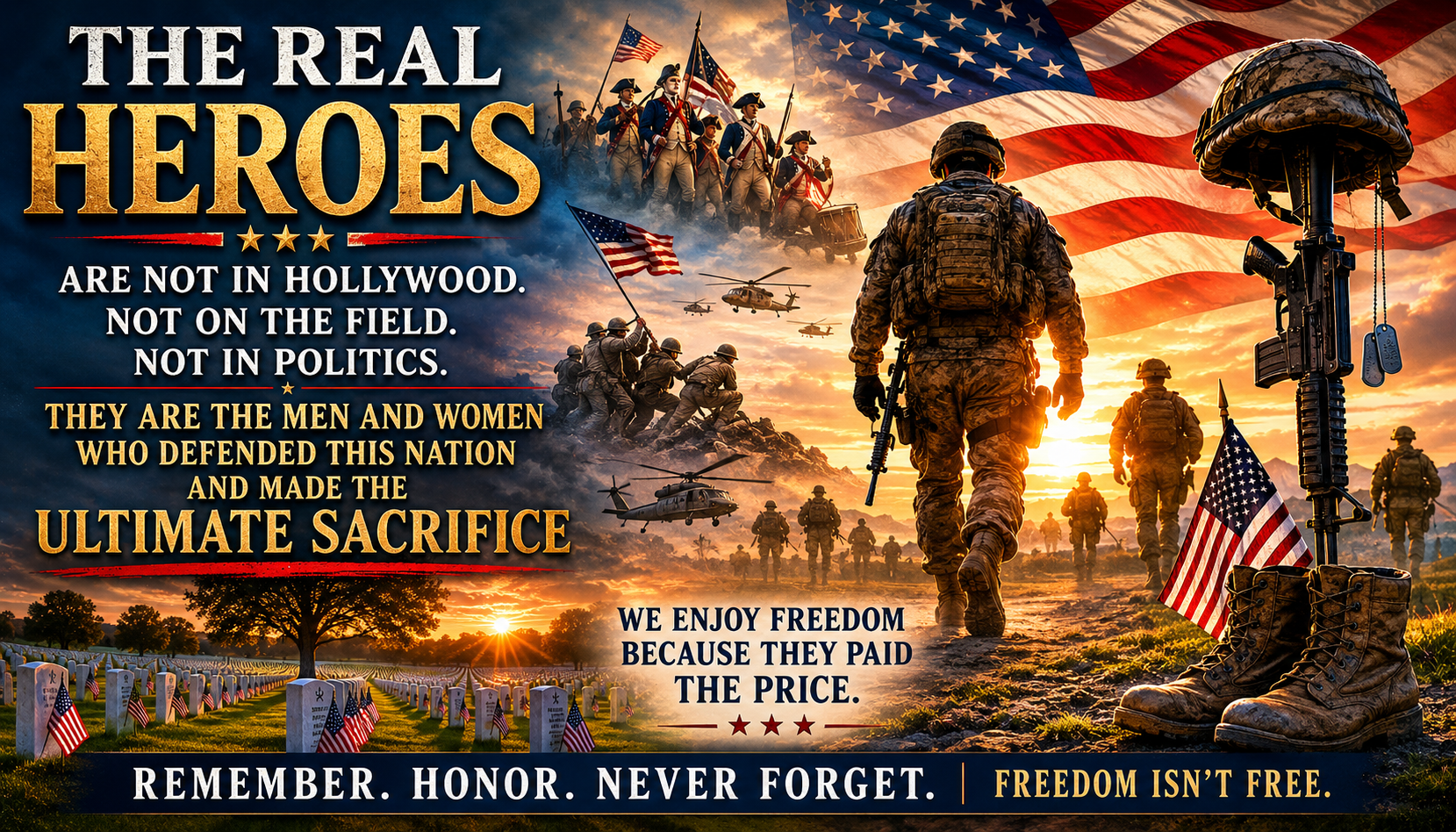
America has become very good at confusing fame with greatness. We call actors heroes because they pretend for a living. We call athletes heroes because they can run or throw better than almost anyone else. We call politicians heroes because their staff writes speeches, their parties protect them and cameras follow them like royalty. But the real heroes are usually not in Hollywood. They are not in professional sports. They are not found standing behind podiums in Washington pretending they built the country with press releases. The real heroes are buried beneath white crosses, stone markers and quiet grass. They are the men and women who defended this nation when it was young, fragile and uncertain. They are the ones who made the ultimate sacrifice. And every American should stop long enough to remember this: we are here because they are not.
It Started Before America Was Even Secure
The Revolutionary War was not a clean patriotic movie with drums, flags and polished speeches. It was an eight-year struggle against the most powerful empire in the world. The men who fought were not guaranteed victory. They were not guaranteed comfort. They were not guaranteed that history would remember them kindly. They were farmers, tradesmen, merchants, laborers, sons, husbands, fathers and ordinary colonists who stepped into an extraordinary fight.
The Declaration of Independence did not make America free by itself. It stated the principles. It declared the purpose. It gave language to the cause. But parchment does not win wars. Ink does not hold a line. A signature does not stop a musket ball. America was not born because the Founders wrote beautifully. America was born because ordinary men were willing to suffer for those words.
Those soldiers did not die for a perfect country. They died for the possibility of one. Every generation since has inherited not a finished product, but a responsibility.
The Civil War and the Price of Holding the Nation Together
The Civil War forced America to confront whether the country would survive at all. It was not just a war over territory or political control. It was a war over the meaning of the Union, human liberty and whether a nation founded on equality could continue while tolerating slavery. It remains the bloodiest conflict in American history.
Memorial Day grew out of that grief. It began as Decoration Day after the Civil War, when Americans started decorating the graves of the fallen. The first national observance took place at Arlington National Cemetery on May 30, 1868. That origin matters. Memorial Day was not created for cookouts, furniture sales or three-day weekends. It was born because Americans looked across fields of graves and understood that freedom had been paid for in flesh and blood. The Civil War dead held the country together. They preserved the Union. They gave America another chance to live up to its own words.
From the Trenches to the Beaches
World War I dragged Americans into the brutal reality of industrial war. The trenches of Europe were mud, gas, artillery and mass death. Young Americans crossed an ocean to fight in a conflict many barely understood, but they answered the call anyway. Then came World War II, which did not merely change borders. It changed civilization. Nazi Germany, Imperial Japan and fascist aggression threatened to plunge the world into darkness. American sacrifice helped save it.
The beaches of Normandy were not movie sets. They were killing grounds. The skies over Europe were not patriotic paintings. They were filled with flak, fire and falling aircraft. The islands of the Pacific were not exotic backdrops. They were places where Marines, soldiers, sailors and airmen fought yard by yard against a determined enemy.
The American Battle Monuments Commission maintains 26 overseas military cemeteries and honors more than 200,000 fallen service members at its sites. Think about what that means. They left home and never returned. They died in places many Americans cannot pronounce, defending a future they would never see. They did not get to come home, start families, grow old or tell stories from a recliner on a quiet porch. We got that life because they lost theirs.
Korea, Vietnam and the Forgotten Weight of Duty
Not every war is remembered the same way. World War II is wrapped in moral clarity. The Korean War is too often called "forgotten." Vietnam remains politically painful and emotionally complicated. But the fallen from those wars are no less worthy of honor.
The men who died in Korea fought in brutal cold, impossible terrain and violent conditions. They held lines most Americans barely remember existed. They served in a war that never received the full cultural reverence given to others, but they did their duty anyway. Vietnam was different. It divided the country, damaged trust in government and left deep scars on veterans who often came home to contempt instead of gratitude. But the politics of that war do not diminish the sacrifice of those who fought it.
A soldier does not write foreign policy. A Marine in the jungle does not draft the president's strategy. A young man in a helicopter over Vietnam does not decide the wisdom of the war. He serves. He risks. Too often, he dies. A serious country can debate the decisions of leaders while still honoring the men and women who carried the burden. That is the difference between maturity and cheap politics.
The Modern Fallen
After September 11, 2001, another generation went to war. Afghanistan and Iraq produced their own graves, widows, Gold Star families and wounded survivors. Many Americans went about daily life while a small percentage of the country carried the actual burden of war. That is one of the uncomfortable truths of modern America. We can oppose a war and still honor the fallen. We can question strategy and still respect sacrifice. We can criticize politicians and still kneel in silence before the grave of the soldier they sent. The fallen from the modern wars deserve more than slogans. They deserve a country that understands freedom is not maintained by hashtags or campaign speeches. It is maintained by people willing to stand between civilization and chaos.
We Have Lowered the Word "Hero" Until It Barely Means Anything
A celebrity loses weight and gets called brave. An athlete plays through a sore ankle and gets called heroic. A politician reads a statement after a tragedy and gets praised for courage. A millionaire actor lectures the country from an awards stage and somehow becomes a moral leader. Enough. The heroes are not the people pretending to be soldiers in movies. The heroes are the soldiers. The heroes are not the athletes kneeling, posing, branding and selling shoes. The heroes are the men and women who never came home.
That does not mean actors, athletes or politicians cannot do good things. Of course they can. But fame is not sacrifice. Performance is not courage. Applause is not service. The fallen gave everything. That is the standard. And we keep failing to hold it.
Memorial Day Is Not Veterans Day
It is worth saying clearly because the distinction disappears every year. Veterans Day honors all who served. Memorial Day honors those who died in service. Living veterans deserve respect every day. But Memorial Day belongs especially to the dead. It belongs to the soldier who never returned from the battlefield, the sailor lost at sea, the Marine killed on an island or a dusty road, the pilot who never made it back, the medic who ran toward the wounded and did not survive. It belongs to the families who still carry an empty chair through every holiday, birthday and ordinary Sunday dinner.
Those things are what we should be thinking about. Not the mattress sale. Not the barbecue. Not the beach trip. Those things are fine. Enjoy them. That freedom is part of what they died to protect. But do not confuse enjoyment with remembrance. Pause first. Reflect first. Say their names when you can. Remember what was paid.
What We Owe Them
We owe the fallen more than one holiday. We owe them memory. We owe them gratitude. We owe them a country worthy of their sacrifice. That does not mean America must pretend to be perfect. The men who fought the Revolution did not build a perfect nation. The soldiers who died in the Civil War did not solve every injustice. The troops who died in World War II did not eliminate evil from the earth. But they preserved the possibility of something better. That is what sacrifice does. It does not guarantee perfection. It buys time, protects liberty and hands the next generation a chance.
The dead belong to the country, not to a party. They are not Republican dead or Democratic dead. They are American dead. Their sacrifice is bigger than our politics.
The question is what we do with that chance. Do we use it to build families, businesses and institutions worth defending? Or do we waste it on division, decadence, entitlement and political theater? Do we teach our children that freedom is inherited without cost? Or do we tell them the truth — that every right they enjoy rests partly on the graves of people they will never meet?
My Bottom Line
The real heroes are not in Hollywood. They are not in professional sports. They are not found in politics. The real heroes are the men and women who defended this great nation and made the ultimate sacrifice so the rest of us could live under the protection of their courage. We prosper under freedoms they did not get to enjoy. We build businesses in a country they preserved. We argue politics under a Constitution they defended. We raise children in neighborhoods they never came home to see. We grow old because they did not. That should humble every American.
From the first shots of the Revolution to the graves of modern wars, this country has been carried by sacrifice. Not perfect sacrifice. Not always politically simple sacrifice. But real sacrifice. Human sacrifice. Final sacrifice. A nation that forgets its heroes will eventually forget why it is free.
The least we can do is remember. The least we can do is teach our children. The least we can do is stop calling every famous person a hero and reserve that word for those who earned it in the hardest possible way.
Why This Matters
National gratitude is not automatic. It has to be taught, practiced and defended. If Americans forget the fallen, freedom becomes background noise. The flag becomes decoration. The anthem becomes routine. Memorial Day becomes a sale weekend. The country becomes something we consume instead of something we inherit and protect. The men and women who died for America deserve better than that. They deserve silence before celebration, gratitude before comfort and reverence before politics. The real heroes are already gone. The duty to remember them belongs to us.
References
- American Battle Monuments Commission. (n.d.). Home. abmc.gov.
- American Battle Monuments Commission. (n.d.). Burial and memorialization statistics. abmc.gov.
- National Archives. (n.d.). The Declaration of Independence. archives.gov.
- U.S. Department of Veterans Affairs. (n.d.). America's Wars. va.gov.
- U.S. Department of Veterans Affairs, National Cemetery Administration. (n.d.). Memorial Day history. va.gov.
Disclaimer: The views expressed in this post are opinions of the author for educational and commentary purposes only. They are not statements of fact about any individual or organization, and should not be construed as legal, medical, or financial advice. References to public figures and institutions are based on publicly available sources cited in the article. Any resemblance beyond these references is coincidental.