
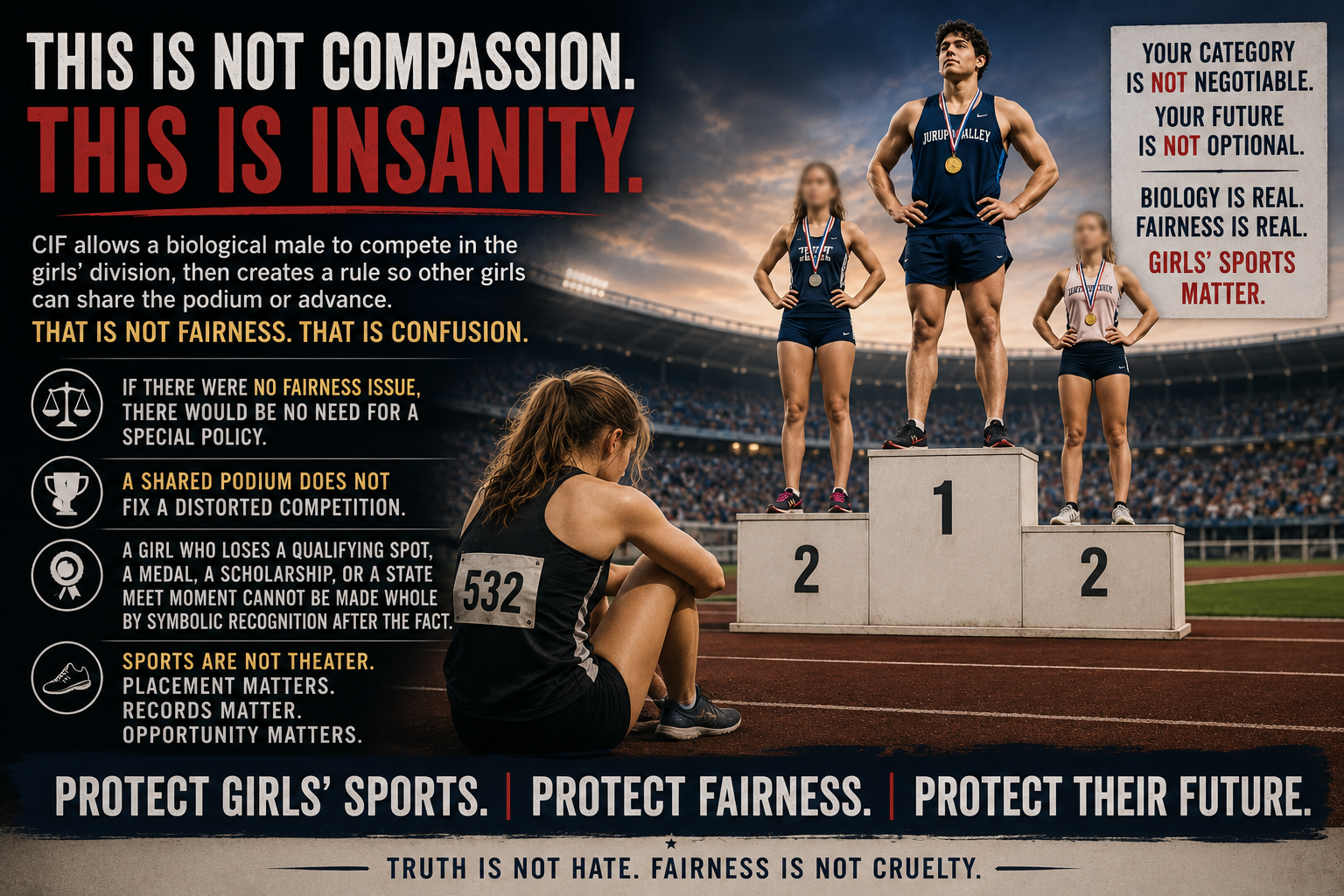
The California Interscholastic Federation has managed to create one of the most perfect examples of modern institutional insanity. CIF allowed a transgender athlete to compete in the girls' division, then used a policy allowing additional female athletes to share podium recognition or advance when a transgender athlete placed ahead of them. KQED reported that CIF reintroduced a rule allowing an additional competitor to medal in events where a transgender athlete places. AP reported that California opened the track-and-field finals to more girls after AB Hernandez qualified in multiple events. The policy was framed as an effort to balance inclusion and fairness, which is exactly the problem. A fair category should not need a political patch after the competition is over. That is not fairness. That is institutional confusion dressed up as compassion.
The Workaround Is the Confession
The CIF policy is fascinating because it accidentally admits what its defenders often deny. If there is no fairness problem, why create a special rule allowing additional girls to medal or advance? If biological sex does not matter, why compensate girls who are displaced? If the girls' category can include male-bodied athletes without meaningful competitive impact, why does CIF need a podium-sharing mechanism at all?
The answers are obvious. Officials know the result looks unfair, so they patch it with ceremonial fairness. A girl does not train for years so an adult committee can hand her symbolic recognition after the rules have already been bent against her. She trains to compete under rules that mean something before the event begins. A shared podium does not fix a distorted competition. A girl who loses a qualifying spot, a medal, a scholarship opportunity or a state meet moment cannot be made whole by recognition after the fact. Sports are not theater. Placement matters. Records matter. Opportunity matters.
The workaround is the confession. It says the adults in charge know something is wrong. So instead of defending the female category, they created a symbolic Band-Aid. That is what modern identity politics does. It breaks reality, then invents language to make the break sound compassionate.
A co-championship does not erase the competitive advantage that may have shaped the result. An extra advancement slot does not protect the meaning of the girls' division. It only proves the institution knows the original rule is defective. A shared podium is not justice. It is theater.
Girls' Sports Are Not a Courtesy Category
Girls' sports are not a courtesy. They are not a social club. They are not an emotional support category for adult politics. They exist because sex-based athletic differences are real. That does not mean every male athlete is better than every female athlete. The argument is that male puberty creates physical advantages in many sports that are directly relevant to competition. Strength, speed, power output, skeletal structure, heart and lung capacity, muscle mass and explosive movement matter in athletics. Especially in track and field.
The long jump does not care about pronouns. The high jump does not care about institutional messaging. The triple jump does not care about DEI training. The tape measure is brutally honest. That is why female categories were created in the first place. Without them, girls and women lose opportunities — not because they lack talent or discipline, but because male physical development creates advantages that cannot be wished away by policy language. This is not hatred. It is reality.
The NCAA Already Saw the Problem
The NCAA changed its transgender participation policy in February 2025, limiting women's sports competition to student-athletes assigned female at birth. The NCAA stated that the policy was intended to provide clear and uniform eligibility standards nationwide, and AP reported that the change followed President Trump's executive order on women's sports. That matters. The largest college athletic governing body in the country recognized that women's sports need a clear sex-based standard.
CIF should have done the same. Instead, California created a procedural compromise that makes almost no sense. It keeps the gender-identity rule in place while trying to soften the consequences for female athletes. That is not leadership. That is cowardice with a policy memo. A serious governing body would say: female athletic opportunity requires a female category based on biological sex. That is the clean rule. That is the fair rule. That is the rule adults are afraid to say out loud.
Identity Politics Replaced Equal Treatment
This controversy is bigger than one meet, one athlete or one state. It is part of the larger insanity of identity politics. Identity politics tells institutions to stop treating people as individuals and start sorting them into political categories. It tells athletic associations that fairness no longer means equal rules. Fairness now means constant adjustment based on identity claims. That is how we got here. A girls' sports category created to protect female athletes is now treated as negotiable because gender identity has been elevated above biological sex. Then, when the outcome looks unfair, the institution adds another identity-based correction to offset the first one.
First, divide people into categories. Then assign moral weight to those categories. Then adjust standards, outcomes, language and procedures until the institution can say it has achieved inclusion. But inclusion without fairness is not justice. It is manipulation. Girls are told to be kind while adults take away the meaning of their category. They are told to be inclusive while their own opportunities become conditional. They are told biology is complicated only when biology protects them.
The Message to Girls Is Rotten
The worst part of the CIF policy is not administrative. It is moral. Girls are told they can train hard, follow the rules, show up, compete and still find that their category belongs partly to someone else. They can lose to a male-bodied athlete, then be handed symbolic recognition as if that fixes the problem. They can object, but if they object too loudly, they risk being smeared as hateful by the adults who are supposed to protect them.
We spent decades telling girls they deserved their own athletic opportunities. Title IX was built around that promise. Now, in the name of progress, girls are being told to accept a contradiction: your sports category matters, except when it does not. That is not progress. That is betrayal. Girls should not have to whisper what every honest adult already knows. Sex matters in sports.
Compassion Without Boundaries Becomes Injustice
The defenders of these policies hide behind compassion. But compassion without boundaries becomes injustice. It is possible to treat transgender students with basic human dignity without erasing girls' sports. It is possible to oppose bullying and cruelty while also insisting that female athletic categories remain female. It is possible to care about every student without making girls surrender fairness. Both things can be true simultaneously. The problem is that modern identity politics refuses to hold both truths at the same time. It demands total submission to one narrative. Question the sports policy and you are accused of attacking a person. Defend girls' categories and you are accused of hate. Point to biology and you are accused of ignorance. That is how weak arguments protect themselves. They criminalize disagreement.
Trump Was Right to Push Back
President Trump's 2025 executive order, "Keeping Men Out of Women's Sports," made the federal position clear: educational programs receiving federal funds should not deprive women and girls of fair athletic opportunities. The order framed the issue around safety, fairness, dignity and truth. That was the right direction. The federal government needed to say what too many institutions were afraid to say — that female sports exist for females and that Title IX was not created so male-bodied athletes could enter women's divisions under a new ideological theory.
But federal action is not enough. The real fight is in states, school boards, athletic associations, universities and local policy offices. California is proving that. One executive order does not automatically fix a state culture captured by progressive orthodoxy. The ideology simply moves into rulebooks, committees and pilot programs. The CIF policy is not just a California problem. It is a preview of what happens when institutions know the public is angry but refuse to abandon the ideology causing the anger. They compromise around the edges. They add podium spots. They call it balance. But balance between truth and nonsense is still nonsense.
The female category should be reserved for biological females. The male or open category can remain open to anyone who qualifies. No one is being banned from sports. The question is category. We separate competition by age, weight, sex, skill level and disability status because fair competition requires meaningful boundaries. A heavyweight does not get to enter a lightweight division because he feels more comfortable there. When it comes to girls' sports, suddenly boundaries are treated as cruelty. That is the insanity.
My Bottom Line
CIF's policy is not a clever compromise. It is a public admission that the system has lost its nerve. Allowing a male-bodied athlete into the girls' division, then giving additional girls podium recognition or advancement opportunities after the fact, does not solve the fairness problem. It exposes it. Girls do not need symbolic fairness. They need actual fairness. They do not need adults handing them consolation recognition after changing the rules against them. They need adults with enough backbone to protect the category that was created for them.
Identity politics has taught institutions to distrust reality, punish honesty and treat biology as an obstacle to political messaging. But girls' sports cannot survive that kind of thinking. The girls' division should mean girls. The women's category should mean women. Fairness should not require a workaround. No young female athlete should be asked to sacrifice her opportunity so adults can congratulate themselves for being enlightened.
The answer is not cruelty. The answer is clarity. Protect girls' sports. Respect reality. Stop making children pay for adult confusion.
Why This Matters
Institutions teach values through rules. When CIF tells girls their category is negotiable, it teaches them that fairness is conditional. When adults create symbolic fixes instead of honest rules, they teach children that appearances matter more than truth. When identity politics overrides biology, it teaches everyone that reality must bend to ideology. Sports are supposed to teach discipline, effort, humility, courage and fair competition. They are not supposed to become laboratories for adult political theories. Girls deserve better. Parents should demand better. Coaches should say so. Lawmakers should act. And institutions like CIF should stop pretending that symbolic podium-sharing can fix a policy that should never have existed in the first place.
References
- Associated Press. (2025). NCAA changes transgender policy to limit women's competition to athletes assigned female at birth. AP News.
- Associated Press. (2025). California opens track-and-field finals to more girls after success of trans athlete. AP News.
- KQED. (2026). California quietly brings back controversial scoring policy for trans student athletes.
- NCAA. (2025). NCAA announces transgender student-athlete participation policy change.
- The White House. (2025). Keeping Men Out of Women's Sports. Executive Order.
Disclaimer: The views expressed in this post are opinions of the author for educational and commentary purposes only. They are not statements of fact about any individual or organization, and should not be construed as legal, medical, or financial advice. References to public figures and institutions are based on publicly available sources cited in the article. Any resemblance beyond these references is coincidental.