People sometimes ask what it would take to convince me, expecting me to say that nothing would. That the game is rigged, that I have closed my mind, that I would explain away a burning bush as swamp gas and a resurrection as a trick of the light.
It is a fair question, and I owe a fair answer. I do not think a god is impossible. I think the claim has not been shown. Those are different positions, and the difference is the whole point of this article. A person who says nothing could convince him is not reasoning. A person who can say exactly what would convince him, and then notices that it has never been offered, is.
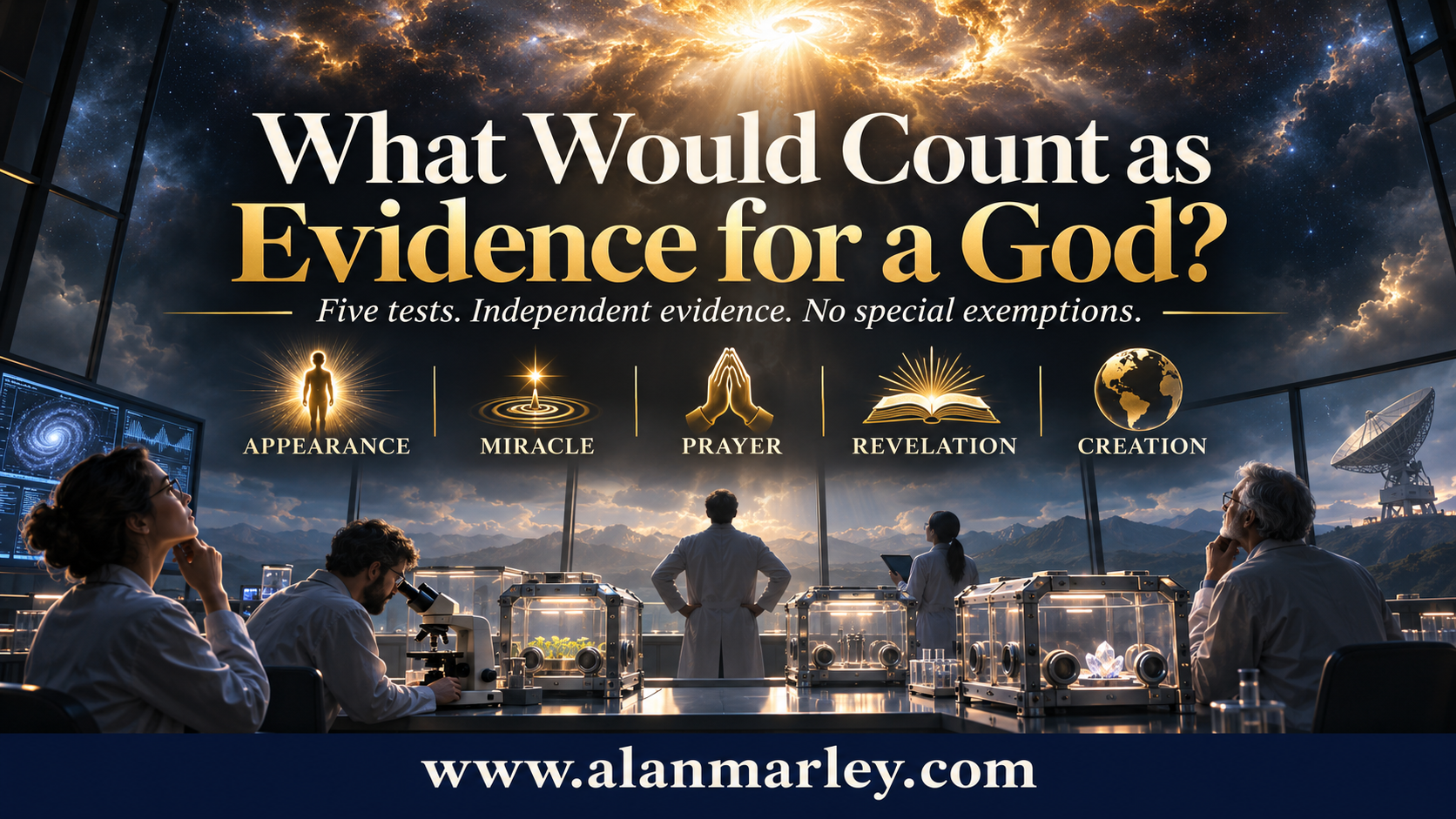
So here is the list. These are five things I would take seriously as evidence for a god. None of them is exotic. Each one is the kind of evidence we already demand when the claim is a new drug, a bridge design or a witness’s alibi. I am applying the same standard to the biggest claim anyone can make.
Why a List Like This Matters
Before the five items, the rules behind them. Every item on my list shares four features, and I want them stated up front because they are what separate evidence from testimony.
The first is independence. The people checking the claim must not be the people who already believe it, and they must be able to check without the claimant’s help.
The second is specificity. The claim has to say in advance what will happen, when and where, so that it can fail. A claim that fits every outcome explains none of them.
The third is repeatability. One surprising event is a story. The same event on request, under conditions chosen by skeptics, is a fact.
The fourth is controls. If someone says a being did something, we need to rule out the ordinary explanations: coincidence, trickery, honest error, selective memory and wishful thinking. Those are not exotic. They account for nearly every miracle report in history.
Now the list.
One: A Being Shows Up and Identifies Itself
The simplest evidence for a person is that the person appears. Not in a dream, not as a feeling in a quiet room, not in a voice only one believer hears, but in the world where other people can check.
Suppose a being announces itself and says it is the creator. People in different countries, who have no way of coordinating, ask it questions in real time. They ask it things only a being with its claimed knowledge could answer, and they get coherent answers. They record the encounter independently, on their own equipment, and the records agree. The being then demonstrates the powers it says it has, in front of anyone who wants to watch.
That would be a serious event. It would not need faith, because it would not be a claim anymore. It would be a visitor.
Compare that to what we are offered. Believers point to a book, to a church and to private experience. Each of those is a record of a claim, not an appearance. The book was written by people, copied by people and compiled by people, long after the events it describes. A building is evidence that people built a building. An experience is evidence that a mind had an experience. I do not deny any of them. I only observe that none of them is a being standing in the room.
Two: A Miracle on Cue, Under Observation
The second item is the one critics love to call unfair, and it is not unfair at all.
A being says it will regrow an amputated limb at a specific time. Independent doctors observe the patient before, during and after. They document the stump, the growth and the finished limb with imaging and records that anyone can review. Then the being repeats the demonstration with patients chosen by the investigators, not by the being and not by a church.
Why a limb? Because it is unambiguous. Cancers go into remission sometimes. Infections clear. Fevers break. Doctors know about spontaneous recovery, and they know that when thousands of people pray about illnesses that sometimes get better, some of those illnesses will get better right after a prayer. That is arithmetic, not a miracle. A regrown limb has no ordinary explanation. Humans do not regrow arms. Salamanders do, and a being with the power to create life should have no trouble.
I know of no case of prayer or divine intervention restoring an amputated limb that has been documented to that standard. I would be glad to be corrected, and I mean that. It would be the most important medical news in history.
When a believer tells me about a recovery that doctors could not explain, I do not argue on the day someone gets well. But suppose a being had told the doctors beforehand exactly when and how the recovery would happen, and then repeatedly demonstrated the same ability under independent observation. That would give us something concrete to investigate about who caused it. Without that, the recovery is a good thing that happened to someone, and the cause remains what it always was: the body, the treatment and the odds.
Three: Prayers Get Specific, Measurable Answers
Here is the experiment I would find hardest to explain away, and the easiest to run.
Independent teams randomly choose which of two sealed chambers will be named in a prayer. The people choosing do not tell the being, and they do not tell the people praying. A being promises that a particular object will appear in the chosen chamber. The object appears where promised, again and again, under conditions that rule out tampering and information leaks.
The design is deliberately dull. Randomization takes the choice away from the claimant. Sealed chambers take the observation away from anyone with an interest. Repeating the trial many times turns a lucky hit into a pattern. If the being can do it, the result would be overwhelming. If no being is doing it, the object turns up in the right chamber half the time, and anyone can see the difference.
This is not a hypothetical way of testing prayer. It is how we test prayer, within the limits of what researchers can measure, and it has been done.
The best-known study is the Study of the Therapeutic Effects of Intercessory Prayer, known as STEP, published in the American Heart Journal in 2006. It followed 1,802 patients at six hospitals who were having coronary bypass surgery. Researchers assigned them at random to three groups. Two groups did not know whether they were being prayed for, and one of those was prayed for while the other was not. A third group was told that it would be prayed for, and was.
Among the patients who were uncertain, 52 percent of those who were prayed for had complications within 30 days, against 51 percent of those who were not. The prayer made no difference. Among those who were told they would be prayed for, 59 percent had complications, a higher rate than the uncertain group. [1]
The authors added a caution that I will repeat because honesty demands it. They said the study was never intended to address whether God exists or whether God answers prayers, and that it studied one kind of prayer, offered by strangers, for one kind of patient. [3] I agree. A single study cannot settle the question, and I am not claiming it does. What it shows is something narrower and still important: when believers agreed to a design with controls, the effect they expected did not appear.
That is the pattern. When the claim is vague, it survives. When it gets specific, it vanishes. A being that cared about the outcome of surgery and could act on prayer would have a hard time doing a worse job of making itself known than the one reflected in those numbers.
Four: A Revelation That Gives Us Knowledge We Can Verify
Every major religion claims a revelation, a message from the divine to human beings. Here is the test I would apply to any of them.
A being provides precise details about several phenomena that nobody has yet discovered, and tells us exactly how to test them. Independent teams run the tests and the predictions come true.
Imagine that the message said: in a particular region of the sky you will find an object of a particular mass, and when you look with this kind of instrument you will see this kind of signal. Or: this molecule, built this way, will cure this disease, and here is the mechanism. Not a verse that can be read in four ways after the fact. A prediction with numbers in it. We could check, and if the checks came back right, we would have knowledge that no human of the era could have had.
The sacred books we have do not meet the standard. They contain moral teaching, poetry, history, law and prophecy, much of it deeply human. What they do not contain is a single verifiable scientific discovery that was unknown to their authors and that we confirmed later by independent means. The believers who say otherwise generally find the discovery after the fact, in a verse that could have been read many ways, once the science was already in hand. That is reading a result back into the text. A prediction runs the other way.
Five: A Creator Who Can Create
The fifth item is the biggest one, and it is the hardest to meet. It has to be, because it is the claim.
The core of most monotheistic belief is that a being brought the universe into existence and set its laws. If that is true, then creating a universe is something a being can do. So the test is easy to state. If independent observers could verify that a being brought a new universe into existence and set its physical laws the way it said it would, that would be direct evidence of the power it claims.
There is an important gap in this one, and I do not want to skip it. Even if a being created a new universe in front of us, that would not establish that it created ours. Establishing that would require evidence tying it to our universe: a record, a signature or a prediction about our cosmos that came true. The first four items could supply some of that. The fifth could not supply it alone.
Putting Them Together, and What They Still Would Not Prove
A combination of these would make a much stronger case than any single event. Suppose a being appeared, identified itself, regrew a limb on cue, answered prayers in sealed chambers, gave us predictions that came true and built a universe on demand. I would be the first to say that something extraordinary was going on, and I would want to find out what.
Even then, I would insist on separating three claims, because they are three different claims and each needs its own evidence.
The first is that a being has extraordinary power. The second is that this being created our universe. The third is that this being is the all-powerful, all-knowing, perfectly good God of the Bible, or the Quran, or any particular tradition. A being that can regrow a limb has shown the first. It has not shown the second, and it has certainly not shown the third.
That third step is where most arguments go wrong. A powerful being might be benevolent or indifferent or cruel. It might be one of many. It might be an advanced intelligence rather than a creator. It might be lying about its own nature. The evidence for power is not evidence for goodness, and goodness would have to be assessed against the world we see, including the childhood cancers and the earthquakes. Claims about the nature of a being require evidence about that nature, step by step.
I am not setting this bar to be difficult. I am setting it where any careful person sets it when someone claims something big. It is the reason a jury wants more than one witness and a scientist wants a second lab. The bigger the claim, the more careful the evidence needs to be. In the words Carl Sagan made famous, extraordinary claims require extraordinary evidence.
The Objections I Hear
Two objections come up whenever this subject does. They deserve answers.
The first is that God will not be put to the test. People quote the line from the Gospels, “do not put the Lord your God to the test.” I have two replies. The first is that the line is a rule for believers, from one tradition, and it carries no weight with someone who is asking whether the tradition is true. A rule that says do not check the claim cannot be the evidence for the claim. The second is that the Bible itself contains tests. In the book of Judges, Gideon asks for a sign with a fleece of wool and a dew on the ground, and then asks again with the conditions reversed. In the book of 1 Kings, the prophet Elijah challenges 450 prophets of Baal to a public contest, each side preparing a sacrifice and calling on its god to light it, and he sets the terms so that no one can claim a trick. In the Gospel of John, the disciple Thomas says he will not believe the resurrection until he has seen and touched for himself, and he is given what he asked for. The scripture does not treat a request for evidence as a sin. It treats it as a reasonable thing to want, and it records the evidence being provided. I am only asking for the same.
The second objection is that the divine cannot be measured by instruments. That is a claim about what a god is like, and it has a cost. If the being never does anything that can be detected in the world, then it is not a being who answered a prayer, healed a patient or moved a mountain. All of the claims that make the belief matter in practice, that God listens, acts, heals and judges, are claims about events in the world. Events in the world can be checked. A god who is entirely undetectable and a god who does not exist look the same from the outside, and no one should be asked to organize a life around the first as though it were the second.
What Has Actually Been Tested
Believers offer old books, sincere experiences, secondhand miracle stories and a lot of people who agree. None of that is independent, specific, repeatable or controlled. One test from a nearby field is worth mentioning. For decades the magician James Randi offered one million dollars to anyone who could demonstrate a paranormal or supernatural ability under agreed-upon controlled conditions. About a thousand people applied, and none succeeded before the challenge ended in 2015. [4] I want to be fair about this: the rules made clear that purely religious claims were not accepted, because they were described as untestable. [2] That fact should be the beginning of a conversation, not the end of one. If a claim cannot be tested at all, then it does not matter to us what the claim is. It cannot do anything in the world, and it cannot be known by anyone.
The Deal I Am Offering
I want to be clear that I am not setting a trap. The five items above are not a way of avoiding belief. They are a map of what I would need.
If any of them happened, I would say so. I would say so publicly, under my name, in the same place I publish everything else. I would be delighted. If a being that created the universe and cared about us stepped forward and demonstrated it, that would be the most important news ever delivered, and the person most thrilled to receive it would be me.
But I do not think we should say we have it when we do not. And it is the claim of having it that bothers me: the confident announcement that the question is settled, the demand that other people live by the answer, and the treatment of doubt as a character flaw. A person who says I believe this, and I cannot show it, is an honest person. A person who says it is proven, and then offers a book, is doing something else.
Here is where I leave it. The challenge is open and always has been. A being that wants to be known has had thousands of years to make itself known to anyone who asks the way we ask about everything else. If it exists and it is able, it can do so tomorrow, and I will write the next article. Until then, I will keep asking, and I will keep holding every claim, including the biggest, to the standard we use for the smallest.
Show up, do what you say, and let someone else check. That is all anyone has ever needed to do.
- Benson, H., Dusek, J. A., Sherwood, J. B., et al. (2006). Study of the Therapeutic Effects of Intercessory Prayer (STEP) in cardiac bypass patients: A multicenter randomized trial of uncertainty and certainty of receiving intercessory prayer. American Heart Journal, 151 (4), 934–942. pubmed.ncbi.nlm.nih.gov/16569567/
- Psi Encyclopedia, Society for Psychical Research. (n.d.). The One Million Dollar Paranormal Challenge [Rules excluded purely religious or spiritual claims as untestable]. psi-encyclopedia.spr.ac.uk/articles/one-million-dollar-paranormal-challenge/
- Relias Media. (2006). Study says: Prayer doesn't benefit heart patients [Quoting the STEP authors on the study's limits]. reliasmedia.com/articles/121738-study-says-prayer-doesn-t-benefit-heart-patients
- Wikipedia. (n.d.). One Million Dollar Paranormal Challenge. en.wikipedia.org/wiki/One_Million_Dollar_Paranormal_Challenge