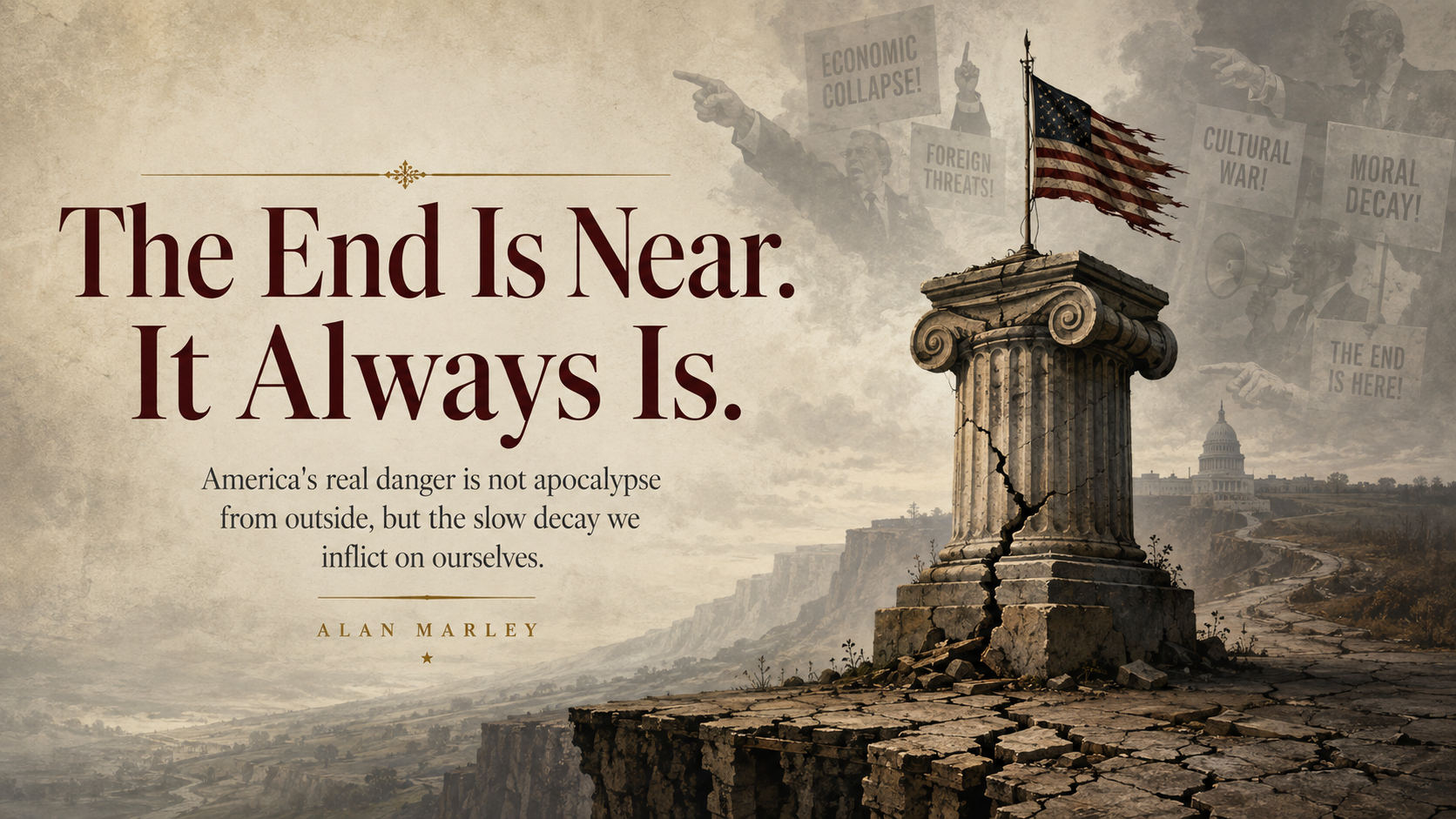
Pick a preacher, a pundit, a party or a podcast, and you will eventually hear the same sermon delivered in a different accent. America is on the verge of destruction. The threat changes depending on who is talking. For one crowd it is Islam, quietly replacing the country's Christian character. For another it is God's own judgment, coming due for a nation that has wandered from Him. For another it is wokeness, dissolving the culture from the inside. For another it is socialism, one election away from turning the United States into Venezuela. Strip away the specific villain and the sermon is identical every time. Somebody is coming to destroy us, and only fear, faith or the right vote can stop it in time.
I do not believe any of it. Not the Muslims, not the wrath of God, not the woke mob, not the socialists. None of these things is going to destroy the United States of America. That is not because the country is invincible or because these movements and ideas do not have real consequences worth arguing about. It is because the actual historical record, the one nobody making these predictions ever seems to consult, tells a very different story about how nations like this one actually come apart. It is one part misreading the Bible, one part manufactured fear and one part simple ignorance of history, and all three parts deserve to be taken apart separately.
The Muslims Are Not Coming to Destroy Us
Start with the version of this fear built around Islam, because it is the one built most explicitly on numbers nobody bothers to check. Pew Research Center's most recent Religious Landscape Study puts Muslims at roughly one percent of the American adult population. Pew's longer-range demographic projections have Muslims growing to something like two percent of the country by 2050, driven mostly by immigration and a younger average age within the community. That is the entire basis for a fear that gets described, in some corners, as an existential demographic threat to the nation's character.
One percent of the country, projected to reach roughly two percent by mid-century, according to Pew Research Center. For context, that is a smaller share of the population than several individual Christian denominations. A group this size cannot impose Sharia law, replace the Constitution or overturn American civic life through sheer numbers, and no serious student of American demographics or law believes otherwise. The fear is not built on the numbers. It is built on unfamiliarity, and Pew's own survey research finds most Americans say they do not personally know a Muslim, which is precisely the condition under which a small, unfamiliar group becomes an easy target for outsized fear.
None of this means every concern about Islamist terrorism is bigotry, and it is not an argument against taking specific, documented security threats seriously wherever they come from. But there is a wide gap between "a violent extremist movement operating under a religious banner is a security threat" and "a one-percent religious minority is coming to destroy the United States," and conflating the two does nothing except manufacture fear of your neighbors for no measurable security benefit.
God Is Not Coming to Destroy Us Either
The second version of the sermon swaps Islam for divine judgment. In this telling, America has become too sinful, too secular, too far from its founding faith, and the nation itself stands under some form of collective judgment that will manifest as decline, disaster or collapse unless enough people repent in time. This is a sincerely held belief for a great many Americans, and I am not writing to mock anyone's faith. But it is worth pointing out plainly that this specific claim, that national calamity is coming as divine punishment, has been made confidently and specifically, by name and by date, more times than anyone can count, and it has been wrong every single time.
Radio preacher Harold Camping predicted the end of the world, twice, in 1994 and again in 2011, with dates specific enough that followers sold homes and possessions in preparation. Y2K was going to collapse civilization through failed computer systems on a schedule set not by scripture but by calendar formatting, and plenty of religious commentary at the time folded it into the same apocalyptic framework anyway. Every recession, every pandemic, every lost election has, at some point, been confidently identified by somebody with a large platform as the specific mechanism of America's promised judgment. Every single one of those predictions has failed to arrive on schedule.
A prediction that has been wrong every time it has ever been made does not become more credible the next time somebody makes it with more conviction.
This is a separate claim from whether God exists, whether He judges nations, or whether any individual believer's faith is well founded, questions this piece has no interest in settling. It is a claim about a specific, repeatedly falsified prediction: that national doom is imminent and identifiable. History's actual scorecard on that prediction is not close.
Wokeness Is Not Coming to Destroy Us
Swap the villain again and you get the cultural version of the same sermon. Progressive activism on race, gender and identity, lumped together under the label "woke," is described by its loudest critics not as a set of policy disagreements to be argued and voted on, but as a civilization-ending contagion. And swap the villain one more time in the opposite direction and you get activists on the left who describe conservative cultural pushback in nearly identical apocalyptic terms, as the literal end of pluralism, decency or democracy itself.
Cultural fights are real and they matter. Curriculum decisions, workplace policies and public rhetoric around identity are legitimate things to argue about, sometimes heatedly. But American culture has swung through dramatic pendulum shifts before, temperance and its repeal, the sexual revolution and the backlash that followed it, the rise and partial retreat of countercultural movements in the 1960s and 1970s, without any of those swings actually ending the republic. Culture wars generate genuine winners and losers in specific fights. They have never yet been the mechanism by which an entire nation collapsed, and there is no serious historical mechanism by which a set of college campus vocabulary trends dissolves a continental economy, a military alliance system and a two-hundred-and-fifty-year-old constitutional order.
Socialism Is Not Coming to Destroy Us, Either
This one deserves only brief treatment here because it has been argued at length elsewhere on this site. The United States has a massive, decentralized, interdependent economy involving hundreds of millions of people, fifty state governments and deeply entrenched private institutions that a handful of election victories cannot simply dismantle. Checks and balances, an amendment process deliberately built to be nearly immovable, and a culture allergic to concentrated authority all stand between any single ideological movement, socialist or otherwise, and the kind of total transformation the doomsayers describe. That argument does not require pretending socialist policy ideas are harmless or beyond criticism. It only requires being honest about how difficult this country actually is to remake overnight, in any direction.
What History Actually Shows About How Nations Come Apart
Here is the part that the doomsday sermons, religious and political alike, consistently skip. When historians study why great republics and empires actually declined, the honest answer is rarely a single external villain, a rival religion, a rival ideology or a foreign people, sweeping in to finish the job in one dramatic stroke. Edward Gibbon's classic account of Rome's decline points to internal causes accumulating over centuries: overextension, currency debasement, civic disengagement, political dysfunction and the slow erosion of the institutions that had once held the republic together. The external invasions came late, and they succeeded largely because the internal structure had already hollowed itself out first.
Modern political scientists studying how democracies actually die have found a similar pattern much closer to home. Steven Levitsky and Daniel Ziblatt's research on democratic backsliding argues that democracies today rarely collapse through sudden coups or foreign conquest. They erode gradually, through the slow abandonment of unwritten norms, elected leaders who chip away at institutional guardrails, and citizens who stop defending rules once defending them becomes politically inconvenient.
Nobody has ever destroyed a great republic from the outside as efficiently as that republic's own citizens can destroy it through debt, division and neglect.
That is the pattern worth actually worrying about. Not a one-percent religious minority. Not a divine judgment that has been wrongly predicted for as long as anyone has kept records. Not a set of campus vocabulary trends or an economic ideology that the American system is structurally built to resist. The accumulation of unaddressed debt. Institutions that lose public trust because they have earned the loss of it. Selective enforcement of laws depending on who is politically convenient to prosecute. Citizens who stop showing up, stop paying attention and stop defending the boring, unglamorous work of self-government because doomscrolling about the next apocalyptic villain is more entertaining than doing that work.
The Honest Counterargument
A fair version of this piece owes its critics their strongest case. Islamist terrorism has killed real Americans, and dismissing security concerns entirely because the overall population is small would be its own kind of historical ignorance. Progressive activists and conservative activists alike can point to real policy consequences from the cultural shifts they oppose, lost parental authority over curricula on one side, real discrimination faced by minority groups on the other, and neither side is required to treat those concerns as manufactured simply because the apocalyptic framing around them is overblown. And religious readers are right to note that this piece cannot disprove a theological claim about divine judgment using historical data alone. Faith operates on different terms than falsifiable prediction, and a believer who holds their eschatology loosely, as a matter of ultimate meaning rather than a specific near-term forecast, is not making the same claim this piece is arguing against.
What this piece specifically challenges is narrower and, I think, harder to defend: the repeated, specific, confidently dated claim that a named group, a named ideology or a named judgment is currently in the process of imminently destroying the United States. That specific claim has a track record, and the track record is one of unbroken failure.
My Bottom Line
Every generation of Americans has been told, by someone with a large enough platform, that this is the one. This is the group, the ideology, the sin or the election that finally ends it. Every generation before us heard some version of the same warning, about different villains, and the country is still here, imperfect, argumentative and very much intact. That does not mean nothing can ever go wrong. It means the things capable of actually going wrong are less cinematic than the sermons suggest, and considerably harder to fix, because they require looking at ourselves rather than at whichever group has been cast as this decade's villain.
If America ever actually falls, it will not be because Muslims outnumbered us, God ran out of patience on schedule, wokeness won a culture war, or socialists took over Congress. It will be because we stopped doing the boring work of holding the place together, and blamed somebody else for it the entire time.
Why This Matters
Fear aimed at the wrong target is not a harmless mistake. Every hour spent convinced that a one-percent religious minority, an overdue apocalypse, a hashtag or an election outcome is about to end the republic is an hour not spent on the debt, the institutions, the civic habits and the plain hard work that actually determine whether a self-governing country survives. The villains change with the news cycle. The real risk does not. It has looked the same in every republic that has ever failed, and it has never once required an outside monster to finish the job.
References
- Pew Research Center. (2025). How US Muslims compare with other Americans on religion, age, education, race. pewresearch.org. [Muslims at approximately one percent of the U.S. adult population.]
- Pew Research Center. (2018). The Future of World Religions: Population Growth Projections, 2010-2050. pewresearch.org. [Projected U.S. Muslim population growth to roughly 2.1 percent by 2050.]
- Associated Press and other outlets. Coverage of Harold Camping's 1994 and 2011 end-times predictions.
- Gibbon, E. (1776-1789). The History of the Decline and Fall of the Roman Empire.
- Levitsky, S. & Ziblatt, D. (2018). How Democracies Die. Crown.
Disclaimer: This article reflects the author's personal opinions and is intended for commentary and public discourse only. It does not target any religious group, political movement or individual believer, and it does not dispute the validity of religious faith itself, only specific, repeatedly falsified predictions of imminent national destruction made in its name. It does not represent the positions of any institution, employer, organization or affiliated entity with which the author may be associated in any capacity. Political and religious commentary is protected opinion under the First Amendment. Readers are encouraged to consult primary sources and form their own conclusions.