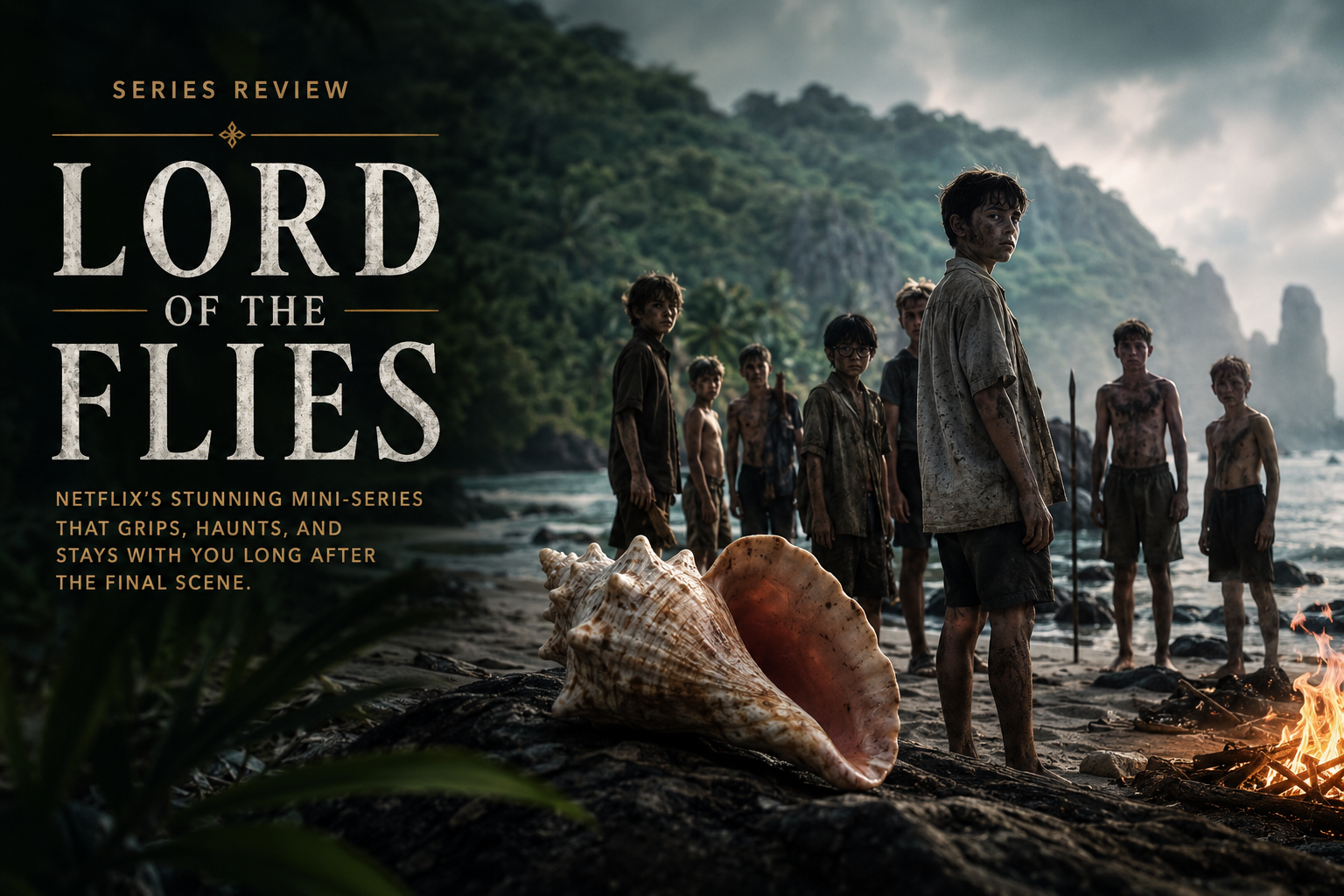
Every once in a while, a television series comes along that reminds you what the medium can accomplish when everything works at the same time, the writing, the acting, the directing, the cinematography, the casting, the music, the pacing and the atmosphere. Netflix's 2026 Lord of the Flies was that experience for me.
I did not come to this one cold. I have read William Golding's novel several times over the years, first as an assignment and then on my own once it stopped being homework and started being something I wanted to revisit. I also sat through the earlier film adaptation long ago, and while it had its moments, it never fully got under my skin the way the book did. Going into this four-part limited series, I knew the story cold. A group of British schoolboys survives a plane crash and finds itself stranded on a tropical island without adults. They initially attempt to organize themselves, establish rules, assign responsibilities and maintain some semblance of civilization. Gradually, fear, rivalry, tribalism and violence begin tearing that civilization apart. We know the story.
What I was not prepared for was how extraordinarily well this version would tell it. This was quite simply one of the best limited series I have ever watched, and it is the first screen adaptation that finally matched what the novel does to a reader.
Those Kids Were Stupendous
Let's start with what impressed me most: the kids. They were phenomenal, not "good for child actors," not "surprisingly convincing." They were genuinely outstanding actors. Netflix says many members of the cast were making their screen debuts after an open casting process, which almost seems impossible after watching the finished product.
Winston Sawyers plays Ralph, David McKenna plays Piggy, Lox Pratt plays Jack, Ike Talbut plays Simon and Thomas Connor plays Roger. Every one of them feels like a kid rather than an adult's conception of how a child should behave, and that distinction matters enormously. The boys are not miniature adults delivering perfectly polished dialogue. They interrupt each other, stumble over words, joke around and become irritated over stupid things. They brag, they cry, they become embarrassed, they seek approval, they follow stronger personalities and they lash out when frightened. They feel real, and because they feel real, what eventually happens on the island becomes far more disturbing.
David McKenna's Piggy deserves special recognition. Piggy could very easily become a caricature. He is intelligent, awkward, physically vulnerable, irritating at times, sensible at others and desperately dependent upon rules protecting him from stronger boys. McKenna makes him completely believable. You understand why the other boys sometimes become frustrated with him while simultaneously understanding that Piggy is often the person making the most sense.
Winston Sawyers gives Ralph the difficult combination of confidence and vulnerability the character needs. Ralph wants to lead, but he is not some naturally invincible hero. He doubts himself. He becomes frightened. He makes mistakes. He discovers that being chosen as leader and actually maintaining authority are two entirely different things.
Then there is Lox Pratt as Jack. What a performance. Jack does not simply wake up one morning as a monster. His transformation happens gradually. Pride becomes resentment. Resentment becomes rivalry. Rivalry becomes obsession with power, and eventually power becomes something maintained through fear, belonging, intimidation and violence. That progression is absolutely essential to the story, and Pratt sells every stage of it.
Even more impressive is the strength of the entire ensemble. The smaller roles matter because the story depends upon watching ordinary kids gradually become a tribe. One boy becoming violent is not particularly interesting. Watching an entire group slowly change is terrifying, and these young actors make that transformation believable.
Critics noticed it too. Rotten Tomatoes' critical consensus specifically praised the series' "uniformly terrific troupe of child actors," and the series currently carries a 91 percent critics score. For once, I think the critics got that exactly right.
The Island Is Almost Another Character
Then there is the cinematography. Absolutely gorgeous, but "beautiful" is not quite the right word, because the photography constantly makes beauty feel threatening. The series was filmed in Malaysia, with the production using dense rainforest and uninhabited islands to create its environment. Director Marc Munden and cinematographer Mark Wolf took full advantage of those locations. The island can look like paradise in one moment and something almost prehistoric in the next. The beaches are spectacular, the jungle is lush, the ocean is magnificent, and somehow you gradually begin feeling trapped there. That is tremendous visual storytelling.
The camera repeatedly gets close to the boys' faces, forcing us to look at them and watch what is happening inside them. RogerEbert.com's review noted how Munden photographs the boys in tight close-ups, almost presenting them for our examination as the story progresses.
There are also some remarkable visual choices as reality begins mixing with fear and imagination. Because regulations prevented the production from filming the children after 6 p.m., Munden and Wolf developed an ingenious infrared "day for night" technique. The green foliage could shift into surreal pinks and reds, producing an almost hallucinatory atmosphere. It works. Boy, does it work. The visual world seems to become increasingly unstable at exactly the same time the boys' social world is becoming unstable. That is not cinematography being pretty for the sake of being pretty. It is cinematography telling the story.
The Direction Lets the Story Breathe
Marc Munden also deserves enormous credit for something increasingly rare in television. He lets scenes breathe. The production does not appear terrified that viewers will become bored if something does not explode every thirty seconds. There are quiet moments, long looks and awkward conversations. There are periods when very little appears to be happening, but something is always happening underneath it. Relationships are changing. Status is changing. Fear is spreading. Resentment is building. One boy is gaining influence while another is losing it. The social order is shifting almost imperceptibly underneath everything.
That pacing is essential because Lord of the Flies is not really about boys surviving on an island. It is about watching civilization disappear one small piece at a time. The genius of the story is that there is not a single moment when everybody announces that civilization is over. Instead, one rule stops mattering, then another. Authority becomes slightly weaker. Fear becomes slightly stronger. The group becomes divided, people begin choosing sides, and violence becomes acceptable under certain circumstances, then under more circumstances. Before long, the boys have crossed lines that would have seemed unimaginable when they first arrived. The series gives that transformation room to happen.
It Understands What Golding Was Saying
This is also where Jack Thorne's adaptation succeeds. The original Lord of the Flies was published in 1954, yet the central ideas have not aged very much. Maybe they never will. Golding was not simply writing about naughty schoolchildren left unsupervised. He was writing about us. Human beings, civilization, power, fear, tribalism, the need to belong, the temptation to surrender individual judgment to the group, the attraction of the strongman who promises protection, the ease with which outsiders can be created, and the frightening speed with which normal behavior can become abnormal once enough people participate in it.
The beast is not really something wandering around the island. The beast is what the boys are capable of becoming. That is what makes the story endure, and this adaptation understands it.
Jack's Rise Is Especially Powerful
I found Jack's transformation particularly fascinating because it demonstrates something very real about power. Jack does not gain followers merely because he is physically aggressive. He gives them something. Identity, excitement, belonging, protection and purpose. He offers them an enemy to fear. He gives them rituals. He gives them a tribe, and eventually he gives them permission to behave in ways they previously would have considered unacceptable. That is how the transformation works.
Ralph offers rules and the discipline of maintaining the signal fire. Jack offers emotion, meat and belonging. Ralph asks for responsibility. Jack offers certainty. And slowly we watch which message becomes more attractive when frightened human beings are forced to choose between responsibility and emotional certainty. That is where Lord of the Flies stops being merely an adventure story and becomes something much more profound.
Piggy and the Conch
And then there is the conch. Such a simple object, yet it gradually comes to represent nearly everything separating the boys from chaos. The right to speak. Rules. Procedure. Equality before an agreed system. The idea that authority belongs to something larger than whichever person happens to be strongest.
Piggy understands this better than almost anyone. His faith in rules is almost heartbreaking because he believes civilization should protect him. He is physically weaker than many of the other boys. He cannot dominate them. He cannot intimidate them. What he has is reason and the belief that agreed rules matter, and Golding forces us to confront an uncomfortable question: what happens when everybody simply decides they do not care about the rules anymore?
A rule written on paper cannot enforce itself. Neither can a constitution. Neither can a law. They exist because enough people collectively agree that they matter. The moment that agreement disappears, the paper itself cannot save anybody.
The Sound and Music Deserve Credit Too
The music also contributes enormously to the atmosphere. Cristobal Tapia de Veer, known for The White Lotus , composed the score, and it refuses to behave like generic television background music. The soundscape frequently feels strange, primitive, uncomfortable and unpredictable. At times you almost feel the island rather than merely seeing it, the insects, the vegetation, the surf, the silence, the chanting, the breathing, the distant noises whose origins are not immediately apparent. It puts you there. That level of immersion is difficult to achieve, and this series achieves it beautifully.
And Then Comes the Great Irony
Of course, anyone familiar with Golding's novel knows the ultimate irony. The boys finally encounter an adult representing civilized society. The nightmare appears to be over. Civilization has returned. Except the adults themselves belong to a world engaged in war. That is Golding's final punch. The children became savages. The adults have battleships. Which group exactly is civilized? Golding leaves us sitting with that question. The island is not some bizarre exception to human behavior. It is humanity reduced to a smaller stage.
Four Episodes Was Exactly Right
Another smart decision was keeping the series to four episodes. Netflix describes it as a four-part adaptation, and that length feels almost perfect. There was enough time for the characters to develop and for the social breakdown to feel gradual, but the series does not overstay its welcome. It does not pad a four-hour story into ten episodes because somebody wanted additional streaming hours. It begins, it develops, it tightens the screws, and it ends. I appreciate that. Sometimes storytelling benefits enormously from restraint.
One of Those Rare Television Experiences
When I finished Lord of the Flies , I was not thinking that it was a pretty good adaptation. I was thinking about what an extraordinary piece of television I had just watched. The cinematography was outstanding. The direction was outstanding. The locations were spectacular. The atmosphere was haunting. The adaptation respected Golding while giving the story enough room to exist as television.
But I keep coming back to those kids. They were stupendous. It is difficult enough for experienced adult actors to convincingly portray fear, cruelty, insecurity, grief, jealousy, loyalty, shame and the intoxicating pull of group acceptance. These young actors did it while making me forget I was watching actors. That may be the greatest compliment I can give them. I was not watching performers attempting to recreate Lord of the Flies. For four episodes, I was watching Ralph, Piggy, Jack, Simon, Roger and the others stranded on that island. And when a production makes you forget that there are cameras, directors, scripts, crews, sound stages, editors and hundreds of people standing just outside the frame, something special has happened.
There are shows I enjoy. There are shows I admire. There are shows I recommend. And then occasionally there is a series that becomes an experience. This was an experience. Beautiful, disturbing, heartbreaking, frightening, intelligent and extraordinarily well made.
One of the best limited series I have ever watched. And those kids? Absolutely stupendous.
References
- Netflix. Lord of the Flies production notes and cast information. netflix.com.
- Rotten Tomatoes. Lord of the Flies (2026). rottentomatoes.com. [Critics consensus and 91 percent critics score.]
- RogerEbert.com. Review of Lord of the Flies (2026).
Disclaimer: This is a personal review reflecting the author's own opinions and viewing experience. It does not represent the positions of any institution, employer, organization or affiliated entity with which the author may be associated in any capacity. Factual details about the production are drawn from publicly available sources cited above.