We Already Have Universal Healthcare. We Just Run It Through the Emergency Room.
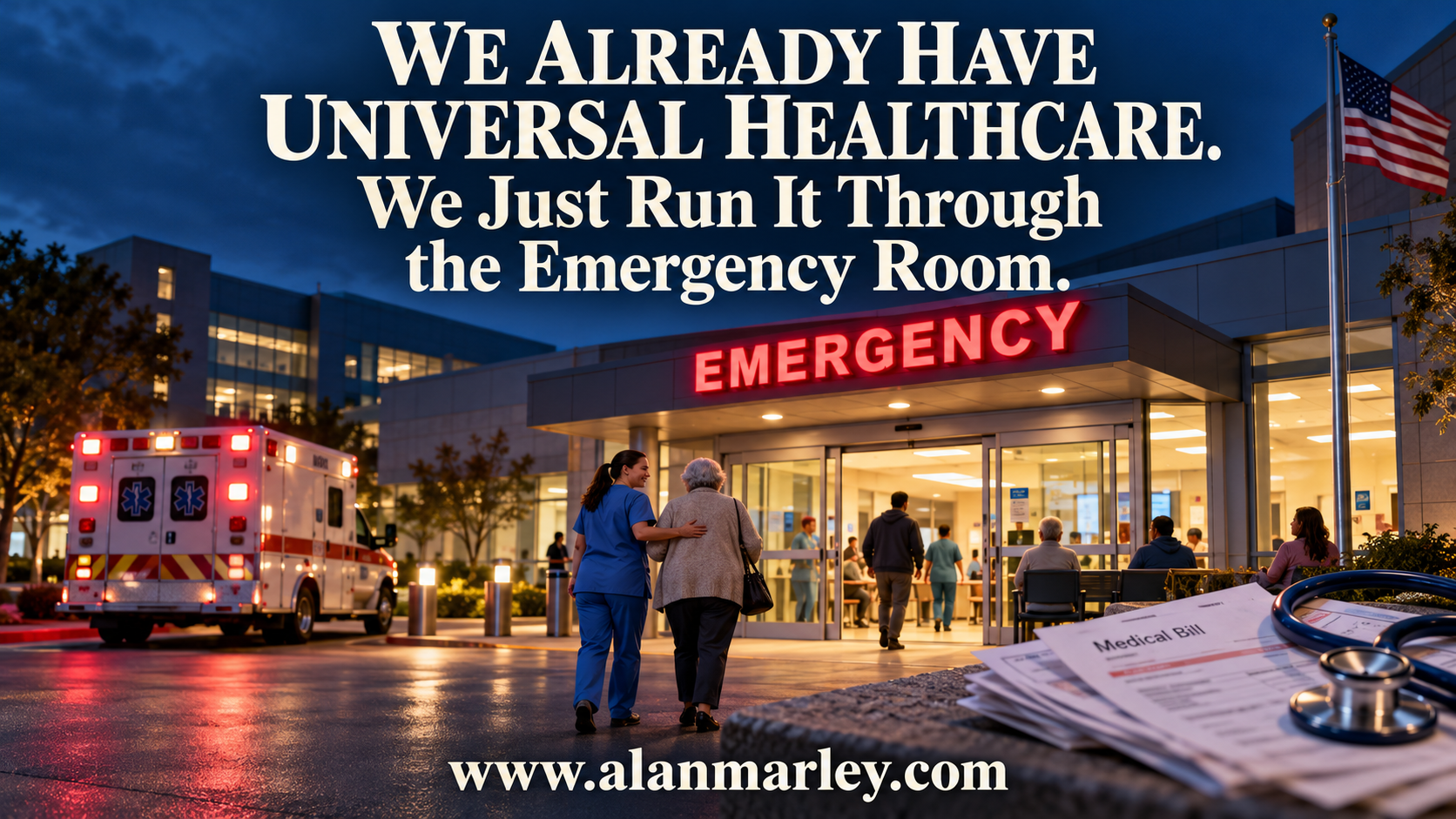
Walk into almost any hospital in America, broke and uninsured, and the law says they have to treat you. We built universal care at the most expensive door in the system and then argued for decades about whether it exists.
I have watched it happen to people I love. Friends and family who were poor and had no coverage walked into a hospital, got treated and were transferred to a county hospital when the first one could not finish the job. Nobody asked for a card. Nobody checked a bank balance before the doctors went to work. They got fixed. Then they went back for routine care, and some of them still get their medications at the county.
So when I hear a politician stand at a podium and announce that America has no universal healthcare, I have a simple reaction. That is political balderdash. We have it. We have had it since 1986. We just built it at the emergency room door, which is the most expensive place to put it, and then spent forty years pretending the door does not exist.
The Law Nobody Campaigns On
The Emergency Medical Treatment and Labor Act, known as EMTALA, was passed in 1986. It applies to every hospital that participates in Medicare and has an emergency department, which is nearly every hospital in the country. If you come to that emergency department and ask for help, the hospital must give you a medical screening exam. If the exam finds an emergency condition, the hospital must treat you until you are stable, or transfer you to a facility that can. It does not matter whether you can pay. It does not matter whether you have insurance. It does not matter whether you are a citizen. Hospitals are required to post signs telling you your rights.
A screening exam for anyone who comes to the emergency department. Stabilizing treatment if an emergency condition is found. An appropriate transfer if the hospital cannot stabilize the patient. And a hospital with the capability and the capacity to take that transfer cannot refuse it. The law is also known as the patient dumping statute, because Congress wrote it to stop hospitals from turning away the poor and shipping them down the road.
Think about what that means. Congress looked at the country in 1986 and decided that a person with a heart attack, a broken leg or a woman in labor does not get turned away at the door for lack of money. That is not a small rule. That is a national guarantee of emergency care for every human being who can get to a hospital. Almost nobody running for office mentions it, because it ruins the speech.
The Hand-Off to the County
What my friends and family went through is the system working the way the law describes it. The first hospital screens you and stabilizes you. If you need more than it can give, it arranges a transfer, and the receiving hospital with the capacity has to accept you. For the poor and uninsured, that receiving hospital is very often a county or public hospital, or one of the safety-net hospitals that exist to carry this load.
That is what I saw, and it is not just my experience. County and public hospital systems run primary care for exactly these patients. Denver Health runs a sliding fee discount program that covers primary care, specialty care and hospital services, with discounts for households up to 250 percent of the federal poverty level for hospital services and up to 200 percent at its community clinics. Cook County Health runs CareLink, which discounts primary care visits, specialty visits, lab tests and hospital stays for uninsured adults, with up to 100 percent off for a single person earning under $39,900 a year. Its own pharmacy fills prescriptions for $4 each, up to $20. My friends who pick up their medications at the county are using a system that exists for them.
The numbers show how heavy that load is. America's Essential Hospitals, the association of safety-net hospitals, reports that its members provided $8.6 billion in charity care in 2023, which was 29 percent of the national total, and absorbed $11 billion in uncompensated care. A small group of hospitals carries a very large share of the country's unpaid care. They do it every day, and they do it because the door is open and the law says it stays open.
The Rest of the Safety Net
The county is only one piece. Look close enough and you find medical help for the poor in almost every direction. Medicaid spent $931.7 billion in 2024, which was 18 percent of all national health spending. Federal rules cap what a state can charge a Medicaid patient at or below the poverty line at $4 for an outpatient visit and $75 for a hospital stay.
Now look at the worker who pays for coverage. KFF’s 2025 employer survey found that single coverage averaged $9,325 a year, with the worker contributing $1,440 of it. Covered workers who have a general deductible faced an average of $1,886 on top of the premium. At times the poor have lower out-of-pocket costs than the people paying for insurance, and in that sense better coverage. I know the objection. Medicaid patients can have a harder time finding a doctor and often wait longer, and I take that up below. But the claim that nothing exists for the poor does not survive a look at the numbers.
Who Pays for the Open Door
Somebody pays. The American Hospital Association estimates that hospitals have absorbed almost $745 billion in uncompensated care since 2000. In 2019 alone the figure was $41.61 billion. That money does not come from nowhere. It comes from higher prices charged to insured patients, from taxpayer subsidies to safety-net hospitals and from the thin margins of the hospitals that carry the most unpaid care.
The burden is not spread evenly, either. KFF found that half of all hospitals spent 1.2 percent or less of their operating expenses on charity care in 2023, while about one in ten spent 6 percent or more. Some hospitals do the heavy lifting. Others do the minimum. The country has a universal emergency system with no fair way of sharing its cost.
This is the part that makes the balderdash so maddening. We are already paying for universal care at the emergency room and at the county hospital. The Census Bureau reports that 26.7 million people, or 7.9 percent of the country, had no health insurance for all of 2025. Those are the people the open door is there for, and the door is open. The question is not whether the country treats the poor and the uninsured. It does. The question is why politicians keep telling voters it does not.
Now ask who would pay for a bigger version. The CMS numbers for 2024 show that the federal government paid 31 percent of national health spending, households paid 28 percent, private businesses paid 18 percent and state and local governments paid 16 percent. Governments get their money from taxpayers. Employers pay for coverage as part of what they spend on their workers. Households are the insured and uninsured people who pay premiums and bills. In my opinion the answer to who pays for universal healthcare is the same people who pay for the system now: taxpayers and the people who are currently insured. There is no other pocket. Anyone selling it as a gift from somebody else is selling more balderdash.
The Honest Objection
Critics have a fair point to make. An open door paid for through higher bills on the insured, taxpayer subsidies and the thin margins of safety-net hospitals is not the cleanest way to run a system, and the cost is not shared evenly. I agree with all of that. The care also costs the patient something other than money, which is time. The person at the county waits longer than the person with a private insurance card, and the waiting-room data points the same way. A 2015 study in JAMA Internal Medicine found that waiting-room times averaged 94 minutes for unemployed patients compared with 72 minutes for the highest earners. That is the trade. It is not the same as being shut out, and it is also my point. Supporters of a single national system argue it would spend less by cutting administrative costs and treating people earlier. They may make their case. They still cannot say the money comes from somewhere new. We already pay. The argument worth having is how we pay for it, not whether it exists.
The Balderdash
Here is what I object to. Politicians stand up and say America has no universal healthcare, as if a broke man with a bleeding wound gets turned away at the door, and as if nothing exists for the poor after that. In my opinion that is an outright lie. The hospital treats him. The county takes him if he needs more. Medicaid, the county clinics and the sliding fee programs are there to keep treating him. He keeps coming back for the care he needs.
I do not need a candidate to tell me what I saw. I saw poor people with no coverage get fixed and I saw them go back for routine care. A country that has already decided nobody gets turned away has already decided the principle. What is left is an argument about money and paperwork, and calling it a missing system only lets both parties avoid that argument.
Why This Matters
If the principle is settled, the debate should be honest about it. We spend billions on uncompensated care already. Congress answered the question of whether Americans deserve emergency treatment in 1986, and the county hospitals have carried the rest of the load ever since. Voters deserve to hear that from the people asking for their vote.
Call it what you like. We have universal care for the poor and uninsured, delivered through the emergency room and the county. I think the country should stop pretending otherwise and start arguing about how best to pay for what it already does.
- American College of Emergency Physicians. EMTALA Fact Sheet. acep.org. [Screening, stabilization and transfer requirements]
- American Hospital Association. Uncompensated Hospital Care Cost Fact Sheet. aha.org. [Almost $745 billion since 2000, $41.61 billion in 2019]
- America's Essential Hospitals. (2025, November). Charity care and uncompensated care at member hospitals. essentialhospitals.org. [$8.6 billion in charity care, 29 percent of the national total, $11 billion in uncompensated care]
- Centers for Medicare & Medicaid Services. (2024). National Health Expenditure Fact Sheet. cms.gov. [$5.3 trillion in 2024, Medicaid $931.7 billion or 18 percent, spending shares by federal government 31 percent, households 28 percent, businesses 18 percent, state and local governments 16 percent]
- Centers for Medicare & Medicaid Services. Emergency Medical Treatment & Labor Act (EMTALA). cms.gov. [Hospitals with emergency departments, patient dumping statute, signage]
- Code of Federal Regulations. 42 CFR 447.52, Cost sharing for services other than drugs and emergency room services. ecfr.gov. [Medicaid cost sharing capped at $4 per outpatient visit and $75 per inpatient stay at or below 100 percent of the poverty level]
- Code of Federal Regulations. 42 CFR 489.24, Special responsibilities of Medicare hospitals in emergency cases. ecfr.gov. [The regulation implementing EMTALA, including transfer acceptance]
- Cook County Health. CareLink. cookcountyhealth.org/carelink. [Discounts on primary care, specialty visits, labs and hospital stays for uninsured adults, up to 100 percent, $4 prescriptions at its own pharmacy]
- Denver Health. Denver Health Sliding Fee Discount Program (DHSFDP). denverhealth.org. [Discounted primary care, specialty care and hospital services for households up to 200 percent (clinics) and 250 percent (hospital) of the federal poverty level]
- HealthDay. (2015, October 5). Poor, minorities spend more time waiting for medical care. Reporting on Ray, K. N., et al., JAMA Internal Medicine. healthday.com. [Average waiting-room time of 94 minutes for unemployed patients versus 72 minutes for the highest earners]
- KFF. (2025). 2025 Employer Health Benefits Survey. kff.org. [$9,325 average single premium, $1,440 worker contribution, $1,886 average deductible]
- KFF. Key Facts About Hospitals. kff.org. [Half of hospitals at 1.2 percent or less of operating expenses on charity care in 2023, about 10 percent at 6 percent or more]
- U.S. Census Bureau. (2026, September 15). Health Insurance Coverage in the United States: 2025, Report P60-291. census.gov. [26.7 million, or 7.9 percent, uninsured all of 2025]
- U.S. Department of Health and Human Services, Office of Inspector General. EMTALA enforcement and patient dumping. oig.hhs.gov. [Enforcement of the patient dumping statute]