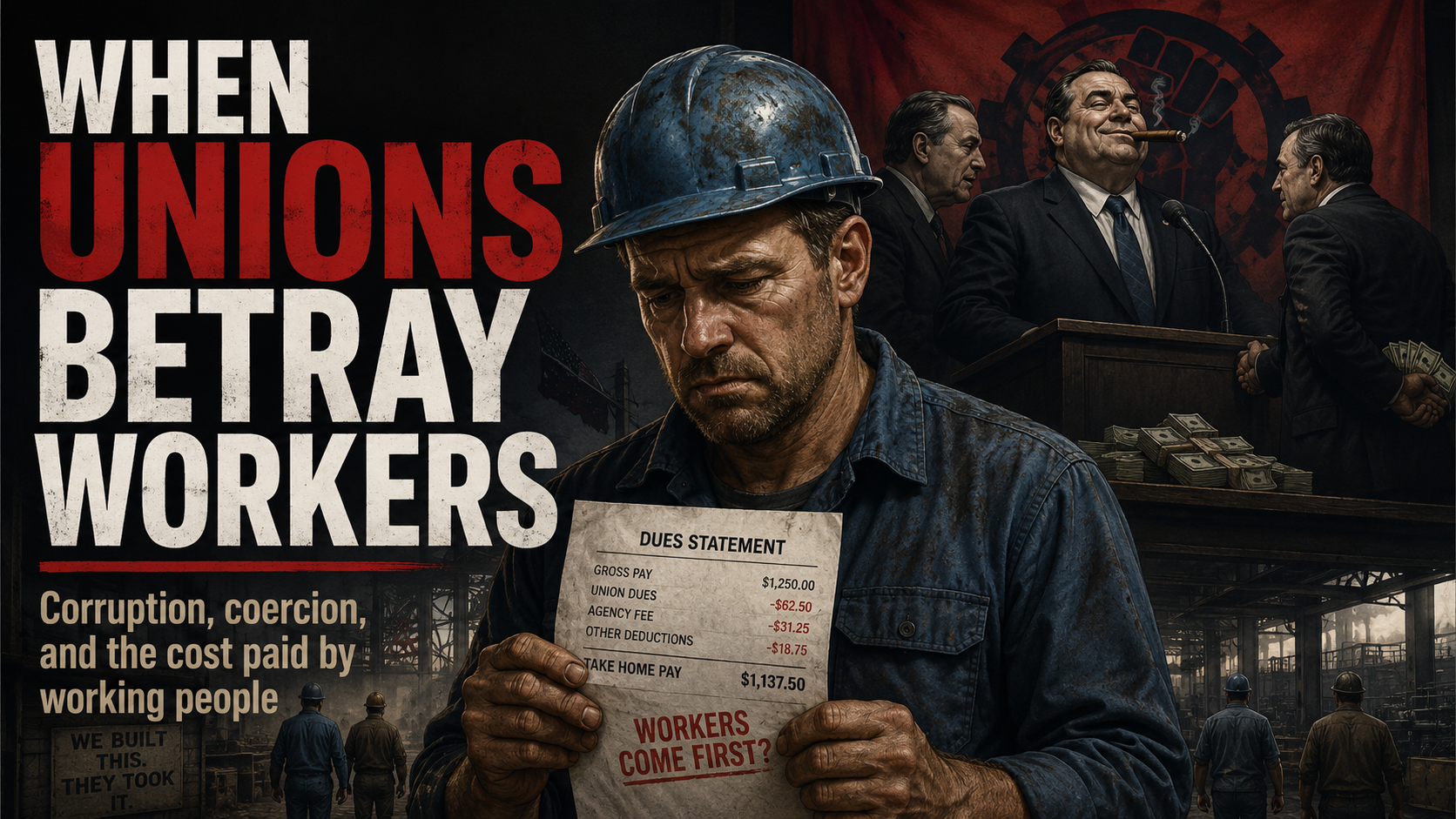
There was a time when unions served a necessary and honorable purpose. Workers were abused, underpaid, injured and discarded by powerful employers who held nearly all the leverage. In that environment, unions gave ordinary people a collective voice. They helped win safer workplaces, better wages, overtime protections, grievance procedures, pensions and a check against employers who could otherwise treat workers as replaceable machinery. That part of history is real and worth acknowledging plainly. But so is the other part. Over time, too many unions became exactly what they were created to fight: powerful institutions controlled by insiders, protected by politics, funded by working people and too often corrupted by money, arrogance and the absence of accountability. That is the part union defenders do not want to talk about. The modern pro-union argument sounds simple: corporations are greedy, workers are exploited and unions are the answer. But that framing leaves out a major truth. A union can protect workers, but a union can also exploit workers. The problem is not only corporate greed. The problem is unchecked power wherever it exists.
The UAW: A Case Study in Betrayal
The United Auto Workers corruption scandal is one of the clearest documented examples of union leadership turning against the workers it claimed to represent. The federal investigation produced 17 convictions, including two former UAW presidents. Former President Gary Jones pleaded guilty to conspiring to embezzle more than one million dollars in UAW dues money, in addition to racketeering and tax evasion. Former President Dennis Williams also pleaded guilty and was sentenced to 21 months in prison. According to federal prosecutors, UAW leaders embezzled money from worker paychecks, shook down contractors and schemed with Fiat Chrysler auto executives. In one year alone, Jones used union money to purchase over thirteen thousand dollars in cigars for senior UAW officials. One top official received one and a half million dollars in kickbacks. Another had ten thousand dollars in cosmetic surgery for a relative paid through union funds.
These were not minor bookkeeping mistakes. These were union leaders who stood at podiums and spoke the language of worker solidarity while stealing the dues those workers paid expecting representation, strength and protection. The FBI's Special Agent in Charge in Detroit said it plainly at the time of the charges: "The charges against Gary Jones are offensive to the hard-working men and women of the UAW." He was right. And the offenders were not outside corporate villains. They were the people the workers elected to lead them.
Seventeen convictions. Two former union presidents sentenced to prison. Over one million dollars embezzled from dues. Leaders spending union money on private villas, golf outings, expensive cigars and personal luxuries while using fraudulent expense forms to conceal the theft. A cabin built for former president Dennis Williams using interest from the union's $721 million strike fund, constructed with non-union labor to save money. The victims of this corruption were not executives. They were the autoworkers who paid dues every paycheck, trusting that money would be used to fight for them.
The Teamsters: Thirty Years of Federal Supervision
The UAW scandal is not an isolated case. The Teamsters' history makes the UAW episode look like a footnote. In 1988, the federal government filed a civil lawsuit under the Racketeer Influenced and Corrupt Organizations Act against the International Brotherhood of Teamsters, alleging that the union had long been under the control of organized crime, specifically La Cosa Nostra. Then-U.S. Attorney Rudolph Giuliani described the relationship as a "Devil's pact" and alleged a pattern of racketeering that included twenty murders, shootings, bombings, beatings, extortion and theft of union funds. Hours before the federal RICO trial was set to begin in 1989, the Teamsters entered a consent decree placing the union under government oversight and requiring sweeping structural reforms. That federal oversight lasted over thirty years, with the final remnants ending in 2020.
When a labor organization becomes so corrupted by organized crime that federal racketeering law is required to reform it and court supervision runs for three decades, the problem is not anti-union propaganda. The problem is documented institutional failure at the highest levels. The victims, again, were workers. Workers whose dues funded a union whose leadership was making deals with organized crime. Workers who were told they had representation while their organization was being used as a vehicle for racketeering.
Union corruption is not victimless. The victims are the workers who pay dues. The worker whose paycheck funds the institution. The worker told the union is fighting for him while leadership protects itself. The worker who watches union bosses live well, play politics and cut deals with the money taken from workers' paychecks.
The Hypocrisy That Needs Naming
The great hypocrisy of corrupt union leadership is that it speaks the language of the working class while behaving like the political class. It condemns corporate greed while building its own institutional empire. It tells workers they are indispensable, then punishes dissent, protects insiders and demands loyalty even when it has stopped earning trust. This is why the modern pro-union political argument, in its simplest form, asks people to ignore a substantial body of evidence. Yes, corporations can be greedy. Yes, employers can exploit workers. Yes, collective bargaining can produce real results. None of that makes unions immune from the same analysis. Unions can also become corrupt. They can become political machines. They can protect incompetence. They can punish independence. They can waste dues. They can sell out their members. And when they do, working people pay the bill.
The Right-to-Work Question
The appeal of right-to-work laws is not mysterious when you understand what they respond to. The question is not whether workers deserve leverage. They do. The question is whether any private organization should be able to compel workers to financially support leadership they do not trust. Union defenders answer that non-paying workers create a free-rider problem: if a union has a legal duty to represent everyone in the bargaining unit, workers who pay nothing still benefit from negotiated wages and protections. There is truth in that. But it does not erase the other side. What about the worker trapped under a union he believes is corrupt? What about the worker who disagrees with how dues are spent? What about the worker who sees his dues flowing into political campaigns he opposes? What about the worker who simply believes the union is not worth what he is being forced to pay?
Those workers matter too. Compelled financial support of an institution that has betrayed member trust is not solidarity. It is a second betrayal on top of the first. If a union is honest, effective, transparent and valuable, workers should want to support it. The case for right-to-work is fundamentally a case against coercion, not a case against unions. The difference matters and the debate is too often conducted as if it does not.
What Honest Support for Labor Looks Like
The old labor movement had moral force because it stood against abuse. The modern labor movement loses moral force when it refuses to acknowledge its own history of abuse. You cannot preach accountability to corporations while demanding immunity for union bosses. You cannot claim to defend workers while dismissing workers who do not want to fund your organization. You cannot pretend every criticism of unions is corporate propaganda when the corruption is written into federal court records, Department of Justice press releases, criminal convictions and decades of documented history. The honest position is not blind loyalty to corporations or blind loyalty to unions. Workers should have the right to organize and bargain collectively. They should also have the right to question union leadership, demand transparency and refuse to fund organizations that no longer serve them. Those positions are not contradictory. They are what accountability looks like applied consistently.
My Bottom Line
Unions deserve credit for what they accomplished in the early and middle twentieth century. Safer workplaces, the forty-hour week, child labor protections, grievance procedures and retirement security are real achievements with real human costs behind them. That history is not in dispute. What is also not in dispute, for anyone willing to read the court records, is that union leadership produced seventeen federal convictions in the UAW alone, that the Teamsters required thirty years of federal supervision to remove organized crime from its leadership structure and that the victims of this institutional corruption were the working people who paid dues and trusted their organizations to represent them honestly. The working class does not need another ruling class wearing a union jacket. It needs representation that earns trust, tells the truth, protects workers and remains accountable to the people who fund it. Anything less is just another power structure feeding off the people it claims to defend.
You cannot simultaneously demand corporate accountability and grant union leadership a permanent immunity from scrutiny. Power corrupts in any institution. The working class learns that lesson at its own expense when union leadership goes wrong.
Why This Matters
It matters because the labor movement still has work to do in America. There are workers in industries with genuine exploitation, genuine safety failures and genuine need for collective leverage. When union leadership squanders the moral authority of that cause through corruption and self-dealing, it does not just harm its own members. It makes the case for organized labor harder to make to the workers who most need representation. Every dollar stolen by a UAW executive from a worker's dues is a dollar that funds the argument against unions. Every year the Teamsters spent under federal oversight for organized crime infiltration is a year that funds the argument that unions cannot govern themselves. Honest advocates for worker rights should be the loudest voices demanding accountability from union leadership. Too often, they are not. That silence is its own kind of betrayal.
References
- U.S. Department of Justice, Eastern District of Michigan. (2020, June 3). Former UAW President Gary Jones pleads guilty to embezzlement, racketeering and tax evasion. justice.gov.
- NPR. (2020, June 3). Former UAW president Gary Jones pleads guilty to embezzlement, racketeering. npr.org.
- CNBC. (2021, June 10). Second UAW president sentenced to 28 months in prison in union corruption probe. cnbc.com.
- UAW Investigation. (2024). Federal investigation overview: 17 convictions, two former presidents, embezzled funds. uawinvestigation.com.
- U.S. Department of Justice, Southern District of New York. (1989). United States v. International Brotherhood of Teamsters: Civil RICO consent decree. justice.gov.
- U.S. Department of Justice, Southern District of New York. (2015, January 14). Manhattan U.S. Attorney announces proposed settlement agreement in landmark civil RICO action against Teamsters. justice.gov.
- Influence Watch. (2023). International Brotherhood of Teamsters: History and federal oversight. influencewatch.org.
- U.S. Department of Labor, Office of Inspector General. (2021). Gary Jones guilty plea press release. oig.dol.gov.
Disclaimer: The views expressed in this post are the personal opinions of the author and are offered for educational, commentary and public discourse purposes only. They do not represent the positions of any institution, employer, organization or affiliated entity. Nothing in this post constitutes legal, financial, medical or professional advice of any kind. References to legal proceedings, court records and government documents are based on publicly available sources cited above. Commentary on labor and political subjects reflects the author's independent analysis and is protected expression of opinion. Readers are encouraged to consult primary sources and form their own conclusions.