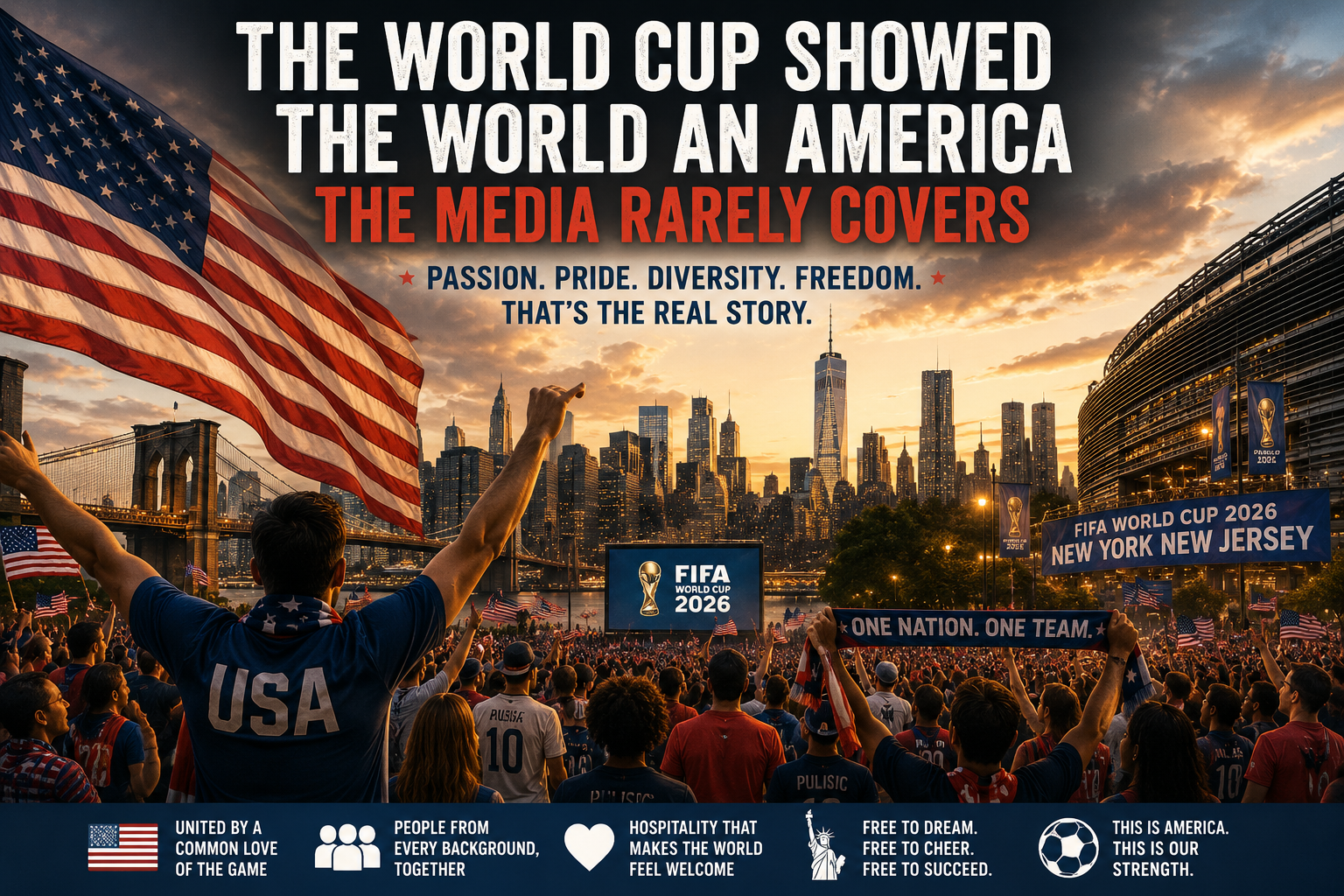
Something genuinely heartening happened this summer and it had very little to do with the scoreline. As the 2026 FIFA World Cup brought millions of international visitors to American cities from Seattle to Boston to Miami to Los Angeles, a remarkable pattern emerged on social media and in news coverage from around the world. Fan after fan, from Scotland, Brazil, Germany, Japan, England, France and dozens of other countries, documented their first impressions of the United States and expressed what can only be described as pleasant surprise. Not surprise that the country functioned, or that the stadiums were good, or that the logistics held up. Surprise at the people. Surprise at the warmth, the friendliness, the ease of interaction, the sheer generosity of spirit that ordinary Americans showed to strangers from every corner of the world who showed up on their doorstep speaking a dozen different languages, wearing outlandish kits and occasionally playing bagpipes in the street at six in the morning. America took a moment to see itself through fresh eyes this summer, and what it saw was worth paying attention to.
The Gap Between the Narrative and the Reality
The United States has absorbed a sustained beating in global media coverage for years. Depending on which outlet you read and which country you live in, America is a violent, divided, politically dysfunctional nation torn apart by inequality and incapable of agreeing on anything. There is truth in parts of that picture. This is a country with real problems, real divisions and a political culture that produces more heat than light on most days. None of that is worth pretending away. But the picture that global media most frequently transmits is not the whole picture, and what the World Cup did was send millions of people to check the rest of the picture themselves.
Marina De Buchi, a British entrepreneur who moved to California last year, told ABC News that the reactions she was seeing from World Cup visitors mirrored her own when she first arrived. "A lot of people say Americans are fake and I just don't think that's true," she said. "I think Americans are just really nice and friendly." That sentiment was documented across every host city. Visitors expressed consistent surprise at conveniences Americans take entirely for granted: free ice, self-serve refill stations, 24-hour retail, sprawling supermarkets and, above everything else, customer service that felt genuinely attentive rather than merely transactional. Jim Rooney, president of the Boston Chamber of Commerce, described visitors becoming "unofficial ambassadors" for the city, documenting Fenway Park and the North End for audiences back home. Tourism researchers consistently find that people remember people more than places. A visitor may forget the final score, but they will remember the Uber driver who recommended a local barbecue spot or the stranger who said welcome to America.
Perhaps nowhere was the cultural exchange more visible than in Boston, where an influx of Scottish supporters prompted some social media users to jokingly rename the city "New Scotland." One Scottish fan told Sky News he had driven every kind of American road he could find and had nothing but good things to say about what he encountered. Scottish fans singing in pubs, marching through city streets and interacting with local residents generated millions of views online. Boston content creator Shawn Moran described watching the city embrace Scottish fans as one of the most uplifting aspects of the tournament. "Social media is often full of negativity, and seeing nothing but pure joy and happiness in my feed for the past week has been the greatest thing," he told ABC News. "People are simply having fun and enjoying each other's company, learning about other cultures and embracing them wholeheartedly."
A Country That Gets a Black Eye It Does Not Always Deserve
America is a work in progress. That is not a criticism. Every democracy is a work in progress. The honest version of American civic life includes real failures alongside real achievements, and anyone who pretends otherwise in either direction is not telling the truth. But there is a specific distortion in how this country is portrayed internationally that the World Cup, somewhat accidentally, corrected. The distortion runs in one direction: conflict gets covered, warmth does not. Division is news, community is not. Political dysfunction travels, ordinary decency does not. The result is a global image of the United States assembled almost entirely from its worst days and filtered through media systems that have no particular incentive to complicate the picture. Millions of visitors showed up this summer expecting the worst version of that image and found something considerably different.
That does not mean the problems are not real. It means the problems are not all there is. A country capable of welcoming the entire world to its doorstep, putting on a logistically enormous tournament across dozens of cities simultaneously and leaving visitors with memories of genuine human warmth is not the dystopia the narrative sometimes suggests. Both things are true and the World Cup reminded us that the version most often exported is not the complete one.
Fan after fan documented their first impressions of the United States and expressed what can only be described as pleasant surprise. Not at the stadiums or the logistics. At the people. That gap between expectation and reality is the most honest review America has received in years.
The Team Nobody Expected to Remember
Soccer is not America's primary sport. It is not the secondary sport either. It sits somewhere further down a hierarchy dominated by the NFL, NBA, MLB and college athletics, occupying a passionate but minority following in a country where most adults could not name the starting lineup of the national team on a normal week. Which made what happened in the tournament all the more enjoyable to watch. The US men's national team, coached by Mauricio Pochettino, won Group D outright, defeated Bosnia-Herzegovina 2-0 in the Round of 32 in what was only the second knockout stage win in the program's history, then fell to Belgium 4-1 in the Round of 16. The Belgium loss was painful. The run to get there was historic by American standards.
Folarin Balogun scored three goals in the tournament, the most productive World Cup by an American striker in memory. The team scored more goals in this tournament than in any prior World Cup campaign in the program's history. Pochettino became the first US manager to win three World Cup matches. The Americans won back-to-back World Cup matches for the first time since 1930. For a country where soccer still fights for attention against four other major sports, this was not nothing. It was a genuine run that captured real national attention, drew sold-out crowds in city after city and gave American soccer fans something to actually feel good about heading into the next cycle.
Won Group D outright. Beat Bosnia-Herzegovina 2-0 in the Round of 32, only the program's second ever knockout stage victory. Lost to Belgium 4-1 in the Round of 16. Three goals from Folarin Balogun. Most goals scored in a single World Cup tournament in US history. Three wins in one tournament for the first time ever. Mauricio Pochettino became the US's winningest World Cup manager. First knockout win since beating Mexico 2-0 in 2002. Not a championship. Not a quarterfinal. A solid, proud, historically meaningful run for a program still building toward where it wants to go.
What Made This Summer Actually Enjoyable
The enjoyment of this World Cup had multiple sources, not all of them American. Watching Scotland's Tartan Army descend on Boston in kilts and immediately befriend everyone in sight was genuinely funny and genuinely moving. Watching Brazilian fans walk across the Brooklyn Bridge on opening weekend and post videos of their astonishment at American supermarkets was a reminder that the ordinary is extraordinary to someone seeing it for the first time. Watching the USMNT actually compete, actually win a knockout game, actually score goals in bunches, was something long-suffering American soccer fans had been waiting years to feel. And watching city after city put its best foot forward, from the fan festivals in Los Angeles to the historic streets of Boston to the waterfront in Seattle, demonstrated something the country's daily political discourse tends to obscure: Americans are genuinely good at hosting and genuinely good at welcoming strangers.
There is something instructive in the contrast between how this country looks to someone arriving for the first time, full of openness and curiosity, versus how it looks after years of immersion in its political media environment, full of grievance and zero-sum conflict. The tourists were not naive. They were just seeing what was actually in front of them rather than what the narrative told them to expect. More of that would serve everyone well, including Americans themselves.
My Bottom Line
The 2026 World Cup was a good summer. The US team went further than a team that ranks soccer third or fourth among its national sports had any particular right to expect, made history in the process and gave American soccer something to build on. But the deeper story was the one happening off the pitch: millions of visitors from around the world encountering a country that surprised them with its warmth, its scale, its friendliness and its willingness to throw a party for the entire planet on relatively short notice. America has real problems. It always has. But it also has something that does not always make the international news cycle: an enormous capacity for genuine hospitality, genuine openness and genuine fun. The World Cup put that on display for six weeks to an audience of billions. It was a better advertisement than anything a government communications office could have produced, and it had the distinct advantage of being true.
The tourists came expecting one country and found another. That gap between the America the world thinks it knows and the America these fans actually experienced was the most honest review this country has received in years. We should pay attention to it.
Why This Matters
It matters because national self-image is not a trivial thing. A country that sees itself only through its failures and its conflicts is a country heading toward the learned helplessness that makes genuine problems harder to solve. The World Cup offered a different frame, not an uncritical one, but a complete one. The same country that produces the political dysfunction filling international headlines also produced the warmth and hospitality that left millions of visitors with memories they will carry home and share for years. Both are real. The version that gets exported should eventually catch up to that reality. Six weeks of viral videos from visitors who fell in love with America's grocery stores, its fire engines, its barbecue and its people is a start.
References
- ABC News. (2026, June). World Cup visitors are going viral for their reactions to everyday American life. abcnews.com.
- Yahoo Sports. (2026, June). World Cup visitors are reminding Americans who we truly are, in the best way. sports.yahoo.com.
- OutKick / Fox News. (2026, June). The USA is a FIFA World Cup hit as visitors from around the globe are in love with Americana. foxnews.com.
- Fox Sports. (2026, July). Recapping USA's run at the 2026 FIFA World Cup. foxsports.com.
- NBC News. (2026, July 6). World Cup 2026 results: US eliminated from World Cup in lopsided 4-1 defeat to Belgium. nbcnews.com.
- ABC7 Los Angeles. (2026, July 1). US beats Bosnia-Herzegovina 2-0 to advance to round of 16. abc7.com.
Disclaimer: The views expressed in this post are the personal opinions of the author and are offered for educational, commentary and public discourse purposes only. They do not represent the positions of any institution, employer, organization or affiliated entity. Nothing in this post constitutes legal, financial, medical or professional advice of any kind. References to public figures, events and media coverage are based on publicly available sources cited above. Commentary on cultural and political subjects reflects the author's independent analysis and is protected expression of opinion. Readers are encouraged to consult primary sources and form their own conclusions.